
Delamu Cord Hider
4.5Editor score
Paintable wall raceway
Multi-cable capacity
Cut-and-connect kit
Cord hiding tubes and cable covers create a cleaner, safer route for wires that would otherwise hang from furniture, trail across floors, or remain exposed near children and pets. A useful product must match the cable path, accommodate the required wire capacity, and provide a secure way to conceal cords without complicating future adjustments.
The products in this guide include flexible split sleeves, self-closing braided tubes, paintable wall raceways, and side-opening silicone covers. We compared their stated dimensions, installation methods, material characteristics, cable capacity, cutability, safety features, and intended environments, while also distinguishing between products designed for one wire and those suited to several cables.
The list reveals that there is no single construction for every installation. The leading sleeve is useful for bundling and shielding cables, while wall raceways are better when the priority is a neat, permanent route along a wall or beneath a mounted television. Each review explains the strongest use case and trade-offs, and current prices should be checked before purchasing.
4.5Editor score
4.7Editor score

4.4Editor score
As an Amazon Associate we earn from qualifying purchases.
The comparison covers split sleeves, braided cable sleeves, wall-mounted raceways, and flexible silicone hiders, highlighting cable capacity, length, installation style, material, and the environments each product is designed to address.


The Alex Tech cord protector combines a practical split-loom design with a generous ten-foot length, earning a 4.7 rating and the leading position in this guide. Its half-inch diameter makes it a practical cord hiding tube for USB leads, power cords, audio cables, video cables, and speaker wiring. The split opening allows a user to place cables inside without threading each connector through a narrow end.
We may earn a commission when you buy through this link, at no additional cost to you.
Once the wires are loaded, the sleeve closes around itself, creating a compact bundle that is less conspicuous than loose wiring. That self-closing behavior also makes the product useful for protecting cables in areas where pets might chew or scratch exposed leads. Its stated operating range of minus 103 to 257 degrees Fahrenheit and melt temperature of 446 degrees suggest broad suitability for household, office, and automotive cable organization.
The main limitation is that this is a sleeve rather than a wall raceway. It conceals and protects a bundle wherever the bundle can remain, but it does not hide cables against a wall, create a low-profile route beneath a television, or offer the decorative finish of a paintable channel. Its white color may also contrast with darker furniture or equipment. These constraints make it less appropriate when appearance along a wall is the sole objective.
Despite those trade-offs, the Alex Tech sleeve is the most versatile pick in the list. It is particularly well suited to computer desks, entertainment centers, automotive interiors, and areas where several cords need to travel together. Buyers seeking a tube that is easy to load, closes without extra fasteners, offers meaningful environmental resistance, and helps protect bundled wiring will find this model a strong all-around choice.
The longitudinal split eliminates the need to feed every cable through a closed end. After the wires are placed in the sleeve, the material closes on itself, helping keep the bundle organized and less accessible to curious pets.
The stated temperature tolerance and broad intended applications make the sleeve suitable for home, office, automotive, and hi-fi cable runs. It is especially helpful where several functional cables need protection without being fixed to a wall.
We may earn a commission when you buy through this link, at no additional cost to you.
The Delamu Cord Hider is a substantial wall raceway built for customers who want to conceal several cables around a wall-mounted television or across an office. Its 4.5 rating reflects a balance of useful capacity, simple installation, and decorative flexibility. The 157-inch total length offers substantially more routing coverage than most compact covers in this guide, while the 0.95-inch width and 0.55-inch height are intended to accommodate two to four wires.
We may earn a commission when you buy through this link, at no additional cost to you.
The attach-and-snap structure allows sections to be joined and opened without complicated tools. This matters when cables need to be added, removed, or accessed later. The channel can also be cut to fit and painted to blend with a wall, making it more adaptable than flexible silicone covers that cannot be painted. The supplied matching connectors are intended to support longer routes and changes in direction.
Its construction is described as premium PVC, and the material passes the UL94 V-0 flammability standard. The channel also offers a clearer alternative to leaving visible cords where they can be played with by children or pets. The tradeoff is that a fixed wall installation is less reversible than wrapping a sleeve around a cable, and the broad channel may stand out more than a narrow single-wire hider in a compact space.
This is the best choice for a permanent, polished TV cable route, especially when multiple cables need to follow the same line. It offers greater capacity and a more finished appearance than a basic adhesive strip. For renters, narrow spaces, or installations where a wire must remain fully accessible, a flexible sleeve may be easier to reposition. For a dedicated television or office wall, however, the Delamu kit provides one of the most complete routing systems in the roundup.
Unlike slim covers intended for a single thin wire, this raceway is designed for two to four cables. That makes it a more practical option behind televisions, desks, and entertainment systems where several leads tend to follow the same path.
The cuttable, paintable channel can blend into a light wall more closely than exposed wiring or a bulky sleeve. Matching connectors also help maintain a continuous appearance across longer runs and junction points.
We may earn a commission when you buy through this link, at no additional cost to you.
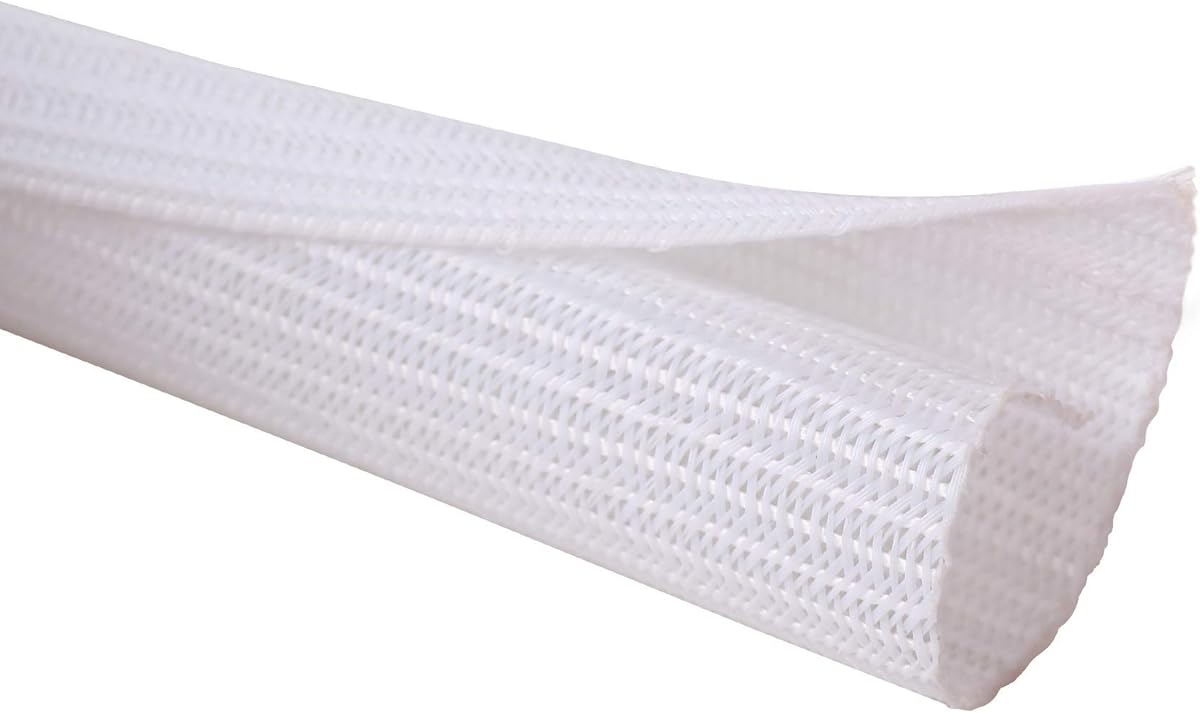
The 6.6-foot White Cable Sleeve is a flexible option for people who need to organize a meaningful group of wires without installing a wall channel. Its 4.6 rating places it among the strongest products reviewed, and the stated ability to hold four to eight cables distinguishes it from compact one-wire solutions. The four-fifth-inch diameter gives it sufficient room for typical computer and home-office wiring.
We may earn a commission when you buy through this link, at no additional cost to you.
Like the top-ranked Alex Tech product, this sleeve uses a self-wrap design. Users open the braided covering, place cables inside, and allow it to close around the bundle. This is especially convenient around computer towers, television stands, and desks because the cords remain removable and can be reorganized as equipment changes. The sleeve can be cut with scissors to accommodate shorter runs or custom arrangements.
The polyethylene construction is described as thermostable and flame-retarding, with an operating range of minus 40 to 302 degrees Fahrenheit. That range supports use in offices, homes, automotive settings, marine areas, and industrial environments. Nevertheless, a sleeve does not create a flush wall route, and its six-foot-six-inch length may not cover a long path between rooms or along a large entertainment center.
This pick is best for desktop cable clusters, computer setups, and other areas where multiple cords should be gathered into one protected line. It offers generous capacity, straightforward installation, and the ability to move the entire bundle later. Buyers needing a longer covered run should look at the ten-foot Alex Tech sleeve, while those wanting a concealed wall route should choose a raceway instead.
The stated four-to-eight-cable capacity makes this sleeve useful for computer peripherals, charging leads, and entertainment wiring. Bundling them into a single cover reduces visual tangles and keeps more of the work surface clear.
Scissors are sufficient for shortening the braided sleeve, allowing it to fit a compact desk setup or a shorter section of a larger cable path. This makes it less rigid than a modular wall raceway.
We may earn a commission when you buy through this link, at no additional cost to you.
The 39-inch Silicone Cord Hider offers a flexible route for concealing a thin cable along a wall. It has a 4.6 rating, a clean white appearance, and a side-opening clasp that gives users access to the cable without removing the entire cover. Its primary application is a wall-mounted television, where a single power or signal wire may hang loosely or cross an otherwise open area.
We may earn a commission when you buy through this link, at no additional cost to you.
The silicone body is described as soft, flexible, waterproof, and flame retardant. Those properties make it suitable for indoor and outdoor use in homes, offices, garages, or warehouses. The flexible form also allows the cover to follow a wall route where a rigid raceway might be less convenient. Installation relies on an oil-proof adhesive film rather than screws or drilling.
Preparation matters. The wall should be cleaned, and the adhesive needs time to establish a full bond; the instructions call for pressing the cover repeatedly and waiting 12 hours before inserting the wire. Textured or dusty walls are not suitable, and removal may require a thin blade, which introduces a risk of wall damage. The product also accepts cables no larger than one-quarter inch, limiting it compared with the Delamu multi-wire channel.
This cover is a good match for a thin TV cable, lamp lead, charging wire, or small network cable on a smooth surface. It is less suitable for a large power bundle or a textured wall. For users who value a soft, discreet, side-opening design and do not need substantial capacity, the 39-inch silicone hider is a straightforward and flexible option.
The soft body can conform to the installation area, while the side clasp lets a user add or remove a cord without dismantling the route. This is useful when a television or accessory may need to be repositioned later.
A clean, smooth, dry wall produces the most reliable adhesive bond. Because the instructions rule out textured or dusty surfaces, checking the wall before installation is an essential part of using this hider correctly.
We may earn a commission when you buy through this link, at no additional cost to you.
The YesBes Cord Hider Kit is a flexible wall system for TV cables and other exposed wires. It carries a 4.4 rating and includes 116 inches of raceway, six couplings, two L-shaped elbows, one T-fitting, and instructions. With a 0.96-inch inner width and 0.57-inch inner height, it offers more room than a narrow single-cable channel while remaining manageable for typical wall installations.
We may earn a commission when you buy through this link, at no additional cost to you.
Its installation method is intentionally simple. After cleaning the surface, the user removes the backing and presses the raceway into place, avoiding screws and drilling. The channel can be cut with scissors or a saw, and its white finish can be painted to match a wall. The included connectors make it possible to build longer paths, turn corners, or create a branching arrangement as the installation requires.
The material is described as meeting the UL94 V-0 flame-retardancy rating, adding a meaningful safety characteristic to a product likely to be used around electronics. The primary caveat is the adhesive system. The instructions warn against applying the tape to textured walls, and the raceway is less convenient to relocate than a sleeve. Its modular fittings also require planning before the adhesive is committed.
The YesBes kit is a compelling choice for a new television installation, office wall, or entertainment area where a coordinated set of connectors and a paintable finish are priorities. It offers more flexibility than a one-piece cover and a less permanent feel than a screwed raceway, although it still needs careful surface preparation. It stands out as a well-equipped option for buyers who want a complete routing kit without a complicated installation.
Six couplings, two elbows, and a T-fitting allow the channel to follow a more complex path than a single straight strip. This is valuable around furniture, mounted screens, and other areas where a cable must change direction.
The white channel can be trimmed and painted to coordinate with a wall. That makes the route less conspicuous while retaining the functional benefits of a rigid raceway and concealed wire path.
We may earn a commission when you buy through this link, at no additional cost to you.
The One-Cable Silicone Raceway is designed for a narrow installation behind a wall-mounted television or along a desk. Its 4.4 rating reflects a focused product: a 39-inch, low-profile channel made to conceal one cable. At 0.55 inches wide and 0.39 inches high, it should occupy less wall space than a broader raceway while still giving the cable a defined path.
We may earn a commission when you buy through this link, at no additional cost to you.
The flexible silicone construction and side buckle make it easier to add, remove, or reposition the cord. The channel can also be cut with a saw to create a more precise length. Pre-applied adhesive provides a no-tools, no-screws installation, while the white finish is intended to blend into a light-colored wall. These details make it useful for a quick visual cleanup without a major wiring project.
Because it is designed for a single cable, the product will not solve a multi-wire entertainment setup. The adhesive is also strong enough that the manufacturer advises slow removal and suggests a knife if necessary, which means it is not ideal for a wall that may need to remain undamaged. The compact dimensions and cable-specific design limit its use in busier wiring environments.
This raceway is best for a single thin TV wire, a lamp lead, or a charging cable where minimizing visual bulk matters more than carrying several wires. It provides a useful compromise between a completely exposed cord and a larger wall channel. Buyers should measure their cable and confirm that the low-profile opening will accept it, then install it on a smooth surface to achieve the cleanest result.
The 0.55-by-0.39-inch profile is designed for spaces where a broader raceway would feel visually intrusive. It creates a cleaner path around a mounted screen while accommodating one cable.
The side buckle provides a practical way to reach the cord without detaching the entire channel. That flexibility is valuable when equipment is moved or a connection needs adjustment.
We may earn a commission when you buy through this link, at no additional cost to you.
The Side-Open One Cord Hider is another focused television-cable solution, with a 39-inch length and a single side opening. Its 4.4 rating reflects a simple installation and a broad list of compatible wire types, including TV, lamp, monitoring, telephone, network, charging, and speaker cables. The maximum cable diameter of one-quarter inch should be checked before purchase.
We may earn a commission when you buy through this link, at no additional cost to you.
The soft silicone body is described as flame retardant, flexible, smooth, and easy to clean. It can be cut to the required length, with a 45-degree cut suggested for joining sections at a corner. The side-opening design helps retain the wire while still allowing it to be inserted or removed. This makes the cover suitable where the exact route may need to be modified during installation.
The adhesive is the main limitation. It does not perform well on textured or rough walls, and the product's non-paintable surface limits decorative options. Users must also wait one hour after mounting before loading the cable, and the one-cord capacity makes it unsuitable for a wall where several leads must travel together.
This hider is a good choice for a thin wire on a smooth wall, especially when the goal is a flexible path rather than a rigid modular raceway. It offers a useful compromise between a loose cord and a bulky cable-management channel. For TV power cables, network leads, and lamp wires within the stated size range, it provides a neat, accessible solution with straightforward care and maintenance.
The channel is intended for common household and electronics wires, from charging leads to network and speaker cables. Checking the quarter-inch diameter limit is the fastest way to confirm whether a specific cable will fit.
A 45-degree cut can be used at a corner to create a neater transition between sections. The soft material is easier to trim than a rigid raceway, which helps users customize the route more freely.
We may earn a commission when you buy through this link, at no additional cost to you.
The AGPTEK Cable Management Sleeve is the most generously sized tubular option in the guide, with a 1.2-inch diameter and two five-foot sleeves. Its 4.6 rating reflects a strong balance of capacity, flexibility, and broad intended use. The extra-large opening can accommodate a substantial bundle of different cable sizes, making it useful for computer equipment, automation wiring, or automotive interiors.
We may earn a commission when you buy through this link, at no additional cost to you.
The self-closing design allows the braided sleeve to be opened for loading and then wrapped securely around the cables. It can be shortened with scissors, and the product description recommends treating a cut end with fire to prevent fraying. Its wide operating range of minus 50 to 150 degrees Celsius and UL94 V-2 flame-protection class support use in settings where heat management and wire protection matter.
The sleeve is also marketed as non-toxic and pet-friendly, with the specific aim of discouraging pets from chewing or scratching wiring. That protective positioning is most useful in a home with cats, dogs, rabbits, hamsters, or gerbils. The trade-off is its size: a one-point-two-inch diameter consumes more room than ordinary split loom and may be excessive for one or two slender cords. The wood color is also a deliberate aesthetic choice rather than a universal match.
AGPTEK stands out for buyers who want large-diameter braided sleeves in a two-pack, especially where a collection of different wires needs one substantial protective cover. It is less appropriate for a narrow wall raceway or a small electronics setup with only a thin lead. Within the sleeve category, however, its combination of capacity, heat resistance, and pet-focused protection makes it a premium option.
The 1.2-inch diameter sets this sleeve apart from narrow loom tubing. That additional room helps when several differently sized wires need to be protected together without forcing the cover open.
A stated temperature range of minus 50 to 150 degrees Celsius makes the sleeve relevant to automotive and equipment environments. Its protective surface can also reduce the visibility of wires to pets that might otherwise chew exposed cords.
We may earn a commission when you buy through this link, at no additional cost to you.
The Yecaye Cord Hider combines a 113-inch total routing length with an eight-piece set of narrow wall channels. Its 4.5 rating reflects a useful balance of capacity, low-profile dimensions, and installation hardware. Each channel is designed for one cable, with the kit intended for a range of applications such as power cords, Cat5 cables, speaker wires, and lamp cords.
We may earn a commission when you buy through this link, at no additional cost to you.
The channels measure 0.59 inches wide and 0.4 inches high, making them less visually intrusive than a broad raceway. Mounting tape is included, and the product description emphasizes strong adhesion along walls or desks. Because the kit contains eight sections rather than one uninterrupted strip, it is easier to position pieces around a room, furniture, or a mounted television without requiring a large excess of channel.
This segmented format also has limitations. Each channel is intended for a single cable, so a multi-wire installation would require additional pieces. Adhesive mounting is less flexible than a sleeve and may be difficult to remove without risking the wall finish. The white surface is designed for a clean, minimal appearance, but it is not described as paintable.
Yecaye is a practical option for a home or office that contains several isolated single-cord routes. It is particularly useful when a user wants the visual benefit of a wall channel but does not need to route several cables through the same piece. For those seeking a decorative modular raceway, the YesBes or Delamu kits offer more sophisticated fittings; for a narrow one-wire route, Yecaye provides a straightforward and compact solution.
Eight shorter channels can be placed only where needed, which helps when cords follow separate paths around a room. The arrangement avoids committing to a single long, uninterrupted installation.
The 0.59-by-0.4-inch profile keeps the installation visually restrained while giving a low-voltage wire, network lead, speaker cable, or lamp cord a defined route away from open view.
We may earn a commission when you buy through this link, at no additional cost to you.
The Mini Side-Opening Cord Cover is the final recommendation and stands out because it offers small and medium versions. Its 4.5 rating reflects a practical choice for users with different wiring needs: the small model is intended for a single wire under five-sixteenths of an inch, while the medium version can manage two or three wires in parallel and helps limit cable extrusion.
We may earn a commission when you buy through this link, at no additional cost to you.
A side-opening buckle allows cables to be added, removed, or adjusted without removing the full cover. The semi-circular shape is intended to blend with home decor while keeping the cord protected. The body is described as flame-retardant silicone compliant with UL94 V-0, and the material also provides the smooth, easy-to-clean surface expected of a flexible wall cover.
Installation is adhesive-based. The wall should be cleaned, the oil-proof film removed, and the cover pressed firmly into place. A 12-hour wait is recommended before routing the wires, which is longer than the settling time mentioned by some competing products. The cover is not intended for highly rough or powdery walls, and removal may require careful peeling or a thin-blade tool.
This product is a good fit for a compact route where one or a few thin cables need to disappear from view. The choice between model sizes adds flexibility that the one-cord covers in the guide cannot offer, while the rounded profile may look neater beside furniture. It is less suitable for a large bundle or a difficult wall surface, but for smooth indoor locations it combines a discreet shape, useful access, and a safety-oriented material.
The small version is appropriate for a single thin wire, while the medium model is designed to separate two or three parallel cables. Selecting by cable diameter and bundle count is more reliable than choosing solely by appearance.
The semi-circular geometry avoids the boxy look of a conventional raceway. With a white finish and a relatively slim profile, it can integrate into a room without drawing as much attention as exposed wiring.
We may earn a commission when you buy through this link, at no additional cost to you.
The right cord hiding solution depends on where the cable travels, how many cables must fit, whether the installation must remain accessible, and whether appearance or pet protection is the main objective. Measure first, then choose the construction that fits the route.
Cord hiding tubes, sleeves, and wall raceways solve different routing problems. A split or braided sleeve wraps around a bundle and moves with the cable, making it useful under desks, behind equipment, inside vehicles, and in other locations where the wires may shift. A wall raceway is fixed to a surface and creates a defined route between a wall-mounted television and an outlet. A side-opening silicone cover is a wall product, but its flexible body and buckle make it more adjustable than a rigid channel. Buyers should identify whether the priority is bundling, shielding, or creating a decorative wall path before comparing dimensions.
Start with the installation location. Choose a sleeve for movable bundles and a wall cover for exposed runs along a wall or beneath mounted equipment.
Capacity is more than a count of cables because wire thickness determines whether a bundle will fit. The 6.6-foot braided sleeve is stated to hold four to eight cables, the Delamu channel accommodates two to four wires, and several compact silicone covers are limited to one cable no larger than one-quarter inch. The AGPTEK sleeve offers the largest listed diameter at 1.2 inches, while the Alex Tech sleeve uses a half-inch opening. Measure the outside diameter of the cable bundle, including connectors where relevant, and compare it with the product's stated inner dimensions.
Leave practical clearance when the specification is close. A tight fit may require forcing the cover closed or squeezing the cable unnecessarily.
Product length should correspond to the full cable path rather than only the visible gap. The Alex Tech sleeve provides ten feet, while the AGPTEK option supplies two five-foot sleeves. Wall raceways in this guide range from 39-inch compact covers to 113-inch, 116-inch, and 157-inch systems. A long route may require multiple sections, junctions, or sleeves rather than one product. Modular kits can be especially useful where the cable changes direction, while a continuous sleeve works well for a straight path. Extra length is generally easier to trim than to add, although rigid raceways should be measured carefully before their adhesive backing is exposed.
Map the entire path, including turns and endpoint connections, before selecting a length. This prevents a short cover from leaving the most visible section exposed.
Adhesive-backed wall covers require a smooth, clean, dry surface, and several products explicitly warn against textured or dusty walls. Waiting periods range from one hour to 12 hours before loading cables, depending on the model. Side-opening buckles improve ongoing access, and modular raceways can be opened or removed in sections. A sleeve is usually the least permanent option because it can be lifted from the cable without touching the wall. Customers should consider whether cables will be added or replaced often; if so, access should take priority over the smallest possible profile.
For frequent adjustments, select a sleeve or side-opening cover. For a fixed decorative route, a paintable or modular raceway may be more appropriate.
The products use split plastic or polyethylene sleeves, PVC raceways, and flexible silicone covers. Their stated safety characteristics differ: the Alex Tech sleeve is UL Recognized; the Delamu, YesBes, and Mini Side-Opening products reference UL94 V-0 performance; the AGPTEK sleeve lists UL94 V-2; and the Side-Open One Cord Hider is described as flame-retardant. These ratings are useful distinctions, but they do not replace careful installation or safe cable handling. Silicone options are flexible and easy to clean, while PVC channels tend to offer a rigid profile and a more paintable finish.
Compare the stated material rating with your environment. Do not infer suitability for a location or condition that the manufacturer has not specified.
White is the common finish across the guide, but a white cover is not automatically invisible. Its visual impact depends on the wall color, cable direction, profile, and whether the product can be painted. The Delamu and YesBes raceways are explicitly cuttable and paintable, allowing them to blend more closely with a wall. Most silicone covers cannot be painted, so their white color and rounded or low-profile shape must be accepted as part of the appearance. The AGPTEK sleeve offers a wood color for furniture or equipment that may not have a surrounding white wall.
For a coordinated wall installation, choose a paintable raceway. For a sleeve, consider the surrounding furniture and equipment color instead.
Concealing a cable can reduce the chance that children or pets interact with it, but coverage alone does not guarantee electrical safety. A sleeve adds a physical barrier around the bundle, while a wall raceway removes the wire from an open walking area. Several products specifically identify pet chewing and scratching as a concern. The most useful choice depends on the risk: for a pet near floor-level cables, a durable sleeve may add valuable protection; for a wall-mounted television, a fixed raceway keeps the wire out of sight and less accessible.
Use a suitable cover as one part of a broader safety plan. Keep damaged cables out of service and ensure installations do not create new trip or entanglement hazards.
Begin by tracing the intended route and measuring both the length and the cable diameter. For a wall raceway, clean the surface and allow it to dry completely. Remove the protective film gradually so the adhesive does not begin sticking to itself before the channel is positioned. Press the cover firmly along its full length, paying particular attention to corners and endpoints, and observe the stated waiting period before inserting any cable.
Load a split or braided sleeve by opening the longitudinal slit, placing the wires inside, and allowing the sleeve to close around the bundle. A side-opening silicone cover is installed in a similar way, but its buckle is opened before the cord is pressed into the channel. Route cables in an order that leaves the most frequently changed or connected wires nearest the opening. If using a paintable raceway, allow the installation to set before trimming, painting, or adding connector pieces.
For care, keep the sleeve or channel free of dust and avoid pulling exposed cables sharply at their ends. Clean flexible silicone with a soft cloth and inspect the adhesive periodically for lifting. Do not paint silicone covers unless the manufacturer expressly allows it. A sleeve can be checked for frayed or heat-damaged sections, while a wall raceway should be examined for loose edges that could catch clothing or create a trip hazard.
A cord hiding tube wraps around and bundles cables, so it moves with the wires and works well under desks or behind equipment. A wall-mounted raceway fixes to a wall and creates a defined, often more decorative route for cables. The right choice depends on whether the cable bundle needs mobility or the main goal is a clean wall installation.
It depends on the model and the cable thickness. The Delamu raceway is intended for two to four wires, the 6.6-foot braided sleeve for four to eight cables, and the AGPTEK sleeve offers a wide opening for varied bundles. Several silicone covers accept only one cable of a specified maximum diameter, so check the stated capacity before purchasing.
Most of the adhesive-backed products in this guide are intended for smooth, clean, dry surfaces. Several explicitly warn against textured, rough, or dusty walls because the contact area is reduced and the bond may fail. A split sleeve or braided tube can be a better choice when a wall surface is unsuitable for adhesive mounting.
The Delamu and YesBes wall raceways are specifically described as cuttable and paintable, allowing them to match a wall more closely. Most flexible silicone covers in the guide should not be painted because the instructions do not authorize it. The AGPTEK sleeve instead offers a wood color, which may be better suited to furniture or equipment than a white wall finish.
First identify the number and thickness of the cables, then measure the distance from the television area to the outlet or connection point. A rigid raceway is ideal for a permanent, decorative route, while a side-opening silicone cover offers easier access and a lower profile. If several cables share the path, choose a raceway with adequate internal width and matching connectors.
A sleeve can add a physical barrier around cables and may discourage some pets from reaching the wires. Several products in the guide specifically highlight pet and child protection, including the Alex Tech, AGPTEK, and wall raceway options. Protection is not guaranteed, however, and a determined pet may still damage a cable or the covering itself.
A split sleeve is generally straightforward to load because it opens along its length, while a self-closing braided sleeve provides a more finished appearance and can conceal the cable bundle more completely. Both are cuttable and movable. The braided version is attractive for desktop bundles, whereas a simple split sleeve often works well for routing and protecting cables in less visible areas.
Remove them slowly and gently, working along a short section rather than pulling the full cover from one end. Some manufacturers suggest using a thin blade to lift an edge, but a blade should be handled carefully to avoid damaging the wall. If the cover must remain undamaged, removing it is another reason to choose a removable sleeve rather than an adhesive raceway.
The Alex Tech 10-foot split sleeve is the strongest all-around recommendation because it combines easy loading, self-closing construction, a useful half-inch opening, and broad environmental suitability. The Delamu Cord Hider is the leading choice for a permanent wall-mounted TV route because it supports several cables, includes connectors, and can be cut and painted. For a flexible multi-cable bundle, the AGPTEK sleeve provides the largest opening, while the 6.6-foot braided sleeve is a convenient desktop-oriented option.
Prioritize the installation conditions before focusing on appearance. Measure the cable diameter, count the wires, identify the length and turns in the route, and confirm that the mounting surface can support adhesive. Choose a sleeve when the bundle must move, a rigid raceway when appearance and a fixed route matter most, and a side-opening silicone cover when a discreet low-profile installation must remain easy to adjust.
Finally, check current prices and the latest product details before ordering. Cord covers vary considerably in capacity, installation method, and finish, so the lowest cost is not always the best fit. Confirm the cable dimensions, adhesive requirements, waiting time, and included accessories for your specific installation before making a final selection.