
0.4–4% Adjustable Fertilizer Injector
4.7Editor score
0.4–4% dosing range
Water-powered proportional mixing
3/4-inch NPT connections
Adapters for flexible installation
An inline fertilizer injector mixes liquid nutrients into irrigation or garden-hose water, helping deliver consistent feeding without measuring every watering cycle by hand. The right model depends on pressure, flow, coverage, connection size, tank capacity, and the type of fertilizer you plan to use.
We compared all ten products using the supplied specifications, focusing on practical distinctions such as on/off versus constant-pressure operation, dosing range, flow capacity, included tubing, tank size, and compatibility with hoses, sprinklers, or drip lines.
Each pick below highlights a different use case, from compact hose-end feeding to proportional dosing for larger irrigation systems. Ratings and product details reflect the supplied listings, while prices can change and should be checked on the linked product pages.
4.7Editor score

4.1Editor score

4.6Editor score
As an Amazon Associate we earn from qualifying purchases.
The comparison below places all ten injectors side by side, emphasizing pressure compatibility, dosing method, connection type, tank capacity, and the irrigation setups each model is designed to serve.



The EZ-FLO 2.5-Gallon Fertilizer Injector earns the Editor's Choice position because it combines a relatively generous 2.5-gallon tank with the flexibility to feed nutrients through either a garden hose or drip line. Its 4.1 rating is supported by a well-rounded feature set that suits many residential watering systems.
We may earn a commission when you buy through this link, at no additional cost to you.
The model connects to a standard 3/4-inch GHT outdoor faucet without tools and includes color-coded 1/4-inch supply and return tubing. Built-in flow discs allow the user to fine-tune the injection rate, while the stated flow of approximately 2–5 GPM makes the unit appropriate for timer-controlled watering. It also accepts liquid or water-soluble fertilizer, iron, bio-stimulants, organic teas, micronutrients, supplements, and insect repellents.
Its most important limitation is equally clear: it is designed for on/off pressure systems operating at no more than 50 PSI and should not be installed on a continuously pressurized main irrigation line. The 2.5-gallon tank also occupies more space than smaller units and requires more solution to be mixed when only a small feeding is needed. Buyers with a well pump, tank system, or constant-pressure faucet should consider the dedicated EZ-FLO constant-pressure model instead.
This is the strongest overall choice for a homeowner who wants one injector to support both hose-end watering and drip irrigation, values a large reservoir, and wants more control than a simple fixed-ratio unit. It is particularly useful for routine lawn, vegetable, and ornamental feeding where a standard hose timer can switch the water on and off as needed.
The 2.5-gallon reservoir is three times the capacity of the standard EZ-FLO model. That extra capacity makes the injector more convenient for gardens and lawns that require several watering cycles or a substantial amount of mixed nutrient solution.
Adjustable flow discs and the included supply and return tubing give users more control over fertilizer delivery. Trim the tubing to fit, switch between watering methods, and automate the schedule with a suitable standard or smart hose timer.
We may earn a commission when you buy through this link, at no additional cost to you.
The EZ-FLO 3/4-Gallon Hose-Bib and Drip Fertilizer Injector is a compact, approachable option for gardeners who want flexible feeding without the footprint of a larger tank. Its 4.2 rating is slightly higher than that of the 2.5-gallon version while retaining the same broad on/off-system feature set.
We may earn a commission when you buy through this link, at no additional cost to you.
A universal 3/4-inch GHT connection allows tool-free attachment to an outdoor faucet or garden hose. The injector can be used as a hose-end fertilizer feeder or connected to drip tubing, and both color-coded 1/4-inch lines are included. Users can adjust the injection rate with built-in flow discs, while the stated 2–5 GPM flow supports standard and smart hose timers.
The smaller 3/4-gallon tank is a double-edged feature. It is easier to store, move, rinse, and fill, but it may require more refills than larger models. The unit also remains limited to on/off pressure systems at or below 50 PSI, making it unsuitable for direct use on a continuously pressurized main line. Its broad fertilizer compatibility is a strength, including liquid and water-soluble products, iron, bio-stimulants, and organic teas.
Choose this model for container gardens, small vegetable plots, or a drip zone that receives periodic watering and does not need a large reservoir. It offers an easier-to-store alternative to the larger EZ-FLO model while retaining the hose-end convenience, drip compatibility, timer friendliness, and flow-disc adjustments that make the brand practical for residential gardeners.
The 3/4-gallon reservoir is practical where storage space is limited or only a small quantity of nutrient solution is needed. Its wide-mouth format also simplifies filling, rinsing, and routine seasonal maintenance.
The included supply and return tubing makes it possible to move between hose-end watering and drip-line injection without rebuilding the installation. Built-in flow discs provide a practical way to adapt the delivery rate to different products and watering routines.
We may earn a commission when you buy through this link, at no additional cost to you.
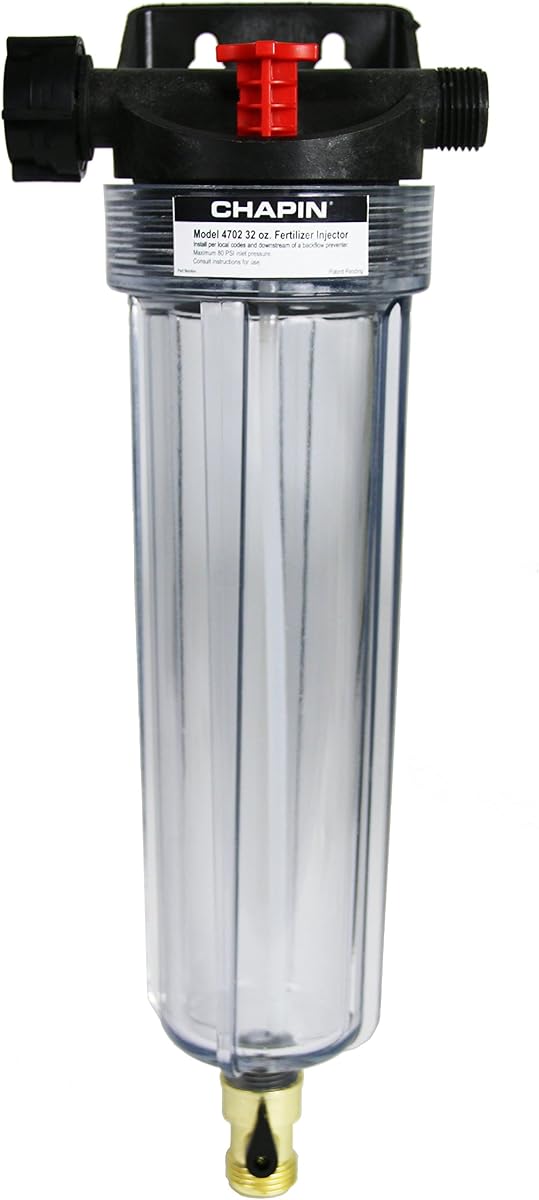
The Chapin 4702 HydroFeed is built for gardeners who want an injector mounted directly into a drip irrigation system. It has a 4.0 rating and distinguishes itself with a transparent 32-ounce tank, a convenient funnel-shaped fill head, and a rigid inlet tube that filters debris before solution reaches the mixing system.
We may earn a commission when you buy through this link, at no additional cost to you.
Its large opening and O-ring are intended to support clean filling and leak-free operation. A built-in bracket secures the unit to a wall or post, which is useful in a garden bed, utility area, or beside a raised planter. After feeding, the drain plug and valve allow the remaining solution to be emptied quickly, reducing the chance of leaving concentrated fertilizer in the tank.
The main trade-off is reservoir capacity. At 32 ounces, this model is among the smallest options listed and may require repeated fills for a substantial garden or extended application. The supplied specifications do not state a pressure limit, flow rate, or precise dosing range, so users should verify compatibility with their particular drip system before installation. It also cannot be assumed to support the broader hose and sprinkler applications described for some competing models.
The Chapin HydroFeed is a sensible pick for a focused drip-irrigation installation where visibility, mounting stability, and easy draining matter more than large capacity. Its support for liquid or granular concentrates and fish emulsion broadens the range of products it can handle, while the one-feeder package keeps the setup straightforward.
The clear reservoir makes it easy to see how much solution remains, while the funnel-shaped head helps guide fluid into the large opening. This visibility is especially helpful when determining when to refill or clean the tank.
The included wall or post bracket keeps the unit stable in a permanent drip system. A rigid inlet tube and filter help reduce debris entering the mixing path, while the drain valve provides a convenient way to empty leftover solution after use.
We may earn a commission when you buy through this link, at no additional cost to you.
The EZ-FLO 3/4-Gallon Constant-Pressure Fertilizer Injector addresses the limitation of many hose-end feeders by supporting well pumps, tank systems, and other constant-pressure arrangements. Its 4.4 rating reflects a versatile design with an operating range of 5–50 PSI and an 80 PSI maximum.
We may earn a commission when you buy through this link, at no additional cost to you.
Commercial-grade brass fittings are a notable feature for a compact unit intended to connect to irrigation infrastructure. The injector has a 3/4-inch GHT adapter and works with rotor, spray, or drip lines. It feeds automatically without electricity or batteries, making it suitable for remote or automated setups where a powered dosing pump would be inconvenient.
The stated coverage of up to 16,000 square feet suggests a broader residential application than a small container-garden accessory. However, the 3/4-gallon tank remains modest, and the product title's adjustable micro-dosing claims should be understood in the context of the listed connection and pressure specifications. Users should also confirm how the unit behaves when the water source remains pressurized while the injector cycles.
This is the best match among the list for a homeowner with a well pump or constant-pressure faucet who wants one injector to serve sprinklers or drip lines. The included warranty, portable format, and lack of an electrical requirement make it especially appealing for reliable, automatic nutrient delivery across multiple garden zones.
Unlike the standard EZ-FLO on/off models, this version is purpose-built for constant pressure. Its stated operating range allows it to fit more irrigation sources, including well pumps and tank systems, subject to proper installation and operating limits.
The 3/4-inch GHT adapter and compatibility with rotor, spray, and drip lines make this unit practical for properties with varied watering zones. Its compact, portable form also allows it to be repositioned when a different zone needs attention.
We may earn a commission when you buy through this link, at no additional cost to you.
The Chapin 4710 HydroFeed provides a conventional one-gallon reservoir and a clearly stated variable-rate adjustment from 1 to 10 ounces of product per gallon. Its 3.3 rating is the lowest among the products in this guide, so buyers should evaluate the design carefully, although the listed features are appropriate for many home irrigation tasks.
We may earn a commission when you buy through this link, at no additional cost to you.
The translucent tank allows users to monitor remaining solution, and the large four-inch opening makes filling and cleaning less cumbersome. Standard hose fittings support direct hose use and sprinkler connections, while a rigid inlet tube and filter help keep debris out of the mixing system. A drain plug with valve permits quick tank emptying after a feeding cycle.
Its one-gallon size requires more space than the smaller Chapin and EZ-FLO models but avoids the frequent refills associated with a 32-ounce reservoir. The wide 1-to-10-ounce range is useful for different fertilizer strengths, and compatibility with liquid or granular concentrates and fish emulsion adds flexibility. Buyers should confirm their source pressure and planned flow against the manufacturer's complete instructions before buying.
This injector is best for a conventional garden or lawn system where a visible one-gallon tank, standard fittings, and straightforward rate adjustment are more important than a compact footprint. It may suit a homeowner who wants to alternate between hose watering and sprinklers, but the lower rating warrants checking recent customer feedback and installation requirements.
The one-gallon tank is large enough for more substantial feeding than a small reservoir while remaining transparent and easy to fill. A wide four-inch opening reduces the chance of spills during routine refills and cleaning.
Standard hose fittings make the unit familiar to install for direct hose use or a sprinkler arrangement. The variable-rate control from 1 to 10 ounces per gallon gives users a documented range for adapting fertilizer concentration.
We may earn a commission when you buy through this link, at no additional cost to you.
The NEWTRY 0.4–4% Fertilizer Injector is a water-powered dosing pump with a broad documented operating envelope. Its 4.1 rating is supported by specifications including a 0.4–4% concentration range, ratios from 1:250 to 1:25, flow from 0.09 to 11 GPM, and pressure from 2.9 to 87 PSI.
We may earn a commission when you buy through this link, at no additional cost to you.
Because the pump uses water pressure rather than electricity, it can operate automatically after the supply is turned on. Volumetric proportioning is designed to keep the chemical mixture consistent despite pressure and flow variations, while reciprocating dynamic sealing and the piston-and-cylinder design are intended to improve dosing accuracy and mixing uniformity.
This is a technical injector rather than a simple tank-and-hose attachment. It can mix liquid products only, not gas, and the solution pH must remain between 5 and 9. The 3/4-inch NPT connection will need to match the user's pipework, and the product description notes that flow decreases as water passes through the injector. The supplied information also indicates clean-water testing before shipment, so a wet unit is described as normal.
Choose the NEWTRY for users who need a more precise concentration range and wider flow window than typical garden feeders provide. Its stated uses extend beyond home irrigation to dilution and nutrient-delivery systems, making it suitable for technically confident buyers who understand pressure, pH, and fluid-handling requirements.
The water-powered mechanism uses the incoming flow to operate the dosing pump. This makes the injector suitable for irrigation locations without convenient electrical service while allowing fertilizer to be mixed automatically.
A 0.4–4% concentration range and 1:250 to 1:25 ratio span give users considerable flexibility. The 0.09–11 GPM flow range also accommodates small garden watering through substantially larger irrigation demands.
We may earn a commission when you buy through this link, at no additional cost to you.
The 0.4–4% Adjustable Fertilizer Injector stands out with a 4.7 rating, the second-highest rating among the ten products, and a straightforward proportional dosing design. It is particularly attractive for gardeners seeking a modern automatic injector without a tank, electronics, or a constant-power requirement.
We may earn a commission when you buy through this link, at no additional cost to you.
Its concentration can be adjusted by removing the U-shaped lock and rotating the control knob. The unit connects through 3/4-inch NPT inlet and outlet interfaces, and two one-inch adapters are included to broaden installation options. Once connected to the fertilizer hose and irrigation pipeline, water flow drives the mechanism to draw, proportion, and mix concentrated liquid fertilizer automatically.
The specified flow range is 2.2–13 gallons per hour, which is a different measurement framework from the gallons-per-minute range used by some competing products. Buyers should compare it against their actual watering demand rather than treating the numbers as directly interchangeable. The product is designed for liquid fertilizer and automated mixing; it does not describe a reservoir-based method, and the supplied information does not state a pressure range.
This injector is a strong budget pick for a home garden, greenhouse, livestock operation, or agricultural base using drip irrigation. It is especially helpful for users who want hands-off proportional feeding and do not need a large tank. Confirm the pipe size, anticipated flow, liquid compatibility, and local watering schedule before installation.
The lock-and-knob control allows the concentration to be changed without mixing solution manually. That convenience is useful when moving between crop stages, different fertilizer formulations, or separate planting areas with varying nutritional needs.
This model draws concentrate directly through a fertilizer hose and mixes it as water moves through the injector. The absence of a reservoir makes the unit compact, while water-powered operation removes the need for electrical connections.
We may earn a commission when you buy through this link, at no additional cost to you.
The HOSS Fertilizer Injector is the Best Premium pick because it combines a one-gallon tank, a brass coupling, and four clearly defined dilution settings in a design intended to serve several watering methods. Its 4.6 rating places it near the top of the group.
We may earn a commission when you buy through this link, at no additional cost to you.
The PVC tank and brass hose coupling are designed to handle up to 50 PSI. Four ratios—1000:1, 500:1, 250:1, and 100:1—allow users to select among different application rates. The injector works with hand-watering containers, raised beds, overhead sprinklers, and drip irrigation, making it particularly versatile for a property with several planting styles.
Its compatibility extends to water-soluble fertilizers such as 20-20-20 and Miracle Grow, as well as liquid fertilizers including fish emulsion. The trade-off is that the four fixed settings offer less continuous control than a proportionally adjustable dosing pump. The 50 PSI limit also rules out higher-pressure installations, and the one-gallon tank needs suitable storage space when not in use.
The HOSS is best for a serious home gardener who wants one recognizable tank-based injector to serve raised beds, sprinklers, containers, and drip lines. Its clear ratios, solid material choices, and broad system compatibility make it a premium all-rounder when 50 PSI is sufficient and a handful of standard dilution rates meets the user's needs.
The 1000:1, 500:1, 250:1, and 100:1 settings make it possible to move from gentler dilution to more concentrated feeding. This is a practical alternative to a continuously adjustable pump when the user prefers a limited set of predictable ratios.
A single unit can support hand-watering containers, raised beds, overhead sprinklers, and drip irrigation. The brass coupling and PVC tank are engineered for pressures up to 50 PSI, giving the product a durable foundation for routine garden feeding.
We may earn a commission when you buy through this link, at no additional cost to you.
The 0.2–2% Water-Powered Dosing Pump has a perfect 5.0 listed rating and offers a gentler concentration range than several competitors. It is designed for direct installation on a water-supply pipeline, where incoming water pressure powers continuous proportional injection without a motor.
We may earn a commission when you buy through this link, at no additional cost to you.
The product description emphasizes that the injected amount follows the amount of water moving through the line, even when pressure fluctuates. External adjustment is convenient, and the unit provides continuous proportional dosing, tracking, and uniform dilution. Its outer shell uses a PP construction described as wear-resistant, UV-resistant, and resistant to aging.
This model is less flexible in one important respect: its 0.2–2% range stops below the 4% maximum offered by several other water-powered injectors. The listed G3/4-to-G1 male-thread description also requires careful comparison with the user's actual pipe and fitting arrangement. A perfect customer rating is encouraging, but it should not replace checking installation compatibility or understanding the fertilizer formulation being used.
Choose this injector for a drip irrigation, garden, or livestock application that benefits from a lower, adjustable concentration and automatic proportional delivery. It is especially attractive to users who want a compact, weather-resistant unit that operates without electricity and tracks water flow rather than relying on a fixed tank recipe.
The injector adjusts the amount of solution according to water passing through the pipeline. This proportional approach supports more consistent dilution when flow or pressure changes during an irrigation cycle.
The wear- and UV-resistant PP shell is intended to withstand extended outdoor exposure. Its water-powered operation also eliminates batteries and electrical wiring, reducing installation clutter around gardens and livestock watering areas.
We may earn a commission when you buy through this link, at no additional cost to you.
The Adjustable 20–2500 L/H Fertilizer Injector pairs a 5.0 rating with the widest stated flow range in the guide. It supports 20 to 2500 liters per hour, allowing one proportional injector to serve anything from a garden hose to a larger irrigation, livestock, or hydroponic system.
We may earn a commission when you buy through this link, at no additional cost to you.
Its concentration range is 0.4–4%, and the unit uses water pressure rather than a power cord or batteries. The 3/4-inch NPT connection supports relatively straightforward installation in compatible systems. According to the supplied description, proportional mixing remains consistent as water flow or pressure changes, helping maintain uniform nutrient delivery without repeated manual adjustments.
The large flow capacity is both its main advantage and the factor requiring the most attention. A home user with a modest hose may have little use for the upper end of the range, while larger installations need the full 2500-liter-per-hour capacity. The description also mentions a corrosion-resistant body designed for common liquid fertilizers and nutrients, but buyers should still verify chemical compatibility before use.
This is the best choice in the guide for a buyer who values a broad flow window or has a high-demand irrigation system. It also fits users who want automatic, hands-free dosing without access to electricity. For small gardens, a simpler hose-end unit may be easier to manage, but for greenhouses, livestock lines, and small farms, the 20–2500 L/H range offers impressive flexibility.
A 20–2500 L/H range allows the same general dosing concept to scale from a household garden to a larger water-demand system. This makes the injector useful for raised beds, greenhouses, livestock watering lines, and small-scale farming operations.
Water pressure drives the pump, which draws in nutrient concentrate and mixes it proportionally. The absence of batteries or electrical connections supports reliable outdoor use and reduces the need to manage a power supply.
We may earn a commission when you buy through this link, at no additional cost to you.
Choosing an inline fertilizer injector starts with your water source, irrigation layout, fertilizer form, and desired degree of control. The most important distinctions are pressure compatibility, proportional accuracy, flow capacity, connection size, and how much solution the unit must hold.
Pressure compatibility determines whether an injector can be installed safely and function as intended. Several EZ-FLO hose-end models operate on on/off pressure systems at no more than 50 PSI, while the dedicated constant-pressure model accepts a 5–50 PSI operating range and has an 80 PSI maximum. Water-powered proportional pumps have their own documented ranges, such as 2.9–87 PSI for NEWTRY. Match the product to the faucet, pump, irrigation controller, and any pressure-reducing equipment in the line.
Tank capacity affects convenience more than the underlying dosing principle. The 32-ounce Chapin is compact but may need frequent refills, the 3/4-gallon models offer a middle ground, and the one-gallon Chapin and HOSS hold more solution. The 2.5-gallon EZ-FLO goes further by reducing refills during larger feeding jobs. A larger tank is useful when mixing enough solution for multiple zones, while a smaller tank is easier to move, store, rinse, and fill. Choose capacity based on the area covered and how often you want to refill.
Some injectors use fixed or stepped ratios, while others adjust concentration continuously. The Chapin HydroFeed 1-Gallon offers a stated 1-to-10-ounce-per-gallon range, and the HOSS provides four ratio settings. The NEWTRY, 0.4–4% adjustable model, 0.2–2% unit, and 20–2500 L/H model offer proportional adjustment without a conventional tank. Fixed ratios are simple and predictable; proportional controls offer more flexibility but may require closer attention to operating conditions and product concentration.
An injector must handle the flow of the system without starving the irrigation area or exceeding the pump's range. Listed figures include 2–5 GPM for the EZ-FLO hose models, 0.09–11 GPM for NEWTRY, 2.2–13 GPH for the adjustable 0.4–4% model, and 20–2500 L/H for the high-flow unit. These measurements use different units, so compare them carefully. Also note that the NEWTRY description says flow is reduced while water passes through the injector.
Hose-end models commonly use a 3/4-inch GHT faucet connection, while proportional dosing pumps may use 3/4-inch NPT or G3/4-to-G1 male threads. NPT and GHT are different thread standards, so inspect the existing plumbing before choosing. The HOSS and Chapin products support broader irrigation arrangements, while the 32-ounce Chapin is specifically presented as an inline drip-system feeder with a mounting bracket. Adapters can help, but supported configurations should be confirmed before purchase.
The listed products broadly support liquid and water-soluble fertilizers, with several also mentioning granular concentrates, fish emulsion, iron, bio-stimulants, organic teas, micronutrients, supplements, and insect repellents. The proportional NEWTRY model specifically mixes liquid only and requires a solution pH from 5 to 9. Confirm that the fertilizer dissolves as expected, does not form sediment, and is compatible with wetted materials. Test with clean water first and avoid using an injector beyond the manufacturer's chemical or solution limits.
Water-powered models require no outlet, batteries, or control wiring because incoming water supplies the operating energy. Tank models may also work with on/off faucets, and the EZ-FLO products are described as timer-friendly at approximately 2–5 GPM. Automation depends on the irrigation system, not merely the injector. A standard or smart hose timer, irrigation controller, or pressure source must start and stop water in a sequence compatible with the selected unit's design.
Consider how often the tank must be rinsed, whether a drain valve is useful, and where the unit will be mounted. The Chapin 32-Ounce includes a wall or post bracket, a rigid filtered inlet, and a drain valve. EZ-FLO models emphasize a wide-mouth tank, easy rinsing, and seasonal gasket lubrication. Proportional pumps reduce manual mixing but still require checking connections and the concentrate supply. Outdoor and livestock environments also warrant attention to corrosion resistance, UV exposure, and clean-water testing procedures.
Begin by reading the complete instructions for the selected model and confirming that the water source, pressure, thread size, fertilizer, and irrigation hardware are compatible. Clean the system and flush any existing fertilizer or sediment. Connect the injector according to its flow direction, use the specified adapters, and secure supply and return or concentrate tubing without kinks. For proportional units, set the concentration while the system is stopped and verify the desired ratio before a full irrigation run.
For a tank-based hose injector, fill only with the recommended type and amount of fertilizer, close the lid or fill opening, and connect the unit to the faucet or irrigation line. Open the water slowly at first and watch for leaks, unrestricted return flow, and expected mixing. With a drip system, confirm that the injector remains active throughout the watering cycle and that the return or supply arrangement follows the manufacturer's diagram rather than an improvised connection.
After each feeding cycle, run clean water through the injector according to the instructions, empty the tank if the product recommends it, and inspect seals, O-rings, filters, tubing, and fittings. Rinse the tank, keep the gasket lubricated when directed, and store the unit away from freezing conditions. For proportional pumps, monitor the concentrate container, confirm smooth water-driven operation, and arrange periodic clean-water testing. Never mix incompatible fertilizers or chemicals, and follow all product-label and local irrigation guidance.
Yes, but compatibility depends on the model. The EZ-FLO, HOSS, Chapin 4710, and several proportional injectors are described as compatible with drip lines. Confirm the required pressure, connection size, flow range, and whether the system uses on/off or continuous pressure before installation.
A tank injector draws from a prepared reservoir, while a proportional pump draws concentrated fertilizer directly and mixes it according to the moving water. Tank units are intuitive and easy to inspect, while proportional pumps offer a broader adjustment range and can suit irrigation systems without a reservoir.
Most of the listed products do not. The EZ-FLO units feed when water flows, and the NEWTRY, 0.4–4%, 0.2–2%, and 20–2500 L/H models are water-powered. Automation still requires a faucet, timer, controller, or pump that switches the water on and off correctly.
Most models are intended for liquid or water-soluble products, although granular concentrates and fish emulsion are specifically mentioned for the Chapin units. The NEWTRY model mixes liquid only and specifies a pH range of 5 to 9. Always confirm that the fertilizer dissolves cleanly and is compatible with the injector.
Base the ratio on the fertilizer label, crop needs, water volume, and the system's flow rate. Do not assume that a similar-looking ratio from another injector will produce the same result, because pump design and operating pressure affect actual delivery. Start with the manufacturer's recommended setting and verify the mixture before treating a large area.
The standard EZ-FLO models are explicitly limited to on/off pressure systems and should not be connected to a main irrigation line. Use a model designated for constant-pressure operation, such as the dedicated EZ-FLO constant-pressure injector, and observe its stated pressure limits.
Rinse the unit with clean water after use, clean the filter and inlet, inspect tubing and seals, and empty the tank when recommended. Tank-based models may require seasonal gasket lubrication. Proportional pumps should also be checked for smooth operation, leaks, and an uninterrupted concentrate supply.
Several models are designed for more than one irrigation type. The HOSS supports hand-watering containers, raised beds, overhead sprinklers, and drip irrigation, while the constant-pressure EZ-FLO works with rotor, spray, and drip lines. Verify pressure and flow requirements before changing the injector between zones.
The best inline fertilizer injector is the one that safely matches your pressure source, water flow, irrigation layout, and fertilizer. The EZ-FLO 2.5-Gallon model is the strongest overall pick for on/off systems, hose and drip versatility, and reduced refills. The 0.4–4% Adjustable Fertilizer Injector offers strong value for automatic proportional feeding, while the HOSS provides a premium one-gallon design with four clear ratios and broad irrigation compatibility.
For constant-pressure or well-pump systems, do not rely on a generic hose-end feeder. Choose a model explicitly designed for that pressure mode and verify all operating limits. Compare units by usable flow, not just tank size or concentration range, because different products express capacity in gallons per hour, gallons per minute, or liters per hour. Connection standards and fertilizer compatibility deserve equal attention.
Before buying, review the current listing, manufacturer instructions, customer feedback, and the fertilizer label to confirm that the model fits your setup. Product designs, availability, ratings, and prices can change, so check the linked pages for current details before making a final purchasing decision.