
Jin&Bao Garage Door Bottom Rubber Seal
4.4Editor score
Sixteen-foot dual-seal profile
Standard 5/16-inch T-track
Includes two end plugs
A garage door seal creates the final barrier between your garage and the weather outside. The right one can block wind-driven rain, snow, dust, leaves, drafts, and unwanted noise while helping the door close more quietly. Because garage doors use different track profiles, the most important consideration is matching the seal to the existing bottom track.
This guide compares ten garage door seals based on their stated dimensions, materials, track compatibility, temperature ratings, installation approach, and sealing design. The list includes adhesive-backed threshold seals, rubber strips that slide into T-tracks, a single-track triangular profile, and an aluminum-track replacement system, so readers can compare multiple installation styles.
The picks show how similar products can serve different needs: some prioritize long lengths and broad surface compatibility, while others focus on dual seals, quiet operation, or simple track replacement. Product ratings and availability can change over time, and prices fluctuate, so readers should confirm current listing details before making a purchase.
4.4Editor score

4.6Editor score
4.5Editor score
As an Amazon Associate we earn from qualifying purchases.
The comparison below highlights each seal's length, material, profile, and installation style, helping you identify the option that best matches your garage door and threshold.


The Jin&Bao Universal Garage Door Threshold Seal combines a twenty-foot rubber strip with two adhesives and holds a 4.6 rating. Its standout quality is adaptability: the strip can be cut to fit a shorter opening and installed over concrete, asphalt, painted, or treated surfaces, giving it broader potential applications than a seal restricted to one track style.
We may earn a commission when you buy through this link, at no additional cost to you.
The low-profile design is intended to keep water, wind-driven rain, snow, dust, dirt, and leaves from entering beneath the door. A yellow safety strip makes the barrier easier for people to notice, while anti-slip ridges help reduce slipping. The serrated base creates a textured surface for adhesion, which is especially useful when the seal must bridge the door and floor.
The stated temperature range extends from -40 to 284 degrees Fahrenheit, offering resilience in both cold and hot conditions when properly installed. The main trade-off is that adhesive performance depends on cleaning and surface preparation; the strip will not compensate for a dirty, loose, or uneven surface. A sealant or repair may also be needed to bridge small irregularities.
This is a strong recommendation for a homeowner with a wide garage opening who wants a long, visible, surface-mounted barrier rather than a track-mounted replacement. Measure the opening, prepare the floor carefully, and ensure the rubber rests flat and secure before closing the garage door.
The stated compatibility with concrete, asphalt, painted, and treated surfaces makes this option useful when the threshold material is not uniform. Its long strip can also be cut to suit the actual opening rather than forcing a standard-size component into an irregular space.
The yellow safety strip improves visibility at floor level, while the molded anti-slip ridges are intended to reduce slipping. These details are useful in busy garages, workshops, and homes where people frequently cross the entrance.
We may earn a commission when you buy through this link, at no additional cost to you.
The Jin&Bao 16FT T-End Seal is a practical track-mounted replacement with a 4.4 rating. It combines a U-shaped structure with an O-ring to create two sealing surfaces, making it suited to homeowners seeking dependable air and water protection without installing a full threshold system.
We may earn a commission when you buy through this link, at no additional cost to you.
The strip is designed for standard 5/16-inch T-tracks and can slide into place using soapy water. That installation method avoids screws and special tools, while the supplied end plugs help close the ends of the sealing channel. The flexible rubber can also be trimmed for a more exact fit.
One of the more useful benefits is its impact-absorbing construction, which is intended to reduce vibration and noise as the door moves. It also accommodates minor floor unevenness. The trade-off is that the product cannot overcome a fundamentally incompatible track, and a sixteen-foot length may be insufficient for an unusually wide door.
Choose this option when the garage door already uses a standard 5/16-inch T-track and you want a straightforward repair that includes end plugs. Measure the track carefully, clear debris from the channel, lubricate it with soapy water, and avoid forcing the seal if the profile does not slide in smoothly.
The combined U-shape and O-ring profile is designed to improve the contact between the door and floor. It also forms a more complete barrier at the channel ends when the included plugs are fitted correctly.
Flexible rubber absorbs some movement and impact when the door opens or closes. While actual sound reduction will vary by door and installation, the sealing profile can also help limit airflow around the bottom edge.
We may earn a commission when you buy through this link, at no additional cost to you.
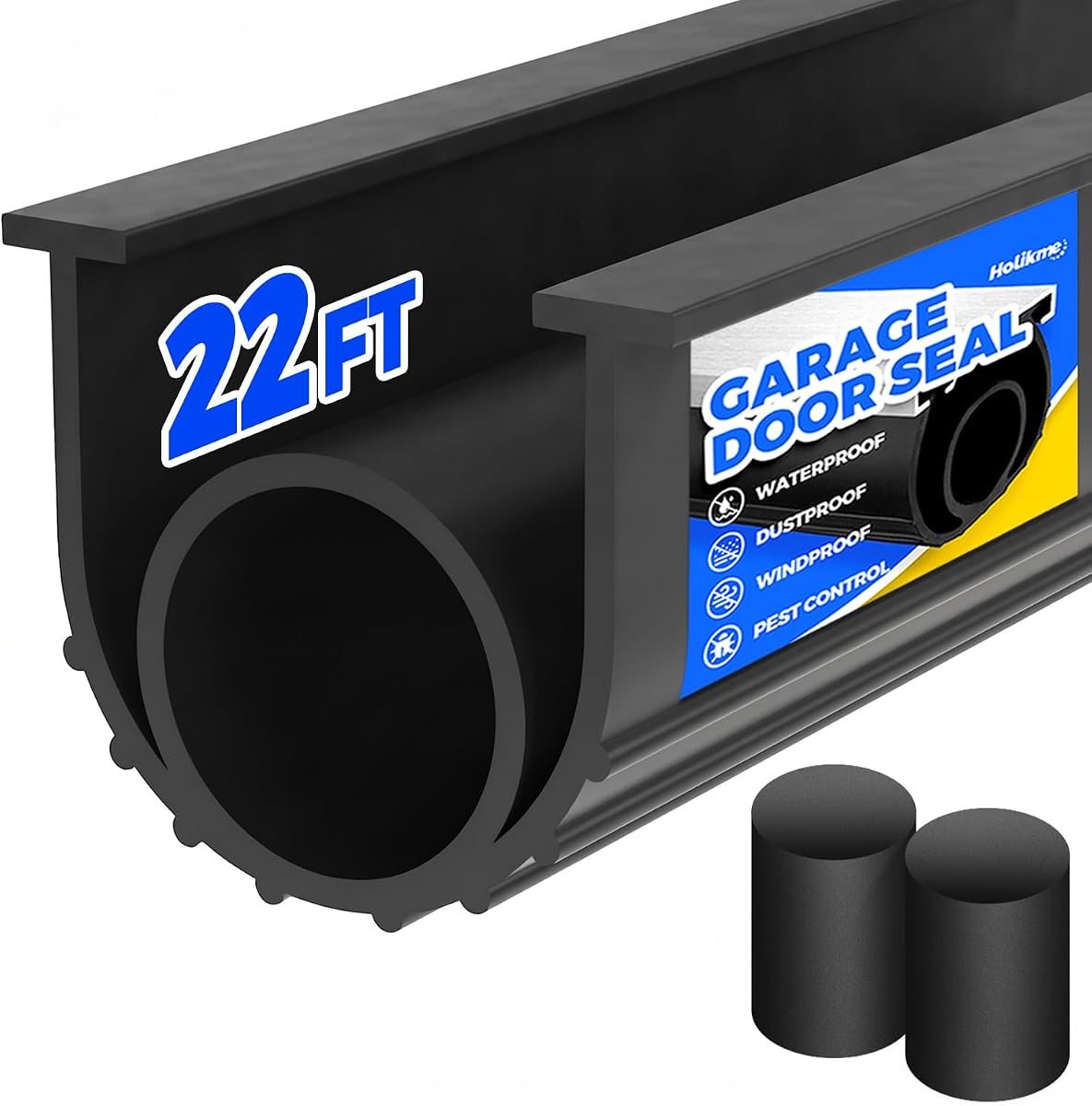
The Holikme 22Ft EPDM Seal combines the longest strip in this guide with a 4.5 rating. Its 22-foot length offers useful flexibility for wider garage doors, while the high-density EPDM construction is specified for flexibility, sunlight resistance, and resistance to cracking and fading.
We may earn a commission when you buy through this link, at no additional cost to you.
The U-shaped structure and O-ring create dual barriers against moisture and air movement. Custom-fit rubber end plugs are included to close the center channel and help prevent shifting. A 5/16-inch double T-end is intended to fit most compatible residential and commercial garage doors.
The important limitation is that metal tracks are not included. Buyers must already have a suitable double T-track or be prepared to source one separately. The rubber can create friction during installation, but the manufacturer recommends clearing the old track and using soapy water or silicone spray to help the seal slide.
This is an excellent choice for a compatible wide door where length and a robust dual-seal profile are priorities. Confirm the track opening, measure the door before trimming, and do not attempt to force a double T-end into a different profile.
A 22-foot strip gives installers room to trim the material to the measured width. That flexibility is helpful when the opening does not align neatly with a shorter standard length.
The listed -40 to 240 degree Fahrenheit range and EPDM material are intended to withstand cold, heat, ozone, and sunlight exposure. Inspect the seal periodically for trapped debris or deformation, especially after severe weather.
We may earn a commission when you buy through this link, at no additional cost to you.
The Holikme 17Ft EPDM Seal offers a balanced alternative to the longer version in this guide. It carries a 4.5 rating and uses the same high-density EPDM construction, U-and-O-ring design, and 5/16-inch double T-end profile.
We may earn a commission when you buy through this link, at no additional cost to you.
Its stated purpose is straightforward: block rain, drafts, leaves, dust, and debris beneath the garage door. The dual structure creates two contact barriers, while included end plugs help close the center channel and resist movement. The material can be trimmed with scissors or a knife to match the opening.
As with other track-mounted seals, compatibility is the decisive issue. The metal track is not included, and a double T-end will not fit a single-slot design. The installation process also benefits from lubrication because rubber can grip the metal channel tightly.
This is a good fit for owners with a compatible residential or commercial door who value EPDM durability but do not need the maximum 22-foot length. Verify the channel profile, clean it thoroughly, and trim the new seal only after confirming the desired finished length.
The nested sealing structure is designed to interrupt the direct path of air and moisture. This can improve the garage's interior conditions without replacing the door's existing insulation system.
Because the product uses the existing track, installation is largely a preparation task. Remove old debris, lubricate the channel, feed the seal into place, and trim only the excess after it is seated.
We may earn a commission when you buy through this link, at no additional cost to you.
The Jin&Bao 16FT Threshold Seal has a 4.6 rating and offers a surface-mounted approach for garages that do not need a track insert. Its flexible rubber is designed to protect against water, wind-driven rain, snow, dust, dirt, and leaves.
We may earn a commission when you buy through this link, at no additional cost to you.
The strip measures 3.7 inches wide and 0.6 inches high, with anti-slip ridges and a serrated base that improves adhesion. It can be used over concrete, asphalt, painted, or treated surfaces, and the included instructions support a straightforward do-it-yourself installation.
The main limitation is its sixteen-foot length, which may not cover a wide garage without joining another section. Adhesive performance also depends on careful preparation. Dust, moisture, oil, and loose paint can prevent a lasting bond, so cleaning and surface repair are important.
This seal is best for a medium-width opening or a relatively short garage door where a surface-mounted barrier is convenient. Use it when the existing track profile is uncertain, provided the surface can provide a secure and level mounting area.
The serrated base is designed to hold sealant against the rubber and floor. Clean the entire contact area, repair cracks or loose material, and make sure moisture cannot collect beneath the strip before applying the adhesive.
The anti-slip ridges help distinguish the seal at floor level and reduce the chance of a person catching a foot on it. The 0.6-inch height also creates a relatively low threshold compared with bulky alternatives.
We may earn a commission when you buy through this link, at no additional cost to you.
The DGSL 16FT T-End Seal is a conventional track-mounted option with a 4.2 rating. It uses flexible waterproof rubber and a 5/16-inch T-channel design combining U-shaped and O-ring structures for an airtight and watertight barrier.
We may earn a commission when you buy through this link, at no additional cost to you.
Its installation is refreshingly direct. The seal slides into a compatible track without screws or nails and can be trimmed to fit the threshold. The dual rubber design is also intended to reduce noise and limit dust, drafts, and outside air around the door.
The stated operating range is -40 to 140 degrees Fahrenheit, a lower upper limit than several EPDM options in this roundup. That specification should be considered in very hot climates or wherever the lower edge of the garage is exposed to prolonged direct sun.
This product suits owners of compatible garage doors who value a familiar, uncomplicated replacement over an elaborate track system. Confirm the track opening, inspect it for sharp edges, and lubricate the channel if the rubber resists sliding.
Because the seal enters the existing track rather than attaching to the floor, it does not require screws or nails. This makes the product suitable for replacing a worn bottom seal with minimal permanent alteration.
The soft construction can be cut to the measured width of the door. Leave the cut edge square and inspect the finished end to ensure it will not interfere with the door's opening and closing motion.
We may earn a commission when you buy through this link, at no additional cost to you.
The Jin&Bao 20FT Threshold Kit combines a long rubber strip with two adhesives and carries a 4.6 rating. It is designed to stop wind-driven rain, snow, dust, dirt, and leaves while creating a visible, relatively low barrier across the garage entrance.
We may earn a commission when you buy through this link, at no additional cost to you.
Its 3.7-inch width and 0.6-inch height provide enough surface area for a firm seal without creating an excessively tall obstruction. Anti-slip ridges help reduce trip risk, and the serrated base gives the adhesive or sealant a textured bonding surface.
The important issue is installation quality. A long adhesive strip can lift at its edges if the floor is porous, wet, uneven, or contaminated. The listed compatibility with concrete, asphalt, painted, and treated surfaces is broad, but each surface may require different preparation and a compatible adhesive system.
This is a sensible option for a wide opening where a track-free installation is preferred. It is also a reasonable choice when the existing bottom track is unusual and difficult to match. Apply the adhesive only after thorough cleaning, align the strip carefully, and test the door through several cycles before considering the job complete.
The twenty-foot length can accommodate a broad single opening or be cut to fit. Its length reduces the need to join short sections, which can help avoid extra seams that might interrupt the threshold barrier.
The raised profile provides a clear line around the opening, while anti-slip ridges help people navigate it. The black rubber remains visually understated in a working garage.
We may earn a commission when you buy through this link, at no additional cost to you.
The 16.5FT Triangle Bottom Seal is built specifically for single-track garage doors. It holds a 4.2 rating and uses an EPDM triangular profile with a 0.2-inch endpoint, providing a more specialized alternative to standard 5/16-inch T-end seals.
We may earn a commission when you buy through this link, at no additional cost to you.
Compatibility is both its strength and its main constraint. The product clearly states that it is not suitable for double-channel doors, helping buyers avoid an expensive mismatch. Its flexible EPDM material is specified from -40 to 240 degrees Fahrenheit and is designed to resist cracking and fading.
Installation requires a clean, relatively even track. If the seal is not flat, the instructions recommend warming it with hot water or a hair dryer before feeding it into the channel. Soapy water can help the rubber slide more smoothly, and no screws or nails are required.
Choose this option for a confirmed single-slot door measuring 16.5 feet or narrower. It is also applicable to listed sliding, flush, wood, and steel door types when their track design matches the product profile.
The triangular profile is intended to fit a narrow single channel. Confirm the shape and size of the existing seal before ordering because the product is not a universal replacement.
A seal stored in a tight roll may need gentle heat before installation. Warming can restore flexibility, but it should be handled carefully and tested before placing it near the track.
We may earn a commission when you buy through this link, at no additional cost to you.
The Jin&Bao Aluminum Track Seal is a more involved replacement system with a 4.4 rating. Rather than relying only on an existing bottom track, it includes five aluminum T-track pieces, a sixteen-foot rubber seal, and twenty-eight screws for mounting beneath the garage door.
We may earn a commission when you buy through this link, at no additional cost to you.
The rails are oxidized to resist rust and discoloration. Pre-drilled holes simplify attachment, while the extra rail pieces allow the installer to cut the system to the required door width. The U-and-O-ring rubber design is intended to block wind-driven rain, snow, dust, dirt, and leaves.
Unlike slide-in products, this system requires accurate alignment and screw placement. It is intended for steel or wood roll-up doors, and the bottom of a steel roll-up door must be flat for proper fit. Improper drilling or mounting can leave the door rubbing against the rail.
This option is best for an owner willing to replace or upgrade the bottom rail and whose door matches the specified profile. It may be especially attractive when the existing track is damaged, since the new rail components provide a fresh mounting surface.
The included aluminum rails create a new attachment point for the rubber seal. This can be useful when an old plastic or worn track no longer holds a replacement securely.
The listed 5/16-inch T-end and approximately 3.75-inch width are intended for compatible steel or wood roll-up doors. Verify the bottom shape and available mounting space before modifying the door.
We may earn a commission when you buy through this link, at no additional cost to you.
The DGSL 20FT T-End Seal brings the familiar DGSL track-strip design to a longer twenty-foot length. It carries a 4.3 rating and combines 5/16-inch T-channel ends with U-shaped and O-ring structures to create an airtight and watertight barrier.
We may earn a commission when you buy through this link, at no additional cost to you.
The flexible waterproof rubber can be trimmed for the actual door width and installed without screws or nails. It is intended to limit dust, drafts, and noise while helping keep the garage more comfortable throughout the year.
Its stated temperature range is -40 to 140 degrees Fahrenheit, so the upper limit is worth considering in a hot garage or sun-exposed entrance. The seal also depends on a compatible 5/16-inch track; visual similarity alone is not enough to guarantee a proper fit.
This is a straightforward choice for a standard residential track and a door requiring more length than a 16-foot strip. Clear the channel, lubricate it, slide the seal into place, and trim it evenly after confirming the door can close without interference.
The longer strip can cover a broad opening and is easy to reduce to a custom length. It provides more material than the 16-foot DGSL option without changing the basic track profile.
Sliding the rubber into the existing channel is convenient for routine repairs. Use a lubricant compatible with the track and avoid sharp tools that could nick the rubber or damage the channel lining.
We may earn a commission when you buy through this link, at no additional cost to you.
Choosing a garage door seal requires matching the product's profile, length, material, and mounting method to the door and threshold. These factors determine fit, weather resistance, noise control, and installation difficulty.
The first step is identifying the shape and size of the channel at the bottom of the garage door. A 5/16-inch T-track seal is designed for a channel with a matching T-shaped opening, while a single-track triangular product fits a narrow slot. Double T-end, single-slot, U-channel, and standard T-end profiles should not be treated as interchangeable simply because they look similar.
Measure the track opening and compare it with the product dimensions before ordering. If the old seal is still installed, its cross-sectional shape, end fittings, and track width can provide useful clues. When a listing explicitly says a track is not included, plan to purchase the appropriate track separately.
Garage door seals are commonly offered in lengths ranging from 16 feet to 22 feet, but the correct choice depends on the actual opening. Measure from one side of the bottom track to the other and account for the space required at the ends. A seal should fit fully without being stretched, compressed, or twisted.
Track-mounted strips should be trimmed after they are seated because this helps prevent curling or an uneven cut. Adhesive-backed threshold seals are easiest to trim before application. For very wide openings, consider whether two shorter sections can be joined cleanly, though a continuous strip may provide a more consistent barrier.
Slide-in seals are convenient when the existing track is intact and compatible. They generally require no permanent fasteners and can be trimmed to size. Adhesive-backed seals are useful when the track profile is unusual or when a visible threshold barrier is desired, but their longevity depends on surface preparation, adhesive compatibility, and correct alignment.
A rail-mounted system requires drilling and more deliberate alignment, but it can provide a durable replacement base when the old track is worn. It may also suit steel or wood roll-up doors with flat bottoms. Choose the method that matches both the door construction and the level of installation work you are comfortable performing.
EPDM rubber is highlighted for resistance to sunlight, ozone, cracking, fading, and cold brittleness. Other flexible rubber products in the guide list similarly broad cold-weather performance, although their upper temperature limits vary. The stated ranges range from -40 degrees Fahrenheit to as high as 284 degrees Fahrenheit for some threshold seals.
Consider where the garage door sits and whether the bottom edge receives direct sun. A higher upper temperature rating offers more margin in a hot climate, while a lower ceiling may still be adequate in a shaded garage. Material choice should also reflect how often the door is used and how much the seal must flex during each cycle.
A single rubber profile may stop some airflow and debris, while a U-shaped structure with an O-ring creates a more complex barrier. The product data indicates that the dual designs can improve airtight and watertight performance, particularly around minor floor unevenness. End plugs or closed channel ends can further reduce gaps where the seal terminates.
More complex geometry is not automatically better, however. It must match the track and contact the floor properly. A well-fitted simpler profile can outperform a complicated one installed incorrectly. Consider the profile, the end treatment, and the door's closing clearance as a single system.
A tight bottom seal can reduce airflow, vibration, and the sound transmitted through the door opening. Flexible rubber absorbs some impact as the garage door closes, while additional sealing around the edges may improve overall comfort. The degree of noise reduction depends on the door, surrounding materials, floor condition, and installation quality.
If noise reduction is a main goal, pay particular attention to a flexible profile, secure end closures, and a seal that makes continuous contact with the threshold. If drafts are the concern, inspect the entire garage opening because a bottom seal alone cannot correct gaps around the sides or top of the door.
A low-profile seal that blends into the floor may be less noticeable, but a high-contrast edge can alert people to the threshold. Some products in this guide include anti-slip ridges, and one adds a yellow safety strip. These features are especially useful where people walk across the opening frequently or where a low-light garage creates visibility concerns.
The profile should not be so tall or bulky that it interferes with vehicles, carts, or the moving door. Inspect the bottom clearance and choose a design that creates a clear warning without creating an awkward obstruction. Dark rubber is common, while a visible strip may be useful for accessibility and everyday awareness.
Even a durable seal can collect dirt, leaves, ice, or grit. A track-mounted profile can be removed for cleaning, while an adhesive strip may be harder to reposition without damaging the floor. Inspect the threshold periodically and remove debris before it forces the seal upward or creates a gap.
Look for signs of cracking, hardening, warping, or separation from the track. A damaged section does not necessarily require replacing the entire seal, but it is worth checking whether a compatible segment can be trimmed and fitted. Keeping replacement specifications and profile details on hand makes future repairs easier.
Begin by closing the garage door and identifying its bottom track, floor surface, and available clearance. Measure the opening and inspect the old seal before removing it. For a slide-in replacement, pull out the worn strip, clear compacted debris, and check the channel for rust, loose sections, or sharp edges that could damage the new rubber.
Install the new seal in the direction recommended for its profile. Track-mounted strips can usually be worked into place with soapy water or another suitable lubricant, while the triangular product may benefit from gentle warming if it has become flattened. Adhesive-backed seals require clean, dry, stable surfaces, so clean the floor, repair gaps, and apply the strip evenly without stretching it.
After installation, open and close the door several times while watching the full width of the seal. Confirm that the door does not compress the strip excessively or leave a visible gap, and trim excess material only after the seal is seated. Periodically remove leaves and grit, inspect the rubber for cracks or hardening, and replace damaged sections before weather can enter around them.
Measure the width of the bottom track and compare its shape with the product profile. Standard residential doors often use a 5/16-inch T-track, but single-slot and double T-end designs require different seals. If the old seal is still installed, its cross section and end fittings can help identify the correct replacement.
Most slide-in styles are relatively straightforward because the rubber simply enters the existing channel. Soapy water can reduce friction, and the strip can usually be trimmed with scissors or a knife. Adhesive-backed and screw-mounted systems require more preparation and careful alignment, but they remain achievable do-it-yourself projects.
A flexible rubber seal can accommodate minor unevenness better than a rigid replacement, but it should still make continuous contact with the threshold. Large dips, raised edges, or cracks can create gaps that no strip fully solves. Repairing or leveling the floor is advisable when the problem is substantial.
That depends on the chosen design. Track-mounted strips usually slide into place, adhesive-backed seals bond directly to the floor, and rail systems attach with screws. The existing track condition, door material, and your preferred installation method should determine which approach is most suitable.
Replacement frequency depends on use, sunlight, weather, and material. Inspect the seal for cracks, tearing, flattening, hardening, or separation from the track. Cleaning and maintaining an intact seal can extend its useful life, while a visibly damaged or compressed section should be replaced promptly.
It can help by reducing drafts, airborne debris, and the movement of air around the door's lower edge. Flexible rubber may also absorb some vibration during closing. The overall effect depends on the condition of the door, surrounding walls, and the tightness of the complete seal around the opening.
Most rubber seals in this roundup are designed to be trimmed to a custom length. Use a sharp knife or suitable scissors, make a straight cut, and avoid leaving a jagged edge that could interfere with the door. For track-mounted products, confirm the fit and placement before making the final cut.
A T-end seal has a T-shaped profile that fits a corresponding T-track channel. A single-track seal uses a narrower triangular or wedge-shaped profile intended for a single-slot door. They are not interchangeable, so the existing track shape must be confirmed before ordering.
The Jin&Bao Universal 20FT Threshold Seal stands out for broad surface compatibility, a visible safety strip, and flexible installation, while the Jin&Bao 16FT T-End option offers a convenient track replacement with end plugs. For a compatible double T-track, the Holikme 22Ft EPDM Seal provides the longest rubber strip and a substantial dual-sealing design.
Prioritize track compatibility above all else, followed by the material, length, and installation style that suit your garage. Track-mounted products are generally the simplest choice when the existing channel is intact. Surface-mounted or rail-based options make more sense when a standard profile is unavailable or the bottom track needs replacement.
Before purchasing, confirm the track dimensions, door width, floor condition, and stated temperature range. Product ratings can change as more customers review an item, and current prices also vary, so check the latest listing details and included accessories at the time of purchase.