
EVDANCE Level 2 EV Charger
4.4Editor score
Up to 32A output
Adjustable charging current
25-foot charging cable
Portable carrying case
Explore the best fast chargers for electric vehicles at home, comparing power, connectivity, safety, installation, connector compatibility, and smart features
A fast home charger can turn an overnight driveway into a reliable routine, adding meaningful range while your vehicle is parked overnight. The best models balance charging speed, electrical safety, connector compatibility, cable length, app controls, and installation flexibility, making them far more useful than a basic wall outlet.
This guide compares ten Level 2 home charging stations across amperage, power, installation methods, safety certifications, weather protection, scheduling features, displays, and J1772 or NACS support. It covers hardwired and plug-in models at different power levels so commuters, families, apartment residents, and EV owners can find a realistic match.
Each review identifies the charger’s strongest qualities, practical limitations, and ideal owner, from portable 32A units to 80A hardwired systems. Product details and ratings can change over time, and prices fluctuate, so verify current specifications, incentives, electrical-panel capacity, and vehicle charging limits before purchasing.
4.4Editor score
4.8Editor score

4.4Editor score
The table below compares all ten chargers by maximum power, installation style, connectivity, and connector support, making it easier to separate basic plug-in units from high-output home systems.
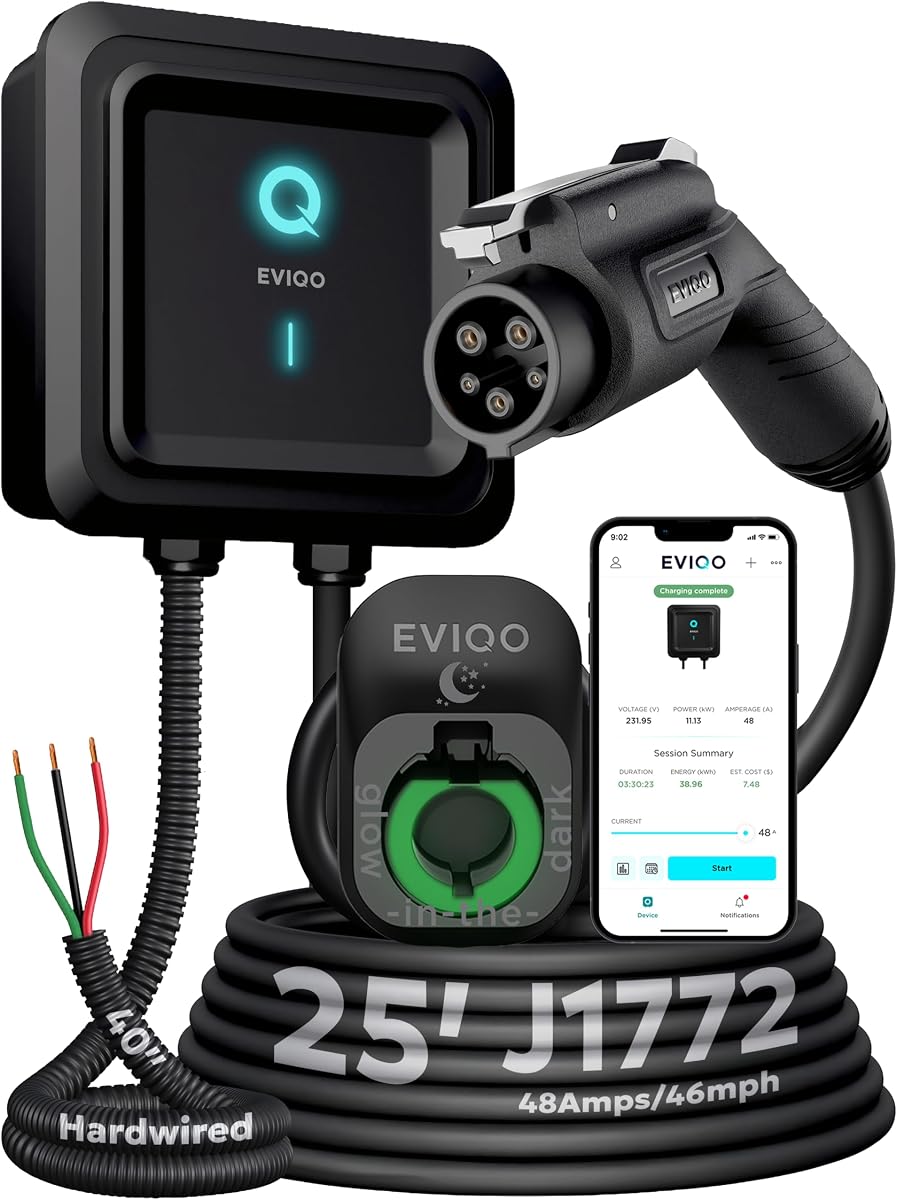



The EVIQO Level 2 EV Charger J1772 48A – Hardwired 240V Wall Charging Station earns a 4.7 rating for its strong combination of charging power, useful phone controls, and durable construction. It is designed for owners with a suitable 240V electrical service who want a permanent home station rather than a basic cord set.
We may earn a commission when you buy through this link, at no additional cost to you.
Its principal advantage is flexibility within the 48A class. The charger can deliver up to 48A on a dedicated 60A circuit, while DIP switches 4 and 5 can unlock 50A when supported by a dedicated 70A circuit. The 25-foot cable simplifies garage and driveway placement, and the app can start or stop sessions, set charging speed, schedule off-peak charging, and report energy use.
This is still a hardwired product, so a licensed electrician should size the circuit, install the unit, and make sure the electrical panel can accommodate the additional load. The charger also uses J1772 rather than native NACS, meaning Tesla owners need the appropriate vehicle-supported adapter. Its 2.4 GHz app requirement and hardwired-only design may not suit every household.
Overall, the EVIQO is a compelling choice for EV owners who want strong overnight charging, remote session control, and long cable reach in a permanently installed system. It is particularly well suited to drivers with larger batteries or homes able to support a dedicated high-amperage circuit.
The built-in antenna is designed to maintain a more dependable connection in garages and basements, while the free app provides scheduling, speed adjustment, session tracking, and energy and cost reporting. These features make recurring overnight charging easier to manage and easier to shift away from peak periods.
A sealed IP66 and NEMA 4 housing is suitable for indoor or outdoor installation in varied weather, while the glow-in-the-dark holster makes the connector easier to locate at night. A side reset button also allows the unit to restart without opening the enclosure or switching off power at the breaker.
We may earn a commission when you buy through this link, at no additional cost to you.
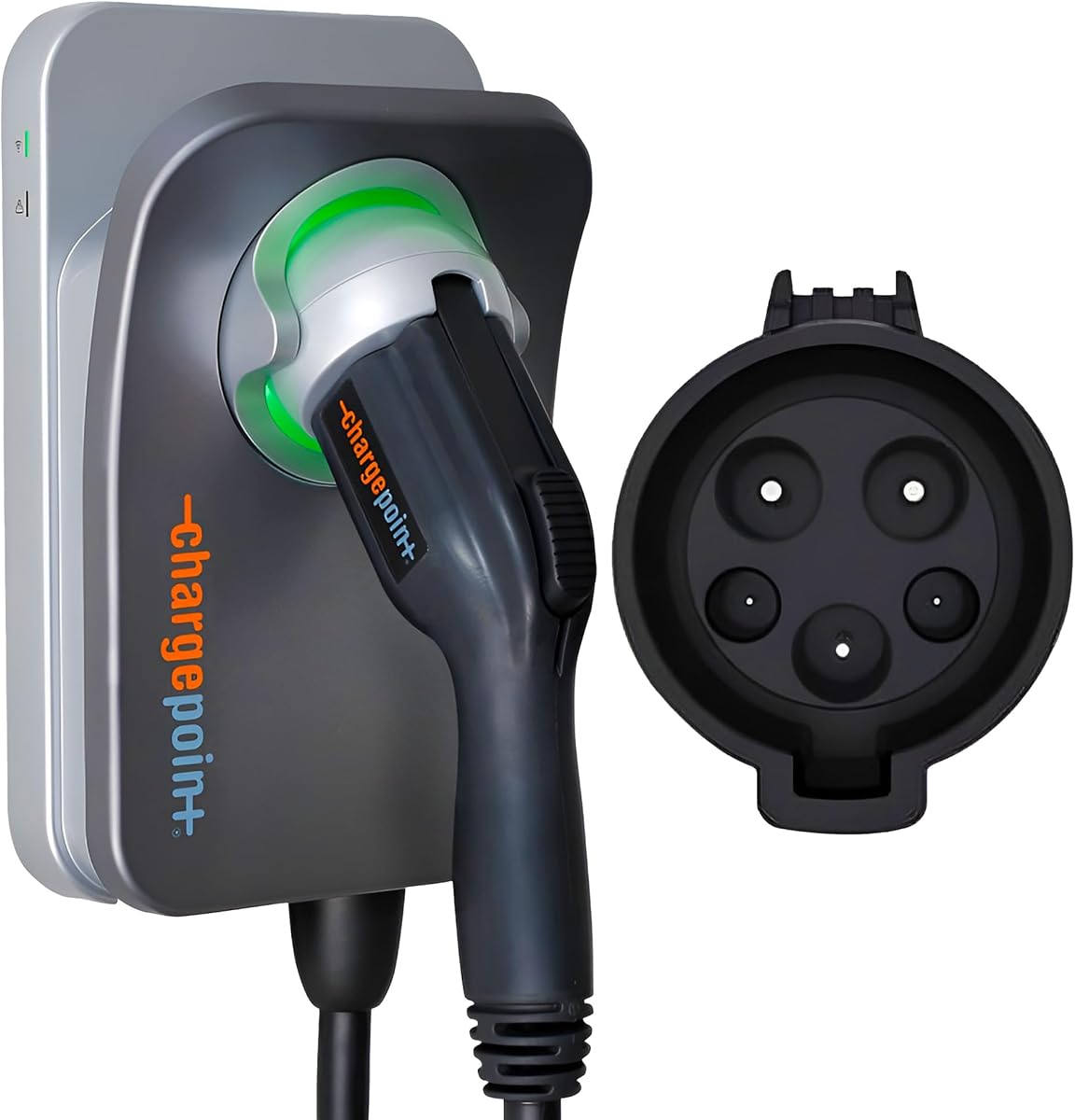
The ChargePoint HomeFlex Level 2 EV Fast Charger, J1772, Smart, Hardwired, 50A carries a 4.3 rating and brings the familiarity of ChargePoint’s broader charging network to a residential installation. It is a logical option for buyers who value a recognizable brand, app-based controls, and a hardwired charging path designed for faster home replenishment.
We may earn a commission when you buy through this link, at no additional cost to you.
The station can deliver up to 50A and is listed as charging up to nine times faster than a 120V outlet, although the actual miles-per-hour figure depends on the EV. The ChargePoint Mobile App supports remote control, reminders, smart-home connections, station finding, and charging information. HomeFlex is UL certified, can be installed indoors or outdoors by an electrician, and includes a cold-resistant cable.
The charger requires a compatible electrical circuit and professional installation, which should be expected for a permanent 50A system. Its J1772 connector serves non-Tesla vehicles directly, while Tesla drivers need an adapter. Some app features and troubleshooting steps depend on WiFi, so a weak signal in a detached garage could affect the experience.
ChargePoint HomeFlex is best for a driver who wants a conventional hardwired home charger with smart functions and familiar network support. It may not be the strongest choice for maximum output, native NACS convenience, or plug-and-play installation, but its straightforward proposition remains attractive for many EV households.
The app can handle more than starting a session. It offers reminders, charging data, smart-home integration, and access to the wider ChargePoint network, which includes a large number of public and roaming locations. That ecosystem can be reassuring for owners who may also rely on public charging during longer trips.
A 50A hardwired design gives HomeFlex enough output for efficient overnight charging on compatible vehicles. Its cold-resistant cable and indoor or outdoor installation options make it suitable for garages, carports, and other exposed home locations when installed according to electrical requirements.
We may earn a commission when you buy through this link, at no additional cost to you.
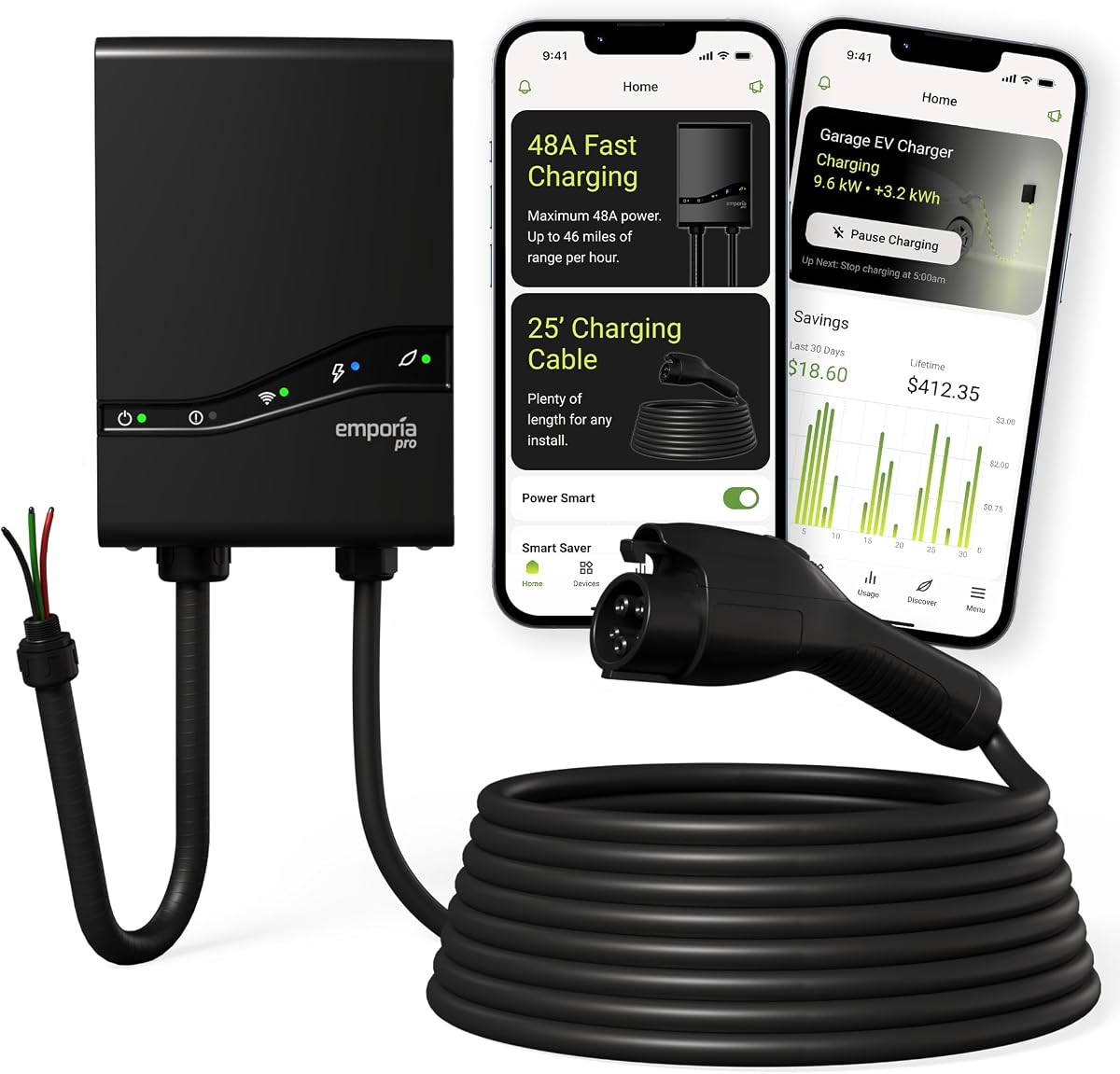
The EMPORIA Pro Level 2 EV Charger with PowerSmart – 48 amp Fast EV Charger for Home with Hardwire and J1772 Connector – 240v Electric Vehicle Charging Station and 25' EV Charging Cable is the highest-rated model in this group, with a 4.8 rating. It stands out for its ability to manage charging around the electrical demands of a real home rather than treating the vehicle as the only load on the panel.
We may earn a commission when you buy through this link, at no additional cost to you.
PowerSmart technology is intended to automatically balance charging with existing electrical-panel usage, potentially allowing the charger to operate without a full panel upgrade. The included Emporia Vue adds visibility into whole-home energy use, while the app supports automated schedules, peak-rate avoidance, real-time tracking, and charging controls. Installation may use either a NEMA 14-50 plug or a hardwired connection, giving owners an important degree of flexibility.
The most important caveat is that the usefulness of PowerSmart depends on the home’s electrical configuration and appropriate professional assessment. A 48A installation also requires suitable circuit capacity, and the J1772 connector means a Tesla adapter is required. Buyers should not assume load balancing removes every upgrade or electrician requirement.
This EMPORIA Pro is our Editor’s Choice because it combines high output, two installation paths, strong scheduling, and unusually broad household energy visibility. It is a strong all-around recommendation for owners who want more sophisticated energy management than a basic Level 2 charger provides.
PowerSmart is the defining feature because it seeks to coordinate vehicle charging with existing household demand. Rather than relying entirely on panel capacity at a fixed maximum output, it can adapt charging behavior, subject to proper configuration. That makes it particularly interesting for homes where electrical headroom is limited.
The included Emporia Vue extends the product beyond a charger by showing real-time home energy insights. Owners can use that data alongside automated schedules to manage charging more deliberately, reduce unnecessary consumption, and better understand when high-power appliances are operating.
We may earn a commission when you buy through this link, at no additional cost to you.
The AIMILER Level 2 Electric Vehicle (EV) Charger(WIFI APP/Plug-play), 32A, 25ft Cable ETL Certified, 220V-240V NEMA 14-50P Plug EVSE w/ J1772 Connector, Portable EV Car Charging Stations for Home Level 2 receives a 4.6 rating. It offers a balanced mix of 32A output, app controls, adjustable amperage, and a long cable in a plug-in format.
We may earn a commission when you buy through this link, at no additional cost to you.
The charger can be set to 32A on a 40A circuit, 24A on a 30A circuit, or 16A on a 20A circuit. Its LED screen displays amperage, charging speed, input voltage, and delay information, while the app adds cost history, charging status, off-peak scheduling, and full-charge notifications. A 25-foot cable adds practical reach, and built-in CCID-20 leakage detection is designed to eliminate the need for an additional GFCI breaker at a NEMA 14-50 receptacle.
AIMILER’s setup notes are important: the 110V-to-120V adapter is not packaged, and an RV adapter is not suitable for EV charging. Some 2025 Kia models using the NACS-style port require a J1772-to-Tesla adapter, and the manufacturer advises against direct sunlight or rainy-day exposure despite its NEMA Type 4 and partial IP66 protection.
This charger is best for a value-conscious owner with access to a correctly configured NEMA 14-50 outlet and a J1772-compatible EV. It delivers respectable overnight charging without a complex hardwired installation, provided the electrical setup and adapter situation are handled correctly.
Changing output to match the available circuit is one of the charger’s most useful qualities. Owners can begin with a lower setting when necessary and move to 32A when the vehicle, outlet, and breaker support it. The app and physical controls both provide amperage and delay adjustments.
The app can schedule charging, report historical costs, and send a notification when the vehicle is fully charged. A physical LED screen provides immediate feedback on voltage, amperage, charging speed, and timer state, which is useful when troubleshooting or when the phone is not nearby.
We may earn a commission when you buy through this link, at no additional cost to you.
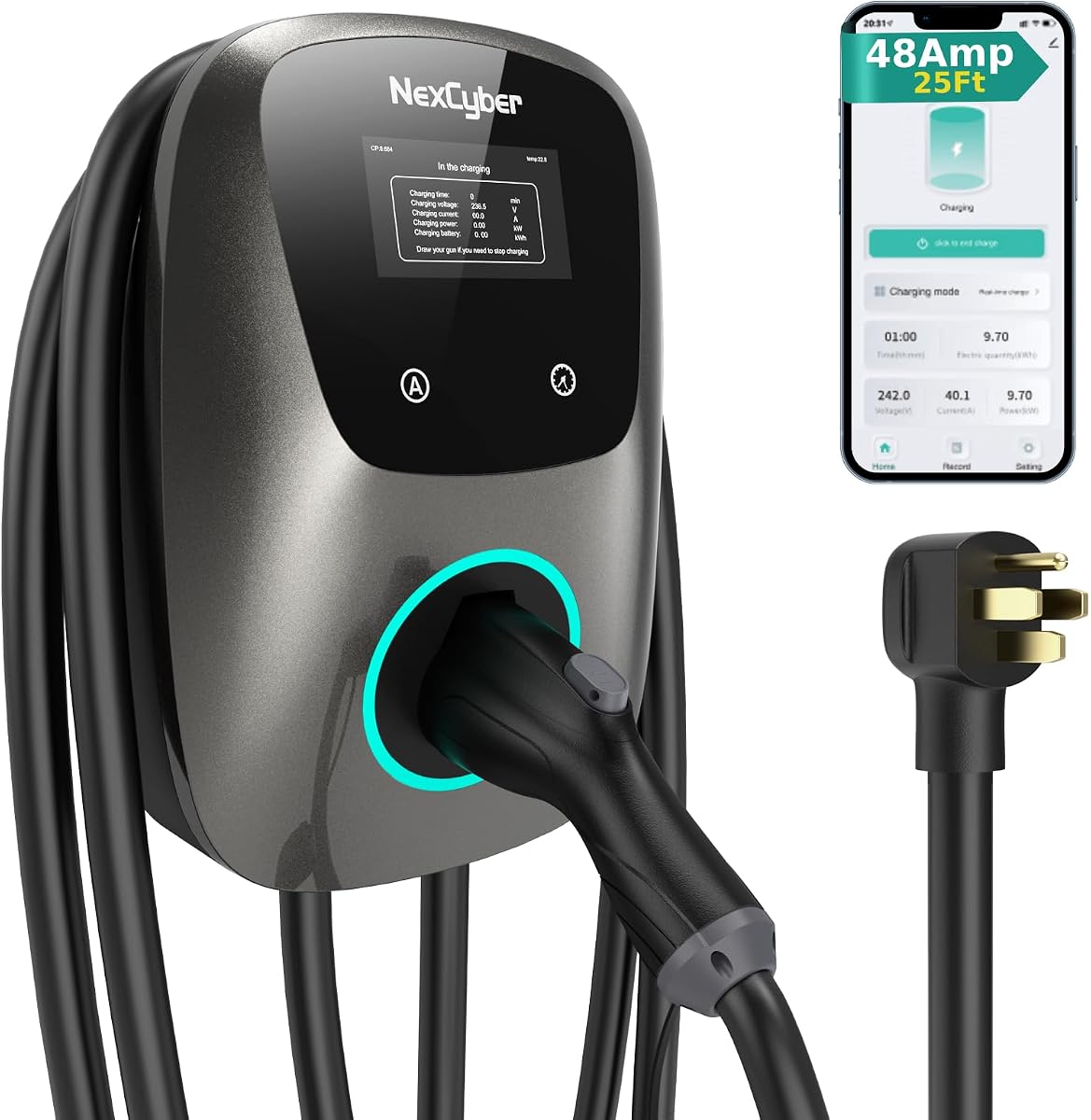
The Level 2 EV Charger(WiFi APP/Plug-Play), 48A Nema 14-50p, 25ft Cable ETL Certified, Home Level 2 EVSE Car Charger w/ J1772 Connector, Electric Vehicle Charging Stations (46) carries a 4.5 rating. Its unusual ability to reach 48A in hardwired mode while also offering a 40A NEMA 14-50 plug-in path makes it a flexible high-output option.
We may earn a commission when you buy through this link, at no additional cost to you.
The product is described as capable of adding up to 46 miles of range per hour in hardwired mode and up to 38 miles per hour through the plug, though actual results depend on the vehicle. It offers 16A through 48A adjustments, a 25-foot cable, a display for operating details, and app-based scheduling and cost tracking. ETL, FCC, and Energy Star certification are listed among its safety credentials.
The electrical guidance is substantial: operating at 40A to 48A requires appropriately sized conductors, and a professional installation is recommended. A 40A NEMA 14-50 connection also depends on a correctly configured outlet and circuit. The unit is described as NEMA Type 3 with partial IP65 protection, and the manufacturer does not recommend installation in direct sunlight or exposed rain.
NexCyber is a strong candidate for owners who want unusually high amperage without giving up the option to begin with a plug-in setup. It is less convenient for newer NACS-equipped vehicles unless the correct adapter is available, and its weather guidance calls for a covered or suitably protected location.
Most plug-in Level 2 chargers top out around 32A, but this model supports up to 40A through its NEMA 14-50 connection. That creates a useful middle ground for drivers with capable vehicles and electrical panels who want faster charging without immediately committing to a hardwired installation.
The default plug-and-charge mode works without an app, while the touch display and WiFi app add control over amperage, timing, status, and charging history. This makes the charger approachable for basic use without giving up scheduling options for owners who want them.
We may earn a commission when you buy through this link, at no additional cost to you.
The EVDANCE Level 2 EV Charger (32Amp, 240V, NEMA 14-50P), 7.68kWh Fast Portable & Home Electric Car Charger with 25ft Cable, Adjustable Current/Delay Chargin for J1772 EVs has a 4.4 rating. It provides up to 32A and 7.68 kW of output in a portable design that includes a wall bracket and carrying case.
We may earn a commission when you buy through this link, at no additional cost to you.
Its flexible amperage settings are a major selling point. Depending on the circuit, it can deliver 32A on a 40A breaker, 24A on a 30A breaker, or 16A on a 20A breaker, while the broader controls include 10A, 20A, and 24A choices. The LED display presents real-time amperage, voltage, charging speed, and delay status, helping users set an appropriate level without an app.
Owners should follow the manufacturer’s guidance about exposure: the charger has NEMA Type 4 and IP66-grade protection but is not recommended for direct sunlight or heavy rain, making a garage or covered carport preferable. Tesla vehicles need a J1772-to-Tesla adapter that is not included, and the 240V outlet must be properly configured.
This EVDANCE is our Best Budget selection because it combines useful speed, a long cable, adjustable current, and genuine portability at an approachable cost. It is a good fit for a first EV owner who wants Level 2 charging without paying for a complex permanently installed system.
At 32A, the charger can provide much faster replenishment than a standard 120V connection. Adjusting current to match the circuit is especially important for first-time owners who may be unsure which level their household wiring can safely support.
The included carrying case makes the unit easy to store between trips or take to another location, while the wall bracket supports tidier permanent placement at home. The 25-foot cable reaches across many garages and parking spaces without requiring a very short lead.
We may earn a commission when you buy through this link, at no additional cost to you.
The EVDANCE Level 2 EV Charger 40Amp, 240V 9.6KW Portable Electric Vehicle Charging Stations with NEMA 14-50P, 25FT Cable Adjustable Current/Timing Delay Home Electric Car Charger for J1772 BEVs/PHEVs earns a 4.4 rating. It is a portable charging station with more output than many entry-level Level 2 units and a particularly informative display.
We may earn a commission when you buy through this link, at no additional cost to you.
Maximum 40A operation produces up to 9.6 kW, and current can be selected from 10A through 40A in several increments. A 2.4-inch TFT screen displays charging current, voltage, power, elapsed time, and operating status. A delay function can defer charging by one to 12 hours, allowing a session to begin outside peak usage periods without requiring smartphone scheduling.
The charger includes a range of protections for leakage, grounding issues, voltage fluctuations, excess current, overcharging, overheating, and short circuits. It also shuts off when the vehicle reaches a full charge. Its stated operating range is minus 22 to 122 degrees Fahrenheit, with IP66 protection, although proper outlet and installation practices remain essential.
The 40A setting requires a properly configured 50A circuit, so this is less convenient than a 32A model for some homes. Tesla owners need a J1772-to-Tesla adapter. Even so, the display, broad current range, carrying bag, and included holders make this a strong portable option for owners who want serious output away from a hardwired wall station.
The TFT panel gives owners a broader view of session information than a simple status light. Seeing voltage, current, power, elapsed time, and work status at a glance can help confirm that a session is operating at the intended level and make setup adjustments easier.
The portable format, 25-foot cable, carrying bag, and separate holders for the connector and control box allow the station to move between a home garage, workplace, or travel stop. A J1772 connector covers a broad range of North American EVs and plug-in hybrids.
We may earn a commission when you buy through this link, at no additional cost to you.
The MACH 1: Fast 48 Amp Level 2 EV Charger, Wall-Mount Electric Vehicle Charging Station, 200-240V Hardwire or NEMA 14-50. J1772 car Connector & Tesla NACS, Indoor/Outdoor, 30ft Cable evse Adapter has a 4.6 rating. Its most distinctive advantage is the included NACS adapter, which makes it more immediately useful to Tesla owners than a standard J1772-only wall box.
We may earn a commission when you buy through this link, at no additional cost to you.
The charger supports both a NEMA 14-50 plug-in arrangement and hardwiring for up to 48A, giving owners a degree of installation flexibility. The 30-foot cable is among the longest in this group, while the wall-mounted format, connector holder, 2.4-inch LED display, Bluetooth and WiFi connectivity, two RFID cards, and mobile app create a feature-rich permanent station.
The product’s outdoor-oriented enclosure and anti-theft hardware make it look closer to shared parking equipment than a simple home wall box. That may be useful for a private drive or small workplace, but it can also make the installation more visually and physically substantial. Full 48A operation requires a 60A breaker and hardwiring, while the plug-in path is associated with a 50A circuit.
ApexCharger MACH 1 is best for an EV owner who wants a wall-mounted, high-output station with J1772 and Tesla support in one package. It is especially attractive for Tesla owners who prefer having the correct adapter included rather than sourcing one separately.
The included PRO 1 NACS adapter allows the standard J1772 cable to charge compatible Tesla vehicles, while J1772 serves the broad majority of North American EV and plug-in-hybrid fleet. This reduces connector shopping for households that own or regularly switch between different charging standards.
A wall-mounted body, long cable, connector holder, lighting indicator, RFID cards, and anti-theft fittings create a more permanent infrastructure feel. That makes the station well suited to a driveway, garage wall, or private parking area where a compact indoor cord set would be less convenient.
We may earn a commission when you buy through this link, at no additional cost to you.
The Autel MaxiCharger Level 2 Electric Vehicle (EV) Charger, up to 80 Amp Fast Charging EV Charger Level 2, Integrated Cloud with AI, Indoor/Outdoor Charging Stations J1772, Hardwired is the most powerful home charger in the guide, with a 4.4 rating. It supports up to 80A and 19.2 kW, making it a premium option for drivers with large batteries, capable vehicles, and serious electrical capacity.
We may earn a commission when you buy through this link, at no additional cost to you.
Autel’s AI-integrated app can schedule charging around time-of-use rates, start or stop sessions remotely, adjust current, provide real-time energy data, and issue alerts when the system detects unusual conditions. The charger also includes dual-network WiFi and Wi-SUN connectivity, internal temperature monitoring, a flame-retardant enclosure, tamper-resistant screws, and remote locking for theft protection.
Reaching the full 80A output is not a casual installation. A 100A circuit is recommended, professional installation is advised, and the unit is hardwired. The vehicle’s own charging system will also determine the maximum current it accepts. Buyers without a strong 240V service should compare a 32A or 48A model rather than sizing an electrical upgrade around the charger’s maximum alone.
Autel MaxiCharger is our Best Premium selection because it provides the highest output, extensive network controls, and substantial security features. It is a strong long-term choice for compatible EVs, multi-vehicle households, and owners willing to invest in professional electrical infrastructure.
At 80A, the charger can add approximately 70 miles of range in an hour according to the product information, subject to the vehicle. It is designed to recharge larger battery packs overnight and can also suit busy homes or shared installations where fast turnaround matters.
Remote locking and tamper-resistant hardware add protection beyond the basic charger enclosure. A five-year warranty, 24/7 support, and managed software features make the unit more attractive for owners who expect to maintain and use the station over many years.
We may earn a commission when you buy through this link, at no additional cost to you.
The EMPORIA Level 2 EV Charger w/ J1772 Connector — 48 Amp, 240V WiFi Enabled Electric Vehicle Charging Station, 25ft Cable, NEMA 14-50, White has a 4.7 rating. It is a well-rounded 48A home charger that supports both plug-in and hardwired configurations while adding scheduling and energy monitoring through a mobile app.
We may earn a commission when you buy through this link, at no additional cost to you.
The charger can deliver up to 48A in hardwired mode and 40A through the NEMA 14-50 plug, with stated range-addition rates of up to 46 miles per hour and 38 miles per hour respectively. Actual results depend on the vehicle. The 25-foot J1772 cable reaches across typical garages and drives, while 2.4 GHz WiFi connectivity enables real-time energy data and session management.
The product is UL listed and Energy Star certified, with compliance cited against NEC 625, SAE J1772, and several UL standards. Professional installation is recommended for optimal performance and safety, particularly when operating at 48A. The need for a 2.4 GHz signal and a J1772 connector should be considered before purchase.
This EMPORIA model is a strong fit for owners seeking a proven mid-to-high-power charger with flexible installation and useful connected features. It may not offer the same panel-aware automation as the EMPORIA Pro, but its 4.7 rating, output options, and broad vehicle compatibility make it a compelling all-around home station.
The unit is preconfigured for a NEMA 14-50 connection up to 40A and can be converted for hardwired 48A operation. That gives a buyer a way to match the charger to the home’s current electrical setup while preserving the option for faster output after a professional upgrade.
Connecting through 2.4 GHz WiFi allows owners to schedule charging around utility rates and monitor real-time energy use. These features help make Level 2 charging more deliberate and can reduce the temptation to begin a large charging session during peak electricity periods.
We may earn a commission when you buy through this link, at no additional cost to you.
The right home charger depends on your vehicle, electrical panel, connector, installation preferences, and tolerance for smart features. Compare the following factors before ordering so the unit is safe, compatible, and practical for your routine.
Level 2 charging is defined by 240V household power, but amperage determines how much energy the charger can deliver. A 32A unit offers up to 7.68 kW, a 40A unit reaches 9.6 kW, 48A systems provide up to 11.52 kW, and the Autel MaxiCharger can reach 19.2 kW at 80A. Higher output can shorten charging time, but only if the vehicle accepts that current and the home has a suitable dedicated circuit. Many EVs cap charging below the station’s maximum, so matching the charger to the car’s onboard charging capability is more important than chasing the largest number.
Choose a current level that your vehicle and electrical service can both support. A lower-powered charger may add little practical time for a vehicle with a modest onboard charger, while an oversized station can create unnecessary installation costs.
A 240V Level 2 charger usually requires its own dedicated circuit. Common examples include a 20A circuit for lower output, a 30A or 40A circuit for 24A or 32A charging, a 50A circuit for 40A charging, and a 60A circuit for 48A output. The Autel’s full 80A performance calls for a 100A recommended circuit. Load-management technology can sometimes help, but it does not automatically make an undersized electrical service safe or adequate.
Ask an electrician to evaluate available panel capacity, circuit length, grounding, and local code before buying a high-current hardwired unit. This step is especially important in older homes, renovated garages, and properties with existing solar, heat pumps, or workshop equipment.
A plug-in charger is easier to move, test, or take on a trip, but it requires a correctly installed NEMA 14-50 outlet and may be limited to a lower output level. A hardwired charger looks cleaner, can support higher current, avoids leaving a large plug exposed, and is generally better suited to permanent daily use. Some products, including the EMPORIA, AIMILER, and NexCyber options, support both approaches, giving owners more flexibility.
Choose plug-in for flexibility or a temporary charging arrangement. Choose hardwired when you want maximum output, a permanent wall installation, or a cleaner finished garage. For either approach, use a licensed electrician and follow all local electrical requirements.
Most North American EVs and plug-in hybrids use the SAE J1772 connector, which is standard on the EVIQO, ChargePoint, EMPORIA, AIMILER, NexCyber, EVDANCE, and Autel models reviewed here. The ApexCharger MACH 1 also includes a NACS adapter. Newer vehicles from certain manufacturers increasingly use the North American Charging Standard, so identify the port on your own car before selecting a charger. A J1772 charger can serve a NACS vehicle with a properly supported and correctly rated adapter, but a physical connector match alone does not guarantee full-speed charging.
Check both the vehicle’s port and the maximum amperage it accepts. Do not assume that an adapter enables the charger’s highest output; the vehicle’s onboard charger may impose a lower limit.
WiFi and app control can add scheduling, real-time energy data, remote start and stop, charging history, cost estimates, and notifications. The EVIQO, ChargePoint, both EMPORIA models, AIMILER, NexCyber, and ApexCharger include connected features, while the EVDANCE models in this list emphasize physical controls and displays. Smart features are most useful when the charger can maintain a reliable 2.4 GHz connection inside a garage or basement.
Prioritize dependable connectivity if remote control matters, but do not overlook the physical display and buttons. The best experience is one you can understand at a glance without a phone and still automate when convenient.
Look for recognized electrical and EV-charging certifications rather than relying only on generic claims. The listed products include combinations of UL, ETL, CSA, Energy Star, FCC, SAE J1772, and relevant UL standards. Built-in protections may cover leakage, ground faults, overcurrent, overvoltage, undervoltage, overheating, short circuits, and automatic shutoff at full charge. Certification supports safe design, but correct circuit sizing, grounding, and installation remain equally important.
Review the certification list and electrical specifications before purchasing. If anything is unclear, ask the manufacturer or a qualified electrician to confirm suitability for your panel, outlet, location, and vehicle.
Cable length determines whether the connector can reach the vehicle’s charge port without awkward extension cords. Most of the reviewed chargers include a 25-foot cable, while the ApexCharger MACH 1 has a 30-foot lead. Longer is not automatically better: excess cable can be heavier to manage, and very long runs may increase installation cost or require different conductor specifications. Think about the shortest route from the mounting point to the normal parking position.
Measure your garage, driveway, and parking space before ordering. Also consider connector storage, cable bend radius, snow buildup, and whether the vehicle needs to be positioned in two different spots for convenient access.
A charger exposed to rain, snow, dust, and temperature changes needs appropriate environmental protection. IP66 and NEMA 4 ratings appear frequently in the product information, while the NexCyber is described as NEMA Type 3 with partial IP65 protection. Manufacturer guidance also matters: some products recommend a garage or covered area rather than direct sunlight or heavy rain. Portability is a separate advantage offered by the AIMILER and both EVDANCE chargers through carrying cases, while the ApexCharger is designed as a more substantial wall-mounted installation.
Match the charger to its actual environment rather than assuming a connector rating means it can be exposed indefinitely. For portable units, use a dry outlet and protected location when weather is severe.
Begin by confirming that the charger’s connector and current rating are compatible with your EV. Install the required dedicated circuit and outlet with a qualified electrician, following the charger manual, National Electrical Code, and local rules. For hardwired models, switch off the appropriate breaker before wiring and let the electrician verify grounding, conductor size, breaker rating, and the unit’s configuration.
Before the first full session, connect the charger and review the displayed voltage, amperage, and charging status. If the model offers app controls, connect it to a 2.4 GHz network, enable scheduling, and set the current below the circuit and vehicle limits. Begin with off-peak timing if your electricity plan uses time-of-use rates, and confirm that the vehicle’s charging screen reports the expected behavior.
For routine care, keep the connector dry, inspect the cable for cracks or damage, and clean the holster and control box without directing harsh liquids into openings. Do not use an extension cord unless the manufacturer explicitly permits it. If the charger stops unexpectedly, check the display, breaker, emergency-stop control, app messages, and vehicle notifications before attempting a reset, and contact the manufacturer or electrician if the fault persists.
A Level 2 charger uses 240V power and is substantially faster than a standard 120V Level 1 outlet. Depending on amperage, it can deliver roughly 7.68 kW at 32A, 9.6 kW at 40A, 11.52 kW at 48A, or up to 19.2 kW at 80A. The vehicle’s onboard charging limit usually determines the actual speed, so a more powerful station will not force every EV to charge at its maximum rating.
Professional installation is strongly recommended for any hardwired charger and for plug-in models using a newly installed NEMA 14-50 outlet. A licensed electrician can confirm panel capacity, choose the correct breaker and conductor size, and ensure the installation satisfies local electrical codes. Even if a product includes installation instructions or plug-in hardware, the outlet and circuit still need to be safe and correctly configured.
Many Teslas can charge with a supported J1772-to-NACS adapter, but adapter compatibility and charging speed depend on the vehicle, adapter, and charger. The ApexCharger MACH 1 includes a NACS adapter, while the other J1772 chargers in this guide generally require one to be purchased separately. Confirm that the adapter supports the intended amperage and check the manufacturer’s compatibility guidance before purchasing.
The best match is the highest amperage that both the vehicle and home electrical system can support. Many vehicles accept up to 32A, 40A, or 48A, but some models charge more slowly on lower-current Level 2 connections. Check the vehicle’s charging specifications and consult an electrician about your panel and circuit before selecting a higher-output unit such as a 40A, 48A, or 80A charger.
Yes, a Level 2 home charger should normally use a dedicated 240V circuit sized for its maximum output. The required breaker depends on the charger’s amperage and manufacturer specifications, with higher-output models requiring larger circuits and potentially larger conductors. Some load-management products can coordinate charging with other household loads, but they do not eliminate the need for a safe, code-compliant installation.
A portable model can be especially useful in a garage if the garage already has a correctly installed NEMA 14-50 outlet on an appropriate circuit. It can also be moved to another permitted 240V location. The AIMILER and EVDANCE products support plug-in operation, although you should follow their weather and amperage instructions and never use an unsuitable adapter or extension method.
Scheduling can reduce costs when your utility plan charges different rates at different times. By starting the session during off-peak hours, the vehicle can often recharge overnight before daytime rates begin. Savings depend on your tariff, the vehicle’s required energy, charger power, and any demand charges, so compare the schedule with the specific rate plan from your utility.
Check the vehicle’s charge port, maximum accepted amperage, and onboard charging limit first. Then confirm the connector type, electrical-panel capacity, circuit and breaker requirements, installation style, cable length, WiFi support, safety certifications, and permitted weather exposure. A qualified electrician can resolve panel and wiring questions before installation begins.
The EMPORIA Pro stands out as the most complete feature set because PowerSmart load balancing, flexible installation, and home energy monitoring work together. The EVDANCE 32A is a straightforward Best Budget option for portable or plug-in charging, while the Autel MaxiCharger delivers the guide’s highest output for owners prepared to invest in serious electrical capacity.
For most EV owners, prioritize connector compatibility, an appropriate amperage level, and safe electrical infrastructure before app features. A 32A or 40A charger can deliver excellent overnight results for many vehicles, while 48A and 80A systems make the most sense when the car supports them and the electrical panel can accommodate the required circuit.
Product specifications, ratings, incentives, and prices can change, so review the current listing and manufacturer documentation before buying. Check local rebates, utility requirements, electrical-panel capacity, and your vehicle’s charging limits to ensure the selected charger is both compatible and worthwhile.