
12V RV Water Pump 4.0 GPM
4.1Editor score
Four gallon per minute flow
Low 40 dB operation
Adjustable pressure switch
Explore the best 12V water pump options for RVs, campers, boats, and off-grid systems, comparing flow rate, pressure, priming, noise, and durability.
A 12V water pump is the heart of many mobile and off-grid water systems, delivering pressurized freshwater from a tank to a sink, shower, faucet, or washing point. The right pump balances flow, pressure, electrical demand, noise, self-priming ability, and durability while fitting the available space and plumbing.
We compared ten 12V diaphragm pumps using their published specifications and supplied product details. The list covers compact single-fixture models, higher-flow RV pumps, quiet options, high-pressure units, and self-priming designs for boats, campers, marine systems, irrigation, washing, and other practical applications.
Each pick highlights the capabilities that distinguish it from the alternatives, along with important limitations to consider before installation. Ratings and specifications reflect the available product information, while prices and availability can change, so compare the current listing details before making a final purchase.
4.1Editor score

4.9Editor score

4.3Editor score
The comparison below organizes all ten pumps by flow, pressure, self-priming capability, and intended application, making it easier to identify the right balance for an RV, boat, compact off-grid system, washing task, or light-duty freshwater installation.




The WASSERMANN RV Pump earns a place near the top of the list with a 4.4 rating and a practical combination of flow, pressure, and installation features. Its rated output of up to 4.0 GPM is substantial enough for a typical RV freshwater system, while the 45 PSI operating pressure is a familiar level for common RV fixtures and plumbing arrangements.
We may earn a commission when you buy through this link, at no additional cost to you.
Its pressure switch brings welcome automation: the pump starts when a tap is opened and stops after the faucet closes. The self-priming design makes the unit suitable for placement on or above a freshwater tank, while the included barbed adapters, threaded hose adapter, debris filter, and manual create a more complete replacement package. Corrosion-resistant construction and short-duration dry-run capability add practical resilience.
The main limitation is that 4.0 GPM falls short of the 5.5 and 6.0 GPM offered by higher-output competitors. The listed pressure setting also provides less explicit adjustment information than several alternatives. Those trade-offs matter most for users running several outlets simultaneously or seeking very high pressure, but they are less significant for a single RV kitchen, bathroom, or compact freshwater loop.
This pump is a strong all-around recommendation for RV owners and campers who want meaningful flow without moving to a high-current premium model. Confirm that its 1/2-inch fittings match the existing plumbing, use a properly sized power circuit, and follow the supplied manual when adjusting or servicing the pressure switch.
The supplied barbed hose adapters, male-thread adapter, debris filter, instructions, and pump make this more convenient than a bare replacement unit. Buyers still need to confirm hose diameter, mounting space, wiring requirements, and compatibility with the rest of the freshwater system.
A 45 PSI switch and automatic operation provide a familiar balance for RV plumbing. The result is a pump that can support routine faucet use without requiring constant manual starting or stopping.
We may earn a commission when you buy through this link, at no additional cost to you.
The 2026 Upgraded RV Water Pump stands out with a 4.9 rating, the highest score among the ten products, and the strongest stated flow figure at 6.0 GPM. It is designed for users who want a pump capable of serving multiple fixtures, a tankless water heater, or a demanding RV shower without compromising on output.
We may earn a commission when you buy through this link, at no additional cost to you.
Its smart bypass is intended to reduce rapid cycling and pulsing, while genuine NSK double ball bearings and a one-piece four-chamber diaphragm emphasize quieter operation and lower vibration. The pressure switch is factory set to 70 PSI but adjustable, and the self-priming specification reaches 10 feet vertically and 155 feet horizontally. Standard 1/2-inch NPT ports and included barbed adapters simplify integration.
This performance comes with trade-offs. A maximum current draw of 15 amps means a more substantial power connection than the 4-amp SEAFLO or 6-amp ECO-WORTHY models. The high flow and pressure may also be unnecessary for a tiny sink or basic boat galley. Furthermore, bypass pressure is listed at 85-90 PSI, so installers should verify that the complete plumbing system can tolerate the complete operating range.
For a full-size RV, larger camper, boat with multiple outlets, or off-grid installation needing high output, this is the most capable and sophisticated pick in the group. The three-year factory warranty and U.S.-based support further strengthen the case. Ensure the electrical system, hoses, and fixtures are appropriately sized before installation.
The 6.0 GPM rating and smart bypass make this pump better suited than most listed models to simultaneous use. Its listed cut-in range of 25-40 PSI also allows some configuration for different RV plumbing systems.
NSK double ball bearings, a four-chamber diaphragm, and bypass control target both mechanical and hydraulic noise. These features are particularly valuable when the pump operates near sleeping or living areas.
We may earn a commission when you buy through this link, at no additional cost to you.
The RV Fresh Water Diaphragm Pump combines a 4.4 rating with a 4.0 GPM flow and 50 PSI shutoff pressure. That gives it slightly more nominal pressure than several 45 PSI competitors, making it relevant for RV, marine, irrigation, washing, and general transfer applications where a somewhat stronger output is useful.
We may earn a commission when you buy through this link, at no additional cost to you.
The included package contains the diaphragm pump, instructions, two 1/2-inch barbed hose adapters, and a 50-mesh inlet strainer. Thermal overload protection and short-duration dry-run capability add safety in real-world installations. Its pressure switch starts and stops with demand, and the product is specified for 12-volt DC operation with a maximum draw of eight amps.
Buyers should pay close attention to the inlet-pressure warning. The manufacturer specifies a maximum inlet pressure of 30 PSI and advises avoiding applied inlet pressure when possible. The off pressure is factory preset, and users are advised not to adjust the pressure screw themselves. Those restrictions make this less flexible than models with clearly documented adjustment ranges.
This is a convincing choice for a general-purpose mobile pump that may handle freshwater, washing, or yard work in addition to RV use. It suits users who value a straightforward preset system more than extensive control. Installation must include secure hose joints, adequate current, and protection against excessive inlet pressure.
The stated applications include boats, caravans, kitchens, bathrooms, yards, sprinklers, and marine systems. That flexibility makes the pump attractive to buyers who want one unit for several water-transfer needs.
Thermal overload protection reduces motor risk, while the strainer helps keep debris out of the pumping chamber. Secure fittings remain essential because the manufacturer explicitly warns against leakage and loose joints.
We may earn a commission when you buy through this link, at no additional cost to you.
The SEAFLO 21 Series is the premium choice for compact installations where low electrical demand, certification, and a long warranty matter more than maximum flow. Its 4.3 rating accompanies a measured specification set: 1.2 GPM open flow, 35 PSI shutoff pressure, 4.0 amps of current draw, and self-priming up to four feet.
We may earn a commission when you buy through this link, at no additional cost to you.
The pump is listed as compliant with NSF/ANSI/CAN 61 and 372 for potable water safety, NSF 24 for RV plumbing, and UL 778 for motor-operated water pumps. A Santoprene diaphragm, corrosion-resistant materials, and ignition-protected construction suit RV, marine, and off-grid environments. Automatic operation, dry-run capability, thermal protection, and a compact mounting footprint add further practicality.
Its compactness also defines its limits. A 1.2 GPM flow is best for one sink or another light-duty fixture rather than multiple simultaneous outlets, and the 35 PSI shutoff pressure is lower than that of the RV-focused models in this guide. The three-eighth-inch hose barb ports also require appropriately sized tubing rather than the half-inch components commonly used by larger freshwater pumps.
For a van conversion, small boat, auxiliary freshwater system, or a single-fixture installation, this is a premium pick with low power consumption and a four-year limited warranty. Verify NSF certification requirements for your jurisdiction and choose fittings that match the system's actual hose diameter.
The listed NSF and UL certifications make this particularly suitable where fresh water quality and RV plumbing compliance matter. Those credentials do not replace proper sanitation, but they provide useful assurance about the pump's intended use.
A four-amp draw makes this pump attractive for battery-powered, solar, van, and compact boat installations. It can deliver useful flow to one outlet without the higher electrical demand of multi-fixture RV pumps.
We may earn a commission when you buy through this link, at no additional cost to you.
The ECO-WORTHY RV Fresh Water Pump offers a balanced middle ground between compact single-fixture pumps and higher-output RV models. It has a 4.2 rating, a listed 3.5 GPM flow rate, a 45 PSI pressure switch, and a maximum draw of six amps, making it suitable for RVs, yachts, campers, and food trucks.
We may earn a commission when you buy through this link, at no additional cost to you.
Its most attractive feature is the adjustable pressure range of 35-80 PSI. That gives installers more latitude than a fixed preset model, while the self-priming capability of 9.8 vertical feet and a listed lift of up to 98 feet offers installation flexibility. The automatic pressure switch starts with faucet demand and stops when the flow ceases.
Thermal overload protection shuts the circuit down above 70 degrees Celsius, or 158 degrees Fahrenheit, and the pump is also described as dry-run safe. That protection is valuable, although it is not a substitute for ensuring the tank contains water. Compared with the 4.0 and 6.0 GPM alternatives, its lower output may feel modest in showers or when multiple fixtures are opened.
This model is well suited to a moderate-size RV or mobile system where adjustable pressure and efficient current draw matter more than maximum flow. Match the pump to the expected number of outlets, use suitable hose and wire gauges, and verify the plumbing can tolerate the selected pressure.
The 35-80 PSI adjustment range is useful when replacing a pump with a different original pressure setting. It also provides flexibility for RV fixtures, marine washdown lines, and other compatible systems.
A listed vertical priming lift of 9.8 feet allows the pump to sit above the water source in many installations. Planning the hose route and ensuring no air leaks remain important for dependable priming.
We may earn a commission when you buy through this link, at no additional cost to you.
The VEVOR Water Diaphragm Pump delivers a substantial 5.5 GPM open flow and a rated pressure of 70 PSI. Although its 4.1 rating is not among the highest, the specification set is well suited to users seeking strong output for washing, spraying, irrigation, or long-distance water transfer.
We may earn a commission when you buy through this link, at no additional cost to you.
Its automatic pressure switch starts and stops the pump with faucet demand, and the pressure can be adjusted from 40 to 100 PSI. The pump self-primes up to six feet, includes sealing tape, and supports short periods of dry running. Overload protection and FCC certification add confidence for users who need dependable operation across varied tasks.
The significant trade-off is electrical demand. Its stable 17-amp motor exceeds the maximum draw of every other pump in the comparison and requires a suitably substantial 12-volt supply, cable, fuse, and switch. The product information also explicitly states that it is suitable for car washing and agricultural irrigation rather than RV use, so it should not be treated as a conventional RV freshwater replacement.
This is a compelling choice for car washing, agricultural irrigation, yard work, and other transfer applications where high flow is more important than low noise or compact size. Choose it over the RV pumps when its electrical requirements and stated application align with the task at hand.
A 5.5 GPM flow and adjustable 40-100 PSI range provide useful flexibility for washing and spraying. The higher open flow can move more water quickly, while pressure adjustment helps match different spray patterns.
The listed 17-amp motor is the main installation consideration. Adequate cable and circuit capacity are essential, and the pump should not be connected to an undersized battery lead or accessory socket.
We may earn a commission when you buy through this link, at no additional cost to you.
The 12V RV Water Pump combines a 4.0 rating with features that are especially useful in occupied RVs: a stated 40 dB operating level, a rubber vibration-damping base, and a four-gallon-per-minute flow rate. It targets users who want an inexpensive replacement without giving up automatic operation or a useful pressure-adjustment range.
We may earn a commission when you buy through this link, at no additional cost to you.
The pressure is preset at 45 PSI but adjustable from 30 to 80 PSI. A ten-foot self-priming lift and listed 100-foot head pressure provide flexibility when positioning the pump near the tank. Overheating protection is rated at 158 degrees Fahrenheit, and the package includes fittings intended to support a straightforward replacement installation.
Compared with the 6.0 GPM premium model, this pump offers less capacity for multiple fixtures or a tankless water heater. The low sound figure is a manufacturer claim and real-world noise can vary with mounting, plumbing, water conditions, and vibration paths. As with any self-priming unit, air leaks or a poorly arranged suction line can also affect performance.
For RV, camper, boat, marine, or food-truck users seeking a quiet, compact, and moderately capable system, this is the value pick in the guide. Verify the supplied fitting sizes, use sound-isolating mounting, and choose the pressure setting carefully if the RV includes pressure-sensitive fixtures.
Vortex noise reduction technology and a rubber base target airborne noise and structure-borne vibration. Isolation from walls and cabinetry can make the practical difference in a sleeping area.
The 30-80 PSI adjustment window provides meaningful control. A lower setting may suit delicate fixtures, while a higher setting can support stronger spray or shower flow within the system's limits.
We may earn a commission when you buy through this link, at no additional cost to you.
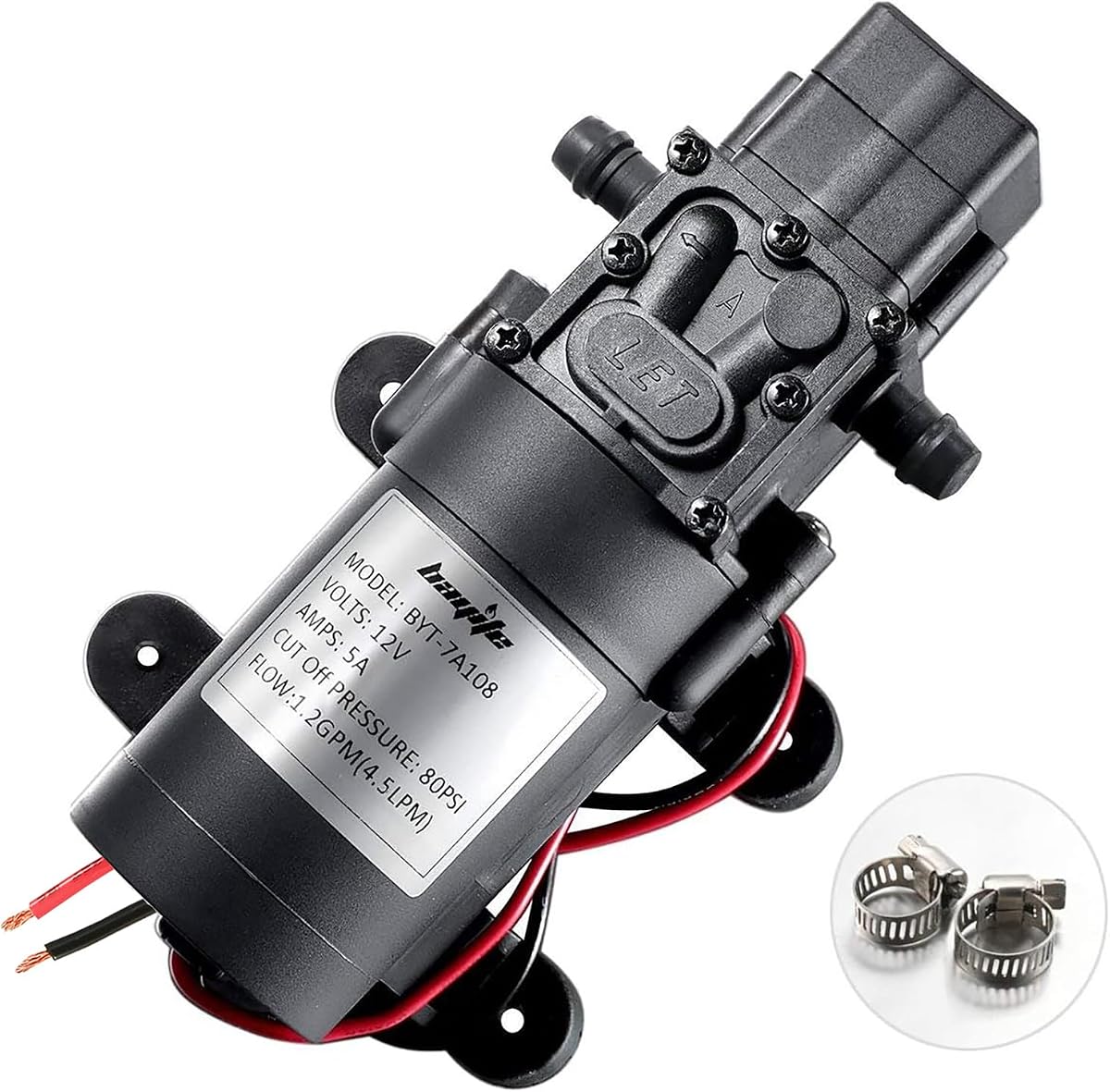
The 12V DC Water Transfer Pump is a compact option for moving water where modest flow and relatively high pressure are more important than serving multiple fixtures. It carries a 4.3 rating, produces 1.2 GPM, and has a default shutoff range of 80-85 PSI, giving it a distinctly different performance profile from most RV pumps in the list.
We may earn a commission when you buy through this link, at no additional cost to you.
Its patented design is described as producing smooth, consistent flow while drawing low current. The sealed body protects against incidental moisture and dust, electro-coated components help inhibit corrosion, and rubber mounting tabs reduce vibration. A 6.6-foot vertical suction lift permits some placement above the source, while three-eighth-inch hose barb ports suit smaller hose arrangements.
Important operating warnings accompany the specifications. The pump requires a DC 12-volt supply only, and voltage above 14 volts may damage the motor. It should not run continuously for more than six hours. The 80-85 PSI figure describes the default cutoff range, not the flow available at that pressure, so users must not interpret the listed 4.5 liters per minute as a high-pressure output figure.
This pump is best for compact transfer, freshwater, or point-of-use applications with appropriately sized plumbing. It is less appropriate for a busy RV shower or a system requiring several gallons per minute. Correct polarity, voltage regulation, flow restrictions, and mounting isolation are essential for reliable service.
The combination of a 1.2 GPM rate and an 80-85 PSI cutoff suits smaller systems where pressure matters more than volume. Appropriate narrow-bore hoses and fittings help maintain useful delivery.
The sealed pump body, corrosion-inhibiting electro coating, and rubber isolation tabs support use in damp or marine environments. They reduce contamination risk and vibration transmission when correctly installed.
We may earn a commission when you buy through this link, at no additional cost to you.
The DC HOUSE 33 Series earns a 4.5 rating and targets smooth, steady delivery in campers, boats, cabins, and off-grid homes. Its three-chamber diaphragm is designed to reduce pulsation and extend pump life while delivering up to 3.5 GPM at a listed 45 PSI shutoff pressure.
We may earn a commission when you buy through this link, at no additional cost to you.
A built-in adjustable pressure switch offers a range from 40 to 80 PSI and automatically activates when water flow is detected. The copper-wound motor is paired with overload protection and dry-run capability, while a noise-dampening rubber base helps reduce motor noise and vibration. Self-priming lift of 9.8 feet provides flexibility in placement.
The model is not the highest-output pump available, so users expecting showers and several fixtures to operate simultaneously at maximum performance may find its capacity modest. The description also does not provide a precise maximum current draw, making it especially important to follow the manufacturer's wiring and circuit guidance rather than assuming it can share a lightly loaded accessory socket.
This pump is a strong fit for users who value smoother flow and quiet operation over maximum gallons per minute. It can serve as an upgrade to a modest RV or cabin system when paired with correctly sized wiring, fittings, and a pressure setting appropriate for the connected fixtures.
The three-chamber diaphragm is intended to smooth flow and minimize pulsation compared with simpler chamber arrangements. That can make the pump a better fit for fixtures sensitive to fluctuating pressure.
The rubber mounting base combines with a copper-wound motor to target lower noise and vibration. Installing the pump on a rigid but isolated surface helps keep those benefits in practice.
We may earn a commission when you buy through this link, at no additional cost to you.
The SEAFLO 22-Series rounds out the guide as a compact pump with an unusually high listed shutoff pressure. Its 4.3 rating accompanies a 1.3 GPM open flow, 100 PSI shutoff pressure, six-foot priming capability, and automatic operation for marine, RV, agricultural, and off-grid applications.
We may earn a commission when you buy through this link, at no additional cost to you.
The internal bypass is designed to reduce cycling and maintain steadier pressure across multiple outlets. EPDM valves and a Santoprene diaphragm provide the stated material construction, and the pump is described as capable of running dry without damage. The package includes hose barbs, installation instructions, a pressure switch, quick-connect wiring, warranty documentation, and a user manual.
A 100 PSI shutoff rating should not be mistaken for constant 100 PSI delivery or high-volume flow. At just 1.3 GPM, the pump is better suited to a compact faucet, wash line, transfer point, or light-duty fixture than a full RV shower system. Hose restrictions and leaks can also make pressure and flow behave differently in a complete installation.
This is a worthwhile choice when maximum compact pressure and on-demand operation matter more than volume. It offers a broader potential application range than a dedicated RV freshwater pump, but users should match the 100 PSI ceiling to their hoses, valves, and fixtures before installing it in a pressurized system.
The 100 PSI shutoff setting differentiates this model from low-pressure compact pumps. It may suit specialized washing, transfer, or agricultural arrangements where higher pressure is useful and low flow is acceptable.
A built-in pressure switch and internal bypass support hands-free use while conserving energy. The bypass also helps stabilize delivery when more than one outlet is active.
We may earn a commission when you buy through this link, at no additional cost to you.
Choosing a 12V water pump requires matching flow and pressure to the intended load while accounting for power, plumbing, mounting space, noise, and water-system compatibility.
Flow determines how quickly water reaches a fixture and how the system behaves when several outlets open at once. Compact pumps in this guide deliver around 1.2 to 1.3 GPM and are generally best for one sink or another light-duty point of use. Midrange models provide approximately 3.5 to 4.0 GPM, while the VEVOR and 2026 Upgraded models reach 5.5 and 6.0 GPM for washing, showers, tankless heaters, or multiple fixtures.
Choose flow according to actual demand, not just the largest headline number. More capacity can require more current, larger hoses, and a stronger power circuit.
Pressure affects shower force, spray performance, and compatibility with fixtures and valves. Listed shutoff pressures range from 35 PSI on the SEAFLO 21 Series to 100 PSI on the SEAFLO 22-Series, with many RV-oriented pumps clustered around 45 to 70 PSI. Models with an adjustable pressure switch can be adapted to different plumbing requirements, whereas a fixed preset may be simpler but less versatile.
Avoid assuming that shutoff pressure equals sustained working pressure. Flow generally falls as pressure rises, and the complete system's hoses, regulators, and fixtures determine the result.
Self-priming capability determines whether the pump can sit above the water tank and how much vertical separation the installation can tolerate. The listed values range from four feet on the SEAFLO 21 Series to ten feet on the 2026 Upgraded and 4.0 GPM RV models. Some pumps also advertise long horizontal priming distances, but those claims should be checked against actual hose length, fittings, bends, and elevation changes.
Plan the pump-to-tank distance before ordering. Even a pump with a strong priming specification depends on a sealed suction path and an unobstructed water source.
A pump's current draw can determine the cable, fuse, switch, battery, and charging system required. The SEAFLO 21 Series lists a 4.0-amp draw, while the ECO-WORTHY model lists 6.0 amps and the premium 2026 Upgraded model reaches 15 amps. The VEVOR pump's 17-amp motor is substantially more demanding. A cigarette-lighter-style connection may suit a low-current compact pump but can be inadequate for a high-output RV model.
Use the manufacturer's specified current, wire size, and protection. An underpowered lead can overheat, prevent the pump from reaching pressure, or create unsafe conditions.
Noise is especially important when the pump operates inside an occupied RV, van, cabin, or boat. The 4.0 GPM RV model lists a 40 dB operating level, the SEAFLO 21 Series emphasizes quiet operation, and several other models use rubber mounting bases to limit vibration. Actual sound depends on pump quality, mounting material, pipe vibration, water flow, and whether the unit is running continuously.
Isolate the mount with suitable vibration-absorbing material and keep rigid plumbing connections from transmitting noise into cabinetry. Avoid loosening the entire installation merely to reduce sound.
Pumps intended for drinking or potable freshwater should have appropriate material and safety credentials. The SEAFLO 21 Series is listed as compliant with NSF/ANSI/CAN 61 and 372, NSF 24, and UL 778. Other products may be suitable for RV freshwater use without displaying the same certification details. Certification can help establish suitability, but it does not replace sanitizing the tank, hoses, fittings, and entire system.
Check local regulations and the complete system components. Potable-water hose, seals, connectors, and tanks must all be appropriate for the intended use.
Hose and thread sizes determine installation effort. Several larger RV pumps use 1/2-inch barbed adapters or 1/2-inch NPT ports, while the compact SEAFLO models and the 12V DC transfer pump use 3/8-inch hose barbs. A mismatched port can require additional adapters or create restrictions that reduce flow. Threaded connections also need correct sealing, while barbed connections depend on suitable hose and clamps.
Measure the installation and verify fitting dimensions before purchasing. Account for the pump body, service clearance, mounting orientation, and space needed to route hoses without kinks.
A low-water condition can damage a pump quickly, so dry-run capability and thermal overload protection provide valuable safeguards. Most models in the comparison claim some form of short-term dry-run tolerance or overload protection. The ECO-WORTHY unit specifies an automatic circuit stop above 158 degrees Fahrenheit, while several others include thermal overload protection. These systems reduce risk but should not be treated as permission to operate without water.
Keep the reservoir filled where possible, inspect the suction line for leaks, and address unusual cycling or noise promptly. A continuously running pump may indicate an empty tank, a leak, a blocked filter, or a pressure-switch problem.
Begin by reading the included instructions and confirming that voltage, amperage, port sizes, pressure settings, and mounting orientation match the vehicle or system. Connect the pump with properly sized wire, an appropriate fuse, and a reliable ground. Use a dedicated circuit for high-current models rather than sharing an undersized accessory socket. Secure the pump to a stable surface using vibration-isolating material.
Install a clean inlet strainer or filter where appropriate, keep the suction line as short and straight as practical, and eliminate kinks. Prime the pump according to the manual, allowing water to fill the chamber until flow is steady. Connect compatible hoses, check every fitting for leaks, and set the pressure only within the limits specified for the pump and all connected fixtures.
Operate the pump through normal faucet demand so the pressure switch can start and stop it automatically. After each use, inspect fittings, wiring, filters, and the water source for leaks or debris. Keep the pump protected from freezing, excessive heat, and contaminated water, and address unusual noise, vibration, cycling, or loss of flow promptly. For stored seasonal systems, draining or protecting the pump according to its manual helps prevent freeze damage and stale water.
A single-sink or light-duty RV system may operate acceptably with a compact 1.2 to 1.3 GPM pump. A system serving a shower, several fixtures, or a tankless water heater benefits from roughly 3.5 to 6.0 GPM. Actual performance also depends on hose diameter, lift, leaks, pressure, and available electrical power.
Some pumps can operate without a conventional external switch because they use an integrated pressure control, but their operating behavior differs. Manual or always-on operation wastes power and water and can make short cycling more likely. For most RV, boat, and cabin installations, an automatic pressure switch is the preferred control method.
Self-priming means the pump can draw water from a source located above the pump after it initially fills and expels air from its chamber. It does not eliminate the need for a sealed suction line, a suitable filter, or adequate vertical clearance. Air leaks and restrictions are common causes of poor priming.
No. Higher shutoff pressure can help with specialized washing or spraying, but it may be unnecessary or undesirable for ordinary RV fixtures. A pump that supplies adequate flow at the intended working pressure is generally more useful than one with a higher maximum figure but restricted real-world delivery.
Most listed pumps can operate from a suitable 12-volt battery, but the battery, cables, switch, fuse, and charging system must support the pump's current draw. High-output models may need substantially heavier wiring and may drain a battery faster than compact pumps. Never exceed the stated voltage limit.
Noise varies by model, mounting, plumbing, and operating point. Some products list figures as low as 40 dB, while others emphasize isolation, smooth flow, or quiet bearings without publishing a comparable number. A properly mounted pump can feel much quieter than one attached directly to thin cabinet panels or rigid pipes.
Dry-run safe indicates that the pump can tolerate a limited period of operation without water, subject to its manufacturer conditions. It is not a guarantee against indefinite dry running, overheating, or damage from a completely failed system. Keeping the tank supplied and responding to unusual cycling remains important.
A compact 1.2 to 1.3 GPM pump may be sufficient for one galley sink or light auxiliary freshwater use. Campers or boats with showers and multiple outlets generally benefit from 3.5 GPM or higher. Account for available space, salt-air exposure, ignition protection, and the electrical system when comparing models.
The 2026 Upgraded RV Water Pump is the strongest all-around performer for users needing high flow, adjustable pressure, reduced pulsation, and quiet operation. The 4.0 GPM quiet RV model offers a more restrained and budget-conscious option, while the SEAFLO 21 Series is the premium choice for compact potable-water systems with low current draw and extensive standards.
Prioritize the requirements that cannot be changed after installation: electrical capacity, port dimensions, priming distance, pressure compatibility, and physical space. Then consider flow, noise, warranty, dry-run protection, and included accessories. A lower-flow pump with properly matched plumbing may serve a single fixture better than a powerful model that stresses a small system.
Ratings, specifications, included parts, warranty terms, and availability can change over time. Check the current product listing and instructions before purchasing, and compare the final configuration with your freshwater, marine, washing, irrigation, or off-grid requirements.