
Waterdrop MNR35 Remineralization Filter
4.6Editor score
Quick-connect tubing compatibility
Natural mineral restoration
Nine-to-twelve-month service life
Remineralization filters add selected minerals back to the water produced by reverse osmosis systems, which can improve flavor, reduce acidity, and make purified water more pleasant to drink. The right model also needs to match your tubing, housing, RO configuration, and preferred replacement schedule.
This guide compares ten remineralization filter listings for reverse osmosis systems using the information supplied for each product. We look at mineral media, connection method, system compatibility, filter dimensions, pH-related design, replacement guidance, certification claims, and ease of installation.
Each review explains the most useful strengths, limitations, and ideal buyer, while the comparison table makes technical differences easier to scan. Ratings and availability can change over time, so confirm the current listing details and system requirements before making a purchase.
4.6Editor score
4.7Editor score

4.7Editor score
As an Amazon Associate we earn from qualifying purchases.
The comparison covers mineral media, physical format, connection or housing requirements, stated replacement intervals, and system compatibility. Products with limited listing information are included for completeness but require additional verification before purchase.


The Waterdrop MNR35 is an inline remineralization filter designed to restore selected minerals to reverse osmosis water. It carries a 4.6 rating and stands out for its unusually flexible installation approach: the supplied information identifies compatibility with both 1/4-inch and 3/8-inch quick-connect tubing, allowing it to work with many undersink RO arrangements, water purifiers, and refrigerators.
We may earn a commission when you buy through this link, at no additional cost to you.
Its media is described as natural material that introduces calcium, magnesium, sodium, potassium, and other minerals. The manufacturer states that the filter uses PCC technology to activate the crystalline structure of minerals. This is a manufacturer claim about the treatment media, so buyers should evaluate it in terms of taste and water chemistry rather than treating broad wellness statements as established medical outcomes.
The main practical advantage is installation flexibility. Quick-connect fittings allow the unit to be plugged into compatible tubing without tools, and the housing can be mounted under a sink or placed with other purification equipment. Waterdrop recommends replacement after nine months, while its broader stated service life is nine to twelve months or 1,100 gallons, whichever occurs first. It must not be connected to a hot-water line.
This is a strong choice for a homeowner with a flexible RO setup who wants a simple inline addition without replacing an entire filtration stage. It is less suitable if your tubing uses a different connection method, if you require a specific branded system fit, or if you need a filter designed for continuous hot-water exposure. For most compatible RO systems, however, it combines useful mineral restoration with straightforward maintenance.
Support for two common quick-connect tube sizes makes this filter easier to integrate than a cartridge limited to one proprietary housing. Confirm that your existing RO plumbing terminates in compatible tubing and that the available space can accommodate the inline unit.
The listed mineral blend is intended to improve the taste of highly purified RO water while adding several common mineral ions. Actual mineral levels can vary with source water, RO membrane performance, cartridge condition, and how much water passes through the filter.
We may earn a commission when you buy through this link, at no additional cost to you.
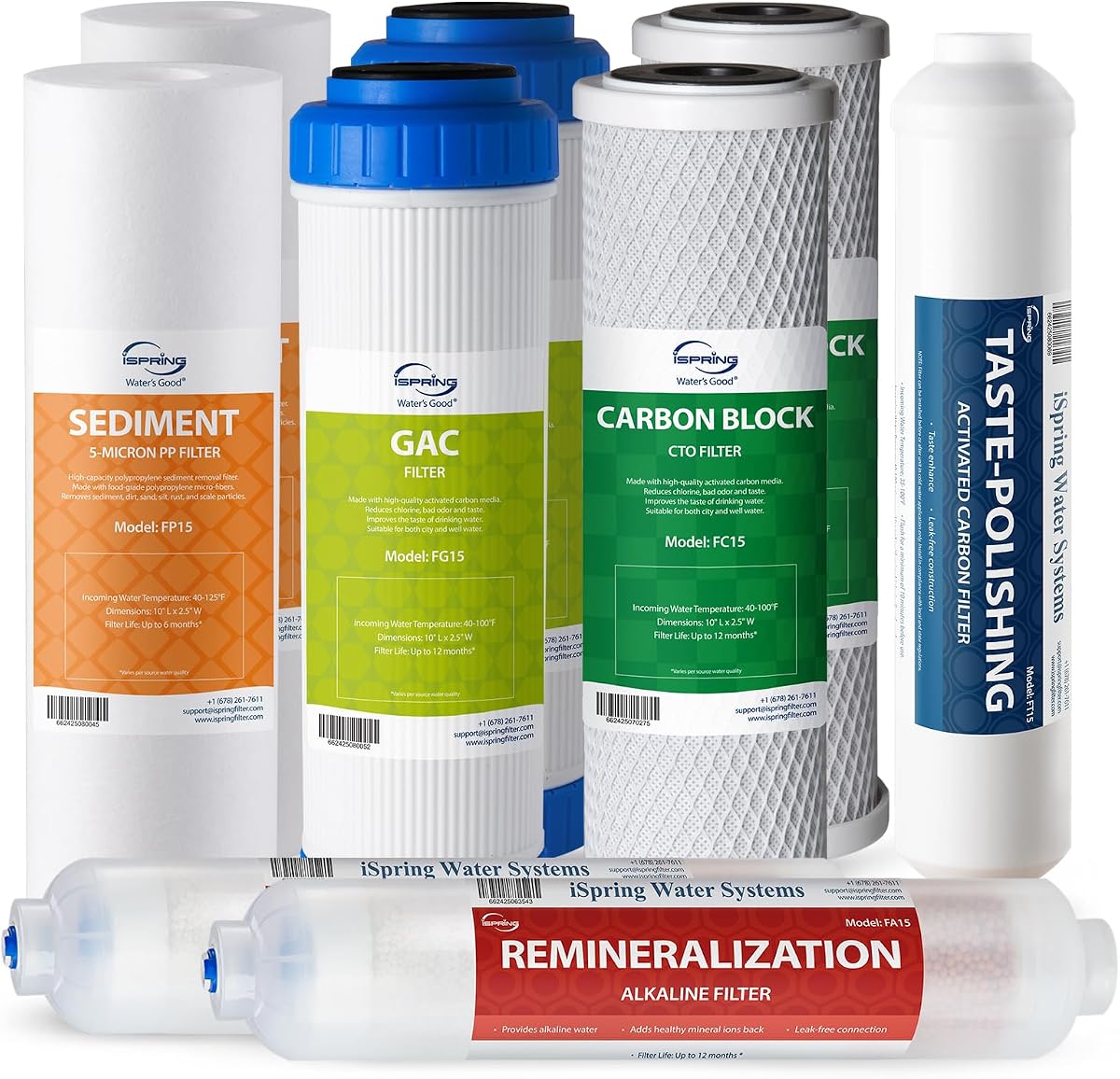
The iSpring F9K is a nine-cartridge replacement pack designed for 6-stage reverse osmosis systems, and it carries a 4.7 rating. Rather than supplying a single mineral cartridge, it includes two sediment filters, two granular activated carbon filters, two carbon block filters, one post-carbon filter, and two alkaline mineral filters, providing a full year of filtration according to the product information.
We may earn a commission when you buy through this link, at no additional cost to you.
Its most compelling feature is the breadth of the set. Owners who want to maintain several stages of a standard 6-stage RO system can replace sediment and carbon elements along with the alkaline filters in one coordinated package. The mineral cartridges are intended to return calcium, magnesium, and potassium ions and help balance the taste and pH character of RO water.
Fit is the central trade-off. The cartridges measure 10 inches long with an outer diameter of 2.5 inches and are intended for standard housings of that size. The pack does not include an RO membrane, so a membrane replacement remains a separate task. Updated FA15 alkaline and FT15 post-carbon cartridges use secure push-fit connections to simplify replacement, but the complete installation still depends on the user's housing configuration.
This is the most complete choice for someone maintaining a compatible 6-stage system and wanting an alkaline remineralization stage as part of a broader filter change. It is not the right purchase for someone seeking only one inline filter, and it may be unnecessary for owners whose other stages remain in good condition. For the right system, though, it simplifies annual maintenance and includes multiple replenishment points.
The pack covers multiple points in a standard 6-stage RO filtration train, reducing the need to source different filter types separately. It is especially convenient for owners who follow a structured annual replacement schedule.
The included alkaline cartridges use mineral media to add calcium, magnesium, and potassium ions to purified water. Their standard dimensions make them useful in compatible 10-inch by 2.5-inch housings, but buyers should verify the housing markings before ordering.
We may earn a commission when you buy through this link, at no additional cost to you.
The GE FQ18RT is a purpose-designed remineralization and replacement filter for GE GXRV40TBN, GXRQ18NBN, and GNRQ18NBN under-sink filtration systems. It has a 4.7 rating and distinguishes itself through a clearly defined compatibility list rather than a universal fit. The single pack includes one cartridge formulated to restore calcium to the system's filtered water.
We may earn a commission when you buy through this link, at no additional cost to you.
For owners of one of the listed GE systems, this focused approach reduces guesswork. There is no need to determine whether a generic inline housing will fit, compare proprietary quick-connect dimensions, or adapt tubing. The listing also states that no prior plumbing experience is required for the filter change, making routine maintenance approachable for users who do not routinely service their RO equipment.
The cartridge is intended to be replaced every 12 months, which gives users a simple maintenance target. That schedule is a manufacturer guideline, and actual performance can vary according to water use, source-water conditions, and how the system is operated. The limitation is equally important: compatibility is restricted to the three named GE filtration systems, making this a poor choice for a different brand or an unidentified model.
This filter is best for a GE owner who wants a straightforward, model-specific calcium remineralization cartridge and recognizes the benefit of maintaining the original system design. It is not a universal upgrade and does not include the other stages of an RO system. For the systems it expressly supports, however, it offers a low-friction replacement option with clear annual guidance.
A dedicated cartridge can be the cleanest solution when the manufacturer identifies the systems it supports. Check the label or system manual before ordering, because a visually similar housing may not have identical fittings or internal geometry.
The product is intended to restore calcium and is replaced annually. This makes it easy to integrate into an existing maintenance routine, although it should not be treated as a substitute for regularly changing sediment and carbon stages.
We may earn a commission when you buy through this link, at no additional cost to you.
The Upgrade RO Reverse Osmosis with 58 minerals inline filter is an inline remineralization product built around Maifan Stone media. It has a 4.2 rating and its listing describes a broad mineral package: although the title refers to 58 minerals, the supplied feature list states that the contents include 57 mineral elements. That distinction makes careful reading of the product description important.
We may earn a commission when you buy through this link, at no additional cost to you.
The product is presented as offering two-way regulation of trace elements and as improving the biological activity of water through dissolved oxygen concentration. It also claims that the Maifan Stone media can adsorb heavy-metal ions and toxins. These are manufacturer statements, and independent laboratory results were not provided in the supplied information, so they should not be treated as independently verified performance claims.
One of the most useful details is also a limitation: the filter does not change water pH. That makes it suitable for buyers specifically seeking added mineral content without materially raising the water's pH, but less appropriate for someone whose main goal is to neutralize acidity or create a more alkaline drinking experience. The supplied data also does not state a replacement interval, flow rate, connection size, or certification status.
The filter may appeal to an RO owner who wants an inline stage with a broad mineral media profile and does not expect pH adjustment. It is less attractive for buyers who need precise installation information or replacement guidance, because those essentials are not included in the available listing details. Confirm all dimensions, fittings, and usage instructions before committing to this model.
This filter differentiates itself by focusing on mineral content while explicitly leaving pH unchanged. That makes it useful for users who do not want an alkaline cartridge, but it cannot satisfy a shopping priority built around acidity neutralization.
The listing uses specialized terms and makes broad statements about biological activity, toxins, and heavy metals. Prospective buyers should look for clear certification and test documentation when making health-adjacent claims important to their decision.
We may earn a commission when you buy through this link, at no additional cost to you.
The available data for ASIN B005LJ8EXU consists only of an Amazon product link, with no product title, description, rating, image, or technical specifications. That makes it impossible to establish whether the listing is a cartridge, an inline housing, a multi-pack, or a universal RO accessory. It is included in the roundup to represent all ten supplied products, but the missing information prevents a meaningful technical evaluation.
We may earn a commission when you buy through this link, at no additional cost to you.
Compatibility is especially important because RO filters are not interchangeable by appearance alone. Housings differ in length, diameter, thread style, quick-connect design, and flow orientation. Inline filters also need compatible tubing sizes and enough installation space, while cartridge filters must fit a specific housing and leave adequate headspace for proper sealing and flow.
No replacement interval, mineral medium, pH function, certification, or installation method can be verified from the supplied listing data. Even the product's intended role is uncertain, so treating it as a remineralization filter would be an assumption rather than a supported conclusion. A shopper should open the current listing and look for a manufacturer model number, dimensions, media description, and compatibility statement.
This listing is not recommended based on the available information. It could become a viable choice only if the full product page confirms that it is a true remineralization filter, matches the user's RO system, and provides credible installation and replacement guidance. Until those details are available, choosing it would involve too much uncertainty.
Before considering any RO filter, compare its model number and connection dimensions with the system. A product can be a poor fit even if it appears to perform a similar function to a more clearly documented model.
A useful buying decision depends on more than a search result's position. Without media, dimensions, and installation details, there is no reliable basis for judging convenience, longevity, or system fit.
We may earn a commission when you buy through this link, at no additional cost to you.
ASIN B09QTRLPGP is another listing for which the supplied information contains no title, description, rating, or image. The product therefore cannot be evaluated by its media, physical configuration, pH function, or intended use. It may ultimately prove to be relevant, but there is not enough factual information in the source data to recommend it as a remineralization filter.
We may earn a commission when you buy through this link, at no additional cost to you.
RO systems use several different service components, including sediment pre-filters, carbon stages, membrane housings, post-carbon filters, alkaline cartridges, and inline remineralizers. Without knowing which category this listing represents, a shopper risks purchasing a cartridge that cannot fit, an inline filter with incompatible connectors, or a multipack that does not address the actual objective.
The lack of a stated service interval is another material gap. Remineralization media loses capacity as water passes through it, and a maintenance plan needs a reasonable replacement trigger. Users should also verify whether the unit restores minerals, raises pH, or simply provides another polishing stage, because these functions are not interchangeable.
Based on the available data, this is not a defensible selection. Check the live listing for a full title, manufacturer, model number, dimensions, fitting type, and replacement guidance. It should be considered only if the current page confirms that it meets the user's specific RO configuration and mineral-restoration needs.
Search results can mix cartridges, inline filters, and complete replacement kits. Confirm whether the product is intended to add minerals, remove contaminants, or perform both functions before ordering.
A replacement schedule should be based on the manufacturer's guidance and actual water use. Once the proper model is identified, add filter changes to the same maintenance schedule used for the rest of the RO system.
We may earn a commission when you buy through this link, at no additional cost to you.
The IPW Omnipure K2548-KK is an inline calcite filter intended to add calcium, neutralize acidic RO water, and improve the taste of purified drinking water. Its 3.8 rating is the lowest among the products with supplied ratings, but the product's core design is clear: it uses calcite in a leak-resistant inline housing with 3/8-inch outer-diameter fittings.
We may earn a commission when you buy through this link, at no additional cost to you.
Calcite dissolves gradually into low-pH water, which is the mechanism by which the filter raises mineral content and reduces acidity. The listing also mentions magnesium among the minerals associated with improved hydration and taste, though the most clearly defined media component is calcite. For an RO user dealing with acidic water, corrosion concerns, or a flat taste, that function may be more relevant than a broad multi-mineral blend.
Installation is described as straightforward, and the product is presented as compatible with reverse osmosis systems, other filtration systems, and other Omnipure models. The suggested replacement interval is six to twelve months. The range reflects that actual consumption and performance depend on use, and users should not wait for taste changes if the manufacturer specifies a service limit for their particular conditions.
This filter is most appropriate for a homeowner who wants a compact inline calcite stage and can accommodate the stated 3/8-inch fitting arrangement. It is less appealing for a buyer seeking extensive certification information or a wide blend of added minerals. Compared with generic inline filters, its model identity and media purpose are clearer, but the lower supplied rating and limited performance information deserve attention.
Calcite slowly dissolves into acidic water, adding calcium while helping neutralize acidity. This can be particularly relevant after RO membrane treatment, which often produces water with a low mineral content and an acidic character.
The inline format allows the filter to be installed near the RO system's storage tank or at a suitable point in the purified-water line. Adequate space and the correct fitting size are essential before purchase.
We may earn a commission when you buy through this link, at no additional cost to you.
The supplied entry for ASIN B08CJFVSW8 provides an Amazon link but no title, product description, rating, image, or specifications. It is consequently impossible to determine whether this is a dedicated mineral cartridge, a generic inline shell, a multi-filter package, or a product intended for a different part of an RO system.
We may earn a commission when you buy through this link, at no additional cost to you.
The key buying issue is fit. A cartridge-style remineralizer must match housing dimensions, while an inline model must match tubing diameter, connector type, and available clearance. Even a filter with the correct nominal length can perform poorly if the housing is designed for a different cartridge shape or flow configuration, so visual similarity is not enough.
There is also no basis for comparing pH effect, mineral content, service life, or certification. A filter that raises pH is not automatically interchangeable with one that simply adds calcium, and a multi-pack can add maintenance complexity a single inline stage does not. These functional differences influence both installation and long-term convenience.
This listing cannot be recommended without additional information. A prospective buyer should open the current product page and verify manufacturer, model, filter type, dimensions, fittings, media, replacement guidance, and system compatibility. If those details are not clearly provided, choosing a more thoroughly documented filter will reduce installation risk and make ongoing maintenance easier.
A product appearing in a relevant search does not guarantee that it performs the required function. Confirm that the listing specifically identifies itself as a remineralization filter rather than a general replacement component.
Record your housing size, tube diameter, connector style, and available installation space before ordering. Those four checks eliminate many mismatches that are not obvious from product photographs.
We may earn a commission when you buy through this link, at no additional cost to you.
The PureT Alkaline Remineralization RO Filter is a 4.9-rated inline cartridge measuring 2 by 10 inches with 1/4-inch EZ Connect fittings. Its three-layer media design is the defining feature: Cororsex magnesium oxide neutralizes free carbon dioxide in corrosive red water, calcite dissolves into low-pH water to add calcium, and mineral ceramic balls supplement minerals while helping address unusual odors.
We may earn a commission when you buy through this link, at no additional cost to you.
The filter is designed to raise pH and add calcium, magnesium, potassium, and other minerals to drinking water. It also removes dirt, debris, and scale according to the product information, making it more of a combined polishing and remineralization stage than a simple single-mineral cartridge. The listing states that the filters are NSF certified and explains that NSF evaluates structural and safety requirements as well as contaminant-reduction claims.
Installation uses a hand-operated quick connection that replaces threaded or flanged connections and requires no additional tools. The stated filter life is 1,500 gallons or six months, whichever the manufacturer indicates comes first. That is a more defined service target than several competing listings provide, although high household water consumption could make the gallon limit arrive before the time estimate.
Among products with available ratings, the PureT filter has the highest score and one of the clearest explanations of how its media works. It is best for an owner with a compatible 1/4-inch line who wants a layered approach to mineral addition, acidity correction, taste improvement, and scale-related polishing. Buyers who do not want higher-pH water or expect to exceed 1,500 gallons quickly should consider a longer-life alternative.
Magnesium oxide, calcite, and ceramic mineral media each address a different aspect of treated water. The combination gives the filter broader scope than a basic calcium-only inline unit while keeping installation in a familiar cartridge format.
The EZ Connect design is intended to make setup and replacement faster than conventional threaded or flanged connections. Confirm that the existing line uses the specified quarter-inch connection and that shutoff and leak checks are possible after installation.
We may earn a commission when you buy through this link, at no additional cost to you.
The APEC Water FI-PHPLUS-QC is a 10-inch inline filter made with high-purity calcium carbonate. Its 4.1 rating reflects a product that delivers a focused function: adding calcium carbonate mineral back into RO water to increase pH and neutralize acidity. It is designed as an add-on to new or existing reverse osmosis drinking water systems.
We may earn a commission when you buy through this link, at no additional cost to you.
The filter's housing uses friction-welded construction without glues or binders. According to the listing, this creates a reliable, no-leak seal and reduces the number of assembly materials. Quarter-inch quick connections support straightforward installation, and the stated construction focuses on durability rather than complicated fittings or tools.
Because the media is calcium carbonate, this is a more specialized choice than products combining several mineral types or multiple treatment layers. It may be well suited to a buyer whose priority is raising pH and reducing the acidic character of RO water. It does not offer the broader media profile of the PureT cartridge, nor does the supplied information identify a specific replacement interval or flow rate.
The APEC filter is a sensible option for compatible RO systems seeking a straightforward pH-plus calcium stage with a welded housing. Confirm the line size, available vertical clearance, and cartridge orientation before purchase. It is not our highest-rated selection, but its straightforward mineral mechanism and leak-conscious construction make it a practical choice for the right setup.
Calcium carbonate provides a direct way to add calcium while neutralizing acidic water. This focused approach can be preferable for owners who want one clear function rather than a complex blend of mineral media.
Friction-welded construction avoids glues and binders, which the manufacturer presents as a dependable seal. Installation should still be checked carefully because tubing seating and connector integrity determine whether an inline housing remains leak-free.
We may earn a commission when you buy through this link, at no additional cost to you.
Choosing a remineralization filter requires balancing system compatibility, mineral function, connection style, cartridge format, and maintenance needs. The most useful purchase is not necessarily the one with the most minerals; it is the one that fits the RO setup, performs the desired function, and can be maintained correctly.
Start with the exact model number of your reverse osmosis system, not just the number of stages. Some filters are designed for named systems, as seen with the GE FQ18RT, while others are generic inline units that depend on tubing size and physical clearance. Check the filter's model, dimensions, housing requirements, and connector type against the system manual or the markings on existing housings. A cartridge that looks similar to an existing filter can still differ in diameter, length, thread configuration, or flow direction. Generic inline filters add another layer of verification because they must connect to the purified-water line without introducing restrictions or awkward bends.
Remineralization filters do not all perform the same task. A calcium carbonate cartridge focuses on adding calcium and neutralizing acidity, while a broader alkaline product may add several minerals and address taste, odor, or scale. The 58-Mineral filter explicitly says it does not change pH, making it unsuitable for a buyer whose main objective is pH correction. The PureT combines magnesium oxide, calcite, and ceramic minerals for a broader function. Decide whether your priority is raising pH, adding calcium, correcting an acidic taste, or creating a multi-mineral profile, and then choose media designed for that outcome rather than assuming every cartridge behaves the same way.
Inline filters sit directly in a water tube and usually need quick-connect fittings on both sides. Cartridge filters install inside a housing, which must have the correct dimensions and internal clearance. Inline models can be convenient when there is no spare housing, while cartridges may integrate more neatly with an existing multi-stage layout. The iSpring F9K is built around standard 10-inch by 2.5-inch housings, whereas the Waterdrop, APEC, PureT, and IPW offerings are described as inline formats. Consider whether you want a dedicated new stage, a replacement in an existing stage, or a complete maintenance set before deciding which physical format fits your plumbing.
Connection compatibility is a frequent source of installation friction. The supplied products mention 1/4-inch and 3/8-inch quick-connect tubing, 3/8-inch outer-diameter fittings, and standard quarter-inch EZ connections. These dimensions are not necessarily interchangeable, and a nominal tube size does not describe every connector feature. Look for the same connection style already used by your RO system, then measure the tubing outside diameter. Also consider whether the filter can be removed without draining a large portion of the tank and whether the added housing can be supported securely. Never force a connector that does not fit.
Replacement guidance gives a useful starting point for budgeting maintenance. The Waterdrop is described as lasting nine to twelve months or 1,100 gallons, the PureT as 1,500 gallons or six months, and the GE cartridge as a twelve-month replacement. The IPW listing gives a six-to-twelve-month range, while some products do not state an interval. A household that drinks or uses purified water heavily may reach a gallon limit before the elapsed time. Conversely, a lightly used system may produce water that passes through the filter infrequently. Follow the chosen manufacturer's instructions, track filter age, and replace based on the relevant limit rather than waiting for a noticeable taste change.
Certification and manufacturer claims provide context for a filter's intended use. The iSpring listing includes an NSF certification statement, and the PureT description also says its filters are NSF certified, including references to structural and safety requirements and contaminant-reduction claims. Other listings emphasize mineral restoration, adsorption, or biological effects without supplying comparable certification details in the provided data. Look for claims tied to a named certification and a relevant standard, and distinguish verified contaminant-reduction performance from general statements about taste, hydration, or health. Broad wellness language should not replace clear fit, media, and maintenance information.
Inline filters require enough room for the housing, connections, and service access. Under-sink cabinets often contain multiple tubes, a storage tank, valves, and dispensing hardware, so adding even a small filter can create crowding. Vertical inline cartridges need sufficient clearance above and below, while horizontal installation may require a support bracket. The filter should remain accessible for replacement without moving unrelated components. A filter that can be reached easily is more likely to be changed on schedule, and a cleanly supported installation reduces strain on tubing and connections.
A remineralization filter is only one part of a properly maintained RO system. Sediment filters protect downstream components, carbon stages address chlorine and organic material, and the membrane performs the main reverse osmosis separation. The iSpring F9K includes several of these stages in one nine-cartridge pack, which is convenient for a broad annual change. If you buy a standalone mineral filter, make sure the other stages are also current. Follow the system's specified sequence so that new filter media does not receive immediately degraded feed water. A consistent calendar, combined with gallon tracking where relevant, is more effective than replacing components only after taste or flow changes.
Begin by shutting off the water supply and relieving pressure in the RO system. Identify the correct post-membrane or post-treatment point according to the filter instructions and your system layout. For an inline model, use compatible tubing and connectors; for a cartridge model, confirm the housing dimensions and orientation. Flush or prepare the new filter as directed by its manufacturer before returning the system to service, because installation alone does not establish that every line is clean and free of installation debris.
After connecting the filter, open the water supply slowly and check each fitting for movement, seepage, or dripping. Run water through the system as instructed and observe the taste and general operating behavior. If the product is designed to raise pH, compare the purified water's taste over time while following the stated replacement limit. Do not judge performance from a single uncalibrated reading, and do not use the filter on a hot-water line unless the manufacturer expressly permits it.
For ongoing care, mark the installation date and record the cartridge model. Replace the unit at the earlier of the stated time or gallon threshold, and clean the housing or inline area without using chemicals that could damage media or components. Review the entire RO system at the same time, including sediment pre-filters, carbon stages, and the membrane. If pressure falls, flow slows, leaks appear, or taste changes sharply, address those signs promptly rather than assuming they are normal effects of remineralization.
A remineralization filter adds selected mineral ions to purified RO water, often improving taste and making the water less acidic. Some products also neutralize acidity, reduce corrosion concerns, address odor, or polish scale-related deposits. The exact function depends on the media, so buyers should distinguish a calcium carbonate filter from a broader alkaline or multi-mineral cartridge.
No. The 58-Mineral inline filter explicitly states that it does not change water pH, while the APEC, PureT, iSpring, GE, and IPW products are described as adding minerals or neutralizing acidity to varying degrees. Choose the media based on whether pH correction is important, and follow the manufacturer's installation and flushing instructions.
Check the system model number and measure the existing filter housing or tubing. Cartridge filters must match length, diameter, and connection style, while inline filters need compatible tube dimensions and fittings. Some products, such as the GE FQ18RT, are made for named GE systems, whereas universal inline models require more careful comparison of the physical installation.
Most inline remineralizers are intended for the treated-water side of the system, but the correct position should come from the filter and RO instructions. Installing too far upstream may reduce the water's final mineral balance or expose the media to sediment. Follow the specified sequence and leave the filter accessible for replacement.
The stated guidance varies by product. Examples include nine to twelve months or 1,100 gallons for the Waterdrop, six months or 1,500 gallons for the PureT, and 12 months for the GE cartridge. Use the limit that occurs first, and track both elapsed time and household usage rather than waiting for a visible change in taste.
No. A rating can help summarize customer experience, but compatibility and media function are more important for a successful installation. Confirm the model, dimensions, connector type, replacement interval, and certification before deciding. A highly rated filter that does not fit the RO plumbing is less useful than a well-documented model designed for the system.
Not automatically. The membrane has its own service guidance and should be replaced according to its condition, water use, and the manufacturer's recommendations. The iSpring F9K is useful for owners who want a broad multi-stage replacement set, but a standalone mineral filter does not replace sediment, carbon, or membrane maintenance.
Several products are designed for hand-operated quick connections that allow tool-free installation and removal. The Waterdrop, PureT, and APEC listings specifically describe quick or EZ connections. Even with tool-free fittings, users should shut off the water, relieve pressure, check dimensions, and inspect every joint for leaks after opening the supply.
The Waterdrop MNR35 is the most flexible budget-minded inline option, with two common quick-connect tube sizes and a nine-to-twelve-month replacement target. The iSpring F9K is the best complete maintenance choice for a compatible 6-stage system because it combines two alkaline mineral cartridges with sediment and carbon replacements. The GE FQ18RT stands out as the cleanest system-specific purchase for owners of the named GE filtration models.
Outside the top three, the PureT offers the highest supplied rating and a detailed three-media approach, while the APEC FI-PHPLUS-QC focuses on calcium carbonate, acidity neutralization, and a welded housing. The IPW Omnipure K2548-KK provides a compact inline calcite format, and the 58-Mineral filter appeals to users who want varied minerals without a pH change. In every case, prioritize the required connection, physical fit, desired pH effect, and maintenance schedule before considering broader claims.
Product ratings, availability, and deal terms can change, so check the current listing before ordering. Also verify the manufacturer instructions, replacement interval, and compatibility with your exact RO system. A carefully matched filter can improve the drinking experience of purified water while fitting cleanly into a maintenance routine that keeps the entire RO system performing as intended.