Rubber Glue 100g, Clear Super Glue for Rubber, RC Tires, Seals, Gaskets
4.4Editor score
Rubber-specific flexible bonding
Waterproof high-strength formula
Six precision applicator tips
Compare the best super glue for rubber options for tires, seals, gaskets, shoes, crafts, and household repairs, with clear application and curing advice.
Super glue for rubber is deceptively specialized: ordinary cyanoacrylate can bond several materials, yet rubber demands flexibility, toughness, and controlled application. The right adhesive should resist cracking, peeling, moisture, vibration, and thermal movement while remaining easy to apply to seams, edges, and oddly shaped components.
This guide compares ten rubber-compatible glues based on their stated bonding materials, cure times, applicator designs, flexibility claims, resistance characteristics, and suitability for tires, seals, gaskets, footwear, crafts, and general household repairs. It also distinguishes conventional instant adhesives from gel, putty, and brush-applied formulas.
Each pick highlights a different practical advantage, from controlled no-drip application to rubber-specific elasticity and precision tips. Ratings and specifications reflect the supplied product information, while product availability, formulations, and current prices can change, so readers should verify the latest listing before purchasing.
4.4Editor score

4.6Editor score

4.3Editor score
The comparison below evaluates all ten options by rubber compatibility, application control, cure speed, finished flexibility, material versatility, and intended repair tasks. It includes conventional super glues, rubber-specific formulas, and one moldable silicone putty so readers can choose the right adhesive type for the job.


Gorilla Super Glue Gel XL combines a recognizable all-purpose adhesive with the controlled application that rubber repairs often need. It carries a 4.6 rating and distinguishes itself through a thick, no-run gel formula that stays where it is placed. That makes it particularly useful on vertical rubber components, narrow seams, and curved surfaces where ordinary liquid super glue could migrate.
We may earn a commission when you buy through this link, at no additional cost to you.
The formula is reinforced with Impact Tough technology and sets in approximately 10 to 45 seconds without clamping, while reaching a full cure in 24 hours. Its stated compatibility includes rubber, plastic, wood, metal, ceramic, glass, leather, and paper. That broad material range is useful when a rubber piece must be joined to a hard support rather than another rubber surface.
The gel consistency is the main tradeoff. It is not marketed as a specialized elastic rubber adhesive, so its flexibility may not be as specifically engineered as products devoted to tire, hose, or gasket repair. It also reaches full strength only after curing, meaning the quick initial set should not be confused with immediate structural readiness. The metal-pin anti-clog cap and clear finish improve repeat use and appearance.
This is the strongest all-around recommendation because it balances fast curing, controlled dispensing, toughness, and material flexibility without being limited to one repair category. It suits a homeowner addressing a rubber seal, a hobbyist repairing a mixed-material assembly, or a crafter who values neat application. For continuous tire use or demanding vibration, a rubber-specific flexible adhesive may offer a more targeted formula.
The no-run gel is particularly valuable when a repair is mounted vertically or when the joint has a narrow bonding line. Applying a small, stationary bead is easier than controlling a fast-flowing liquid, which reduces the chance of gluing the wrong surface or covering an unfinished edge.
Because the adhesive bonds rubber to plastic, metal, wood, and other common workshop materials, it can serve as one general-purpose product for mixed assemblies. Impact Tough technology adds strength where a repaired object may receive knocks or handling stress.
We may earn a commission when you buy through this link, at no additional cost to you.
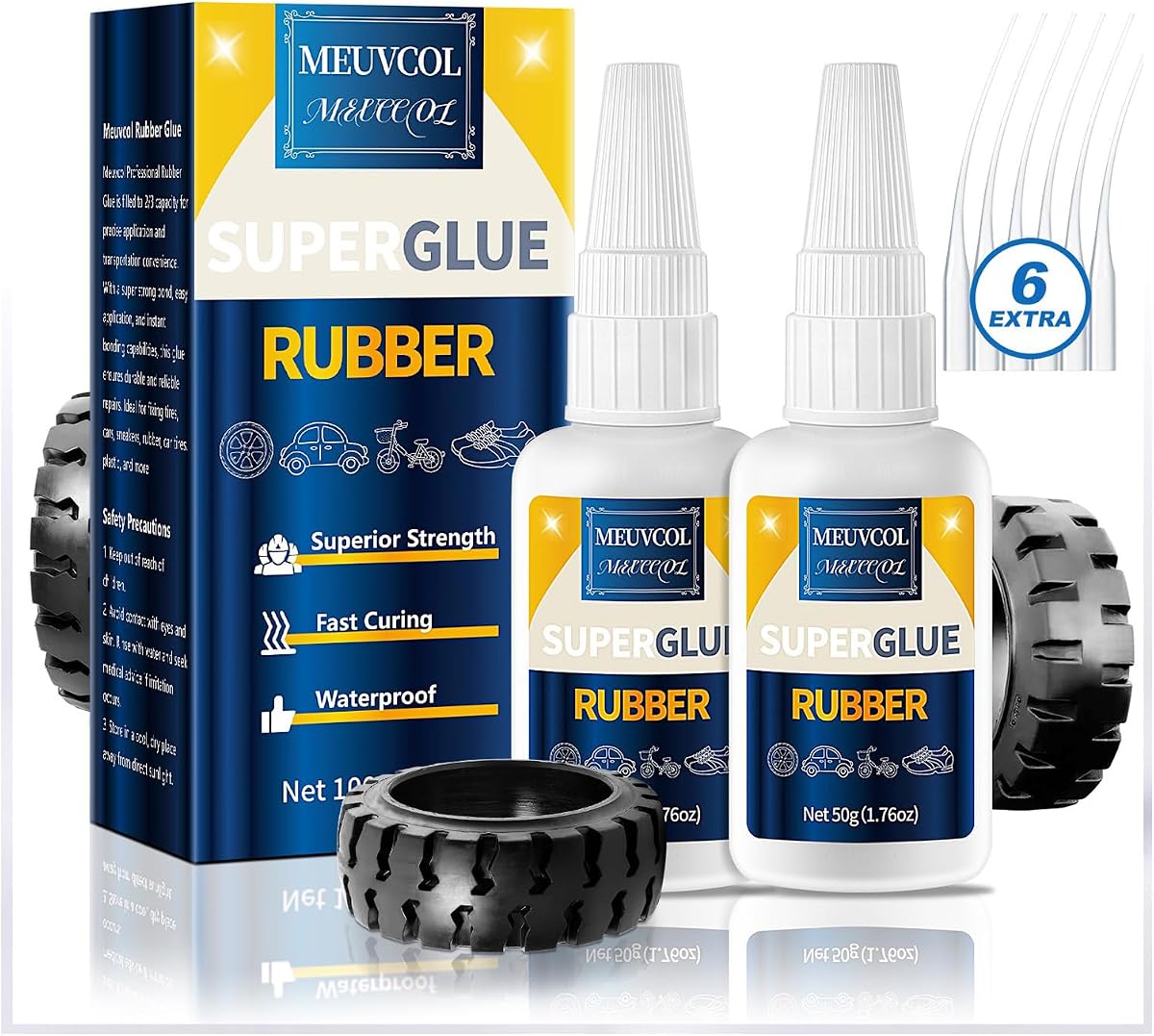
The Meuvcol Rubber Glue Kit is one of the most purpose-built selections in the guide. Its 4.4 rating reflects a formula developed specifically for rubber-to-rubber, rubber-to-plastic, rubber-to-metal, and rubber-to-wood repairs. The target applications include RC tires, refrigerator gaskets, seals, shoe soles, automotive parts, and motorcycle handlebar grips.
We may earn a commission when you buy through this link, at no additional cost to you.
Flexibility is its defining claim. The product is described as able to accommodate bending, torsion, slight movement, and vibration without cracking, while its waterproof, professional-grade bond is intended to withstand harsh environments. It sets in approximately three to five minutes and fully cures within 24 hours, offering a controlled working interval for careful alignment.
Its main limitation is that it is not the fastest product in the roundup. Users accustomed to a ten-second grab may find the initial wait inconvenient, and the instruction to use an aerosol adhesive accelerator highlights how strongly the result depends on good positioning during that early set. A larger 100g bottle may also be more than a casual user needs.
For someone repeatedly repairing rubber, particularly RC tires, hoses, seals, gaskets, or flexible automotive components, this focused formula makes more sense than a general-purpose super glue. The six applicator tips support controlled work in seams and confined spaces, while the flexible waterproof bond targets the movement that causes many ordinary rubber repairs to fail.
A repair adhesive must do more than create a hard bridge between two pieces. This formula is specifically positioned to remain flexible after drying, helping it tolerate bending, torsion, vibration, and minor dimensional changes better than a rigid bond.
Six included tips make it easier to vary bead size and reach narrow seams, tire edges, and gasket channels. The controlled delivery also helps limit waste when a repair needs only a few precise drops.
We may earn a commission when you buy through this link, at no additional cost to you.
LOOCTOT Black Rubber Glue is built for quick repairs to tires, tubes, and rubber edges. Its 4.5 rating is among the strongest in the roundup, and the ten-to-30-second adhesion window makes it attractive when the objective is to hold two pieces together almost immediately. The anti-clogging cap is a practical addition for a frequently used bench bottle.
We may earn a commission when you buy through this link, at no additional cost to you.
The black-exclusive rubber composition is designed to increase elasticity, differentiating it from a general super glue that would leave a conspicuous clear line. It is also described as delivering a 30% strength increase compared with super glue and becoming waterproof after 24 hours of complete adhesion. Tire, tube, and edge applications make the intended rubber focus immediately apparent.
The manufacturer strongly recommends wearing gloves, and the product bonds skin and eyes rapidly like conventional cyanoacrylate. That makes safe handling essential rather than optional. The black color is another practical constraint: it blends naturally with dark rubber but may be undesirable where a transparent repair is needed.
This is a compelling pick for dark tire, tube, and rubber-edge repairs where fast handling and a visually inconspicuous result matter. It is less suitable for pale rubber or projects that require an invisible bond. For those applications, a clear rubber-specific glue with precision tips would be a better fit.
The short 10-to-30-second set window reduces the amount of clamping and careful positioning required. That speed is useful for emergency fixes involving a split tube, raised rubber edge, or another component that needs to be put back into service quickly.
The black composition is intended to increase elasticity while hiding the repaired area against dark material. It is especially relevant to tire and tube repairs where a clear glue line may be conspicuous.
We may earn a commission when you buy through this link, at no additional cost to you.
This 2-in-1 super glue gel stands apart through its dual applicator system. One side offers fine bristles for controlled work on small or delicate parts, while the other provides an anti-clog nozzle for larger surfaces. That flexibility is particularly valuable for rubber repairs because seals, toys, trim pieces, and household components may demand very different application volumes.
We may earn a commission when you buy through this link, at no additional cost to you.
The adhesive lists a 15-to-45-second grip time and a 24-hour full cure. It is described as bonding pottery, ceramics, toys, jewelry, glass, metal, plastic, wood, rubber, and leather, so it can handle a rubber-to-hard-material joint as readily as two rubber pieces. Its clear permanent bond is also said to resist moisture, heat, and wear after curing.
The primary caution is its rapid skin bonding, which the product description explicitly acknowledges. A protected work surface, gloves, and careful handling are important. As a general-purpose adhesive, it may not provide the same rubber-specific elasticity emphasized by dedicated tire and gasket formulas. The included brush is useful, but it must be kept from hardening to maintain consistent flow.
This pick is ideal for users who want more control than a standard narrow bottle offers. Choose the brush for a seam or tiny model component and switch to the nozzle when the rubber edge is broader or needs more adhesive. It is a versatile workshop option, though repeated tire work may favor a formula explicitly formulated to remain flexible under strain.
The brush provides steady coverage on small parts and delicate edges, while the nozzle gives more flow for broader joints. This lets the user match application style to the repair without handling a separate bottle for each technique.
Rubber frequently appears alongside plastic, metal, wood, and craft materials. Listing all of these as compatible surfaces makes this a practical general-purpose option for mixed assemblies and household repair boxes.
We may earn a commission when you buy through this link, at no additional cost to you.
The 30g Rubber Glue Kit is designed for users who need an adhesive across many rubber categories rather than a single quick craft application. It targets tires, boots, belts, toys, rubber edges, tubes, gaskets, and hoses, and it is described as bonding rubber to rubber, plastic, metal, and wood.
We may earn a commission when you buy through this link, at no additional cost to you.
Its most interesting claim is stability across temperature extremes. The formula is described as waterproof, heat-resistant, and capable of maintaining elasticity in very hot or cold conditions, which is important for outdoor seals, vehicle components, and equipment exposed to changing environments. It also offers good abrasion resistance and a 10-to-45-second initial set.
Application requires clean, dry surfaces, an appropriate amount of glue, and firm pressure for 10 to 45 seconds. Although it includes three droppers for controlled application, the 30g bottle is larger than a precision craft adhesive and should be stored carefully. The product information also warns that it is not for PP or PE plastics, a material limitation worth checking before beginning a mixed-material repair.
This is a good choice for someone building a general repair kit around rubber, especially if tires, seals, hoses, boots, and belts are likely projects. It offers an attractive combination of waterproofing, abrasion resistance, and temperature stability, provided the surfaces are prepared properly and the adhesive is allowed to complete its 24-hour cure.
Rubber parts frequently expand, contract, and flex as temperatures change. The stated hot-and-cold stability makes this adhesive more relevant to outdoor and automotive applications than a formula marketed only for quick household bonding.
The broad repair list allows one dedicated product to cover footwear, belts, tubes, gaskets, toys, and hoses. Three droppers help vary the amount applied across these different joint sizes and shapes.
We may earn a commission when you buy through this link, at no additional cost to you.
INSOIA Super Rubber Glue Clear combines a focused rubber-repair formula with four precision tips, making it a practical budget pick for detailed work. It has a 4.3 rating and targets tire sidewall cracks, RC tubes, shoe soles, belts, gaskets, seals, waders, hoses, and automotive rubber parts. The clear finish keeps the repair visually discreet.
We may earn a commission when you buy through this link, at no additional cost to you.
The adhesive sets in approximately 10 to 45 seconds and fully cures in 12 to 24 hours. Once cured, it is described as waterproof and heat-resistant, with enough elasticity to avoid becoming brittle under normal movement. The thin-layer application instruction is important: a smaller deposit is said to cure faster and create a stronger bond.
Its limitation is that it is not intended for PP or PE plastics, so it should not be selected solely because a repair combines rubber with one of those polymers. It also takes considerably longer to reach full cure than its fast initial set suggests. Users handling a safety-critical assembly should understand the difference between grabbing and fully cured strength.
This is the best budget selection for a homeowner who wants a dedicated rubber adhesive without a large specialty format. The included tips reach tight tire-sidewall cracks, gasket seams, and corners, while the anti-clogging cap helps maintain usability. It is particularly compelling for RC tires, footwear, small hoses, and clear or visually subtle repairs.
Four tips support controlled placement inside narrow seams, sidewall cracks, and recessed gasket channels. This is a meaningful advantage over a standard pointed bottle when overspreading adhesive could interfere with the fit of the repaired component.
The product explicitly recommends a thin application, which can reduce curing time and avoid an unnecessarily thick, rigid glue layer. A controlled bead also helps the rubber seat correctly instead of being pushed out of alignment by excess adhesive.
We may earn a commission when you buy through this link, at no additional cost to you.
INSOIA Super Black Rubber Glue offers the same precision-focused repair concept as the clear version, but with a dark finish for rubber where visibility matters. Its 4.3 rating and stated uses include RC tubes, tire sidewalls, shoe soles, belts, gaskets, seals, waders, hoses, and automotive parts.
We may earn a commission when you buy through this link, at no additional cost to you.
It sets in approximately 10 to 45 seconds and fully cures in 12 to 24 hours. The cured adhesive is described as waterproof and heat-resistant while remaining durable rather than brittle. A thin layer is recommended for the fastest and strongest result, and four applicator tips allow more controlled work in tight corners and along small seams.
As with the clear formula, PP and PE plastics are excluded. The black finish may also be unsuitable for light-colored rubber, visible trim, or projects where a natural-colored joint is required. While the product is described as non-toxic, cyanoacrylate adhesives can still bond skin rapidly and should be handled away from the face and eyes.
This is a strong pick for dark RC tires, inner tubes, footwear, and black automotive seals. It combines a fast grab with the visual discretion of a black adhesive and offers better apparent movement accommodation than a rigid general-purpose glue. Choose the clear version when the repaired rubber is light or the bond should remain unobtrusive.
A black adhesive can make a patched sidewall or seam far less noticeable than a contrasting clear line. This is a meaningful advantage on tires, dark footwear, hoses, and automotive rubber components.
The ten-to-45-second initial set supports quick assembly, while the stated elastic and crack-resistant cured bond is better suited to moving rubber than a purely rigid repair. Full cure still takes up to 24 hours.
We may earn a commission when you buy through this link, at no additional cost to you.
The Gorilla Super Glue Brush & Nozzle 2-Pack provides a familiar general-purpose adhesive with a 4.5 rating. It includes two 12g bottles, each offering both a fine brush and precision tip. This is useful for separating small craft work from larger household repairs without sharing one partially used bottle.
We may earn a commission when you buy through this link, at no additional cost to you.
The clear formula is described as impact resistant and strong, with bonding compatibility for glass, plastic, wood, metal, ceramic, rubber, leather, and paper. It dries in 10 to 45 seconds without clamping, and the special anti-clog cap is designed to preserve usability between applications. Both application options provide a level of control that ordinary liquid glue may lack.
Because this is not formulated exclusively for rubber, its elasticity and performance under sustained flexing are not the central focus. The fast cure also leaves little time for adjustment after contact. Users repairing high-value or safety-sensitive tires, brake components, or load-bearing rubber should investigate the repair instructions for the specific component rather than assuming a general adhesive is appropriate.
The 2-Pack is attractive for a repair kit because it combines strong general bonding with two dispensing methods. It is well suited to rubber trim, household objects, toys, leather, and mixed-material assemblies. Choose a dedicated flexible rubber glue instead when long-term movement, heat, or harsh weather is the central concern.
The fine brush offers even coverage on small or delicate areas, while the precision tip can place adhesive more quickly on larger joints. Having both styles available makes the bottle adaptable without switching tools.
A broad compatible-material list makes this a sensible default for a general household adhesive box. Rubber can be joined with plastic, metal, wood, leather, and other common materials in the same session.
We may earn a commission when you buy through this link, at no additional cost to you.
Sugru is fundamentally different from the liquid and gel cyanoacrylates in this roundup. It is a hand-moldable silicone adhesive putty that cures into flexible silicone rubber. Its 4.4 rating and construction make it especially relevant when a repair needs a shaped fillet, custom gasket, mounting pad, or removable attachment rather than a narrow glue line.
We may earn a commission when you buy through this link, at no additional cost to you.
The putty can be kneaded, applied to a clean surface, and shaped directly around the component. It cures in 12 to 24 hours under ordinary conditions, while thick or load-bearing applications may require up to 48 hours. Once cured, it is waterproof and resistant to sun, rain, heat, and cold, allowing indoor and outdoor use.
Its maximum stated support is 4.4 pounds, which makes it appropriate for many lightweight household and craft projects but unsuitable for heavy structural loads. It also cannot be repositioned after curing, so alignment must be planned beforehand. The removable and surface-friendly claims are useful, but users still need to confirm compatibility with the particular substrate and finish.
Sugru is the most approachable option for family crafts, classroom projects, light household mounting, and shaped rubber repairs. Its skin-safe, non-toxic formula is suitable for children three and older. Anyone needing an immediate structural grip or a heavy-duty tire repair should choose a fast-setting rubber-specific cyanoacrylate instead.
Because the adhesive is moldable, users can form a continuous fillet around a pipe, cover an irregular edge, or create a custom pad around a component. The cured result is flexible silicone rubber rather than a rigid bead.
The product is positioned as removable, surface-friendly, non-toxic, and safe for children three and older. Those characteristics make it useful for classroom and family projects where appearance, handling, and future disassembly are important.
We may earn a commission when you buy through this link, at no additional cost to you.
Loctite 454 Surface Adhesive Gel is a compact, clear gel intended to create strong bonds between surfaces including rubber, leather, plastic, and metal. Its 4.6 rating places it among the most highly rated products in the guide, and the transparent formula is attractive for repairs where a visible glue line would be distracting.
We may earn a commission when you buy through this link, at no additional cost to you.
The tube contains 3g and has a full cure time of 24 hours. That cure period favors careful positioning rather than immediate handling, but it allows the adhesive to mature into what the product describes as a durable, long-lasting bond. The surface-gel format should be easier to store and carry than a full-size bottle, particularly in a small toolbox.
Its compact volume is the clearest drawback, especially for a repair involving a broad tire patch or a large gasket. This is a precision product, not a multipurpose bulk container. It is also not marketed with a specific instant-grab window, so users should plan around the full cure and avoid stressing the joint prematurely.
Loctite 454 is a sensible pick for small rubber components, mixed-material repairs, leather, plastic, and metal where discretion and portability matter. It is less compelling for large-area tire work or projects needing immediate handling, but the clear gel and strong multi-material adhesion make it a dependable compact addition to a repair kit.
The small tube is easy to keep in a drawer, toolkit, travel case, or electronics repair kit. It also reduces the likelihood of carrying a large bottle when only a small amount of adhesive is required.
The clear gel works across rubber, leather, plastic, and metal, covering many common household repair combinations. Its transparent cured appearance helps keep the joint visually understated.
We may earn a commission when you buy through this link, at no additional cost to you.
The right rubber adhesive depends on the material being repaired, the amount of movement it must tolerate, the size and shape of the joint, and how quickly the repair must be handled. These factors are more important than brand name or a headline cure figure, particularly when a failed repair could leave a tire, seal, or safety-related item unusable.
Rubber stretches, compresses, bends, and vibrates in ways that rigid plastics and metals do not. A rubber-specific adhesive is formulated to retain flexibility after curing, reducing the chance that the bond line will crack or peel as the repaired area moves. This is especially important for hoses, gaskets, seals, RC tires, footwear, handlebar grips, and flexible automotive trim. General-purpose super glue may create a strong initial attachment, but it is not always optimized for repeated flexing or changing loads.
Choose a formula explicitly described as flexible, elastic, or designed for rubber. If the repair is constantly exposed to bending or torsion, prioritize the dedicated rubber formula over a general all-purpose glue.
Set time and cure time are different measurements. Set time is the period needed to hold the pieces together, while full cure is when the adhesive has matured to its intended strength. Products in this guide begin setting in roughly 10 to 45 seconds, although the Meuvcol rubber kit lists three to five minutes. Full cure commonly takes 12 to 24 hours, and thicker applications of Sugru may take up to 48 hours.
Read both figures before applying the glue. Use set time to plan alignment and clamping, but do not place a freshly repaired safety-critical item back into service until it has had the stated full cure.
A repair exposed to rain, washing, engine heat, sunlight, or household moisture needs more than a convenient indoor bond. Rubber-specific products commonly advertise waterproofing, heat resistance, and stability across hot and cold conditions. Clear and black INSOIA formulas cure to waterproof, heat-resistant seals, while the Meuvcol kit is described as waterproof and able to withstand harsh environments.
Match the adhesive to the actual environment. For a dry craft, basic water resistance may be enough; for a tire, hose, or external seal, prioritize the strongest stated water, heat, and abrasion protection available.
A standard narrow nozzle works on clean, open seams, but many rubber repairs involve narrow channels, raised edges, sidewall cracks, or irregular gasket profiles. Gel, brush, and multi-tip applicators provide better control over bead size and placement. The Meuvcol kit includes six precision tips, both INSOIA rubber glues include four, and the 30g Rubber Glue Kit includes three droppers. Brush-and-nozzle options add another way to cover broader areas without switching products.
For detailed work, select a formula with tips or a brush. For large, accessible joints, prioritize flow and coverage. Precise dispensing also reduces waste and helps the two surfaces make proper contact.
Color can matter when the repaired area remains visible. Clear glue blends with light rubber, transparent seals, footwear, household trim, and craft components. Black glue is more appropriate for dark tires, tubes, hoses, boots, and automotive pieces because a contrasting clear repair line can be distracting. The LOOCTOT and INSOIA Black Rubber Glue products are specifically intended for this type of discreet dark repair.
Color should be a secondary consideration after compatibility and strength. Choose the finish that suits the material and the appearance you want, but avoid sacrificing bonding performance merely to hide a repair.
Many rubber repairs are actually mixed-material repairs. A shoe sole may need to reattach to fabric or leather, an RC tire may meet a plastic rim, and a rubber seal may be retained in a metal housing. General-purpose products in this roundup list broad compatibility, while dedicated rubber adhesives also frequently support plastic, metal, wood, and leather bonding.
Check both substrates before buying. INSOIA explicitly excludes PP and PE plastics, so a rubber part attached to one of those polymers requires a different adhesive. Also verify whether the listed material is rubber itself, a coating, or a porous surface.
Cyanoacrylate adhesives can harden inside their containers when exposed to air or moisture. Anti-clog caps, sealed dual applicators, and metal pins help preserve the remaining glue. The Gorilla Gel XL uses a metal-pin cap, both INSOIA formulas use anti-clogging caps, and several other products use sealed tips. These features are especially valuable when purchasing a small bottle for occasional repairs.
Always close the container tightly, clean the tip before replacing it, and store the bottle upright in a cool, dry place. If a nozzle has hardened, follow the manufacturer's storage and disposal guidance rather than trying to squeeze residue through it.
A craft glue, a household adhesive, and a tire repair product may share the same basic chemical family but carry different expectations. Sugru provides the most user-friendly, removable, family-oriented approach, while dedicated rubber glues focus on strong, flexible, waterproof repairs. Cyanoacrylates can bond skin rapidly, and several products explicitly recommend gloves or a protected work surface.
Read the limitations and intended uses before applying any product. Follow component-specific repair instructions when available, and use professional inspection or replacement for safety-critical parts rather than assuming an adhesive repair is equivalent to the original component.
Begin by cleaning and drying both surfaces. Remove dirt, oil, loose rubber fragments, and any old adhesive, because cyanoacrylate bonds most reliably when it can contact the material directly. Roughening a smooth rubber edge lightly can improve mechanical grip, but avoid aggressive abrasion on thin or finished surfaces. Position and support the pieces before opening the bottle, since most formulas begin setting quickly.
Use the narrowest applicator suitable for the repair and apply a thin, controlled amount. Excess glue does not reliably improve a rubber bond and can squeeze the parts apart, make the joint rigid, or leave excess residue around the edge. Follow the product instructions for pressure and alignment. Maintain the required contact for the initial set, then leave the repair undisturbed for the listed full cure time.
Store the glue tightly closed with its tip clean, and keep it away from children, pets, eyes, and skin. Work on a protected surface because accidental contact can cause rapid bonding. If a part will face water, heat, abrasion, or significant movement, confirm that the adhesive is rated for those conditions and allow the complete cure before returning the item to service.
A rubber-specific cyanoacrylate adhesive is usually best because it is designed to retain flexibility after curing. A general-purpose super glue can work for small, lightly stressed rubber pieces, but it may become rigid and crack when the repair flexes. For tires, hoses, gaskets, footwear, and seals, prioritize stated rubber compatibility, flexibility, waterproofing, and environmental resistance.
Ordinary super glue may form an immediate bond with some rubber surfaces, especially when they are clean and lightly textured. Its long-term performance depends on flexibility, surface preparation, and stress. If the rubber repeatedly bends or stretches, a dedicated flexible rubber glue is more likely to resist cracking than a hard, general-purpose bond.
Most products listed here grab within approximately 10 to 45 seconds, while the Meuvcol rubber kit lists three to five minutes. A complete cure generally takes 12 to 24 hours, and thick Sugru repairs may require up to 48 hours. Treat the initial set as a handling convenience rather than the point at which the bond has reached full strength.
Rubber-specific tire and tube glues are designed for those repairs, but the safety and warranty instructions for the tire should take priority. A listed glue application does not guarantee that a damaged tire is safe to continue using. If the damage is near the sidewall, the tire is structurally compromised, or the product instructions require professional service, replace or inspect the tire through an authorized service.
Gel is often easier to control because it resists running and can be placed precisely along a seam. A rubber-specific gel may also offer a better balance of speed, toughness, and flexibility. The best choice still depends on the repair: a clear or black rubber-focused gel is useful for visible components, while a brush or multi-tip formula can provide better access to awkward joints.
Many products in this guide are compatible with rubber joined to plastic or metal. However, compatibility is not universal: the INSOIA rubber glues specifically exclude PP and PE plastics. Check the substrate type, confirm the adhesive lists both materials, and test a small area if the plastic is unknown or its surface is heavily coated.
Common causes include oily or dirty surfaces, too much adhesive, incorrect alignment, insufficient full cure time, and using a rigid formula on a repeatedly flexing component. A bond can also fail when the repair exceeds the adhesive's environmental or load limits. Clean the surfaces, use a thin controlled bead, align the parts immediately, and allow the complete cure before stressing the repair.
Super glue is a low-viscosity or gel cyanoacrylate that flows into a joint and cures into a hard or semi-flexible bond. Silicone putty is hand-moldable, fills irregular spaces, and cures into flexible silicone rubber. Use putty for shaped fills, removable mounts, and craft projects; use cyanoacrylate when a fast, narrow, strong joint is needed.
The Gorilla Super Glue Gel XL is the best overall choice because it combines controlled no-drip application, a fast set, toughness, and broad material compatibility. The Meuvcol kit is the most focused option for rubber that flexes, vibrates, or faces harsh conditions, while INSOIA Clear Rubber Glue offers the strongest budget-focused package for precise home repairs.
Before buying, prioritize the repair environment and movement demands over the shortest advertised set time. Rubber-specific flexibility, waterproofing, heat resistance, and proper dispensing are more important for lasting results. Use clear glue for light or visible surfaces, black glue for dark components, and moldable silicone putty when a shaped, removable, or family-friendly repair is needed.
Finally, verify the current listing, compatibility notes, cure instructions, and component-specific repair requirements before purchase. Formulations, ratings, availability, and prices can change, so checking the latest product information helps ensure that the chosen adhesive still matches the exact material and repair you intend to perform.