
SanDisk 32GB Ultra
4.7Editor score
32GB SDHC capacity
100 MB/s advertised speed
Single-card simplicity
Discover the best SD cards for trail cameras, with expert comparisons of capacity, speed, durability, compatibility, and recording performance.
A trail camera is only as dependable as the memory card inside it. The best SD cards for trail cameras combine enough capacity for extended monitoring, consistent write performance, broad device compatibility, and durability in cold, wet, dusty, and remote environments. A card can look suitable on paper yet fail when a camera writes continuous video or operates outdoors for days.
This guide compares ten full-size SD and SDHC options from GIGASTONE, SanDisk, PNY, STEALTH CAM, GardePro, and HME. The evaluation considers stated capacity, speed classes, video ratings, transfer speeds, outdoor protections, low-power characteristics, pack quantity, and compatibility with trail cameras and related devices.
Each pick highlights the most useful reason to consider it, from compact backup cards to high-capacity multi-packs for demanding recording schedules. Ratings and specifications reflect the supplied product information, while current prices can change, so check the latest listing and camera requirements before purchasing.
4.7Editor score

4.7Editor score

The table below compares all ten cards by capacity, stated speed, durability, and practical role, making it easier to match a card to your camera and recording schedule.




The GIGASTONE 32GB 5-Pack earns the Editor's Choice position because it combines a generous number of cards with speed and durability features that make sense for trail-camera use. Its 4.7 rating is among the strongest in this group, while the pack format gives users a practical way to rotate storage across several cameras or keep spares close at hand.
We may earn a commission when you buy through this link, at no additional cost to you.
Each card is a full-size 32GB SDHC card with a UHS-I interface, a Class 10 speed grade, and a U1 rating. The stated transfer speed reaches up to 80 MB/s, while the Class 10 and U1 specifications support Full HD video recording and display. That combination is particularly relevant for cameras that alternate between still photographs and short or continuous HD recordings.
The physical protection claims are also well suited to outdoor monitoring. GIGASTONE describes the cards as waterproof, temperature-proof, x-ray-proof, shock-proof, and magnet-proof. A five-year limited warranty adds another layer of reassurance, although it is important to retain purchase documentation and follow the manufacturer's conditions. The five included mini cases help protect cards during transport, storage, and field changes.
This is the most flexible recommendation for households or wildlife-monitoring setups using multiple trail cameras. It is also a practical choice for users who want to rotate cards and avoid erasing footage in the field. The main limitation is that 32GB may not offer as much uninterrupted recording time as a 64GB card, while the advertised transfer figure is lower than the 100 MB/s read speeds claimed by some alternatives. Even so, its broad feature set, five-card quantity, and strong rating make it the most complete package in the guide.
Five cards make it easier to dedicate a card to each camera, maintain rotation schedules, or keep a spare available without delaying a field visit. The included mini cases also help organize cards in a bag or vehicle.
The Class 10 and U1 ratings provide a clear indication that the cards are intended for Full HD workflows. The stated speed of up to 80 MB/s is also sufficient for practical transfers from a trail camera to a computer.
We may earn a commission when you buy through this link, at no additional cost to you.
The SanDisk 32GB Ultra is the Best Budget choice in this guide for a straightforward reason: it offers a useful amount of storage, a well-known brand, and a stated speed of 100 MB/s without requiring a multi-card purchase. Its 4.7 rating places it among the most favorably reviewed products in the selection, making it a sensible starting point for a single trail camera.
We may earn a commission when you buy through this link, at no additional cost to you.
As a 32GB SDHC card, it should fit naturally into many trail cameras that accept standard full-size SDHC media. The product title advertises a speed of 100 MB/s, which is useful when moving photos and videos to a computer or mobile device. SDHC is the format used by many current trail cameras, although the camera's manual should always be checked for capacity and file-system limits.
The supplied product information for this card is concise, listing the SanDisk brand alongside the 32GB SDHC capacity and 100 MB/s figure. That means buyers should not assume additional video-class, waterproof, or endurance specifications without consulting the detailed listing. Keeping those distinctions in mind is important because a fast read speed alone does not describe every aspect of sustained recording performance.
Choose this card if you operate one trail camera, want an uncomplicated SDHC option, and prefer buying a single card rather than maintaining a rotation set. It is less convenient for multiple-camera installations because only one card is included, and the limited supplied details make it harder to evaluate advanced 4K or heavy-duty claims. Even so, the 32GB capacity, strong rating, and advertised speed make it a practical, economical choice for everyday HD trail-camera use.
A 32GB card offers enough space for a typical mix of photographs and HD clips while remaining easy to manage. It is a practical starting point when your camera's recording interval and motion sensitivity are not yet known.
The advertised 100 MB/s figure helps shorten the time spent moving files to a computer. Confirm the camera's supported capacity and format before use, and format the card in the camera when possible.
We may earn a commission when you buy through this link, at no additional cost to you.
The PNY 32GB Elite U1 V10 3-Pack is designed specifically for trail cameras and outdoor devices, giving it a clear identity beyond being a general-purpose memory card. Its 4.1 rating is lower than the leading products here, but the stated performance, broad durability protection, and inclusion of three cards make it a credible option for regular field rotation.
We may earn a commission when you buy through this link, at no additional cost to you.
The cards provide sequential read speeds of up to 100 MB/s and carry Class 10, U1, and V10 ratings. PNY states that the V10 rating supports uninterrupted Full HD wildlife video at 1920 by 1080 resolution, which is more specific and useful for trail-camera buyers than a basic capacity claim alone. The UHS-I interface also indicates a modern full-size SD card format.
Durability is another major strength. According to the supplied information, the cards are shock-proof, temperature-proof, waterproof, drop-proof, x-ray-proof, wearout-proof, vibration-proof, ESD-proof, and humidity-proof. They are also described as compatible with point-and-shoot cameras, DSLRs, standard and advanced HD video cameras, and other compatible devices, giving them broader utility beyond wildlife monitoring.
This pack is well suited to a three-camera setup or to users who prefer rotating one card at a time. It is also useful for keeping a working card and two backups together. The lower 4.1 rating warrants checking recent customer feedback and verifying camera compatibility before deploying the cards in a remote location. Within the PNY line, however, the combination of three cards, V10 video support, and ruggedness makes this a strong rotation-oriented choice.
Three cards allow users to rotate media without repeatedly reusing the same card. Keeping cards in active use also helps maintain a disciplined file-transfer routine before storage space becomes an issue.
The Class 10, U1, and V10 combination specifically targets Full HD recording. That makes the cards more informative choices than cards marketed only with a maximum transfer speed.
We may earn a commission when you buy through this link, at no additional cost to you.
The STEALTH CAM 16GB SDHC card is a trail-focused option whose most interesting distinction is its stated low power consumption. That feature can matter in remote installations where a camera operates on batteries for long periods and every reduction in card-related energy use helps support unattended operation. The card carries a solid 4.6 rating.
We may earn a commission when you buy through this link, at no additional cost to you.
Its Class 10 rating is designed to support smooth video recording and high-resolution images, and the product information says it is compatible with most digital hunting and trail cameras. The 16GB capacity makes it best for setups with lower recording volume, shorter monitoring windows, or a preference to review and transfer files frequently rather than leave them on the card for extended periods.
The card is also described as broadly compatible with electronic devices that support SDHC standards. That universality can be helpful for moving media between a camera, computer, or other compatible device. High-speed data transfer and low power consumption complement the capacity-focused design, making it relevant to hunters and wildlife observers who want uncomplicated storage for photos and videos.
This card makes the most sense for a single-camera setup that uses moderate recording volumes and prioritizes efficient power use over maximum capacity. The 16GB limit means it may fill more quickly during high-activity, high-resolution recording, and the one-card format is less convenient for rotation. It remains a sensible specialized pick for users searching directly for a trail-camera card and a device that operates efficiently in the field.
Low power consumption is a valuable characteristic for cameras that spend long periods away from mains electricity. Actual battery life still depends on the camera, recording frequency, temperature, and other settings.
The 16GB capacity keeps the card small and simple, but it is best paired with regular transfers. Heavy motion activity and extended video recording can fill the available space more quickly.
We may earn a commission when you buy through this link, at no additional cost to you.
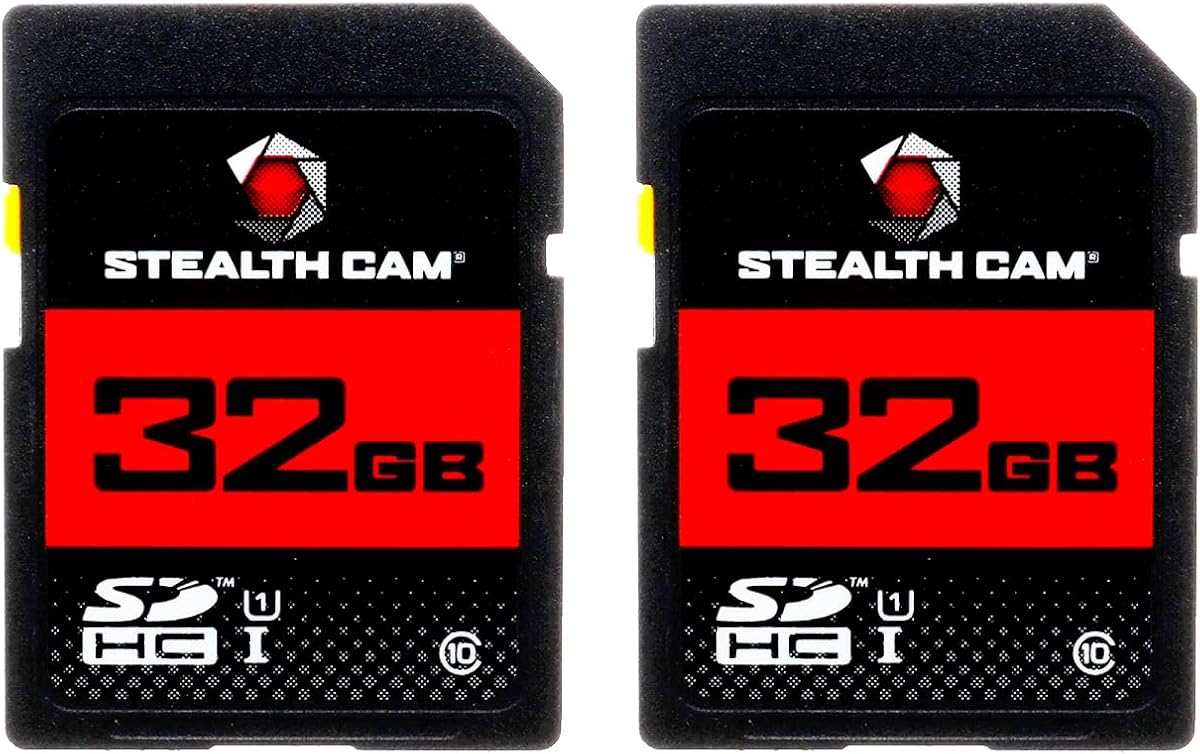
The STEALTH CAM 32GB 2-Pack delivers a balanced setup for users who want more capacity than a 16GB card but do not need to carry as many cards as the larger GIGASTONE multipacks. Its 4.7 rating is among the best in the guide, and the two matching 32GB SDHC cards create a convenient rotation for a single trail camera.
We may earn a commission when you buy through this link, at no additional cost to you.
Class 10 speed is specified for high-speed data transfers, high-resolution photography, and video recording. The product is also designed around low power consumption, which makes it relevant to cameras operating on limited power in remote locations. Compatibility with most digital hunting trail cameras makes the intent of the product straightforward.
Two cards offer several practical advantages. You can keep one installed while transferring the other, use one for a second camera, or maintain a spare in case a card is lost or fails. The 32GB capacity also gives the camera more room than the 16GB versions, potentially reducing how often the card must be cleared during active seasons.
This is a strong recommendation for a two-camera installation or for one camera that benefits from scheduled card changes. The main limitation is that the supplied information lists a Class 10 rating rather than a V30 or U3 video class, making it less obviously targeted at demanding 4K workflows. Even so, the combination of two cards, 32GB each, low power consumption, trail-camera focus, and a strong rating makes this a particularly practical package.
Rotate one card while the other is being reviewed or backed up. This reduces the chance of losing access to footage when a full card interrupts recording.
Two 32GB cards offer more flexibility than a single card while remaining easier to carry than a ten-card set. They are a middle ground for most single or dual-camera installations.
We may earn a commission when you buy through this link, at no additional cost to you.
The GIGASTONE 32GB 10-Pack is the most substantial rotation set in the comparison, designed for users who operate several cameras or want enough cards to follow a disciplined replacement schedule. Its 4.6 rating indicates generally positive reception, and ten cards make it possible to label, rotate, and track each unit without frequent reuse.
We may earn a commission when you buy through this link, at no additional cost to you.
The underlying cards share the same full-size 32GB SDHC format, UHS-I interface, Class 10 grade, and U1 rating as the five-pack version. A stated transfer speed of up to 80 MB/s supports Full HD recording and display as well as routine file transfers. For a larger installation, maintaining a consistent card type can simplify troubleshooting and replacement planning.
Ten mini cases accompany the cards, which is a meaningful organizational benefit for field teams. The cards are also described as waterproof, temperature-proof, x-ray-proof, shock-proof, and magnet-proof, with a five-year limited warranty. These attributes suit cameras exposed to changing weather and the repeated handling involved in maintenance visits.
Choose this bundle if you have a multi-camera property, work as a wildlife-monitoring technician, or prefer to change media on a set schedule without recycling cards. It is less appropriate for a single-camera user who only needs one spare because ten 32GB cards require more storage and organization. The pack is best understood as operational capacity: fewer erasures, clearer card histories, and a spare available for nearly every field visit.
Ten cards can support a scheduled rotation across multiple cameras, reducing wear from constant reuse. Labeling each card with a camera name and date can also simplify matching footage to deployment locations.
The included mini cases help prevent scratches, dirt, and accidental loss during transport. Keeping cards in individual cases makes it easier to account for all ten units after a remote visit.
We may earn a commission when you buy through this link, at no additional cost to you.
The GardePro 64GB stands apart as the highest-capacity option and the only product here explicitly rated for high-bitrate 4K video. It is a natural fit for cameras that record longer clips, use higher-resolution sensors, or are deployed in locations where frequent visits are inconvenient. No numeric customer rating was supplied, so the decision should rely on the stated specifications and device requirements.
We may earn a commission when you buy through this link, at no additional cost to you.
Its V30, U3, and Class 10 ratings form a more demanding performance profile than the U1 and Class 10 combinations used by most selections. GardePro states that these ratings support high-bitrate 4K video and fast continuous shooting. The card also offers a read speed of up to 100 MB/s, which helps when reviewing or backing up larger files from a high-capacity trail camera.
Industrial-grade components are another meaningful distinction. GardePro describes the card as enhanced for stability and reliability in demanding outdoor and long-term use scenarios. Its full-size design is compatible with all GardePro trail cameras and most mainstream devices accepting full-size SD cards, including cameras, video recorders, and other compatible equipment.
This is the best premium choice for users who prioritize capacity and modern video performance rather than a multi-card value pack. One concern is that a single 64GB card can hold valuable footage that would be split across smaller cards, so sensible backups are important. Another is the lack of a supplied rating for social proof. Even so, the 64GB capacity, V30 and U3 ratings, and industrial-grade positioning make this the most advanced specification package in the guide.
A 64GB card can reduce card changes when a camera records extensive video or captures high activity. It is especially useful where traveling to the camera is difficult or inconvenient.
V30 and U3 ratings better indicate suitability for demanding video than basic speed claims alone. Confirm that your trail camera supports 4K and accepts full-size SD cards at the required capacity.
We may earn a commission when you buy through this link, at no additional cost to you.
The HME 16GB 2-Pack is a straightforward choice for a pair of cameras, a primary-and-spare setup, or users who transfer wildlife files frequently. Its 4.6 rating reflects solid customer reception, while the two-card pack offers more operational flexibility than a single memory card without the bulk of a much larger multipack.
We may earn a commission when you buy through this link, at no additional cost to you.
Both cards use the full-size SDHC format and work with devices that have an SDHC slot. That allows the cards to be inserted into a compatible trail camera and then used to transfer media to a smartphone, tablet, or computer. The cards are described as high-speed and engineered for dependable, consistent performance, making them suitable for standard photography and HD video tasks.
Outdoor suitability is emphasized through the stated ability to withstand temperature extremes, moisture exposure, and rugged handling. The product information also notes that HME produces cards in capacities ranging from 8GB to 32GB, although this particular option is the 16GB two-pack. The ease-of-use claim centers on straightforward insertion, transfer, and access rather than advanced configuration.
This pack works best for basic recording, lighter video loads, or a two-camera arrangement where each camera receives a dedicated card. It is less suitable for high-resolution continuous video, 4K workflows, or long unattended deployments because of its 16GB capacity and lack of a stated advanced video class. Within the simpler category, however, it offers a useful balance of portability, durability claims, and two-card convenience.
The two-card format works naturally with a pair of cameras, reducing the need to remove and relabel media constantly. A spare can also remain available if one card is already in use.
SDHC slot compatibility supports a straightforward path from the trail camera to compatible phones, tablets, or computers. Follow each device's required format and capacity guidance when moving files.
We may earn a commission when you buy through this link, at no additional cost to you.
The Stealth Cam 32GB SD Memory Card delivers the essentials for a game camera with minimal complexity. It is described as working with SD-card-compatible game cameras, boosting camera storage, and allowing data to be uploaded, erased, and reused without a loss of quality. Its 4.6 rating provides a solid level of customer feedback.
We may earn a commission when you buy through this link, at no additional cost to you.
The 32GB capacity is a useful middle ground for trail cameras that capture a mixture of photos and videos. It holds more than a 16GB card while remaining a single, easily managed unit. The ability to erase and reuse the card makes it suitable for ongoing monitoring rather than a one-time event where preserving every card would be essential.
Unlike several more technical products in this guide, the Stealth Cam listing does not provide detailed speed-class, video-class, or environmental-protection information. That means compatibility and sustained recording performance should be confirmed through the current product page and your camera's manual. The product information also notes that the brand may vary, which is worth considering if brand consistency matters to you.
This is a sensible choice for a single trail camera that records at moderate volume and for a buyer who prefers a simple, reusable card without an elaborate multipack. It is less appropriate when you need verified 4K ratings, a rotation of matching cards, or extensive environmental certifications. At 32GB with a solid rating and a clearly game-camera-focused use case, it remains a practical option for uncomplicated storage.
The card can be erased and reused after its footage has been uploaded. Maintaining a backup of the original files is still important, because erasing the card removes the only stored copy.
The single 32GB card is easy to transport and manage. It is most appropriate for setups that do not require multiple cards in rotation or a larger video workload.
We may earn a commission when you buy through this link, at no additional cost to you.
The STEALTH CAM 16GB 2-Pack is a compact backup set for users who need more than one card but want to minimize the space each card occupies. It has a 4.6 rating and includes two matching 16GB SDHC cards, making it practical for a primary card, a spare, or two lightly used cameras.
We may earn a commission when you buy through this link, at no additional cost to you.
A Class 10 speed rating supports high-speed data transfer and is intended for video recording and high-resolution pictures. The cards are also described as compatible with most digital hunting and trail cameras. Low power consumption is a notable trait for outdoor devices, although overall battery life remains dependent on the camera and its recording behavior.
The product information emphasizes reliable outdoor use and straightforward data transfer. Two 16GB cards are especially useful for keeping one card in a camera and one in a protected spare slot. This arrangement helps prevent an unexpected card failure or a full-card event from immediately stopping a monitoring session, provided the spare contains the correct format and capacity.
Choose this two-pack for compactness, low-power operation, and light-to-moderate recording volume. The 16GB capacity is the clear limitation, particularly for motion-heavy sites, continuous video, or infrequent maintenance visits. A larger card may be a better fit in those cases. For owners of a single basic camera who transfer files regularly and value a dependable spare, this set remains a sensible, compact choice.
Two small cards are easy to keep in a camera bag or vehicle. Keeping one installed and one protected provides a quick replacement if the active card becomes full or unavailable.
Sixteen gigabytes is most appropriate when recording frequency is moderate and files are transferred often. High-volume video sites benefit from a 32GB or 64GB option.
We may earn a commission when you buy through this link, at no additional cost to you.
The right trail-camera card depends on compatibility, recording format, capacity, environmental conditions, and how often you can retrieve footage. Use the following factors to narrow the field before making a purchase.
Begin with the trail camera's manual and verify whether it accepts full-size SD cards, which format it requires, and the largest capacity supported. Every product in this guide uses either SD or SDHC media, but devices that support older or lower-capacity standards may not accept all of them. A 64GB card can offer excellent value for extended recording, yet it is useless if the camera limits supported media to a smaller capacity or requires a particular file system. The two 16GB options are the most conservative choices, while 32GB and 64GB options suit cameras with more generous support.
Choose a capacity that matches the recording volume and your retrieval schedule. Larger cards reduce the frequency of swaps, but they also place more footage on one device and make a backup routine more important.
Transfer speed, Class 10, U1, U3, V10, and V30 describe different aspects of performance. The stated read speed affects how quickly files can be accessed, while a video speed class provides a more relevant indication for continuous recording. Cards with Class 10 and U1 ratings are well suited to the Full HD workflows described for many of the trail-camera products. The GardePro card adds V30 and U3 ratings, making its specification profile more appropriate for high-bitrate 4K and fast continuous shooting. Do not assume that a large read-speed number guarantees better video capture in every camera.
Match the ratings to the camera output. If your camera records only Full HD, a U1 or V10 card may be sufficient, while a 4K camera benefits from a card with stronger video ratings.
Recording duration varies with video resolution, frame rate, bitrate, motion detection, scene activity, and the camera's still-image settings. A quiet woodland may fill a card much more slowly than a busy trail or property boundary. The 64GB GardePro card provides the most stated capacity, while the 16GB products are best for lower-volume use or frequent transfers. For active sites, 32GB often provides a more comfortable balance between storage and the inconvenience of carrying many cards. Review footage-transfer frequency before selecting capacity rather than relying on a general rule.
For predictable results, start with one card, record through a representative period, and note how quickly it fills. You can then determine the capacity required for your actual camera settings.
Trail cameras operate in locations where temperature, moisture, dust, vibration, and accidental impacts are common. PNY, GIGASTONE, and HME provide explicit environmental-protection claims, while the STEALTH CAM products emphasize outdoor reliability and low power consumption. These claims vary by product and should be considered alongside the manufacturer's warranty and operating limits. No memory card should be treated as immune to every weather condition, particularly when a camera door is open or the card is removed in a wet environment.
Look for protection claims covering temperature, water, shock, and handling, then use a protective case during transport. Consistent care is often as important as the card's advertised specifications.
A rotation system prevents full cards from interrupting a recording session and reduces the risk of confusing footage from different cameras or dates. The two-card products support a simple one-in-use, one-in-transfer workflow. GIGASTONE's five- and ten-card packs are more appropriate for multiple cameras, technicians, or scheduled changes. Labeling cards and maintaining a written deployment log is inexpensive and can save considerable time when reviewing hundreds of recordings.
Match the number of cards to the number of cameras. Buying more than you can manage may create confusion rather than added reliability, so a small, well-labeled set is often more useful than a large untracked collection.
Compatibility is more than recognizing the SD shape. The camera must support the card's capacity, speed class, file system, and recording mode. PNY explicitly lists support for point-and-shoot cameras, DSLRs, and standard or advanced HD-enabled video cameras. GardePro states compatibility with all GardePro trail cameras and most mainstream devices that accept full-size SD cards. The STEALTH CAM products are designed for most digital hunting and trail cameras. These claims still should be checked against the manual for the exact model you own.
When possible, format the card in the camera before its first deployment. This helps the camera establish a compatible structure and can reduce recognition problems.
Battery-powered trail cameras can spend weeks or months in the field, making efficiency important. The STEALTH CAM 16GB and 32GB options specifically highlight low power consumption, while the GardePro card emphasizes industrial-grade stability for long-term use. A memory card is only one part of the camera's energy profile, so these claims should complement—not replace—proper battery selection, temperature management, and a sensible recording schedule.
If the camera operates through a long deployment, use cards explicitly described for low-power or outdoor use and avoid unnecessary card swaps. Regular visits should focus on backups, card changes, and camera maintenance.
A card is the only place its footage exists until it is transferred. Reliable backups are especially important when using a single 64GB card because one device failure or accidental deletion can affect a large body of recordings. Maintain at least one additional card of compatible capacity, and copy footage from the camera card to a computer or another storage device before erasing it. Verify that the copied files open correctly before assuming the backup is complete.
Keep cards in labeled protective cases away from direct heat, moisture, and static discharge. Treat the storage process as carefully as the camera setup itself.
Before inserting a new card, confirm that it is full-size SD or SDHC media, within the camera's supported capacity, and compatible with its required video class. Format the card in the trail camera whenever the camera provides that option. This allows the device to establish the appropriate file system and helps the camera recognize the card. Insert the card with the camera powered off, and confirm that the camera displays the correct capacity before leaving it in the field.
During routine visits, power the camera down before removing or replacing media. Handle the card by its edges, keep the contacts clean, and place used cards directly into a labeled protective case. Transfer photos and videos to a computer or backup device before erasing the card. Check that the copied files play or open properly, especially when the card contains valuable wildlife or property footage. Do not erase a card until a verified backup exists.
Long-term care is simple but important. Keep cards away from extreme heat, direct sunlight, dampness, and conductive surfaces when they are not inside a camera. Use the included mini cases where available, and label each card with its camera, date range, and format status. Periodically test less-used cards, retire cards that show errors, and always carry a compatible spare when visiting a remote camera.
Most users can start with a 32GB SDHC card, which balances recording room and easy file management. A 16GB card is useful for low-activity sites or frequent transfers, while 64GB can reduce interruptions at busy locations. The camera manual is decisive because some models limit supported capacity or require a particular file system. Always verify maximum capacity and video-class support before buying.
Only if the camera's manual confirms support for that card's format, capacity, and speed class. The products in this guide are full-size SD or SDHC cards rather than microSD cards. A physical adapter does not make an incompatible card usable or guarantee that the camera supports its speed. Match the card directly to the camera's full-size slot and specifications.
Both are relevant to Full HD recording, but a V10 rating directly addresses minimum video performance. U1, V10, and Class 10 cards are generally more informative for trail-camera video than a maximum read-speed claim alone. For a 4K camera, V30 and U3 provide a stronger indication of suitability. The card should also meet the camera manufacturer's stated requirements.
Replace or erase it when it becomes full, when the camera reports an error, or when footage is backed up. Rotation frequency depends on activity, video mode, and capacity. At a busy site, check cards more often than at a quiet location. Keeping a compatible spare in the same rotation pattern helps avoid interrupted recordings and unexpected card failures.
Not necessarily. Read speed mainly affects file access and transfer, while sustained video recording depends more on write performance and the card's video rating. A fast card with only a basic rating may not be the best match for demanding 4K capture. Choose ratings that match the camera's output, and treat maximum transfer speed as a secondary convenience when reviewing footage.
Formatting in the trail camera is generally preferable because the camera can create the file system it expects. Use a computer only when the camera lacks a formatting option or when the manufacturer specifically instructs you to. Avoid using a card immediately after computer formatting without confirming compatibility. A successful camera format also provides a basic check that the card is being recognized.
Yes, after all important footage has been transferred and backed up. Reusing a card keeps the operation simple and can prevent full-card interruptions, but it also creates a risk if old files were not saved. Verify backups, erase through the camera when possible, and retain a separate card for the next deployment. A rotation of matching cards is easier to manage in demanding installations.
Power the camera off, reseat the card, and try formatting it in the camera. Confirm that the card is full-size rather than microSD, is within the supported capacity, and meets the required speed or video class. Test the card in another compatible device to narrow down the problem. If errors continue, stop using the card in the field and replace it with a compatible new one.
The GIGASTONE 32GB 5-Pack stands out as the most complete overall option because it combines five cards, protective cases, Class 10 and U1 performance, and broad environmental protections. The SanDisk 32GB Ultra is the simplest budget-oriented purchase, while the GardePro 64GB leads the guide for high-capacity 4K-oriented recording with V30 and U3 ratings. Each serves a different deployment style rather than a single universal need.
Prioritize camera compatibility first, then choose enough capacity for your actual recording volume and video quality. A rotation pack is valuable for multiple cameras or remote locations, while a single 32GB or 64GB card can reduce field visits. Low-power characteristics and outdoor durability deserve attention whenever a camera runs unattended in changing conditions, and every setup should include at least one compatible spare.
Current prices and product details can change, so review the latest listing before purchasing. Check the camera's supported capacity and format, confirm the required video class, and compare the included quantity with the number of cameras you operate. Most importantly, protect the footage by backing it up before erasing any card.