
Finger Training Rehabilitation Gloves
4.6Editor score
Single-finger targeted exercise
Mirror-training function
Portable plug-in power
This guide compares 10 robotic rehabilitation gloves, evaluating training modes, finger control, mirror functions, comfort, portability, and suitability for
Robotic rehabilitation gloves use powered movement to guide the fingers through flexion, extension, grasping, and stretching exercises. They can support structured hand therapy for people recovering from stroke, hemiplegia, cerebral palsy, nerve injury, arthritis, or other mobility limitations, especially when guided repetition is useful.
The products in this guide were compared using the information supplied about their training modes, finger control, adjustment options, mirror-training functions, displays, power systems, comfort features, portability, and stated suitability. The list includes single-glove and two-glove configurations designed primarily for home or caregiver-assisted rehabilitation.
Each review explains the standout features and practical trade-offs of its featured glove, helping readers distinguish basic exercise aids from more programmable systems. Ratings and availability can change over time, and prices also vary between retailers, so confirm the current listing and product details before purchasing.
4.6Editor score

4.8Editor score
4.2Editor score
This side-by-side comparison highlights the principal training methods, control systems, power approaches, and intended rehabilitation scenarios of all ten robotic rehabilitation gloves. It is designed to help readers compare capability and convenience without relying on specifications that are not listed for each product.


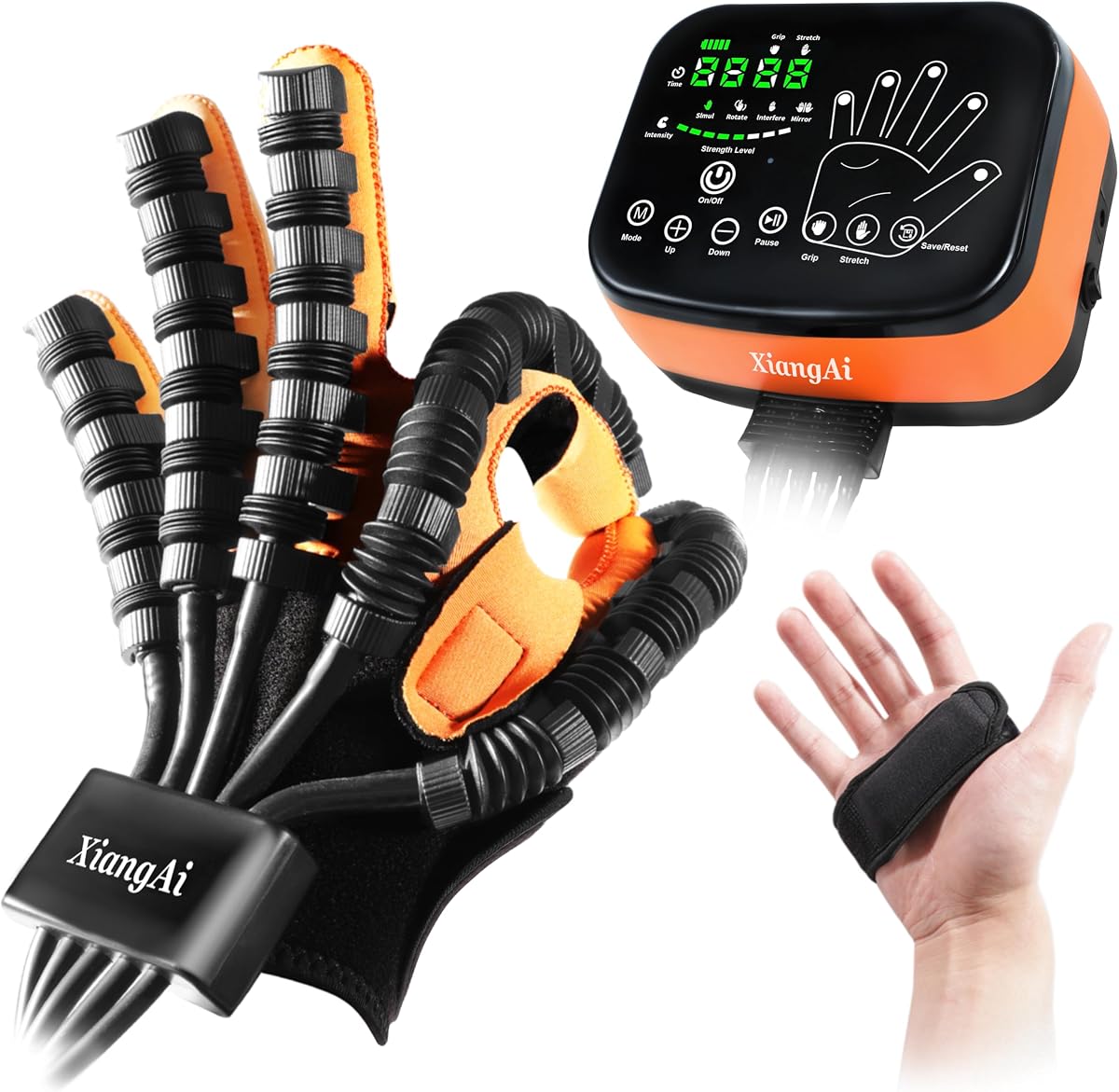
The XiangAi Rehabilitation Robot Gloves for Hemiplegia Stroke Hand Recovery combine powered finger exercise with a touchscreen-based control system. The product carries a 4.1 rating and stands out for offering four distinct training modes, numerous timing and speed adjustments, and a range of stated applications. Its design is aimed at people undertaking structured hand rehabilitation at home with support from a caregiver or therapist.
We may earn a commission when you buy through this link, at no additional cost to you.
The Simul mode opens and closes all fingers together, while Rotate alternates the fingers. Interfere separates the thumb from the other fingers, and Mirror uses remote control for coordinated movement with another glove. Grip and stretch duration can be adjusted through nine settings, and eight speed settings allow the user to vary how quickly the fingers move. A full-size LED touchscreen presents battery status, remaining exercise time, and mode information.
Physical design is another strength. The glove uses a double-layer elastic construction, with a medical-grade nylon and spandex inner fabric intended to reduce irritation and a polyester outer layer for durability and grip. Wide finger sleeves, a hook-and-loop cuff, and two additional straps help keep the device from shifting during exercise. The listed certifications include FCC, CE, and RoHS, and the product includes a three-year warranty.
The main trade-off is that a single glove is less convenient for bilateral mirror work unless a compatible second unit is already available. Remote-controlled Mirror mode can also take time to learn, particularly for an older user or anyone with limited dexterity. Even so, the broad adjustment range, four-mode design, touchscreen, and stable fit make this a capable choice for people who want more control than a basic finger exerciser offers.
The combination of four modes, nine duration settings, and eight speed settings allows exercises to be matched to different tolerances. Beginners can begin conservatively and gradually explore other patterns under appropriate guidance.
The double-layer fabric, broad finger openings, reinforced cuff, and two straps address comfort and retention. The touchscreen also reduces the need to interpret small mechanical controls during a session.
We may earn a commission when you buy through this link, at no additional cost to you.
This second XiangAi listing offers the same broadly specified rehabilitation platform as the first product, including a 4.1 rating, four training modes, and a rechargeable power system. It is designed to guide fingers through natural movement from 0 to 180 degrees while giving users some control over exercise timing, speed, and movement pattern. The target user is someone who needs repetitive or assisted hand movement as part of a broader rehabilitation plan.
We may earn a commission when you buy through this link, at no additional cost to you.
Its four modes cover simultaneous flexion and extension, alternating finger rotation, thumb movement alternating with the remaining fingers, and remote-controlled mirror training. Nine grip and stretch duration settings and eight speed settings add meaningful control. The 11.1V, 2600mAh rechargeable battery removes the need to remain near a mains outlet during a session, while the LED panel supplies information about charge, exercise time, and the active mode.
Fit and skin contact are central to the design. The inner medical-grade nylon and spandex layer is intended to limit irritation, while the durable polyester outer layer adds slip resistance. A wide opening reduces the need to force the fingers through narrow sleeves. The cuff and two straps help maintain alignment, which is particularly relevant when the mechanism is actively flexing and extending the fingers.
This listing shares its principal specifications with the other XiangAi glove, so buyers should compare the actual images, included accessories, seller details, warranty terms, and current availability rather than assuming they are entirely different devices. Its limitation as a single unit is the same: Mirror training is most practical when paired with another compatible glove. Within those limitations, the intuitive panel and broad exercise controls make it a solid general-purpose rehabilitation tool.
Battery level, selected mode, and remaining time are presented on the LED display. This makes it easier for a caregiver to confirm that the programmed session is progressing as intended.
Soft inner fabric and wide finger sleeves help reduce pressure around sensitive areas. A secure cuff and straps further support consistent positioning during powered movement.
We may earn a commission when you buy through this link, at no additional cost to you.
The Upgraded 6th Generation Rehabilitation Robot Gloves provide a broad home-training feature set and hold a 4.2 rating. Their defining strengths are direct finger selection, five-finger rotation, sequential traction training, an anti-interference mode, and a mirror-training function. The manufacturer also emphasizes upgraded power accessories and a design intended to support use in bed or other home rehabilitation environments.
We may earn a commission when you buy through this link, at no additional cost to you.
Rather than requiring a user to manipulate a rotary valve to choose a finger, the control panel allows direct selection through an intuitive interface. The glove can rotate through all five fingers, work through sequential traction exercises, and reduce interference during training. A new mirror hand strap is intended to make synchronized bilateral training easier. The LED display provides visible settings, while memory for the last training mode and a factory-reset option simplify repeated use.
The upgraded battery is intended to deliver longer training sessions, and the product is described as suitable for people recovering from stroke, hemiplegia, cerebral palsy, cerebral thrombus, cerebral infarction, and cerebral hemorrhage. The listing also states that the main motive-power accessories were upgraded to meet automotive-product quality standards. The claimed expected service life is up to five years, accompanied by three years of quality assurance and after-sales support.
This is a more complex product than a simple powered exerciser, and that complexity can be a disadvantage if the intended user needs an exceptionally simple interface. The stated service-life figure is a manufacturer expectation rather than an independently observed result. Nevertheless, the direct selection controls, diverse training patterns, session memory, and home-use orientation make this one of the most sophisticated options in the roundup.
Selecting a finger through the panel avoids the fiddly valve operation described by competing products. Saving the last mode also reduces repeated setup during a regular home routine.
Five-finger rotation, sequential traction, mirror work, and anti-interference training create several ways to structure a session. The range is useful for users following different therapy plans or changing tolerances over time.
We may earn a commission when you buy through this link, at no additional cost to you.
The 2PCS Rehabilitation Robot Gloves set includes a glove for each hand, making it a practical option for bilateral exercise and mirror training. It has a 3.8 rating, the lowest listed among these ten products, but its package contents are unusually complete. The set includes two rehabilitation gloves, two 11.1V and 2600mAh hosts, two 3.7V and 250mAh mirror hand straps, two training balls, two gift boxes, two manuals, two host power cords, and USB cables for the straps.
We may earn a commission when you buy through this link, at no additional cost to you.
The exercise system uses the familiar four-mode design: Simul, Rotate, Interfere, and Mirror. Users can select among nine grip and stretch duration settings and eight speed levels. The included mirror straps are especially relevant for bilateral work because they are intended to transmit or follow movement from one hand to the other. Each glove has a dedicated host, allowing both sides to be powered and managed as a coordinated set.
Construction details match the XiangAi single-glove concept. The inner medical-grade nylon and spandex fabric is intended to minimize irritation, while the outer polyester layer provides durability and grip. A wide hook-and-loop cuff and two straps help prevent slipping. The LED screens provide light feedback, battery information, remaining time, and selected mode. The stated FCC, CE, and RoHS certifications support its positioning as home rehabilitation equipment.
The set's lower rating means buyers should examine current customer feedback carefully, especially regarding noise, comfort, setup, and consistency between units. It also requires more storage space and includes more components than a single-glove system. For someone who specifically wants two-handed mirror training without sourcing a second matching glove, however, the complete package is a substantial advantage.
Two gloves, hosts, straps, cables, manuals, and training balls are supplied together. That completeness can make planning a two-handed home routine more convenient.
The dedicated mirror straps complement the Mirror training mode. They are intended to help one hand guide the other, which may be useful during clinician-directed recovery work.
We may earn a commission when you buy through this link, at no additional cost to you.
The Home Rehabilitation Robot Glove is the highest-rated product in this roundup, with a 4.8 rating. It is designed for home rehabilitation and explicitly supports use while a person is lying in bed. The glove offers four rehabilitation modes, five-finger rotation training, sequential finger traction, a mirror-training function, and an anti-interference mode, combining the kinds of features often sought in a flexible home therapy device.
We may earn a commission when you buy through this link, at no additional cost to you.
Its most user-friendly feature is direct finger selection through the control panel. Unlike systems that require turning a physical rotary valve, this approach lets the user choose the relevant finger from an interface, making targeted exercise more convenient. The LED display presents adjustable settings, and the unit can save the last training mode and return to factory settings when needed. The listed movement range extends from 0 to 180 degrees.
The glove is described as especially suitable for stroke, hemiplegia, cerebral palsy, cerebral thrombosis, cerebral infarction, and cerebral hemorrhage. An upgraded battery is intended to support longer sessions, and a three-year warranty is included. The listed CE, FCC, and RoHS certifications provide additional information about the product's stated compliance, while the product listing also identifies cotton among its materials.
This specific listing is presented in a right-hand medium configuration, so buyers should verify sizing and hand orientation carefully. It is a single glove, making bilateral mirror work less convenient unless a compatible companion is available. Even with those caveats, its 4.8 rating, broad mode selection, intuitive finger selection, and home-focused design make it the strongest all-around recommendation in this guide.
Choosing fingers directly from the panel reduces setup compared with mechanical selector valves. This makes the glove easier to integrate into a repeatable home session.
The product is explicitly intended for use at home and in bed. Its portable format gives users more flexibility than a device that must remain in a clinic.
We may earn a commission when you buy through this link, at no additional cost to you.
The JBMBHC Rechargeable Robot Gloves distinguish themselves with a large number of adjustment levels and a 4.2 rating. The product is intended for finger and hand training associated with stroke recovery, arthritis, hemiplegia, cerebral palsy, dementia, cerebral infarction, cerebral hemorrhage, and nerve injury. It uses a bright orange enclosure and soft, lightweight materials, with a high-definition display for operating the different functions.
We may earn a commission when you buy through this link, at no additional cost to you.
The standout specification is the combination of 15 flexion and extension speeds with 15 support levels. Timed sessions are also available, which can help users structure sessions and avoid pushing the fingers beyond a comfortable range. Individual or combined finger movement modes offer more precise exercise selection, while the upgraded version adds sequential training in which the five fingers can take turns moving.
The product listing says the power-air pump was upgraded to deliver three times the power of an earlier version. All functions are operated from the display screen, and the instructions are intended to make the interface approachable. The glove also supports mirror training, and its timed-session design is meant to minimize discomfort by giving the user more control over the pace and length of exercise.
The fine-grained adjustments are valuable for someone who needs to progress gradually, although 15 speed and support levels can seem complex to a new user. The listing is also for a right-hand medium configuration, so hand orientation and fit need confirmation. With its high adjustment count, sequential training, and rechargeable design, this glove is well suited to users who value detailed control over each session.
Fifteen speed and support levels offer more increments than most competing products. This granularity can help users work with a therapist to find a manageable starting range.
The five fingers can rotate through exercises individually, while combined modes support whole-hand movement. This lets a session shift between focused and coordinated patterns.
We may earn a commission when you buy through this link, at no additional cost to you.
The Finger Training Rehabilitation Gloves provide a focused and comparatively straightforward rehabilitation option, earning a 4.6 rating. They are designed for stroke and hemiplegia rehabilitation, with additional stated uses for arthritis and cerebral palsy. The product centers on controlled finger exercise, adjustable single-finger or multi-finger selection, and a mirror-training function intended to support coordination between hands.
We may earn a commission when you buy through this link, at no additional cost to you.
A mechanical valve determines whether one finger or several fingers are active, allowing users to concentrate on a particular digit. The listing recommends a daily session of 15 to 20 minutes, though an individual rehabilitation plan should determine the appropriate duration and intensity. Mirror training is described as simulating the movement of a healthy hand to help retrain neural pathways and improve coordination.
This unit uses a plug-in design, which the manufacturer presents as more stable and reliable than a portable battery arrangement. It is described as offering three times the operating power of an earlier version. Its compact format is suitable for users who want focused exercise without carrying a large control system around the home. The design is also straightforward compared with touchscreen-heavy alternatives, which can be helpful for users who prefer a physical selector.
The principal drawback is that a cord must remain connected during operation, so it offers less freedom than the wireless or rechargeable alternatives. The product listing also provides fewer explicit speed and intensity adjustments. Nonetheless, its strong rating, targeted finger selection, and simple approach make it a practical choice for users seeking a focused powered glove with mirror-training support.
The selector valve can isolate a particular finger or activate multiple fingers. This focus is useful when a rehabilitation plan emphasizes specific areas of movement.
A wired power connection can be advantageous when uninterrupted operation matters more than portability. It removes battery-level concerns during a session.
We may earn a commission when you buy through this link, at no additional cost to you.
The Adjustable-Strength Rehabilitation Gloves offer a cordless approach to assisted finger exercise and carry a 4.4 rating. Their gear-driven mechanism is rated in the listing to withstand 240 grams of gravity, providing stronger traction than a basic flexible-hand exerciser. The glove can automatically switch between fingers, while four training modes expand the available movement patterns.
We may earn a commission when you buy through this link, at no additional cost to you.
The modes cover grasping, finger extension, single-finger exercise, and full-hand movement. Nine force levels and nine speed levels make it possible to adjust both the resistance of the movement and its pace. The product is intended for stroke recovery, nerve injury rehabilitation, and post-operative therapy. Mirror training is included so one hand can guide the other in a natural-looking sequence.
Its one-touch design relies on clearly labeled onboard buttons rather than a complex touchscreen. This may be advantageous for older adults, first-time users, and household caregivers who need an interface that can be understood without navigating extensive menus. A 2600mAh rechargeable battery eliminates the need for a cable during exercise, allowing the glove to be moved from a table to a bed or other room.
Because the system is mechanically driven, it may produce more sound than pneumatic alternatives, although the listing does not provide a formal noise rating. Mirror training also works best with a second compatible glove, which is not included. Even so, the combination of cordless power, strong traction, automatic finger switching, and straightforward controls makes this a balanced option for home rehabilitation.
The internal 2600mAh battery allows sessions away from a wall outlet or table. That flexibility is especially relevant for a home routine that includes bed-based practice.
Clearly labeled buttons and automatic finger switching reduce setup demands. Users can choose among grasp, extension, single-finger, and full-hand patterns without navigating a dense menu.
We may earn a commission when you buy through this link, at no additional cost to you.
The C10 Upgraded Rehabilitation Robot Gloves use a pneumatic system to flex and extend the fingers, with a 3.9 rating. Their distinguishing feature is the combination of independent air valves, intelligent adjustment of flexion and extension time, and a sensor on the back of the glove that responds to movement from the unaffected hand. The upgraded pneumatic adjustment is intended to provide stronger output while keeping the glove close to the fingers.
We may earn a commission when you buy through this link, at no additional cost to you.
Single-finger training is handled by rotating the white air-valve knobs on the back of the glove. A vertical position opens the air inlet, while a horizontal position closes it, allowing the user to determine which fingers move. The timing system can adjust the clenching and extension periods according to muscle tension, and nine intensity levels offer additional control over the pneumatic assistance.
The sensitive rear sensor is intended to make mirror training more responsive. It detects finger movement signals and is described as suitable for users with high finger muscle tension. The pneumatic actuators are designed to deliver soft power and controlled flexion and extension, while the rechargeable system supports portable home use. Stated applications include stroke, hand trauma, brain injury, cerebral palsy, orthopedic surgery, and other hand rehabilitation needs.
The product's 3.9 rating gives it less customer feedback strength than several alternatives, so buyers should consider the current reviews. Valve operation can also be less intuitive than touchscreen or direct-button selection. Nonetheless, the individually controlled air paths, intelligent timing, sensor-based mirror function, and soft pneumatic output give the C10 a specialized and potentially useful approach to hand exercise.
Dedicated air valves let users open or close specific finger pathways. This supports isolated exercise and allows a session to focus on selected digits.
Adjustable flexion and extension periods can accommodate different levels of muscle tension. The nine intensity levels add another layer of gradual adjustment.
We may earn a commission when you buy through this link, at no additional cost to you.
The Three-Mode Rehabilitation Glove is a compact powered training device aimed at hand motor recovery, with particular relevance to finger spasms after stroke. It has a 4.3 rating and combines a touchscreen, tactile adjustment buttons, independent air-valve switches, and a strength adjustment function. Its stated design goals are straightforward operation, portability, and comfortable guided grasping and stretching.
We may earn a commission when you buy through this link, at no additional cost to you.
The bionic glove structure follows the shape of the hand and is described as light and comfortable. It imitates grasping and stretching motions, which are common rehabilitation patterns, while the smart chip is intended to provide gentle movement. Individual air-valve switches allow users to close the air inlet for a selected finger, making targeted practice more convenient than exercising all fingers indiscriminately.
One-touch activation and the combination of a touchscreen with tactile buttons make the controls approachable for older adults and people who may have difficulty with small interfaces. The compact size also makes the glove easier to store and carry between rooms. Strength adjustment allows the movement to be adapted, while the three training modes keep the operating concept less complicated than larger feature sets.
This glove lists fewer modes than many competitors and provides less detail about certifications, warranty coverage, and specific performance than the higher-rated products. The description does not explicitly state a mirror-training function, and independent valves add a small operational step. Still, its 4.3 rating, portable construction, targeted control, and approachable interface make it a solid compact option for basic assisted home exercise.
A touchscreen paired with tactile adjustment buttons gives users both visual and physical control. The layout is intended to be usable without learning a complicated programming system.
Its small, lightweight form supports flexible use around the home. Independent valve switches make it possible to concentrate on a chosen finger.
We may earn a commission when you buy through this link, at no additional cost to you.
The right robotic rehabilitation glove depends on the user's condition, recommended therapy goals, hand orientation, comfort requirements, and ability to operate powered controls. A therapist's guidance should take priority, particularly when selecting range, intensity, and session duration.
Training modes determine the movement vocabulary available to a user. Whole-hand flexion and extension are useful for coordinated grasping, while alternating and sequential modes can distribute movement among individual fingers. Anti-interference or thumb-alternating patterns may help users focus on a specific digit. Mirror mode adds a different objective by encouraging the unaffected hand to guide the affected hand, which can be relevant to neurological recovery.
Powered gloves should offer enough control to match a user's changing tolerance. Some products provide nine intensity and speed levels, while others advertise 15 levels apiece. More levels do not automatically mean better results, but finer increments can make it easier to increase assistance gradually and avoid abrupt movement. Duration settings are equally important because holding the hand closed and stretching it open may create different levels of effort.
The drive system affects movement character, portability, and maintenance. Pneumatic models use controlled air pressure and may provide soft output, while gear-driven models can offer strong traction and automatic finger switching. Electric or motor-driven systems commonly use a rechargeable battery. Buyers should consider noise, cord placement, charging needs, cleaning access, and the guidance of a clinician familiar with the particular mechanism.
A single glove is easier to store and may meet the needs of someone focused on one affected hand. A matched pair is more useful for mirror training and bilateral exercise. Some packages include two gloves, separate control hosts, mirror straps, charging leads, manuals, and training balls, while other models require a compatible second unit for coordinated use. Buyers should verify handedness and whether the package includes everything required for the intended routine.
A user with limited dexterity or reduced vision may benefit more from large labeled buttons than a dense touchscreen. Direct finger selection is simpler than manipulating a rotary valve, while some systems save the last program for faster startup. The interface should still provide clear feedback about the active mode, timing, battery state, or pneumatic status. Caregivers may need to operate controls when the affected hand cannot do so comfortably.
Powered mechanisms can create pressure around the knuckles, fingertips, cuff, and back of the hand. Soft inner fabrics, wide finger openings, flexible stretch sections, and secure straps can improve the experience, but comfort still depends on hand shape and sensitivity. Reduced circulation, swelling, wounds, or sensory changes warrant particular care. A glove should never be used if it causes pain, skin damage, or discoloration.
Rechargeable and cordless systems offer freedom to use the glove in a bedroom, living room, or other convenient location. Plug-in devices may be useful for stable, stationary sessions and avoid battery uncertainty. Capacity alone does not reveal session length because runtime depends on settings and the user's routine. Buyers should check charging connections, whether the control host and glove are sold together, and how much space the complete setup requires.
A clear manual is essential because powered exercise settings should be introduced gradually and adjusted according to individual tolerance. Look for straightforward diagrams, mode definitions, cleaning instructions, and troubleshooting guidance. Warranty coverage and after-sales support can also be useful, but they should not substitute for professional assessment. Listings that make broad medical claims should be interpreted as product descriptions rather than proof that a device is appropriate for every condition.
Begin by reading the manual and confirming that the glove is intended for the affected hand and the selected training pattern. Fit the fingers into the individual sleeves, position the palm naturally, and secure the wrist cuff and additional straps without restricting circulation. Inspect the fabric, valves, controls, and charging connections before a session. For users with reduced sensation or fragile skin, a healthcare professional should confirm that the device is appropriate.
Start with the lowest comfortable movement, force, or speed setting and the shortest practical duration. Select a mode that matches the user's therapy plan, and avoid treating a stronger setting as a sign of faster progress. Stop if there is sharp pain, numbness, increasing swelling, skin damage, or an unusual change in color. Mirror training requires two correctly coordinated hands or compatible gloves and should be introduced with adequate supervision.
After use, disconnect the power, switch off the controls, and remove the glove gently without pulling on the finger sleeves. Wipe the exterior with a lightly damp cloth as directed by the manufacturer, and avoid immersing the control host or charging components unless the instructions explicitly permit it. Let the glove dry fully before storage, and keep it away from moisture, direct heat, and stretched fabric. Charge the unit as directed and inspect it periodically for wear.
No. Suitability depends on the nature of the impairment, muscle tone, joint condition, circulation, skin sensitivity, and the user's ability to tolerate passive movement. A physical or occupational therapist should evaluate whether powered training is appropriate. Anyone with pain, open wounds, significant swelling, or altered sensation should obtain medical advice before using a device.
Single-finger training isolates selected digits so one area receives focused movement. Full-hand training opens and closes the fingers together, which can support coordinated grasping and stretching. Many gloves provide both patterns, along with alternating, sequential, mirror, and thumb-specific modes. The best choice depends on the rehabilitation goals and the user's tolerance.
A single glove may still be useful for other training modes, but true mirror training is designed to use the movement of one hand to guide the other. It works best with a matched pair and compatible mirror straps or control system. Users should confirm that the included accessories and pairing method are appropriate before starting a bilateral routine.
There is no universal schedule because sessions should match the user's condition, tolerance, and prescribed rehabilitation program. Some product guidance mentions daily sessions of 15 to 20 minutes, while other products offer adjustable timers. Start conservatively, follow the guidance of a qualified clinician, and stop if symptoms worsen.
There is no single best mechanism. Pneumatic gloves can provide soft, controlled air-assisted movement; gear-driven gloves may deliver strong traction and automatic finger switching; rechargeable electric systems offer cordless convenience. Compare comfort, control, portability, noise, and ease of cleaning, and choose based on the user's needs and professional guidance.
Several listed products are marketed for arthritis, nerve injury, or related hand dysfunction, and assisted movement may form part of a broader therapy plan. However, product marketing is not a substitute for a diagnosis-specific recommendation. A clinician should determine whether active, passive, or powered exercise is appropriate and how much movement is safe.
Follow the manufacturer's cleaning instructions because the correct method depends on the fabrics, mechanism, and electrical components. In general, switch off and disconnect the device, wipe compatible surfaces with a lightly damp cloth, and keep liquid away from the control host, ports, valves, and charging contacts. Allow every part to dry fully before storage.
Confirm the intended hand, size, range of motion, training modes, adjustment levels, power method, included accessories, warranty, and instructions. Check the current listing and customer feedback because ratings and product details can change. Most importantly, verify that the device and settings fit the user's clinical needs and can be operated safely.
The Home Rehabilitation Robot Glove is the leading all-around recommendation because of its 4.8 rating, direct finger selection, four training modes, home-focused construction, and three-year warranty. The Finger Training Rehabilitation Gloves offer an accessible, targeted alternative with a 4.6 rating, while the 6th Generation Rehabilitation Robot Gloves provide the most advanced feature set with five-finger rotation, sequential traction, and upgraded battery technology.
Prioritize the features that match the user's actual rehabilitation plan. Targeted valve control may be sufficient for focused digit work, direct touchscreen selection may be easier for frequent home use, and a complete two-glove package may be more appropriate for mirror practice. Comfort, fit, safe intensity, clear instructions, and professional guidance matter more than the largest number of advertised modes.
Before purchasing, confirm the current product configuration, hand orientation, accessories, warranty, and seller information. Prices and ratings can change, so compare the live listing rather than relying on this guide alone. If a powered glove is medically appropriate, choose the model that can be introduced gently, operated confidently, and maintained consistently as part of a broader recovery routine.

