
Frost King ACF19 Foam Coil Cleaner
4.6Editor score
Heavy-duty foaming detergent
Cleans coils and filters
Neutralizes standing-water odors
No rinse required
Discover the best HVAC coil cleaners for evaporator and condenser maintenance, comparing foam performance, rinse requirements, coverage, odor control, and ease
An HVAC coil cleaner helps remove dust, grease, grime, and residues that can restrict airflow and interfere with heat transfer. A useful product should penetrate finned coil surfaces, lift embedded soils, and fit the maintenance routine of the equipment. Aerosol foam, concentrated gallon containers, and hose-fed sprayers each offer different advantages for homeowners and professionals.
This guide compares ten coil-cleaning products using their stated features, intended applications, ratings, rinse requirements, coverage, and design. It includes aerosol cleaners for targeted maintenance, larger containers for repeated service work, and an automatic foaming sprayer for users who want more control over dilution. The selections also distinguish between evaporator and condenser cleaning needs.
Each review explains what the product is best suited to, where it offers a meaningful advantage, and what trade-offs buyers should consider before choosing. The top picks highlight a budget-friendly aerosol, a deep-penetrating cleaner, and a premium hose-fed tool. Product availability and pricing can change over time, so shoppers should confirm current details before making a purchase.
4.6Editor score

4.6Editor score

4.6Editor score
The comparison below places the ten cleaners by format, cleaning scope, rinse guidance, intended equipment, and standout design features. It makes it easier to identify an aerosol for occasional maintenance, a larger supply for repeat use, or a dilution-controlled sprayer for professional-level control.
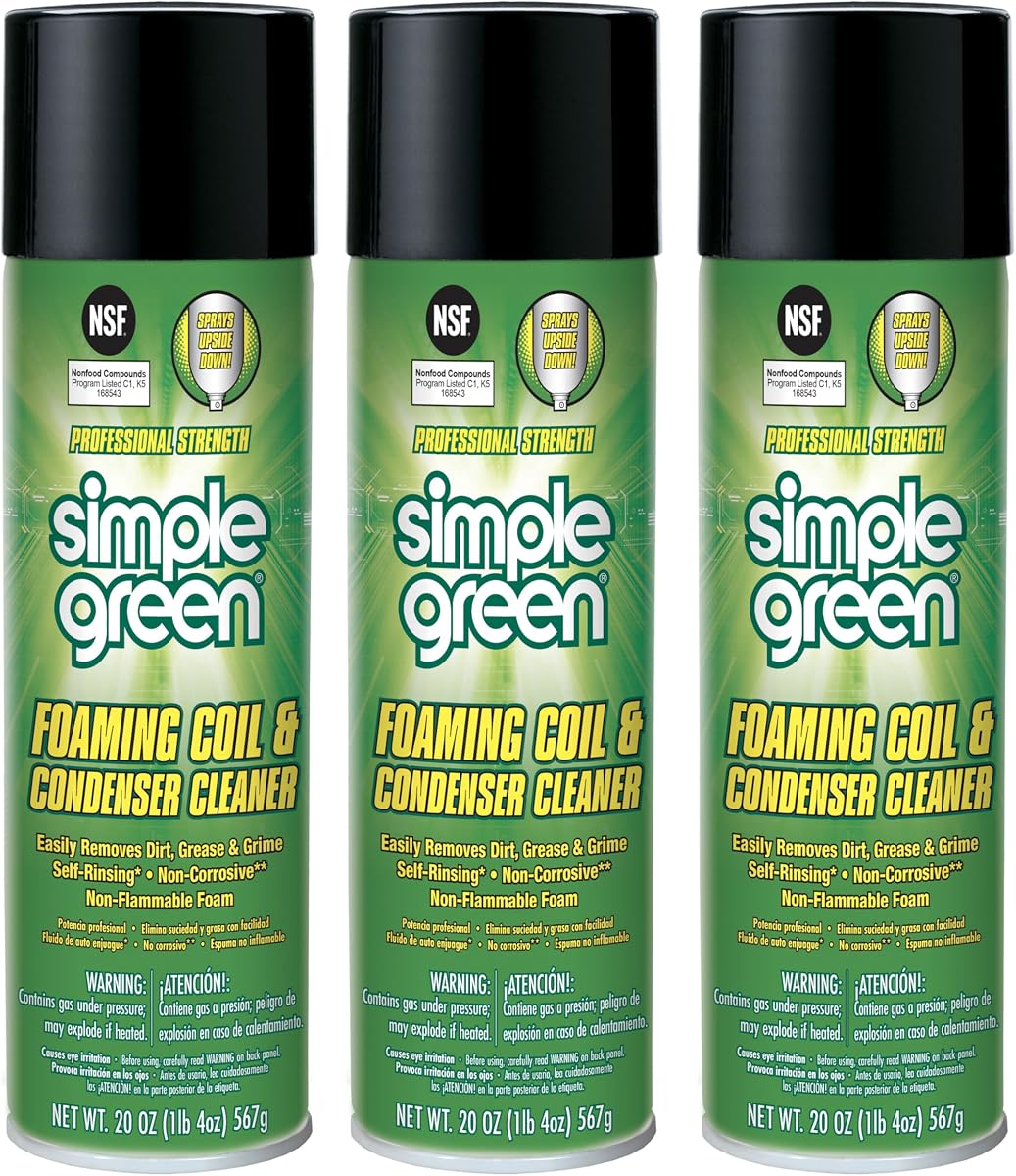


The Simple Green Foaming Coil Cleaner 20oz Aerosol is a multipack cleaner with a 4.5 rating and an unusually broad stated application list. It is intended to remove dirt, grease, and built-up grime from condensate-producing coils while helping maintain the performance of the associated equipment. Its non-caustic, nonflammable formula also makes it appealing for users who want a less aggressive maintenance option.
We may earn a commission when you buy through this link, at no additional cost to you.
This product stands out for its versatility. The supplied information identifies evaporator and condenser coils, fan blades, blowers, heat exchangers, vents, grills, and electronic filters as suitable applications. It is also NSF registered C1 and K5 for use in and around food-processing areas. For condensate-producing coils, the formula is described as self-rinsing, which can simplify routine service when the equipment is operating as designed.
The main trade-off is that the three-can pack may be more than a homeowner needs for a single seasonal cleaning. Also, while the product is described as self-rinsing on condensate-producing coils, users cleaning outdoor condenser coils should verify the current label and equipment instructions before assuming that no water is needed. A multipack offers better continuity for technicians, property managers, or households maintaining several compatible systems.
This is a strong overall choice for buyers who want more than a narrowly specialized aerosol. It combines professional-strength positioning, food-processing-area registration, and a wide range of approved-looking surfaces in one package. Choose it when versatility and maintaining several compatible components matter more than minimizing the amount of cleaner purchased.
The expanded application list gives this cleaner more value than a product formulated only for evaporator fins. Buyers can address coils, fan blades, blowers, heat exchangers, vents, grills, and eligible electronic filters with one maintenance product, subject to the manufacturer's directions.
Self-rinsing performance on condensate-producing coils reduces one step of the cleaning process. The formula is also described as leaving equipment better able to maintain optimal performance by clearing material that can cause clogs and impede heat transfer.
We may earn a commission when you buy through this link, at no additional cost to you.
The Frost King ACF19 Foam Coil Cleaner is a 19-ounce heavy-duty aerosol with a 4.6 rating. It is designed to dissolve stains, loosen dirt, and remove grease and oil from coils, fan blades, and reusable air filters. Its no-rinse claim and included deodorizing benefit make it a practical option for straightforward maintenance when the equipment type and label instructions permit use.
We may earn a commission when you buy through this link, at no additional cost to you.
The cleaner offers more than basic coil treatment. It also neutralizes odors associated with standing water in drain pans, and its low-VOC formula leaves a pleasant lemon fragrance after cleaning. The ability to clean several related components in one session can make seasonal upkeep more efficient, particularly for an owner with both a coil and reusable filters that need attention.
Its biggest limitation is format rather than function. A single aerosol is convenient for a household with one compatible system, but repeated commercial use or a multi-unit property may require multiple cans. The supplied information says no rinse is necessary, although users should still follow the full product label, especially when cleaning different assemblies or materials.
The Frost King is a sensible budget-oriented selection for consumers seeking a no-rinse foam with odor control and broad household HVAC coverage. It may be the easiest option to understand at a glance: apply, allow the foam to work, and follow the stated cleanup guidance. It is particularly useful for routine service on coils, fan blades, and reusable filters.
The stated no-rinse feature makes this aerosol appealing for routine maintenance where minimizing rinsing steps is important. It can clean coils, fan blades, and reusable air filters while addressing grease, oil, stains, and dirt.
Standing water in drain pans is one common source of musty odors around cooling equipment. This cleaner is specifically described as neutralizing those odors, with a lemon fragrance leaving the cleaned area smelling fresh.
We may earn a commission when you buy through this link, at no additional cost to you.
The Leak Saver Foam Blaster 3 Pack combines a 4.6 rating with a distinctive delayed-foam design. Instead of immediately forming a broad layer of foam on contact, it uses a focused, high-speed spray to drive cleaner into the coil before the foam activates. That design is intended to reach hidden buildup rather than merely cleaning the most visible surface.
We may earn a commission when you buy through this link, at no additional cost to you.
After penetration, the heavy-duty formula expands and works to liquify dirt, grime, and buildup. It is intended for evaporator coils without rinsing, with condensate from the operating unit handling the cleanup, and for condenser coils with a light rinse. The formula also leaves a mild fresh scent, and the stated applications extend to refrigeration systems, automotive radiators, fan blades, and metal filters.
The separate rinse instructions deserve attention. A no-rinse evaporator treatment should not be carried over automatically to an outdoor condenser, where the product listing calls for a light rinse. The three-pack format is also substantial for occasional residential use, although it is more convenient for technicians, landlords, or owners with multiple compatible systems.
This is the most distinctive cleaner in the group because of its delayed-foam mechanism and clearly separated coil guidance. It is a strong choice for users who believe buildup beneath the visible coil surface is the main problem. The additional light-rinse step for condensers is a modest inconvenience balanced by more targeted delivery through the coil.
The focused spray is designed to carry cleaner into the coil before delayed foaming begins. This differs from products that form a wide layer immediately, giving the active formula a better opportunity to reach grime hidden below the surface.
The manufacturer distinguishes between evaporator and condenser use: evaporators need no rinse, while condensers need a light rinse. Following those directions is important and makes the product suitable for whole-system maintenance when both coil types are serviced correctly.
We may earn a commission when you buy through this link, at no additional cost to you.
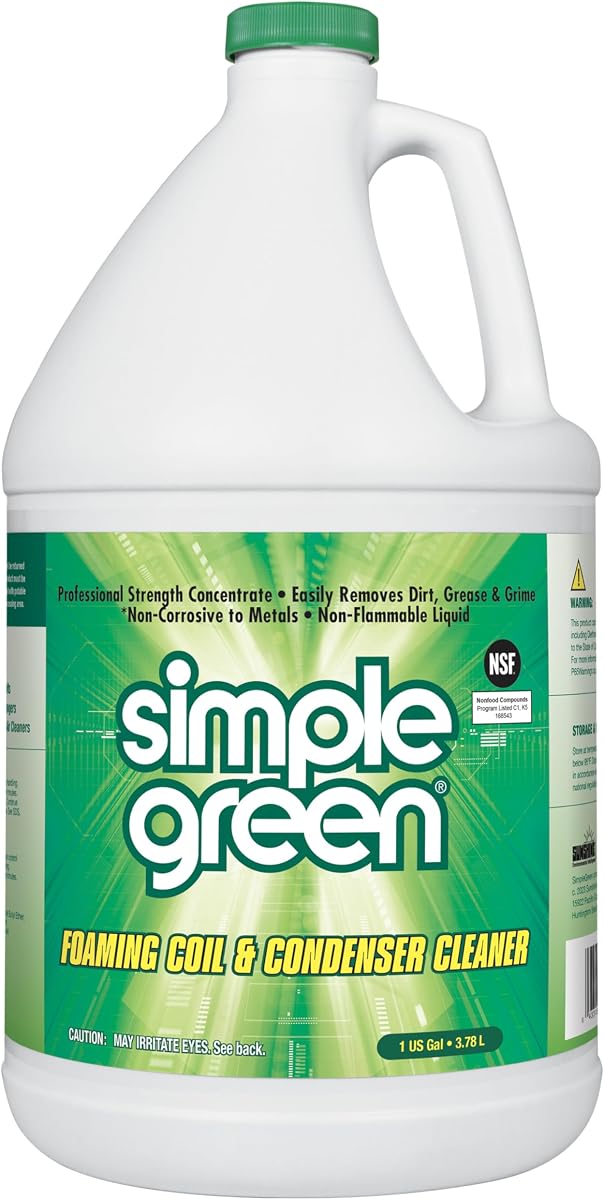
The Simple Green Gallon Foaming Coil Cleaner is a 128-fluid-ounce cleaning agent with a 4.5 rating. Its larger container is the defining feature, offering a practical supply for technicians, property managers, or homeowners who maintain more than one compatible system. The supplied information is concise, so current label directions remain especially important when deciding on application and rinsing.
We may earn a commission when you buy through this link, at no additional cost to you.
A gallon format can reduce the need for repeated aerosol purchases and gives users more product available for routine maintenance. It is designed as a foaming coil cleaner, aligning it with the need to reach finned surfaces and lift accumulated residue. The product's listed package weight of five pounds and physical dimensions may also make it easier to plan storage and transport.
The trade-off is that the provided product data does not describe specific chemical qualities, approved components, food-processing registration, or rinse requirements in the same detail as the 20-ounce Simple Green option. Buyers should not assume that every feature of one size or model is identical without checking the current packaging. Storage and dispensing are also less convenient than a ready-to-use aerosol.
This gallon container is best for buyers who value capacity and plan to perform recurring service. It may be a better fit for a maintenance kit than for a one-time household touch-up. Its 4.5 rating and recognized foaming-cleaner format make it a viable option, but careful label review should be part of the purchase decision.
The 128-fluid-ounce container is intended to cover repeated cleaning sessions without the limited quantity of a single aerosol. It is a logical choice for technicians, landlords, and households with multiple compatible systems.
The supplied details identify it as a cleaning agent and foaming coil cleaner but do not provide specific surface-compatibility or rinse instructions. Buyers should confirm those points on the product label before applying it to sensitive components.
We may earn a commission when you buy through this link, at no additional cost to you.
The Nu-Calgon 417175 Evap Foam is a 4.5-rated aerosol made for lifting dirt, grease, oil, and other residues from evaporator coils. Its fast-breaking foam is designed to wash emulsified material away after the cleaner has loosened the soil, providing a relatively straightforward cleaning process for compatible HVAC equipment.
We may earn a commission when you buy through this link, at no additional cost to you.
Corrosion inhibitors are an important stated feature. They are described as making the product safe for use on metals and other materials, which is reassuring for technicians working around delicate coil assemblies. The aerosol is also NSF registered as a coil cleaner in and around food-processing areas, and its lemon scent helps deodorize the treated area.
The product is presented primarily as an evaporator foam, so buyers should confirm compatibility before applying it to every coil or component. Like any aerosol, it also provides only a limited quantity and requires safe handling away from unintended surfaces. The self-rinsing claim should be applied according to the manufacturer's directions rather than treated as a reason to skip basic care.
Nu-Calgon 417175 is a strong pick for users who value fast-breaking foam, self-rinsing behavior, and corrosion-inhibitor formulation. It is especially relevant to evaporator maintenance and commercial environments where NSF registration matters. The clear model identification and replacement-part framing also help buyers distinguish it from general-purpose household cleaners.
The foam is engineered to break quickly and carry emulsified dirt away. That behavior simplifies the cleanup stage after it has loosened grease, oil, and residue from the evaporator coil.
Corrosion inhibitors support use on metals and other materials, while NSF registration provides a stated qualification for coil cleaning in and around food-processing areas. Buyers handling commercial equipment should follow all applicable site and label requirements.
We may earn a commission when you buy through this link, at no additional cost to you.
The PURAFILTER 2000 is a 4.4-rated commercial and professional-grade foaming cleaner designed for HVAC condenser and evaporator coils. Its foaming action is intended to penetrate and lift heavy soils, while the straightforward removal process lets technicians rinse or wipe away the loosened residue according to the job requirements.
We may earn a commission when you buy through this link, at no additional cost to you.
The most distinctive feature is the 360-degree spray nozzle, which is described as working even when the can is held upside down. That flexibility can help users maintain coverage around fins and awkward portions of a coil. Supporting both coil types in one product also makes the cleaner relevant to broader HVAC service work rather than only one side of a system.
Its 4.4 rating is slightly lower than the ratings attached to most products in this guide, though it remains positive and may simply reflect differences in customer experiences. The product information does not claim a no-rinse treatment, so users should not assume the residue disappears automatically. Exact compatibility and handling instructions should be confirmed on the label.
PURAFILTER 2000 is a good choice for maintenance professionals or careful homeowners who want flexible application and a cleaner designed for both coils. The upside-down capability and easy removal stand out, while the lack of a stated no-rinse feature makes deliberate rinsing or wiping part of the process.
A 360-degree nozzle is helpful when users need to approach a coil from different angles. The listing states that it can even work with the container upside down, which may improve access to confined or awkward areas.
Supporting condenser and evaporator coils makes the product convenient for complete HVAC maintenance. Buyers should follow the correct removal method for each assembly rather than assuming both require identical cleanup.
We may earn a commission when you buy through this link, at no additional cost to you.
The single-can Leak Saver Foam Blaster has a 4.6 rating and uses the same focused, delayed-expansion approach described for the three-pack version. It directs a faster, higher-pressure spray toward the coil before the foam expands, allowing the active cleaner to penetrate the surface and reach buildup that may be concealed below.
We may earn a commission when you buy through this link, at no additional cost to you.
Once activated, the heavy-duty formula expands through the coil and works to liquify grime and dirt. It leaves a mild fresh scent and is intended to support system efficiency by removing material that can restrict coil performance. The stated applications extend beyond residential AC coils to refrigeration systems, automotive radiators, fan blades, and metal filters.
As with the multipack, users must distinguish between coil types. Evaporator coils can be treated without rinsing because condensate is expected to wash away dirt and product while the unit operates. Condenser coils require a light rinse. A single aerosol is convenient for a one-time job, though a three-pack may be more useful for multiple units.
This version is best for a buyer who values the product's penetration-focused design but does not need a multipack. It combines a high rating, clear rinsing guidance, and a wide application list. The single-can format makes storage convenient while still providing a professional-style approach to routine coil cleaning.
The concentrated spray pattern is designed to reach beneath surface buildup before the formula expands. This makes it a more targeted alternative to a cleaner that creates an immediate, broad foam layer.
The stated uses include HVAC units, refrigeration systems, automotive radiators, fan blades, and metal filters. Each application should still be checked against the current label and material-compatibility guidance.
We may earn a commission when you buy through this link, at no additional cost to you.
The 57 oz Foaming AC Coil Cleaner is a 4.5-rated product specifically designed for household AC maintenance. It targets dust buildup, reduced airflow, musty smells, and declining cooling performance by loosening dirt, grease, and residue from evaporator and condenser coils. The straightforward spray format is aimed at homeowners who want a manageable routine-cleaning method.
We may earn a commission when you buy through this link, at no additional cost to you.
Its foam is described as reaching across coil surfaces and into narrow fins, which addresses the restricted areas that can be difficult to wipe directly. A no-rinse formula simplifies the process, while compatibility with central air systems, wall-mounted mini splits, window AC units, and other residential cooling equipment broadens its potential use.
The product data does not mention NSF registration, corrosion inhibitors, pH, VOC level, or specific professional certifications. Those details should not be assumed based on other products in the category. Users should check the current label for material compatibility and follow safety instructions, especially when applying cleaner around electrical components or different coil materials.
This product is a practical option for homeowners who want one no-rinse cleaner for several common residential systems. Its 57-ounce capacity is larger than a standard aerosol and easier to carry than a gallon container, creating a middle ground between convenience and supply. It is best for recurring maintenance rather than specialist commercial applications.
The product is explicitly designed for DIY homeowners and home-maintenance users. Its goal is to simplify seasonal upkeep around common causes of poor airflow, odors, and reduced cooling performance.
The stated compatibility includes central air, mini splits, window units, and other residential cooling equipment. This makes the 57-ounce format useful for homeowners with more than one compatible system.
We may earn a commission when you buy through this link, at no additional cost to you.
The HVAC Guys Coil Cannon is a 4.6-rated automatic foaming mixing sprayer rather than a ready-to-use cleaner. It connects to a standard garden hose, holds up to two quarts of cleaner in its large-mouth bottle, and automatically mixes hose water with the selected chemical. Buyers also need a compatible coil-cleaning product, but gain control over its concentration.
We may earn a commission when you buy through this link, at no additional cost to you.
Five industry-standard dilution settings are available: 3:1, 4:1, 6:1, 9:1, and 10:1. The wand produces thick foam intended to penetrate coils and remove dirt, dust, and debris. Its stated compatibility covers acidic and alkaline cleaners, detergents, disinfectants, and foaming solutions, making it a flexible tool for professional or advanced DIY maintenance.
The setup requires more preparation than an aerosol. The user must fill the bottle, attach a hose, choose a ratio, and then spray and rinse as directed. The chemical-resistant construction supports varied products, but users remain responsible for selecting the correct cleaner and dilution for the equipment. It also creates a reusable service tool rather than a consumable cleaning product.
The Coil Cannon earns the premium designation because of its automatic dilution system, selectable ratios, durable two-quart bottle, and continuous hose-fed foam. It is most attractive to technicians, property managers, and serious homeowners who clean several systems and want repeatable mixing. For a quick one-coil cleanup, a ready-to-use aerosol is more convenient.
Automatic dilution removes much of the guesswork from combining concentrated cleaner with hose water. The five selectable ratios give users useful control while reducing repeated manual measuring.
The two-quart, large-mouth bottle is made with chemical-resistant components and reduces the need to stop and refill during longer jobs. A standard hose connection keeps the setup familiar for outdoor rinsing and general exterior cleaning.
We may earn a commission when you buy through this link, at no additional cost to you.
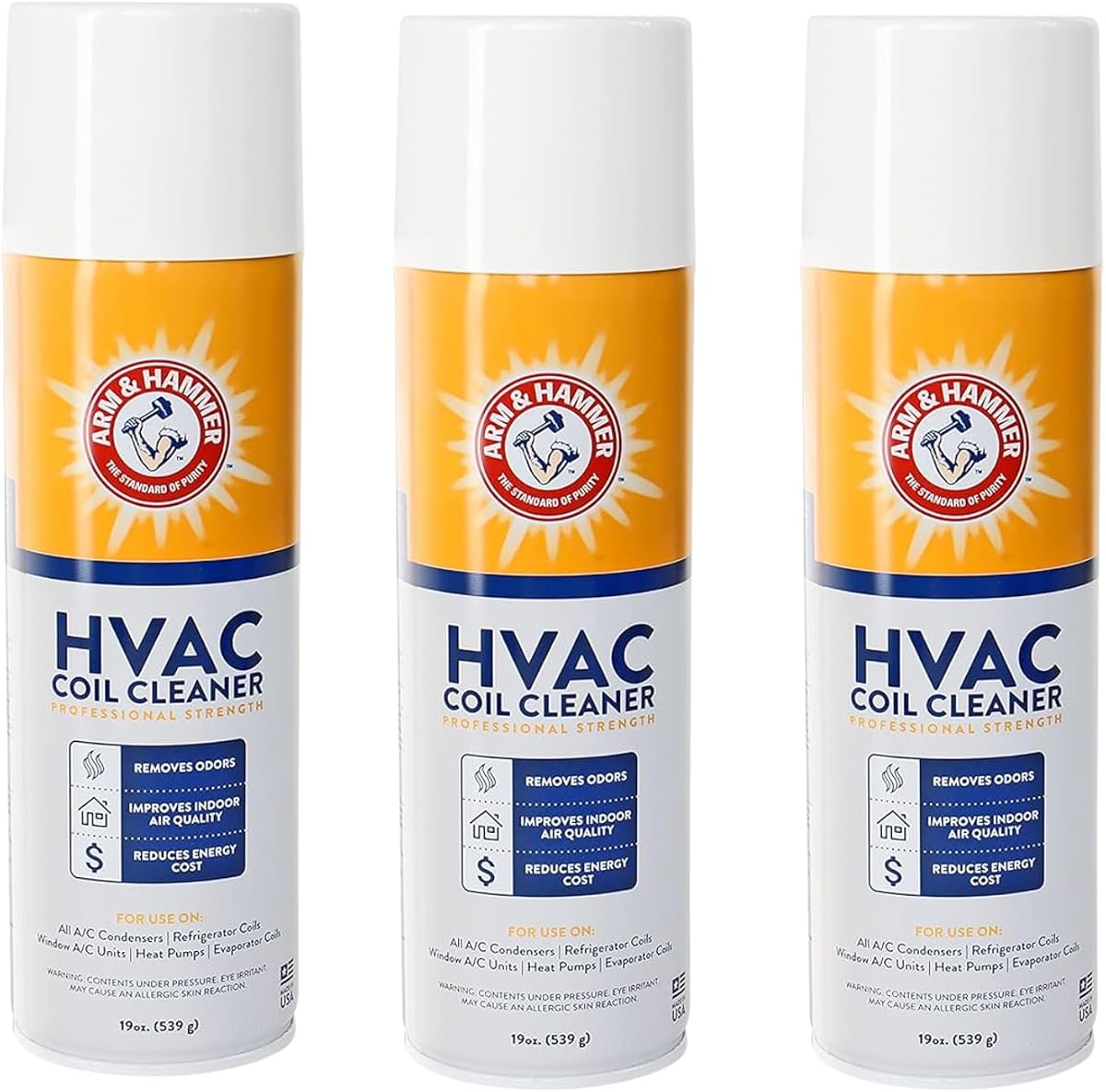
The Arm & Hammer AC Coil Cleaner 19 fl. oz 3 Pack is a 4.6-rated foaming spray made for routine HVAC maintenance. Its self-expanding formula is designed to remove dirt and buildup from coils, while its odor-banishing action is intended to leave the surrounding environment fresh-smelling and support improved indoor air quality.
We may earn a commission when you buy through this link, at no additional cost to you.
The product is intended for both sides of a cooling system, with different finishing instructions. Evaporator coils do not require rinsing because condensate from the operating unit is expected to remove dirt, debris, and cleaner. Condenser coils require a light rinse with water. That clarity makes the product suitable for seasonal whole-system cleaning when both instructions are followed.
The listing describes the formula as environmentally friendly and says it surpasses the industry's standard for green products, but such claims should be evaluated against the specific label and its defined standards. A buyer should not equate the word environmentally friendly with permission to use the product on every material or in every concentration. The three-pack is also more than a single household may need at one time.
This cleaner is a good option for buyers who want an expanding foam, odor control, and a multipack for multiple compatible units. Its 4.6 rating supports its appeal, while the clearly stated rinse difference makes responsible use more straightforward. It is particularly suitable for evaporator cleaning and for condenser maintenance when a light rinse is acceptable.
The cleaning foam expands after application to work over coil surfaces and loosen accumulated dirt. This provides broader visual coverage than a narrow spray while still requiring proper application to surrounding components.
The formula is marketed as eliminating contaminants and odor-banishing material from AC coils. Its fresh scent is a welcome secondary benefit when standing moisture and dirty surfaces contribute to musty smells.
We may earn a commission when you buy through this link, at no additional cost to you.
The right coil cleaner depends on the equipment, the type of soil, available workspace, and whether you prefer a ready-to-use aerosol or a reusable dilution tool. The following factors help narrow the field before you buy.
Begin by identifying which coil you intend to clean. Evaporator coils are often indoor units containing dust, biological residue, and oily film, while condenser coils are generally exposed outdoors to dust, pollen, leaves, and weather-related debris. Some products support both, while others are presented primarily for evaporators. A cleaner that explicitly describes both applications can simplify whole-system maintenance, provided the rinse instructions are followed separately.
Choose a product that clearly identifies the intended coil type. Do not assume an indoor no-rinse instruction applies to an outdoor condenser. In general, follow the product label and the equipment manufacturer's service guidance for application, dwell time, rinsing, and drying.
Foam is useful because it spreads across irregular fin surfaces and remains in contact with accumulated residue. Some formulas expand immediately, while others use a focused spray followed by delayed expansion. The latter is designed to carry cleaner farther beneath the visible buildup before the foam grows. When buildup is embedded between closely spaced fins, look for wording that emphasizes penetration, expansion, and liquefying grime rather than simple surface coverage.
For heavy or long-neglected buildup, prioritize deeper penetration. For light dust and routine upkeep, broad immediate foam may be sufficient. The important point is to match the cleaning action to the condition of the coil instead of choosing solely by the word foam.
Rinse requirements affect both labor and the tools needed for the job. A no-rinse evaporator formula may simplify indoor maintenance, while condenser coils usually benefit from a light water rinse to carry away residue. Some products can be wiped away instead. The supplied cleaner information varies considerably, so read the instructions for the exact model and never substitute a different product's rinse rule.
If a product requires rinsing, make sure you have a suitable low-pressure spray method, protective equipment, and a safe way to control runoff. The goal is to remove cleaner and loosened soil without forcing water into components where it could cause damage.
A household window unit has different access and drainage considerations from a central air handler, mini split, or outdoor condenser. Look for a cleaner approved for the surfaces you will actually touch. Some products also cover fan blades, metal filters, blowers, heat exchangers, vents, grills, and refrigeration equipment, which can be useful when performing a broader service session.
The product should also fit the building around the equipment. NSF registration C1 and K5 can matter in or around food-processing areas, while a stated home-maintenance design may be more appropriate for residential systems. Confirm any regulatory, material, or workplace requirements before opening the container.
Chemical profile matters when the coil assembly contains aluminum, copper, galvanized components, insulation, filters, or coatings that may react with a harsh cleaner. Corrosion inhibitors, a non-caustic formula, low VOC content, and NSF registration are meaningful attributes, but none should be treated as universal permission to spray every component. Always check the manufacturer's surface list and any cautions concerning energized equipment.
Look for clear compatibility language and recognizable qualifications. If a listing provides little technical information, obtain the current label before purchase. Users should also follow standard aerosol and chemical-handling precautions, including appropriate ventilation, eye protection where advised, and keeping the product away from unintended surfaces.
Cleaning can address musty smells, but odor control is not identical to removing every source of contamination. Some formulas specifically neutralize odors associated with standing water in drain pans, while others leave a fresh lemon or mild scent after treatment. Standing water in a drain pan may indicate a drainage issue, so cleaning alone should not be treated as a substitute for correcting a blockage or malfunction.
For odor-focused maintenance, choose a product that explicitly states drain-pan deodorization or contaminant removal. For general freshness, a scented formula can improve the finished smell, but fragrance should be treated as a secondary benefit rather than evidence that the coil is clean.
Ready-to-use aerosols are convenient, portable, and easy to dose for occasional cleaning. Multipacks reduce repeated purchasing and suit multiple units. Gallon and large-container formats provide more product for recurring service, while an automatic foaming sprayer gives users control over dilution and continuous application. These formats are not interchangeable: a tool such as the Coil Cannon requires a separately purchased compatible cleaner.
Match the format to your maintenance volume. A household with one seasonal cleaning may be best served by a single aerosol or moderate container. A technician, landlord, or multi-system owner may benefit more from multipacks, bulk capacity, or a reusable hose-fed sprayer. Consider storage, carrying, refill frequency, and setup time as well as the cleaner itself.
Coverage is not stated numerically for most products, so users should think in terms of application area and number of jobs. A larger container may suit a large coil or multiple systems, while a smaller aerosol is easier to store and use selectively. Multipacks can be particularly helpful for seasonal maintenance across several units, but they provide less flexibility if only one compact system needs attention.
Value should be assessed by compatibility, cleaning method, and convenience rather than container size alone. A product that reduces rinsing, covers both coil types, and includes useful qualifications may be more practical for the job. Confirm current pricing, availability, and package quantity before purchasing because both can change.
Start by identifying the system, the coil type, and the manufacturer's cleaning instructions. Move the switch for the equipment off, avoid spraying electrical parts, and use the recommended personal protective equipment. A condenser generally needs more outdoor access and runoff planning, while an evaporator often sits inside a cabinet or above a drain pan. Clear nearby belongings and protect surfaces that the cleaner could contact.
Apply the product according to its label and the cleaner's spray pattern. For an aerosol, hold the can at the recommended distance and angle, working section by section so that each area receives an even application. For a hose-fed sprayer, add the correct cleaner, select the dilution specified for that product and application, and test the spray before treating the full coil. Do not assume the sprayer's ratio settings override the chemical manufacturer's dilution instructions.
Allow the stated dwell or working time, then follow the product-specific removal instructions. Evaporator treatments may be described as no-rinse, but condensate should be allowed to carry away residue as intended; condenser treatments may require a light rinse. Keep the system in the correct operating state when a product relies on condensate for rinsing, and confirm that the coil is dry before restoring normal operation. If buildup remains, a second treatment or professional service may be more appropriate than forceful brushing.
Only if the product label identifies both applications. Many cleaners are formulated for both, but their finishing instructions differ: an evaporator may require no rinse, while a condenser may need a light rinse with water. Follow the directions for each assembly rather than assuming one treatment applies identically to both.
It depends on the product. The Frost King, Nu-Calgon Evap Foam, and several other choices in this guide are described as no-rinse or self-rinsing products. Other formulas may need to be wiped or rinsed away. Always read the current label, allow the specified working time, and let the unit run as directed if the formula relies on condensate to remove residue.
A foam designed to penetrate and lift heavy soils is a strong starting point, but outdoor coils also need adequate access and a planned light rinse. The Leak Saver Foam Blaster, PURAFILTER 2000, and Simple Green options all address condenser applications in different formats. A hose-fed sprayer such as the Coil Cannon may appeal to users who want controlled dilution and extended spraying.
Cleaning can remove odors caused by dirt, grease, and contaminated standing water, but it may not resolve the underlying source. If moisture is not draining properly, if a pan is blocked, or if another component is contaminated, the odor may return. Cleaning the coil and drain area is still useful, but persistent smells can indicate a drainage or equipment issue that needs attention.
A gallon format is generally more convenient for technicians, landlords, or households with repeated maintenance, while an aerosol is easier to store and use for a single job. Capacity alone does not determine performance; compatibility, foam action, rinse requirements, and application surfaces are more important. The Simple Green gallon is attractive when supply continuity matters, provided its current label confirms the intended use.
Immediate foam spreads across the surface as soon as it contacts a coil. Delayed-expanding products, such as the Leak Saver Foam Blaster, first use a focused spray to drive cleaner into the surface before the foam grows. The intended advantage is deeper penetration, although the actual result also depends on application technique, soil level, and proper dwell time.
No, because many coil cleaners are ready to use from an aerosol container. A dilution sprayer is useful when you want repeatable mixing, larger continuous application, or the ability to use a concentrated cleaner. The HVAC Guys Coil Cannon is a tool rather than a cleaner, so it requires a compatible coil-cleaning chemical and a standard garden hose.
Follow the product and equipment instructions exactly. Some no-rinse evaporator products expect condensate from the operating unit to remove dirt and cleaner, but general spraying around energized or moving components is unsafe. If the instructions do not clearly permit operation during cleaning, turn the system off and allow the fan to stop before accessing the coil.
The Simple Green 20oz 3 Pack offers the broadest overall versatility, with use across multiple HVAC components, self-rinsing behavior on condensate-producing coils, and NSF C1 and K5 registration. The Frost King ACF19 is the budget-oriented pick for no-rinse cleaning, odor neutralization, and straightforward use on coils, fan blades, and reusable filters. For users prioritizing deep penetration, the Leak Saver Foam Blaster 3 Pack stands out with delayed expansion and separate evaporator and condenser guidance.
Prioritize the requirements of the actual cleaning job rather than the package size. Match the product to the coil type, check whether rinsing is required, confirm material compatibility, and consider how often the system will be serviced. A gallon container is useful for recurring work, while an automatic sprayer provides control and consistency for frequent or larger cleaning tasks. Ready-to-use aerosols remain the simplest option for occasional maintenance.
Before buying, confirm the current package contents, label directions, application surfaces, and availability. Product details and pricing can change, and ratings reflect changing customer feedback rather than a guarantee for every installation. With the right compatibility and a careful application process, the right coil cleaner can support cleaner surfaces, smoother airflow, and more consistent seasonal care.
