
QWORK Mini Heat Gun
4.5Editor score
Compact 300W heating element
Focused 390°F output
Retractable hands-free stand
Compare the best heat gun for shrink tubing, including heat control, airflow, safety features, nozzle options, and ideal uses for detailed DIY work at home.
A heat gun for shrink tubing must deliver concentrated, controlled heat without overheating the insulation or nearby components. Temperature adjustment, airflow control, nozzle design, and a stable grip all influence whether the tubing contracts evenly and whether delicate electronics remain protected from accidental damage.
This guide compares ten heat guns based on their published power, heat ranges, airflow settings, safety features, included accessories, and suitability for common shrink-wrapping tasks. It covers compact tools for small repairs as well as higher-output models for demanding workshop projects, helping buyers match capability to the job.
Each review highlights the most useful characteristics and honest limitations of its featured model, while the comparison table provides a quick side-by-side reference. Product availability, configurations, and listed features can change, so confirm the current listing and included accessories before purchasing.
4.5Editor score

4.6Editor score
4.8Editor score
The comparison below evaluates all ten featured heat guns across heating capability, control, accessories, portability, and practical shrink-tubing suitability.


This SEEKONE combines an 1800W motor with variable heat ranging from 122°F to 1202°F, giving it the strongest case for general-purpose shrink tubing work in this group. Its 4.6 rating reflects a favorable balance of power, control, and versatility. The broad adjustment range makes it suitable for delicate wire insulation as well as larger electrical connectors and packaging applications.
We may earn a commission when you buy through this link, at no additional cost to you.
Two operating modes separate temperature range from airflow. Mode I covers 50-450°C with airflow of 190-210 liters per minute, while Mode II extends from 50-650°C with airflow of 250-500 liters per minute. A black rheostat-style dial provides gradual heat adjustment, and a handle-mounted switch controls airflow. This separation is valuable because the correct response to uneven shrinking is not always more heat; sometimes moving more air prevents scorching while maintaining a useful working temperature.
The accessory set is unusually useful for shrink tubing. A deflector nozzle produces a long, narrow pattern, two concentrator nozzles focus the hot air, and a reflector spreads it around a broader area. That range helps when covering a long splice, shrinking a small connector, or heating several adjacent pieces. Overheat protection, an ergonomic handle, and an extensive 122-1202°F range are meaningful advantages, but the larger body and more complicated controls may be unnecessary for someone only occasionally repairing a tiny wire.
This is the most versatile option for buyers who want one tool for electronics, crafts, packaging, PVC work, and other heating tasks. Begin at a lower setting, select the airflow appropriate to the material, and increase heat gradually. For frequent shrink-tubing work or a mixed workshop, the combination of continuous control, strong output, and four nozzles makes this a particularly well-rounded recommendation.
Gradual temperature adjustment lets the user respond to the tubing in real time instead of relying entirely on fixed presets. Lower airflow can help maintain focus around a small splice, while greater airflow is useful when covering a larger connector or keeping the surrounding surface cooler.
The four included nozzles make it possible to switch between narrow, focused, dispersed, and redirected airflow. This versatility is especially helpful when the same project contains both small wire insulation and a broader sleeve that requires more even heating.
We may earn a commission when you buy through this link, at no additional cost to you.
The SEEKONE HG350 is designed for precision rather than maximum output. Its 350W rating, compact body, and two fixed settings of 500°F and 842°F make it a practical choice for small heat-shrink applications around wires, terminals, and electronic connections. The 4.6 rating indicates that buyers generally appreciate its combination of portability, simple controls, and focused performance.
We may earn a commission when you buy through this link, at no additional cost to you.
The included focusing nozzle helps keep the heated region narrow, which is valuable in crowded work areas. At the lower setting, the tool can work on more sensitive materials; the higher setting provides additional contraction force for tougher sleeves. Built-in overheat protection and a nozzle safety shield add visible safety features, while the retractable stand allows the gun to rest upright when both hands are needed for positioning the tubing.
Fixed settings are the main compromise. Some materials benefit from gradual heating, and this model cannot provide that level of incremental control. Its 350W output also makes it less attractive for large-diameter tubing, heavy connectors, or prolonged high-output work. The product description lists heating, shrink wrapping, and 3D printing among its uses, but the focused nozzle and small form factor make it most compelling for detail-oriented shrink tubing tasks.
Choose this model when your work is concentrated on small connections and you value easy handling more than power. It is particularly suitable for home electronics, cable ends, and craft projects in a confined workspace. For larger connectors or frequently changing materials, one of the higher-output variable-temperature guns will offer more flexibility.
The lightweight, short-bodied design is easier to position around dense wiring than a full-size heat gun. Its narrow nozzle also helps the user target a small section of tubing instead of heating a broad area of the assembly.
The 500°F and 842°F choices cover two distinct levels of working heat. That simplicity makes the tool approachable for occasional users who want predictable operation without a complicated adjustment dial.
We may earn a commission when you buy through this link, at no additional cost to you.
With an 1800W motor, two airflow modes, and temperature settings of 752°F and 1112°F, this SEEKONE is built for demanding heat applications. Its 4.7 rating places it among the strongest performers in the group. It is a good fit for larger shrink sleeves, packaging, vinyl work, and other jobs where strong, rapid airflow can reduce the time needed to complete the task.
We may earn a commission when you buy through this link, at no additional cost to you.
Mode I provides 752°F with 250 liters per minute of airflow, while Mode II provides 1112°F with 500 liters per minute. That combination creates two distinctly different working profiles: one for controlled applications and one for aggressive heating. The product is UL certified, incorporates overheat protection, and uses flame-retardant material around the outlet. A non-slip TPE handle, built-in stand, and hanging hook make it practical for extended workbench sessions.
The trade-off is that users choose between two fixed temperatures rather than adjusting heat continuously. That can be less forgiving on heat-sensitive materials, particularly around plastic housings or thin insulation. The manufacturer also notes that smoke and a burning odor during first use are normal as the anti-rust coating on the heating core is heated. Users should follow the manual and work in a ventilated area during initial operation.
This model is most appropriate for experienced users who want a powerful, simple tool with clearly separated operating modes. It offers strong output without the complexity of a variable dial, making it useful for workshop tasks where repeatable high or medium heat is desirable. Buyers working mostly with tiny, delicate connectors may prefer finer temperature control.
The high-output motor and two airflow profiles make this model suitable for larger sleeves and repeated heat-shrink tasks. The higher mode can cover a larger area more quickly, while the lower mode offers a gentler starting point.
A non-slip grip, integrated stand, and hanging hook support both active use and storage. These details are especially valuable when the heat gun is part of a frequently used bench setup rather than a portable occasional tool.
We may earn a commission when you buy through this link, at no additional cost to you.
This SEEKONE combines the broad 122-1202°F range of the full-size variable model with a housing that is 20% smaller than traditional designs. Its 4.7 rating indicates strong user approval, and the combination of continuous temperature control, 1800W output, and a compact format makes it a compelling all-around shrink-tubing tool.
We may earn a commission when you buy through this link, at no additional cost to you.
Stepless adjustment lets users increase or reduce heat in small increments rather than choosing between two presets. Two airflow speeds add another layer of control: Mode I covers 50-350°C with 300 liters per minute, while Mode II covers 50-650°C with 500 liters per minute. A ceramic heating element supports efficient operation and stability, and four included nozzles support heat-shrink tubing, vinyl wrapping, electronics, and other detailed or broader tasks.
The main consideration is that the higher end of this range can heat quickly, so the tool demands attention around delicate materials. The compact body does not make the hot airflow less intense. Buyers should therefore begin with moderate heat, keep the nozzle moving, and use airflow to manage how rapidly the work heats. The model also offers less specialized guidance than some competing products about stand placement or storage, although its reduced footprint remains useful.
This is an excellent choice for users who want broad control in a less bulky package. It handles small electronics and larger sleeves with the same tool, allowing the operator to match the heat to the material rather than changing machines. For anyone building a flexible repair kit, the combination of adjustment range, airflow selection, compact dimensions, and multiple nozzles is particularly valuable.
Continuous adjustment is the key distinction between this model and dual-setting alternatives. It makes the tool easier to adapt when different sleeve materials, connector sizes, or nearby components respond to heat at different rates.
Although 20% smaller than a traditional heat gun, the product retains substantial output and a full nozzle set. That makes it useful for technicians or crafters who need workshop capability without a large fixed tool.
We may earn a commission when you buy through this link, at no additional cost to you.
The QWORK mini heat gun focuses on small-scale craft and repair work. Its 300W power and ability to heat to 390°F are enough for several types of heat-shrink tubing and resin finishing, while its pencil-style body gives the user precise placement. The 4.5 rating reflects a useful combination of affordability, portability, and straightforward operation.
We may earn a commission when you buy through this link, at no additional cost to you.
The tool reaches 390°F for focused hot-air work, making it most appropriate for thin tubing, small wire connectors, epoxy resin bubble removal, candle making, vinyl wrap, and paint drying. A retractable stainless steel stand provides stability while the user manipulates the workpiece. The lightweight grip helps reduce fatigue during detailed crafting, and the published guidance calls for a distance of 3-5 centimeters and use periods of no more than 10 minutes.
Its capabilities are intentionally limited. A 390°F maximum may not provide enough thermal energy for thick-wall tubing, large connectors, or materials that require sustained high-temperature exposure. The product information does not list interchangeable nozzle attachments, so changing the airflow pattern is not part of the documented feature set. Users should also keep the air outlet unobstructed and treat the operating-time and distance guidance as important operating limits rather than optional suggestions.
Choose the QWORK for occasional, detail-oriented shrink tubing where portability and simple handling matter more than industrial output. It is especially useful for hobby desks, small electronics, resin projects, and lightweight household tasks. Users who routinely work with large-diameter sleeves or need precise temperature selection should choose a higher-output variable-temperature model.
The 390°F output targets detail applications without the extreme temperatures of larger tools. Working distance and short operating periods help users control heat buildup around small components.
The retractable stainless steel stand keeps the tool off the work surface and gives the user a free hand. This is useful when holding a short wire or turning a small connector during heating.
We may earn a commission when you buy through this link, at no additional cost to you.
The Wagner HT1000 Kit combines 750°F and 1000°F settings with three purpose-built nozzles. Its 4.6 rating and household-project focus make it a strong candidate for anyone who values straightforward operation and accessory design. Although it offers only two heat levels, each is positioned as a practical choice for common home improvement and shrink-wrap tasks.
We may earn a commission when you buy through this link, at no additional cost to you.
The edge protector nozzle directs heat away from delicate surfaces, making it useful when the sleeve is installed close to a housing or finished face. The flare nozzle distributes heat over a long, narrow region, while the concentrator produces a small, focused pattern for compact connections. Together, they cover several common shrink-tubing geometries without requiring a separate accessory system. An integrated stand provides hands-free placement, and the corrosion-resistant nozzle is designed for longevity.
Fixed temperatures are the main limitation. Users working with materials that demand gradual adjustment may find the two choices less accommodating, particularly if the surrounding components have different thermal tolerances. The tool is also marketed for a broad collection of household jobs, including removing paint, loosening rusted bolts, thawing pipes, shrinking wrap, and heating PVC, so it is more versatile than a dedicated craft-only tool.
This kit is well suited to household users and repair hobbyists who want a safe, simple heat gun with useful nozzle choices. Its edge protector is particularly valuable for accessible installations where shielding the work is difficult. For continuous-temperature projects, consider a variable-control model; for straightforward sleeves and household jobs, the HT1000 provides a practical and well-rounded setup.
The edge protector provides a practical way to direct hot air away from a nearby finished surface. This is helpful when a connector is mounted in a location where shielding with metal or another barrier would be awkward.
Concentrated, long-narrow, and redirected airflow cover most shrink-tube shapes. Having the correct nozzle available reduces the need to improvise or overheat a joint simply because the airflow pattern is poorly suited to it.
We may earn a commission when you buy through this link, at no additional cost to you.
ROMECH combines 1500W output, variable temperature control, and two airflow levels in a heat gun aimed at both craft and repair work. Its 4.6 rating indicates that the core proposition is well received. The 120-1200°F range provides enough flexibility for different heat-shrink materials, from lighter sleeves to demanding connectors.
We may earn a commission when you buy through this link, at no additional cost to you.
The manufacturer states that the tool can reach peak heat in 1.5 seconds and that airflow can be set to either 66 or 132 gallons per minute. Construction includes an UL-certified cord, ceramic frame, nickel-chromium heating coil, polycarbonate blower fan, mica plates, and overload protection. These details point toward durability and thermal stability, while the four bundled nozzles support paint stripping, window tint, candle making, PVC bending, heat-shrink wrap, and connector work.
A major convenience is the ability to stand the tool on its own, freeing both hands while a larger sleeve contracts. The slip-resistant handle supports sustained use, and the broad range makes the gun useful beyond a single material. On the other hand, there is no LCD to display the selected temperature, so the user must rely on the dial and experience. The published peak-heating figure also does not by itself indicate how quickly a particular sleeve reaches its contraction temperature.
This model is a compelling choice for users who want one dependable tool for shrink tubing and several adjacent household or workshop tasks. It is especially appropriate when the gun may be used on large connectors, packaging, tint film, or pipe-related projects. Those who require a digital display and the clearest possible temperature indication may prefer the DEWALT, but ROMECH offers strong physical features and broad adjustment.
The stated ceramic frame, heating coil, fan, and mica plates create a more robust-looking construction than a basic craft tool. Overload protection adds another layer of operational safety when the gun is used for extended tasks.
Independent airflow levels help control how quickly heat reaches the workpiece. Lower airflow supports close work on a small joint, while the higher setting can move heat across a larger sleeve or stubborn material.
We may earn a commission when you buy through this link, at no additional cost to you.
The BLACK+DECKER HG1300 combines 1350W output with an emphasis on handling and convenience. Its 4.8 rating is the joint-highest among the featured products, suggesting that users value its practical construction. The gun is designed for general household tasks, including heat-shrink applications, and its side handle is one of its most noticeable ergonomic features.
We may earn a commission when you buy through this link, at no additional cost to you.
Two temperature settings of 750°F and 1000°F cover distinct levels of working heat. A three-position side handle provides a comfortable grip and allows the user to change wrist angle as the nozzle moves around a connector or along a sleeve. The built-in stand makes cooldown more convenient and keeps the hot nozzle away from the bench, while the lightweight, compact body is easier to maneuver than a large industrial tool.
Because it offers two fixed settings, the HG1300 is less flexible than continuously variable guns. The listed accessory set is also limited to a glass protect nozzle, so users who need several airflow patterns may have to purchase additional accessories separately. Its stated broad applications include paint stripping, loosening rusted nuts, and thawing pipes, but it is not designed to replace a precision electronics rework station with calibrated temperature readouts.
This heat gun suits crafters and household repair users who value comfortable handling, straightforward controls, and a stable cooling position. The three-position grip is especially helpful during repeated shrink-tubing tasks involving different angles. Users with varied-material requirements may prefer a variable model, while those who appreciate simple operation and a familiar household-tool format will find the HG1300 easy to integrate into a toolkit.
The side handle can be repositioned to reduce wrist strain and maintain a comfortable grip. This is beneficial when moving around a circular connector, following a long sleeve, or working at an awkward bench angle.
The integrated stand provides a designated resting position while the gun cools. It reduces the chance of placing a hot nozzle directly on a work surface and makes the tool easier to put away after a project.
We may earn a commission when you buy through this link, at no additional cost to you.
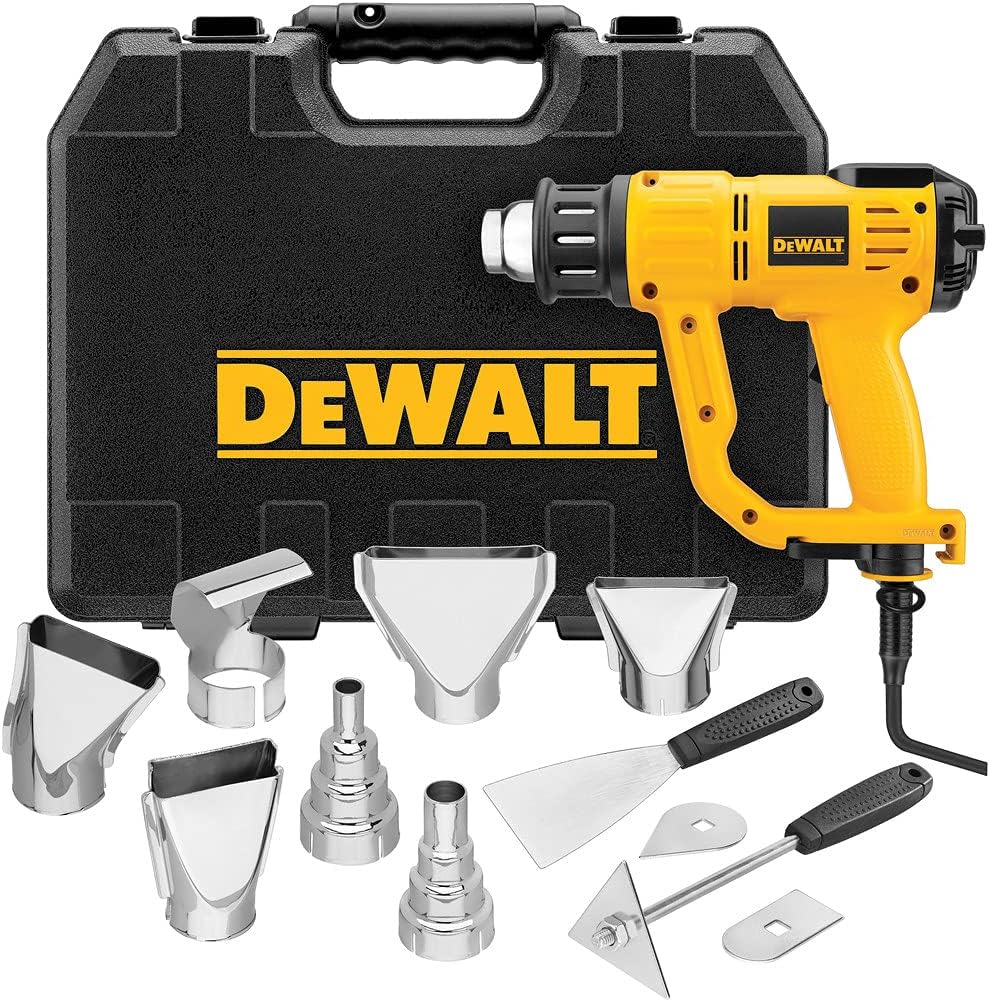
The DEWALT D26960K stands apart through its LCD temperature display and adjustment in 50-degree increments. Its 4.8 rating makes it one of the most highly regarded products in this roundup. For shrink tubing, a visible temperature setting can be especially valuable because it reduces guesswork when working with different sleeve materials or sensitive adjacent components.
We may earn a commission when you buy through this link, at no additional cost to you.
Built-in overload protection shuts down the heating element if the tool overheats. A hang ring supports storage, a cord protector guards the cord entry, and an innovative kickstand improves stability and helps prevent tip-over. The ergonomic comfort grip is intended to reduce fatigue during long jobs, while the listed weight of 2.3 pounds keeps the tool relatively compact for its output class. The product is presented with a hard case and accessory kit.
The premium positioning comes with less emphasis on compactness or simple fixed-setting operation. A digital display is valuable, but it does not replace good technique: the operator still needs to keep the airflow moving, maintain an appropriate distance, and watch the tubing rather than relying entirely on the number shown. Buyers should also verify the current package contents, because bundles can vary by listing or region.
This model is an excellent choice for professionals, serious electronics hobbyists, and anyone who wants repeatable heat selection without estimating a dial setting. It is particularly useful when an assembly includes multiple materials or when a nearby component has a tighter heat tolerance. The display, overload protection, stability features, and storage provisions make it a polished choice for a serious heat-shrink toolkit.
The LCD display and 50-degree increments make selected heat easier to understand and repeat. This is particularly helpful when a project includes multiple sleeves or when documenting the setting used for a specific material.
The kickstand, hang ring, cord protector, and overload protection are practical additions for repeated professional use. Together they support stable placement, organized storage, and protection against overheating.
We may earn a commission when you buy through this link, at no additional cost to you.
The Weller 6966C is a compact industrial-style heat gun with a simple three-position switch and a 250W heating output. Its 4.7 rating indicates a favorable reception, although the supplied product information is more limited than for the other models. It is primarily notable for its dedicated cooling function, grounded power connection, and straightforward operation.
We may earn a commission when you buy through this link, at no additional cost to you.
The Hi-Off-Cool control gives the user an explicit cooling position rather than requiring the tool to cool passively after switching off. This can be useful when moving the gun between tight work areas or setting it down after completing a section. A three-wire grounded plug and six-foot power cord provide a conventional power setup with some extra reach around a workbench.
The main limitation is the lack of documented temperature range and airflow data. Buyers cannot compare its heat output precisely with the 750°F, 1200°F, or continuously adjustable models in this guide. No collection of interchangeable nozzles is listed either, and the 250W rating indicates substantially less capacity than the full-size 1350W to 1800W tools. That makes it better suited to smaller heat-shrink applications than large sleeves or heavy-duty material shaping.
Choose the Weller when a simple dedicated cooling setting and industrial-style power configuration are the deciding factors. It may suit electronics or repair work where compact handling matters more than broad material compatibility. For users who need precise temperature ranges, multiple airflow patterns, or rapid adjustment, one of the variable-control models offers much clearer documentation and greater flexibility.
The third switch position gives the operator an intentional way to cool the heating element. That can make short jobs and repeated repositioning more convenient than relying on passive cooldown alone.
The three-wire grounded plug and six-foot cord support use in a properly grounded workspace. The additional cord length can reduce the need to work directly beside a wall outlet or power strip.
We may earn a commission when you buy through this link, at no additional cost to you.
The right heat gun balances heat output, temperature control, airflow, nozzle design, portability, and safety. The most important factors depend on whether you are shrinking tiny wire insulation, large connectors, packaging, or a mixture of materials.
Prioritize a tool that reaches the required temperature steadily and allows airflow to be managed. Avoid relying on maximum output as the only measure of quality; excessive heat without control can damage insulation before the sleeve has contracted evenly.
Choose adjustable airflow whenever possible, and avoid holding the nozzle still over one point. Continuous movement and a suitable distance help the sleeve shrink uniformly rather than forming bubbles, wrinkles, or thin spots.
Look for at least one focused and one broader pattern for general use. Additional nozzles are valuable only when they serve connectors or sleeves you actually encounter.
Match output to the largest and most difficult sleeve in your regular workload. For detailed electronics work, control and focus are often more useful than maximum power.
Check that the tool can stand securely and cool safely. A stable rest is more useful than extra power when the user must maintain a careful position around a delicate assembly.
Treat a blocked outlet as a serious hazard. Stop operation if the air outlet is obstructed, and follow the manufacturer’s warm-up, cooldown, distance, and ventilation instructions.
Choose the smallest tool that reliably covers your materials. A larger model is unnecessary for a few delicate connections, while a mini model may require repeated passes on thick tubing.
Choose the control system you will understand and use consistently. Clear controls and a visible readout are most valuable for technicians or hobbyists who repeatedly change materials and joints.
Prepare the workpiece before heating. Slide the heat-shrink tubing over the clean connection and confirm that it is correctly positioned without twisted edges or trapped moisture. Inspect the surrounding assembly for plastic housings, labels, glue, and other heat-sensitive materials. A small barrier or the edge-protector nozzle can help shield areas that should not receive direct heat.
Set the tool to a conservative temperature and choose an airflow level appropriate for the material and size of the sleeve. Hold the nozzle a short distance from the tubing and keep it moving in a slow, steady sweep. Work around the circumference rather than concentrating on one side, allowing the heat to spread evenly. Stop when the tubing fits snugly, feels fully contracted, and shows a smooth surface without darkening or blistering.
After use, switch the tool off and place it on its stand or in the designated cooling position. Keep the air outlet unobstructed, allow the heater to cool completely, and unplug it before storage. Wipe away loose debris only after the tool has cooled, avoid blocking the vents, and inspect the cord and nozzle periodically. Follow the product manual for additional operating limits and safety instructions.
The correct temperature depends on the tubing material, diameter, and construction. Start below the manufacturer’s recommended working range, apply heat gradually, and increase it only if the sleeve does not contract smoothly. Thin tubing and heat-sensitive components require more caution than heavy-wall sleeves, so use the tube packaging or instruction sheet as the most reliable reference.
Yes, a mini heat gun can be effective for small wire insulation, short sleeves, and compact connectors. Models such as the SEEKONE 350W and QWORK 300W are intended for this type of focused work. They are less suitable for large-diameter or heavy-wall tubing because their lower output and smaller airflow may take longer to produce an even contraction.
Yes. Continuous movement distributes heat around the sleeve and reduces the likelihood of overheating one section. Sweep the nozzle around the circumference and along the length instead of holding it in one place. If the tubing wrinkles, changes color, or gives off a strong odor, stop and allow it to cool before trying a gentler setting.
A concentrator or narrow focusing nozzle is usually best for small connectors because it limits the heated area. A broader flare or deflector pattern is more appropriate for long sleeves where heat needs to be spread over a larger region. Match the nozzle shape to the joint, and never place the hot tool directly against the plastic insulation.
It can be worthwhile when you work with several materials or nearby components that tolerate different heat levels. Continuous adjustment makes it easier to reduce heat gradually rather than choosing only a high or low preset. For a single familiar sleeve type, a simpler two-setting gun may still provide an effective result.
Follow the manufacturer’s cooldown guidance and wait until the tool is no longer hot before handling or storing it. Use the integrated or retractable stand for this purpose and keep the cord and plastic surfaces away from the hot nozzle. A dedicated cooling position, where available, can shorten the handling interval while preserving safe airflow.
Wrinkling can result from uneven heating, excessive temperature, a poorly positioned sleeve, or trapped moisture. Rotate the workpiece and sweep the heat around it rather than heating one section. Begin with less heat, increase the airflow if needed, and make sure the tubing was slid over the connection before heating.
Most full-size models in this guide are versatile enough for electronics, crafts, packaging, vinyl, and household repair work. Continuous temperature control and interchangeable nozzles provide the greatest flexibility. A mini gun is better for small, focused craft and electronics tasks, while a higher-output model is preferable for larger sleeves and demanding materials.
The SEEKONE 1800W Variable Temp Heat Gun is the strongest all-around choice because it combines broad heat control, two airflow modes, and four useful nozzles. The QWORK Mini Heat Gun serves small, precise craft and electronics work, while the DEWALT Classic LCD Heat Gun stands out for its display, incremental settings, and premium stability features. Each addresses a different need within the same core category.
Prioritize the features that match your actual materials. Small sleeves benefit from focused airflow and compact handling, larger connectors need sufficient output, and mixed assemblies are easier to manage with continuous temperature adjustment. Include the cost of protecting nearby surfaces and consider the usefulness of a stable stand, but do not buy more power than your typical work requires.
Before ordering, confirm the current temperature range, electrical requirements, included accessories, warranty information, and product listing. Availability and configurations can change, and using the manufacturer’s current manual is essential for safe, effective heat-shrink work.