
Standard Horizon HX210
4.6Editor score
Six-watt transmit power
Submersible IPX7 protection
Water-activated emergency strobe
Our best handheld VHF radio for dinghy safety guide compares waterproofing, flotation, transmit power, battery life, channel features, and charging options.
A handheld VHF radio is one of the most practical safety tools for a dinghy sailor because it keeps essential communication close at hand without requiring a fixed installation. The best models combine reliable flotation, water resistance, readable displays, useful power settings, and dependable access to distress and weather channels, even when cockpit space is limited.
We compared the ten models in this guide by examining their confirmed waterproof ratings, floating designs, transmit-power options, battery arrangements, channel coverage, watch functions, emergency lighting, charging methods, and marine-specific features. The list includes compact radios, higher-output models, and advanced units with GPS, Bluetooth, and text-message support.
Each review explains the radio's strongest qualities, practical limitations, and likely appeal so you can match a model to your sailing area, experience, and safety priorities. Product availability and prices change over time, so confirm the current specifications, accessories, and listing details before making a final purchase.
4.6Editor score

4.9Editor score
4.1Editor score
The comparison table highlights the most important distinctions among these dinghy radios, including flotation, water resistance, transmission power, display behavior, battery support, emergency features, and charging options.


The Cobra BlueBound 350 White combines a six-watt transmitter, selectable power settings, Tri-Watch monitoring, and NOAA weather access in a compact marine handheld. Its 4.5 rating reflects a well-rounded feature set, while the high-visibility orange floating core adds an extra safeguard if the radio goes overboard. The white body also makes the unit easy to distinguish among wet deck gear.
We may earn a commission when you buy through this link, at no additional cost to you.
Its strongest benefit is flexibility. Switching between one, three, and six watts allows a dinghy sailor to conserve battery power during routine harbor use and increase output when communicating farther offshore. Tri-Watch keeps channels 9, 16, and a user-selected channel available, which is useful when a sailing area has busy traffic or changing emergency priorities. The day/night LCD mode and NOAA emergency channel access improve situational awareness.
The radio does not include the GPS, Bluetooth, or text-message functions found in some more advanced models, so it is not aimed at cruisers who want extensive digital coordination. Its IPX7 waterproof rating and floating core provide a reassuring baseline for marine use, but neither feature means the radio should be left submerged unnecessarily. Charging information is not detailed in the supplied specifications, so buyers should verify the included power arrangement.
This is a strong all-around choice for a dinghy sailor who wants more range than a low-wattage model without moving to a feature-heavy setup. The combination of flotation, tri-channel monitoring, weather alerts, and selectable output is particularly practical. I would favor it for general-purpose coastal and coastal-estuary use, especially when straightforward physical controls and clear marine functions matter more than integrated GPS.
The one-, three-, and six-watt settings let users match output to conditions. Lower power can reduce battery consumption around shore, while the upper setting is more appropriate when contact with distant vessels or shore stations may be needed.
Tri-Watch allows simultaneous attention to channels 9, 16, and a programmed channel, while access to twelve NOAA weather channels and the emergency broadcast channel adds useful information when conditions deteriorate.
We may earn a commission when you buy through this link, at no additional cost to you.
The black Cobra BlueBound 350 offers the same balanced marine feature set as the white version, including six-watt transmission, Tri-Watch, NOAA weather channels, and an IPX7 waterproof rating. Its 4.5 rating indicates solid customer reception, while the black enclosure may appeal to owners who prefer a less conspicuous instrument in the cockpit. Like the white model, it includes a high-visibility orange floating core.
We may earn a commission when you buy through this link, at no additional cost to you.
The switchable one-, three-, and six-watt output makes the radio adaptable to a range of dinghy journeys. A sailor can begin with efficient low-power communication and increase output when distance or obstruction makes a response difficult. Tri-Watch simultaneously monitors channels 9 and 16 alongside the selected channel, helping preserve access to hailing and emergency traffic. NOAA weather alerts and selectable LCD brightness add further practical value.
Compared with advanced models, this radio lacks integrated GPS, a man-overboard position marker, Bluetooth, and text messaging. Those omissions are reasonable for a sailor who mainly wants dependable voice communication and conventional weather information. As with any waterproof handheld, the stated IPX7 rating should not be treated as permission for routine storage underwater, and users should protect the charging contacts from salt and moisture.
Choose the black BlueBound 350 if you prefer the same core capabilities as the white edition but want a more subdued appearance. It is well suited to dinghy use because it combines flotation, selectable output, emergency-channel monitoring, and weather access without requiring a fixed mounting bracket. It is a particularly sensible option for coastal sailors who want a straightforward high-power radio.
The black model preserves the same marine-focused controls and functions as the white version. That makes it a straightforward alternative for owners who prioritize performance and visibility over enclosure color.
Constant access to channel 16 through Tri-Watch is central to its safety role. Weather channels and the NOAA emergency broadcast channel provide additional information when weather or navigation conditions change.
We may earn a commission when you buy through this link, at no additional cost to you.
The Standard Horizon HX210 is a 4.6-rated floating marine handheld with six-watt maximum power, an IPX7 waterproof rating, a water-activated emergency strobe, and a generous accessory package. Its 1,850 mAh lithium-ion battery and three-hour desktop rapid charger make it a particularly complete option for owners who want a dependable shore-based charging setup.
We may earn a commission when you buy through this link, at no additional cost to you.
The radio provides selectable one-, 2.5-, and six-watt output, international and Canadian channel access, weather reception, an FM broadcast receiver, programmable function keys, and a high-resolution dot-matrix display. The water-activated strobe is a meaningful safety addition because it can make a dropped radio easier to locate in darkness or poor visibility. A three-year waterproof warranty also adds reassurance for regular marine use.
The charging system requires more space than a simple USB-C arrangement because it includes an AC/DC rapid charger cradle, 12-volt and 110-volt charging cables, and the charging cradle. The radio also does not advertise GPS or Bluetooth in the supplied information, so it is less suited to advanced position sharing than the Uniden MHS338BT. Nevertheless, its core voice and monitoring functions are comprehensive for coastal cruising.
The HX210 is best for a dinghy owner who wants a complete, dedicated marine package rather than a general-purpose compact radio. It is a particularly good fit for boats with a protected locker or charging station where the included cradle can remain on board. For sailors prioritizing physical controls, strong battery capacity, conventional channel operation, and emergency visibility, it remains one of the most compelling selections in the guide.
The included rapid charging cradle and both household and vehicle charging cables make it easier to establish a regular charging routine. The 1,850 mAh lithium-ion battery is also a high-capacity option for a floating handheld.
The water-activated emergency strobe is especially relevant after a capsize or accidental drop. It provides a visible locator without replacing the need to monitor the radio or use appropriate emergency procedures.
We may earn a commission when you buy through this link, at no additional cost to you.
The Uniden MHS75 is a rugged floating handheld with a full JIS8 waterproof rating and selectable one-, 2.5-, and five-watt transmission. Its 4.4 rating reflects a dependable feature set, while the ability to remain submerged for up to 30 minutes at five feet gives it a strong water-resistance profile for a dinghy.
We may earn a commission when you buy through this link, at no additional cost to you.
The radio covers USA, International, and Canadian marine channels and preprograms NOAA weather channels with an alert tone for severe weather or other broadcasts. Triple Watch monitors channels 16 and 9 every two seconds while the selected channel remains active. That combination is useful for a sailor who wants a practical balance between ordinary program traffic, hailing channels, and emergency monitoring.
Its maximum output of five watts is below the six-watt ceiling offered by several competing models, which can matter in extended or obstructed line-of-sight conditions. The supplied information also does not mention integrated GPS, a charging cradle, or a water-activated strobe. Users should therefore not assume that the MHS75 includes the same navigation and emergency-lighting features as more expensive units.
The MHS75 is a good choice for dinghy sailors who prioritize ruggedness, familiar emergency monitoring, and adjustable transmission over advanced digital functions. It works well for routine coastal communication and emergency readiness, and its floating, submersible construction reduces the consequences of an accidental drop. For an experienced user who wants a simple and rugged VHF tool, it remains an attractive option.
Triple Watch checks channels 16 and 9 for activity every two seconds. This is useful when the radio is used for general communication but the sailor still wants prompt awareness of distress and hailing traffic.
The one-, 2.5-, and five-watt settings let users manage battery consumption while retaining a higher-output choice for distant stations. The lower settings are generally more appropriate during routine close-range use.
We may earn a commission when you buy through this link, at no additional cost to you.
The Icom M25EVO Blue is the highest-rated product in this guide at 4.9 and emphasizes portability, flotation, charging convenience, and battery endurance. Its 7.8-ounce weight is especially relevant for dinghy sailors who must carry safety equipment in a small space without adding unnecessary bulk.
We may earn a commission when you buy through this link, at no additional cost to you.
Built to IPX7 standards, the radio floats and flashes to improve retrieval if it enters the water. USB-C fast charging allows recharging from a variety of convenient sources, and the manufacturer states an eleven-hour lithium-ion battery life. These qualities make the M25EVO especially useful for short coastal days, club sailing, and sailors who want a radio that is easy to keep in a jacket pocket or dry bag.
The supplied product information does not state the radio's maximum transmit power or identify GPS, Bluetooth, NOAA-channel, or DSC functions. It should therefore be compared against the full manual and regulatory requirements before purchase, rather than assuming it offers the same feature set as higher-end units. The stated battery figure can also vary with volume, transmission time, settings, and use.
For a dinghy owner who prioritizes low weight, reliable flotation, modern charging, and long claimed battery life, the M25EVO is an excellent fit. It may be particularly attractive for day sailors who value simplicity and portability. Buyers seeking advanced position-sharing or high-power features should verify those specifications separately, but among the products presented, its combination of compactness and user-friendly charging is especially strong.
At 7.8 ounces, the M25EVO is easy to carry in a life jacket pocket, cockpit locker, or small dry bag. Lower carried weight is useful on a dinghy where every piece of equipment must serve a clear purpose.
USB-C charging reduces the need to carry a proprietary wall adapter and broadens the range of compatible power sources. This makes routine charging more convenient during travel or extended days afloat.
We may earn a commission when you buy through this link, at no additional cost to you.
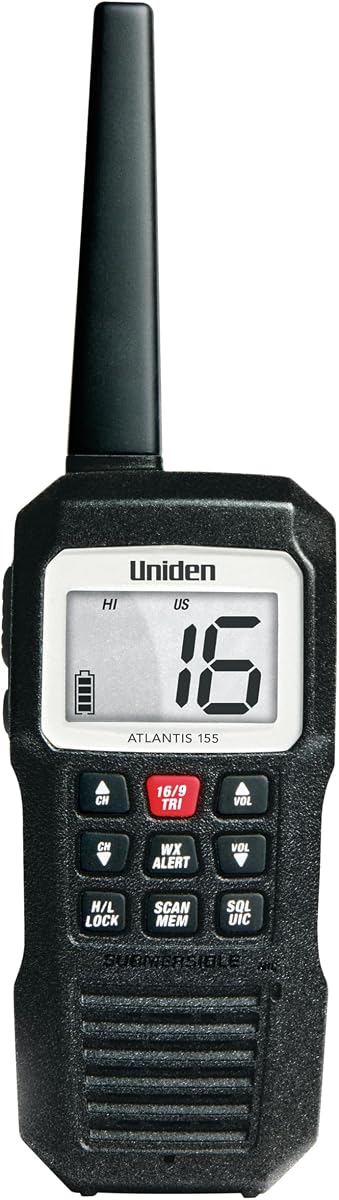
The Uniden Atlantis 155 is a value-focused marine handheld with a floating IPX8/JIS8 design, a dual-color display, one- or three-watt transmission, and broad marine channel coverage. Its 4.1 rating is the lowest in this list, but it remains a capable safety radio for dinghy sailors who want core features without a large collection of advanced electronics.
We may earn a commission when you buy through this link, at no additional cost to you.
The 25-by-40-millimeter LCD is described as the largest in its class and uses a paper-white backlight for daytime viewing and a red backlight at night. The radio receives USA, Canadian, and international marine channels, including four-digit channels and Canadian B channels, while NOAA weather channels and alerts are also included. Its water resistance is stronger than many competing designs, and the speaker is designed to clear water after submersion.
Battery support is simpler than on many modern models. It uses four 950 mAh NiMH rechargeable AAA cells and includes a DC charging cable, but the stated ten-hour battery figure depends on operating conditions. Maximum output is only three watts, so it is better suited to local and near-coastal communication than to situations where maximum range is critical. There is no listed GPS, Bluetooth, or emergency strobe.
The Atlantis 155 is a sensible choice for a new dinghy sailor, a club boat, or anyone seeking a straightforward VHF with strong flotation and weather access. Its dual-color display, complete channel support, and water-resistance specification make it more useful than a basic weather-only receiver. Confirm that its three-watt output and rechargeable AAA arrangement meet the range and charging needs of your sailing area.
The floating IPX8/JIS8 design and water-clearing speaker give this radio a robust foundation for wet marine use. Its high-visibility flotation remains essential because water resistance alone does not prevent a radio from sinking.
A white daytime backlight and red nighttime backlight help preserve visibility without forcing one display setting for every condition. The compact screen is large enough to present essential channel and status information.
We may earn a commission when you buy through this link, at no additional cost to you.
The Uniden MHS338BT is the most feature-rich model in this guide, combining six-watt transmission, integrated GPS, Bluetooth, a floating IPX8 body, and water-activated emergency lighting. Its 4.2 rating reflects a specialized device that goes well beyond a basic voice-and-weather handheld, making it worth considering for dinghy sailors who coordinate with other equipped vessels.
We may earn a commission when you buy through this link, at no additional cost to you.
Integrated GPS can save current and manually entered positions, return to stored locations, display course and direction, and plot a received DSC distress call. Bluetooth permits configuration through the compatible smartphone app and text messaging with other text-capable VHF radios, while DSC information can also be entered. The radio includes a lithium-ion battery, drop-in charging cradle, NOAA alerts, FM reception, dual and triple watch modes, and Class D DSC compliance.
The abundance of features requires more careful setup and familiarity than a basic handheld. Its menu and display also make it larger and more complex to operate, which may not be desirable for a new sailor who mainly wants simple channel monitoring. Because digital functions and battery behavior can change through software and settings, buyers should examine the manual and confirm regional compatibility for their intended use.
This radio is best for offshore-oriented dinghy sailors, couples traveling in separate boats, or anyone who wants the radio to serve as a navigation and communication hub rather than only a voice transceiver. The automatic water-activated man-overboard feature and emergency strobe add significant safety value. For straightforward harbor and coastal communication, the advanced feature set may be unnecessary, but for coordinated cruising it offers exceptional versatility.
Integrated GPS supports favorite-position storage, compass-style course displays, and automatic distress-call plotting. These functions help a sailor retain a location reference and share more structured information when communicating with compatible devices.
Bluetooth links the radio to the Uniden app for configuration, text messaging, and directory information. The feature expands communication options but requires compatible devices, suitable contacts, and a clear understanding of setup procedures.
We may earn a commission when you buy through this link, at no additional cost to you.
The Uniden Atlantis 275 is a 4.6-rated floating handheld that combines six-watt output with a large dual-color LCD, IPX8/JIS8 water resistance, and emergency lighting. It provides a strong middle ground between the lower-power Atlantis 155 and the feature-heavy MHS338BT, focusing on conventional marine communication and physical emergency tools.
We may earn a commission when you buy through this link, at no additional cost to you.
Users can select one, 2.5, or six watts depending on how much range and battery efficiency they need. The radio receives all major USA, international, and Canadian marine channels, including four-digit channels and Canadian B channels, as well as NOAA weather channels and alerts. A paper-white daytime backlight and red nighttime backlight make the 25-by-40-millimeter display adaptable to changing visibility.
The built-in emergency strobe and flashlight add value in a capsize, at anchor after dark, or after the radio is dropped overboard. The floating body and water-clearing speaker strengthen its marine credentials. A lithium-ion battery pack, AC and DC charging cables, and a charging cradle are included, and the product carries a three-year warranty, including a three-year waterproof warranty.
The Atlantis 275 is a strong recommendation for dinghy sailors who want six-watt transmission, solid flotation, and emergency lighting without smartphone connectivity. It suits coastal and offshore day trips where conventional VHF voice contact, weather alerts, and a dependable charger matter most. It lacks the GPS and Bluetooth tools of the MHS338BT, but that simplicity can make it easier to operate under pressure.
The radio offers meaningful maximum output while remaining centered on standard marine voice communication. This makes it attractive for sailors who want more range than a three-watt radio without learning an elaborate digital interface.
The dual-color screen and built-in flashlight improve usability in changing conditions. The emergency strobe adds a separate visual signaling function for low-light recovery and emergency situations.
We may earn a commission when you buy through this link, at no additional cost to you.
The Cobra BlueBound 150 is a compact, flotation-focused marine radio with selectable 0.5-, one-, and three-watt output, IPX7 water resistance, and broad battery flexibility. Its 4.2 rating makes it a credible choice for dinghy sailors who want the ability to use standard AAA cells as well as rechargeable batteries.
We may earn a commission when you buy through this link, at no additional cost to you.
The radio's most distinctive practical advantage is power flexibility. Users can operate with rechargeable or alkaline AAA cells and recharge supported rechargeable cells through the convenient USB-C port. Very low output can be useful for nearby communication, while three watts provides more range than a one-watt setting. The large, clear display is designed to be legible in varied lighting and weather.
A high-visibility orange floating core makes the black radio easier to retrieve after an overboard drop. Dual-Watch gives simultaneous access to channels 9 and 16, and the radio includes 12 weather channels plus the NOAA emergency broadcast channel. Compared with six-watt models, however, its maximum output is lower, and it lacks Tri-Watch's third programmable channel. It also does not list GPS, Bluetooth, DSC, or emergency-light features.
The BlueBound 150 is best for short coastal trips, harbor sailing, race committee use, or dinghy sailors who need a dependable backup radio and value flexible battery choices. Its compact waterproof design and low-power settings can support efficient communication close to shore. For extended offshore passages where maximum range is important, a higher-output alternative may be preferable.
Compatibility with rechargeable or alkaline AAA cells gives users flexibility when planning an extended trip. The USB-C port also simplifies charging compatible rechargeable cells without requiring a large dedicated cradle.
Dual-Watch keeps channels 9 and 16 in view while the selected channel remains active. That makes the radio practical for routine dinghy use in harbors, bays, and other relatively busy local waterways.
We may earn a commission when you buy through this link, at no additional cost to you.
The Icom IC-M73 is a traditional premium handheld built around six-watt transmission, a distinctive hourglass shape, and straightforward marine use. Its 4.5 rating suggests a solid overall reception, and the optional speaker or microphone expands the ways it can be operated in a dinghy cockpit.
We may earn a commission when you buy through this link, at no additional cost to you.
The contoured body is explicitly designed for easy handling, which is useful when the radio needs to be operated one-handed or retrieved quickly. Six watts provides a strong maximum output for a handheld, while the waterproof and submersible construction suits an environment where splashes and temporary immersion are possible. The package includes a charger and cigarette-lighter adapter for convenient charging at home or in a vehicle.
The supplied specifications are much less detailed than those for the other products in this guide. They do not state a specific IPX rating, flotation capability, battery capacity, channel coverage, NOAA support, emergency lighting, GPS, or charging connector. As a result, buyers should not assume that the IC-M73 offers the same documented set of marine features as the more extensively specified alternatives.
This radio is a good fit for a traditionalist sailor who values a secure grip, six-watt output, and a simple dedicated marine form. The optional speaker or microphone is useful for cockpit placement, while the included charging pieces support regular use. Those who want documented flotation, emergency alerts, and advanced channel functions may prefer a model with a more comprehensive feature specification.
The hourglass form is intended to sit securely in the hand, with an interface suited to marine use. That ergonomic focus may appeal to sailors who prefer a straightforward radio over a touchscreen-style device.
Six-watt transmission supports conventional voice communication, while the optional speaker or microphone allows the radio to be positioned for easier access. The included charger and cigarette-lighter adapter cover common charging locations.
We may earn a commission when you buy through this link, at no additional cost to you.
The best handheld VHF radio for dinghy safety is the one that combines reliable flotation, credible water resistance, clear controls, suitable transmit power, and enough battery life for the kind of sailing you do. These factors matter more than extra functions once the radio is wet, dark, or needed urgently.
A dinghy radio should be designed to float after an overboard drop, while its waterproof rating should provide an appropriate level of protection against rain, spray, washing, and accidental immersion. IPX7 models are described as suitable for potential full immersion, whereas IPX8 products may specify deeper immersion capability; ratings are not interchangeable, so compare the exact stated conditions. A high-visibility floating core or flashing body makes recovery easier after a capsize or wet-deck loss.
Power affects how far a radio can communicate and how easily a signal carries over waves, islands, buildings, or other obstructions. The featured models range from 3 watts to 6 watts, with some offering lower settings for battery conservation. For coastal and harbor use, lower power may be adequate, while six-watt output is more appropriate when you may need contact with distant vessels or shore stations. Actual range depends on antenna height, terrain, weather, battery condition, and the other radio, not only the wattage figure.
A useful marine radio should provide access to the channels required in your operating region, including channel 16 for distress and hailing. Dual-Watch monitors channel 16 and channel 9 alongside the selected channel, while Tri-Watch adds a user-specified channel. NOAA weather channels and alert tones provide another layer of information, and models with DSC or GPS may help with structured distress information and position sharing. Confirm that international, Canadian, or other regional channels are supported where you sail.
Battery endurance should cover a normal sailing day with enough reserve for delays or an emergency. Some radios use built-in lithium-ion batteries with dedicated cradles, while others accept standard AAA cells, which can be valuable for extended trips. USB-C charging offers flexibility but does not necessarily mean the radio can be operated while charging. Compare stated battery life carefully, because transmit time, volume, weather scanning, GPS use, and backlight settings can all influence real-world performance.
A screen that is easy to read in daylight, at night, and through spray is essential. Day-and-night backlights or dual-color displays can preserve contrast under changing conditions, and larger characters help when the radio is used in rough water. Check whether the selected channel, power level, battery status, and signal information are presented clearly. A built-in flashlight can be useful at anchor, while a water-activated strobe can assist with finding a dropped radio.
A water-activated strobe, flashlight, distress feature, DSC capability, and integrated GPS can add valuable layers to a safety plan. Advanced digital features are not automatically better for every sailor: they may complicate setup and require compatible equipment. Traditional voice operation remains central to emergency communication. Decide whether you need only dependable voice and weather functions or also favor position storage, man-overboard alerts, Bluetooth text messaging, and exchange of information with other equipped sailors.
A dinghy has limited storage, so dimensions, weight, and grip matter. Compact models can fit in a pocket or dry bag, while a larger display and feature set may require a protected console. Buttons should be distinguishable by touch, and a secure grip is useful when the boat is wet or moving. A radio with an optional speaker or microphone may be easier to use when it cannot be held constantly. Keep it accessible, protected from impact, and secured so it cannot fall overboard unnoticed.
Look for confirmed marine channel coverage, NOAA weather functions where relevant, documented waterproof standards, and an established support pathway. Some radios explicitly mention Class D DSC compliance, while others do not include that detail in the supplied listing. Warranty coverage, especially a stated waterproof warranty, can provide added confidence. Before heading offshore, download the manual, understand the controls, register any required information where applicable, and confirm local radio regulations rather than relying on a marketplace description alone.
Before leaving shore, read the manual, install or fully charge the battery, confirm the radio powers on, and verify that channel 16 and the required regional channels are available. Learn how to change transmit power, activate watch modes, scan weather channels, operate the flashlight or strobe, and distinguish a transmitted call from an incoming one. If the radio includes GPS, Bluetooth, or DSC, configure the relevant directories and ensure emergency information is accurate before departure.
During use, keep the radio within easy reach but secured against impact and accidental loss. Use the lowest power setting that provides reliable communication for routine traffic, and increase output when distant stations or obstructed conditions require it. Monitor channel 16, respond promptly to distress and hailing traffic, and avoid transmitting when the channel is already busy unless the situation is urgent. Keep the antenna unobstructed and hold or mount the radio so its position is not buried under clothing or gear.
After the trip, turn the radio off, disconnect external charging connections when appropriate, rinse away salt and dirt with fresh water, and dry it fully before storage. Keep the charging contacts clean and avoid leaving a wet radio sealed in a damp bag. Inspect the housing, antenna, battery door, and controls for damage, and follow the manufacturer's instructions for battery replacement and storage. A radio with an IPX7 or IPX8 rating is protected for stated conditions, but regular inspection and correct care still help it perform reliably.
Reliable flotation and an appropriate waterproof rating are the foundation. A radio that survives spray and temporarily entering the water is far more useful than one with extra digital features but questionable physical protection. Channel 16 access, weather alerts, readable controls, and suitable transmit power should also be priorities. The best choice ultimately depends on where and how you sail.
Six watts can provide more communication range than a three-watt model, especially where obstructions or distance are concerns. It may also consume more battery during transmission. Many dinghy sailors use lower power close to shore and reserve higher settings for offshore communication. Actual range also depends on antenna position, weather, terrain, and the receiving station.
GPS is not essential for basic voice communication, but it can improve position awareness, distress reporting, and coordination with compatible vessels. Models such as the Uniden MHS338BT offer saved positions, automatic distress-call plotting, and man-overboard features. If you sail with other equipped boats or want enhanced emergency information, these capabilities may justify the added complexity.
Replace or recharge the battery according to the manufacturer's guidance, especially if it no longer holds a normal charge or the operating time has declined significantly. Rechargeable lithium-ion and NiMH batteries gradually lose capacity, and prolonged storage at a high charge level can affect some cells. Keep a charged radio ready and carry compatible backup batteries if your model supports them.
Marine handhelds in this guide have stated IPX7, IPX8, or JIS8 water-resistance levels, which are designed for demanding wet conditions. That does not mean every radio tolerates the same depth or duration of immersion, so read the exact specifications. Always close ports and battery covers correctly, avoid charging a wet radio, and dry it after use.
A waterproof handheld is an important part of a layered safety plan, but it should complement life jackets, a signaling plan, weather information, navigation tools, and reliable communication with other vessels. For remote or extended voyages, a fixed or higher-powered marine radio, emergency beacon, position tracking, and an ashore-contact plan may also be appropriate. The handheld should remain readily accessible rather than serving as the only safety device.
Dual-Watch monitors channels 9 and 16 while the radio listens to the selected channel. Tri-Watch performs the same general function but adds a third, user-specified channel. The additional channel can be useful for a harbor, race, club, or local traffic channel, but it is still essential to understand which channel carries an incoming priority call.
Charge the battery fully, test the radio, verify the required channels, and learn the power, watch, and emergency controls. Write down the relevant coast guard or emergency information, check the weather, and keep the radio accessible in a protected floating pouch or secured cockpit location. Do a final power and channel check immediately before leaving the dock, then preserve battery life by using lower output when adequate.
The Icom M25EVO Blue stands out for its exceptional 4.9 rating, lightweight 7.8-ounce body, flotation, flashing recovery design, USB-C charging, and claimed eleven-hour battery life. The Standard Horizon HX210 is the premium all-in-one choice, offering six watts, a large dot-matrix display, a water-activated strobe, a high-capacity battery, and a complete rapid-charging kit. For value-focused use, the Uniden Atlantis 155 provides floating IPX8/JIS8 construction, weather alerts, a dual-color display, and a rechargeable AAA battery arrangement.
The remaining radios are strong alternatives for specific needs. The Cobra BlueBound 350 models suit sailors who want selectable high power, Tri-Watch, and NOAA alerts; the Uniden MHS75 favors rugged conventional monitoring; the MHS338BT adds GPS, Bluetooth, and text messaging; the Atlantis 275 balances six-watt output with emergency lighting; the BlueBound 150 offers flexible AAA power; and the Icom IC-M73 prioritizes a secure grip and traditional marine design.
Before buying, verify the current specifications, battery details, included accessories, regional channel support, and warranty terms for the exact listing. Prices and product availability change over time, so compare the final cost only after confirming that the model meets your flotation, waterproofing, range, display, charging, and emergency requirements. A radio that is familiar, charged, carried, and easy to operate will serve a dinghy sailor far better than an advanced model left unused in a locker.