TESMEN TLP-123A
4.5Editor score
RJ45 and RJ11 support
Detachable remote unit
Clear LED fault indicators
This Ethernet Cable Tester guide compares 10 models for wire mapping, fault detection, cable tracing, length measurement, and PoE testing.
An Ethernet cable tester helps technicians, installers, and homeowners confirm that network cables are wired correctly and identify common faults before troubleshooting becomes complicated. A genuinely useful model should provide clear results, identify opens, shorts, miswires, and split pairs, and work with the connector types and cable categories encountered in everyday installations.
We compared the ten featured testers by examining their supported media, fault-detection capabilities, display or indicator design, cable tracing functions, length measurement, PoE support, and practical accessory requirements. The list covers basic continuity tools, professional installation kits, advanced verifiers, and specialized devices for fiber optic or live-network diagnostics.
Each review explains where the tester is strongest, where its scope ends, and who will benefit most from it. Ratings reflect the supplied customer feedback, while product details are limited to the listed specifications. Prices and promotions can change, so check the current listing before purchasing.
4.5Editor score

4.8Editor score

4.5Editor score
This side-by-side comparison highlights the most important differences among the ten testers, including supported connectors, diagnostic depth, length measurement, tracing capabilities, and suitability for professional or basic network maintenance.


The Klein Tools VDV526-200 is a balanced choice for technicians who need more diagnostic detail than a basic continuity tester without carrying a full installation verifier. Its 4.8 rating is the highest among the listed products, and the standout feature is a large backlit LCD that makes pin-to-pin results easy to interpret in dim workspaces, utility closets, and under desks.
We may earn a commission when you buy through this link, at no additional cost to you.
The tester checks terminated RJ45 data cables for opens, shorts, miswires, split pairs, cross-overs, and shield problems. Those fault categories are the core requirements for dependable installation troubleshooting. Its three-button interface is designed to keep operation straightforward, while the automatic shutdown after 10 minutes in test mode and 60 minutes in tone mode helps preserve battery life during intermittent fieldwork.
Tone generation adds value when a cable must be traced through walls or a crowded cable pathway. The unit can apply a tone to one wire, a wire pair, or all eight conductors, with solid and warble styles. The limitation is that the specified Cat. No. VDV500-123 analog probe is not included, so buyers who need cable identification should plan to purchase that accessory separately.
This is a strong recommendation for network installers, facilities teams, and advanced home users who want a readable, purpose-built Ethernet tester. It does not measure cable length or test live PoE, but its wiremap and fault coverage make it more versatile than the simplest LED testers. For dependable cable validation and optional tracing, it is the most complete general-purpose choice in this group.
The large backlit display gives technicians a clear alternative to interpreting a row of tiny LEDs. Pin-to-pin wiremaps and identified fault types can be read quickly, which reduces confusion when several cables are being checked in sequence.
Testing for opens, shorts, miswires, split pairs, cross-overs, and shield faults makes this tester useful both before a network is put into service and when a previously working connection begins to fail.
We may earn a commission when you buy through this link, at no additional cost to you.
The Klein Tools VDV501-851 Scout Pro 3 Starter Set is aimed at installers who regularly need to validate more than Ethernet. It has a 4.7 rating and supports RJ45 data cables, RJ11 and RJ12 voice cables, and coax connections with F connectors. That makes it a practical choice for structured-cabling work involving mixed building services.
We may earn a commission when you buy through this link, at no additional cost to you.
Cable length measurement extends to 2,000 feet, or 610 meters, giving the tester considerably more reach than a simple wiremap tool. The backlit screen presents cable length, wiremap, cable ID, and test results in one place. It can also identify opens, shorts, miswires, and split pairs, allowing a technician to move from basic verification to more meaningful fault diagnosis.
Cable tracing uses a multi-style tone generator to follow cables, wire pairs, or individual conductors. As with the VDV526-200, tracing requires the Klein VDV500-123 analog probe, which is sold separately. The product is intended for unenergized Ethernet cables and is not designed to test PoE, so users who need live power-system information should choose a model with dedicated PoE capabilities.
Choose the VDV501-851 when your work regularly includes voice, data, or coax and you need cable-length measurement. It is a more specialized instrument than a general-purpose Ethernet tester but a stronger all-around installation tool for mixed-media cabling. Field technicians and low-voltage installers will likely appreciate its broad connector support and identification features most.
RJ11, RJ12, RJ45, and F-connector support reduces the need to carry separate tools for common voice, data, and coax installation tasks. This broadens its usefulness across offices, homes, and commercial buildings.
Displaying cable length, wiremap, cable ID, and fault results together helps technicians assess a run without moving between several functions or maintaining separate notes for each diagnostic step.
We may earn a commission when you buy through this link, at no additional cost to you.
The Klein Tools VDV526-100 is a simple, portable tester for users who primarily need to know whether a terminated network cable is wired correctly. Its 4.7 rating reflects a well-regarded balance of ease of use and practical fault coverage. The single-button design makes it approachable for homeowners while remaining efficient for technicians checking many cables.
We may earn a commission when you buy through this link, at no additional cost to you.
It supports RJ11, RJ12, and RJ45 terminated voice and data cables, plus CAT3, CAT5e, CAT6, and CAT6A wiring. LED indicators report Pass, Miswire, Open-Fault, Short-Fault, and Shield conditions. These categories make the tool suitable for identifying common installation errors and confirming whether a patch cord or permanently installed run is ready to use.
The remote stores inside the main tester body, reducing the chance of losing a small but essential component. A 9V battery is included, and a low-battery indicator warns the user before an unexpected shutdown interrupts testing. The trade-off is that this model has no cable length measurement or tone generator, so it is not the right tool for locating a break in a long run or tracing a hidden cable.
This tester is best for quick bench checks, home network maintenance, IT support kits, and technicians who value simplicity and portability. It provides more meaningful fault indications than a bare continuity light without adding the complexity of a display-based model. Choose it when RJ45 continuity and basic wire faults are your primary requirements.
Single-button operation and familiar LED status labels make the VDV526-100 efficient when testing patch cords, newly terminated cables, or suspect wall outlets. The workflow is direct and easy to learn.
The remote fits inside the tester body, so both pieces are more likely to remain together in a tool bag or pocket. A compact form factor also makes this model convenient for mobile repair kits.
We may earn a commission when you buy through this link, at no additional cost to you.
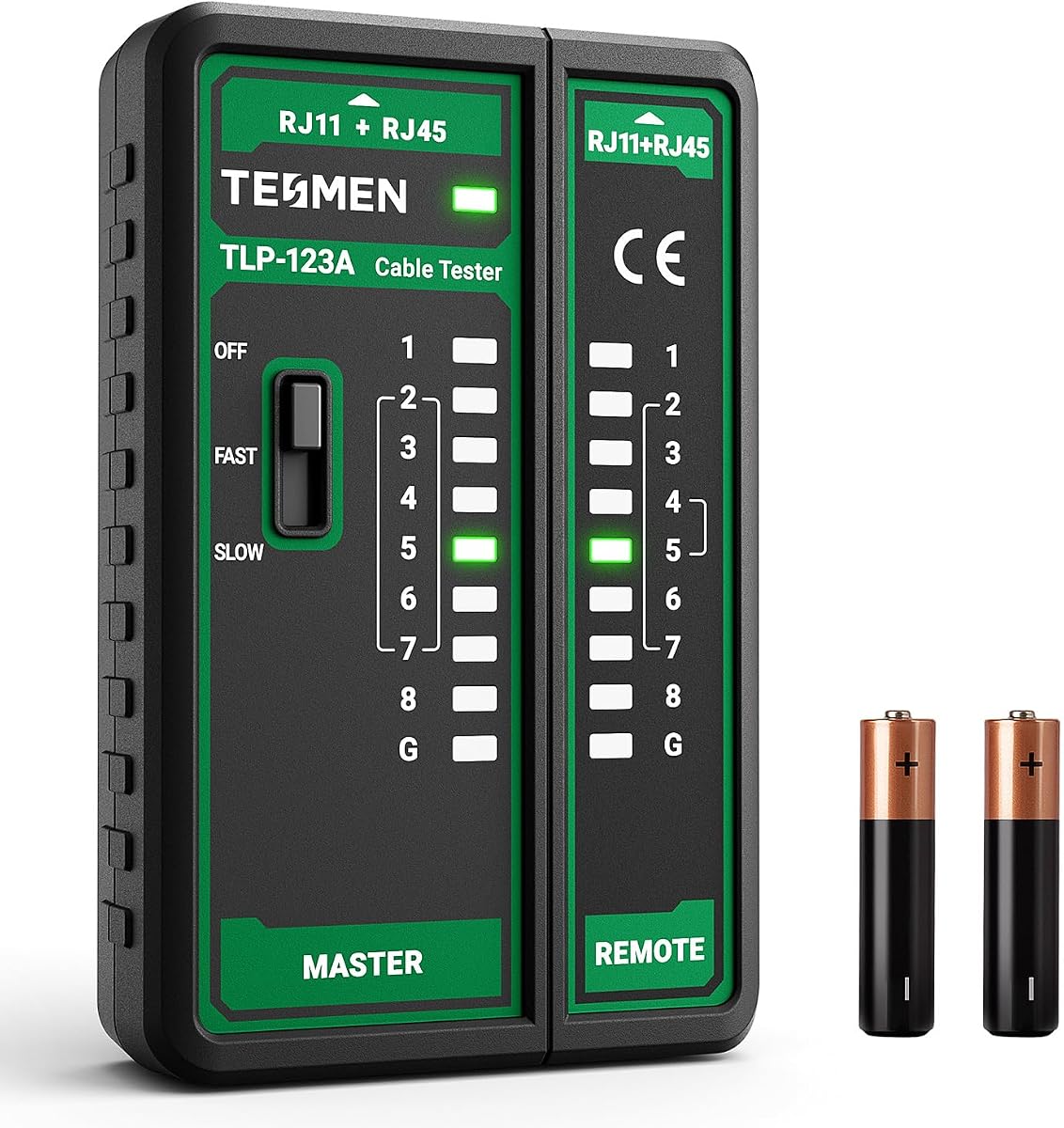
The TESMEN TLP-123A is a budget-oriented multifunction tester designed for everyday continuity and fault-checking work. It has a 4.5 rating and supports both RJ45 and RJ11 connections across CAT5, CAT5e, CAT6, CAT6A, and CAT7 wiring, with compatibility for UTP and STP shielded or unshielded cable.
We may earn a commission when you buy through this link, at no additional cost to you.
Its primary strengths are rapid detection of short circuits, open circuits, miswiring, and shield status. A one-button workflow and clear LED indicators make the tool approachable, while a speed-adjustment control on the main unit offers more control over the scan. The detachable remote allows the two ends of a cable to be tested independently, which is useful at wall-mounted ports and across long structured-cabling runs.
The tester has no display, length measurement, or advanced cable identification. As a result, it is less suitable for technicians who need to measure a run or document detailed wiremaps. Nevertheless, its broad compatibility, simple operation, and included batteries provide a practical combination for homeowners, office administrators, electricians, and entry-level network installers.
For basic LAN and telephone continuity checks, the TLP-123A is a strong budget recommendation. It is particularly useful for anyone who wants to diagnose a cable without learning a complicated interface. Keep in mind that the unit offers a narrower feature set than the display-equipped tools in this list, but it covers the essential fault categories most home users need.
Support for RJ45, RJ11, several common category ratings, and shielded wiring means one compact tool can cover common residential, office, and installation scenarios.
Separating the main and remote units makes it easier to test cables that terminate in different rooms or locations. The design suits wall ports and long network runs without requiring the tester to be carried to both ends at once.
We may earn a commission when you buy through this link, at no additional cost to you.
The HT812A Network Tester is a compact diagnostic tool for RJ45 and RJ11 cables, offering a 4.6 rating. It supports CAT5 through CAT7 wiring and is designed to identify continuity, short circuits, open wires, miswiring, and shielding status, making it a broad option for home repair and routine LAN maintenance.
We may earn a commission when you buy through this link, at no additional cost to you.
One of its most useful distinctions is the ability to switch between fast and slow scanning modes. Fast mode suits quick checks, while the slower setting can help users examine wiring issues more precisely. Both the master and remote units contain LEDs that show wire order, allowing a technician to compare the two ends and identify misaligned pins or open pairs more easily.
The split-type construction permits the main and remote units to be detached and used independently across long runs or at separated wall ports. It supports CAT5, CAT5e, CAT6, CAT6a, and CAT7 cables and identifies FTP or STP shielding versus unshielded wiring through a dedicated indicator. The stated telephone-line safety is for typical voltages under 48–72V, so it should not be treated as a universally safe live-line instrument.
Choose the HT812A for a lightweight tester that offers more control than a fixed-speed continuity tool. It is especially appealing to electricians, DIY users, and network engineers who want clear pin-order information and selectable scan speeds. It does not provide cable length measurement, so users needing installation documentation should select a more advanced model.
Fast mode helps streamline routine testing, while slow mode provides additional time to inspect individual connections. This makes one tool adaptable to both quick checks and more deliberate troubleshooting.
A dedicated light helps distinguish shielded FTP or STP wiring from UTP. That can be valuable when cable specifications or labeling need to be verified during installation or replacement.
We may earn a commission when you buy through this link, at no additional cost to you.
The Klein Tools VDV501-852 is the most extensive installation-oriented kit in the list, with a 4.7 rating. It tests voice connections with RJ11 and RJ12, data cables with RJ45, and coax with F connectors. Its defining feature is PoE testing that displays wire and voltage information, helping installers troubleshoot powered Ethernet systems.
We may earn a commission when you buy through this link, at no additional cost to you.
The self-storing Test + Map Remote tests, maps, and identifies a cable run in a single step. The kit also supports cable-length measurement up to 2,000 feet, and its locator remotes help identify multiple runs in larger buildings. This combination is particularly useful for technicians responsible for documenting or sorting complex structured-cabling systems.
Cable tracing can follow cables, wire pairs, or individual conductors through the multi-style tone generator, but the required VDV500-123 analog probe remains a separate purchase. Another drawback is the size of the included kit: 18 RJ45 locator remotes, 18 coax locator remotes, adapters, jumper cables, a carrying case, and a battery are substantial. Users need a process for keeping small accessories organized.
The VDV501-852 is a strong recommendation for professional network installers, facilities teams, and PoE-focused technicians who need mapping and identification in addition to basic wire testing. It is more specialized and elaborate than the Scout Pro 3 Starter Set. Choose it when PoE visibility, multi-run identification, and a complete remote assortment are central to the job.
Showing PoE wire and voltage information helps distinguish power-related installation problems from ordinary continuity faults. That visibility is valuable when troubleshooting modern Ethernet devices and access points.
Mapping and identifying runs with locator remotes makes the kit especially valuable in offices and buildings with many similar cable paths. The included assortment supports repeated labeling and location tasks.
We may earn a commission when you buy through this link, at no additional cost to you.
The NOYAFA NF-8209 is a feature-rich diagnostic kit for technicians who need to work with both passive cables and active network connections. Its 4.3 rating is lower than those of most tools in this group, but the supplied feature set is unusually broad, including digital cable tracing, non-contact voltage detection, PoE testing, length measurement, port flashing, and link testing.
We may earn a commission when you buy through this link, at no additional cost to you.
The receiver uses Normal, Anti-Interference, and PoE modes to support live cable tracing up to 600 meters. A remote adapter handles one-to-one continuity testing on shielded and unshielded RJ45 cables, while the tester identifies shorts, opens, miswiring, and normal connections. Length measurement covers 2.5 to 200 meters and displays results in meters, feet, or yards.
PoE testing handles standard and non-standard DC 5–60V systems, identifies IEEE 802.3af and 802.3at power delivery, and shows method, voltage, and polarity. Port flash and link functions cover 10M, 100M, and 1000M connections. The kit includes a transmitter, receiver, remote adapter, cables, tool bag, and battery, while the transmitter uses a rechargeable battery. The complexity may outweigh its value for a casual user.
The NF-8209 is best for network engineers, security installers, and advanced technicians who need cable tracing and active-port diagnostics in one package. Choose it when PoE details, live tracing, and link-light identification are routine requirements. Users seeking a simple pass-or-fail tool may find the NF-8209 unnecessarily complex.
The tester reports power method, voltage, and polarity and recognizes common IEEE power-delivery modes. These details go beyond a simple PoE-present indicator and can make power troubleshooting more precise.
Normal, anti-interference, and PoE tracing modes are intended to support cable location in environments where live cabling is present. The 600-meter tracing range also makes the device useful across larger properties.
We may earn a commission when you buy through this link, at no additional cost to you.
The NOYAFA NF-468CS combines Ethernet, telephone, and PoE-oriented testing in a field-friendly package. It has a 4.7 rating and supports RJ45, RJ11, and RJ12 connections across CAT3, CAT5, CAT5e, CAT6, CAT6a, and CAT7 cables. A useful feature is its stated maximum test distance of 1,000 meters, well beyond many compact continuity testers.
We may earn a commission when you buy through this link, at no additional cost to you.
The single-button test workflow presents open, crossed, straight-through, and short results. It can inspect plug crimping, check continuity, and evaluate special shielded network cable, including UTP and STP configurations. A separate PoE function can determine the type and condition of a PoE switch's power supply up to 60 volts, while battery and low-voltage prompts are shown through LEDs.
Charging through USB-C eliminates routine disposable-battery replacement, and the tester automatically switches off after 15 minutes of inactivity. These details make it convenient for technicians who carry one device between jobs. However, there is no optical power measurement, visual fault location, or dedicated non-contact voltage function, so it does not cover the work handled by more specialized tools in the list.
The NF-468CS is a good fit for network installers, IT support technicians, and users who want cable testing and basic PoE checks in a rechargeable unit. It is especially compelling for long cable runs that exceed the measurement range of many basic testers. Users who also maintain fiber networks should look to a more specialized multifunction device.
The lithium battery and USB-C charging reduce interruptions caused by disposable batteries. Automatic shutdown further protects runtime during periods when the tester is left in a kit or on a work surface.
Beyond a basic pass or fail result, the tester can check straight-through, crossed, open, and short conditions, along with plug crimping. This makes it useful during both installation and repair.
We may earn a commission when you buy through this link, at no additional cost to you.
The NOYAFA NF-8508 is the most specialized product in the list because it combines copper-cable diagnostics with optical power measurement and a visual fault locator. Its 4.2 rating is the lowest among the featured products, but the nine listed functions give it a distinct role for technicians who maintain both copper and fiber infrastructure.
We may earn a commission when you buy through this link, at no additional cost to you.
The optical power meter measures seven wavelengths at 850, 1300, 1310, 1490, 1550, 1625, and 1650 nanometers. Its detection range is listed from minus 70 to plus 10 dBm, and FC, SC, and ST connectors are supported. These specifications make the device useful for checking fiber signal strength and identifying attenuation-related concerns.
The visual fault locator uses a 650-nanometer source and provides fast flashing, slow flashing, and high-precision modes to help locate fiber breaks, poor connections, bending, or cracking. Copper-side features include port flashing, PoE voltage and polarity checks, cable tracing, length measurement up to 200 meters, and short and open-circuit tests. A 1,500mAh lithium battery provides up to 10 hours of stated use and supports USB-C charging.
Choose the NF-8508 for a technician who genuinely works with fiber and wants a single multi-function platform. It is less rational for someone who only needs to verify ordinary Ethernet patch cords because the fiber-oriented functions add cost and complexity. Its value rests on combining optical, copper, PoE, and location testing rather than performing a single basic continuity check.
Seven-wavelength optical measurement gives fiber technicians a way to assess signal strength without relying on a separate power meter. Support for FC, SC, and ST connectors broadens compatibility with common patch and equipment connections.
The built-in visual fault locator helps narrow down breaks, poor terminations, or physical damage. Multiple flash patterns provide a practical way to distinguish a visible signal in the field.
We may earn a commission when you buy through this link, at no additional cost to you.
The Fluke Networks MS2-100 MicroScanner2 is a professional-grade copper cable verifier and the premium choice in this guide. It carries a 4.5 rating and is designed for technicians who need concise, consolidated diagnostics rather than a collection of simple continuity lights. It supports RJ11, RJ45, and coax testing.
We may earn a commission when you buy through this link, at no additional cost to you.
The display brings together cable length, wiremap, cable ID, and distance to fault. That information helps answer several common questions at once: how the cable is wired, how long it is, which run it represents, and approximately where a fault occurs. Compatibility with 10/100/1000Base-T also makes it relevant to the Ethernet standards commonly encountered in modern networks.
Built-in IntelliTone technology adds cable and port location capabilities without requiring the separate probe arrangement used by some competing products. The trade-off is its premium positioning: buyers focused only on occasional basic continuity checks may find more capability than they need. It is also a copper-cable verifier rather than a fiber-optic instrument.
The MicroScanner2 is best for professional network engineers, service technicians, and installation teams that need a dependable all-in-one diagnostic workflow. It is particularly useful when a cable fault must be isolated quickly and a conventional tester would require several separate tools. For premium cable verification, fault location, and toning in one device, it is the strongest recommendation here.
Combining length, wiremap, cable ID, and fault distance reduces the time spent switching between basic test modes. The layout is suited to professionals who need to assess a cable and document the result quickly.
Built-in IntelliTone functionality helps locate cables or ports through common installation pathways. Integration is particularly convenient for technicians who want fewer separate accessories to carry.
We may earn a commission when you buy through this link, at no additional cost to you.
The right Ethernet cable tester depends on the cable types you work with, the faults you need to identify, and whether your tasks require only continuity checks or advanced measurement, tracing, PoE, and fiber diagnostics.
Start by matching the tester to the cables actually present in your work. Most Ethernet testers use RJ45 connectors, but voice cables frequently use RJ11 or RJ12, and coax runs use F connectors. A model that supports only RJ45 may be adequate for a dedicated Ethernet role, while technicians handling mixed low-voltage systems should favor a tester that covers data, voice, and video.
A useful tester should do more than show whether a link passes. Open wires, short circuits, miswires, cross-pairs, and split pairs all create different installation problems, and some inexpensive tools detect only the most basic continuity condition. Display-based models can present wiremaps and fault names more clearly, while LED tools are faster for basic pass-or-fail assessments.
Length measurement is valuable for confirming the expected length of a structured-cabling run and for narrowing down where an interruption may be located. The listed devices vary widely here, with supports ranging from 200 meters or 600 meters for tracing to up to 2,000 feet for cable measurement. Check the supported range and units before buying for unusually large properties.
Tracing is different from continuity testing: it helps identify which route a cable follows, especially after it has entered a wall, ceiling, or crowded pathway. Some models generate tones but require a separate analog probe, while others integrate toning directly. Port flashing can provide another way to identify an active connection by making the linked port lights visible.
PoE testing can confirm whether a cable and switch deliver power, and advanced models may show voltage, polarity, and the applicable power method. This is useful when an Ethernet device receives data but not power. Some testers are explicitly intended only for unenergized cables, while others support port flash, link, and live tracing modes.
The interface should make results understandable without guesswork. A backlit LCD offers more detailed wiremap and diagnostic information, while LEDs can be faster and more durable in basic field checks. Consider the work environment: large displays help in dim closets, whereas labeled LEDs remain readable in bright spaces when the tester is small and operated one-handed.
A detachable or self-storing remote is valuable when the two cable ends are in different rooms, closets, or work areas. Cable mapping and ID functions become more important in buildings with many similar runs. Larger locator kits can help technicians label and locate numerous cables, but they also require more storage and organization.
Consider how the tester will be powered between jobs. Some models use replaceable batteries, while others use rechargeable lithium cells and USB-C charging. Automatic shutdown protects runtime, and a low-battery warning prevents surprise interruptions. Also account for separately sold probes, batteries, remotes, adapters, and carrying cases when comparing complete tool requirements.
Begin by inspecting the tester, remote, connectors, and cable ends for visible damage. Install a fresh or adequately charged battery, then connect the tester and remote to opposite ends of the cable. Make sure the cable is disconnected from active equipment when using a model designed only for unenergized testing, and consult the product instructions for live or PoE-capable models.
Select the connector and cable category appropriate for the run, then start the test. Read the wiremap, pass indicator, or fault message carefully. For a failed cable, isolate whether the result points to an open, short, crossed connection, split pair, or shield problem. Use length measurement or tone tracing to narrow the location, and confirm that tone-based tests include the required probe.
After testing, disconnect the cable from both units, switch off the tester, and return remotes or probes to their designated storage places. Keep connectors clean and dry, avoid leaving the instrument in extreme heat or moisture, and follow the manufacturer's guidance for battery charging. Periodic testing of the tester with a known-good cable can help confirm that its indicators remain dependable.
An Ethernet cable tester checks whether conductors are connected correctly between the ends of a cable. Depending on the model, it can identify opens, shorts, miswires, crossed connections, split pairs, and shield faults. More advanced units may also measure cable length, identify runs, test PoE, or trace conductors through walls and pathways.
It depends entirely on the model. Several listed testers are intended for unenergized Ethernet cables, while others provide PoE, port flash, link, or live tracing functions. Always read the product instructions and disconnect the cable before testing if the tester does not explicitly support energized or PoE testing.
Length measurement is useful when confirming the physical length of a run or narrowing down an interruption, but it is not essential for every basic task. Patch cords and short in-wall links can often be validated with wiremap and fault detection alone. Installers working across large buildings gain more from distance and tracing functions.
Continuity testing establishes whether a path exists through a conductor, while wiremap testing also shows which conductor is connected to which position. Wiremap results can expose crossed wires or pair assignments that a simple yes-or-no continuity light may miss. For reliable installation work, a tester with clear wiremap and fault indications is generally more useful.
Some testers generate an audible tone on a selected cable, conductor, or pair, but the signal is located with a separate probe. The accessory may be listed as sold separately because it is optional for users who only need wiremap and fault testing. Check the included components carefully if cable tracing is central to your work.
Many models support both RJ45 Ethernet and RJ11 telephone cables, and some also support RJ12 or coax. The tester should identify the correct connector and cable type before testing. Compatibility with higher cable categories such as CAT6A or CAT7 also matters when newer structured cabling is installed.
Not for a copper-only Ethernet role. A fiber optic power meter is valuable when maintaining fiber links, checking signal strength, and diagnosing attenuation or poor connections. The NOYAFA NF-8508 includes that capability, but it is a more specialized and complex choice than a dedicated copper cable tester.
A split pair may still provide a basic connection, which is why a simple continuity indicator can miss it. Look for a tester that explicitly performs split-pair testing and displays wiremap or detailed fault information. Such testing is especially important for standards-sensitive installations and troubleshooting intermittent network performance.
The Klein Tools VDV526-200 is the strongest all-purpose choice because it combines a backlit wiremap display, comprehensive fault detection, and optional tone generation in a compact design. The TESMEN TLP-123A covers essential RJ45 and RJ11 checks at a budget level, while the Fluke Networks MS2-100 MicroScanner2 delivers premium verification with length, fault-distance, identification, and built-in toning.
Prioritize the capabilities your workflow actually requires. Basic home repairs may require little beyond continuity, open, short, and miswire detection. Professional installers should consider remotes, cable mapping, length measurement, and tone tracing, while technicians supporting powered networks should verify PoE capability. Fiber and mixed-infrastructure work may justify a more specialized instrument.
Check the current listing before buying, because prices, included accessories, and product configurations can change. Confirm connector support, probe requirements, battery type, and live-testing limitations against the task at hand. With those details aligned, the right tester can turn a confusing network fault into a faster and more reliable diagnosis.