
VEVOR 55lb Thrust Trolling Motor
4.1Editor score
55-pound thrust rating
Eight forward and reverse speeds
Freshwater and saltwater compatible
Adjustable 30-inch shaft
An electric motor for canoe can transform quiet paddling into a practical powered setup for fishing, exploration, and long-water trips. A suitable motor must fit the canoe, provide enough thrust, operate quietly, and remain easy to control without interfering with paddlers or cargo.
This guide compares ten trolling and electric outboard motors using their stated thrust, power requirements, mounting systems, shaft lengths, controls, battery guidance, and intended water conditions. It covers compact transom-mounted units, kayak-focused systems, and more substantial premium packages for paddlers with different performance needs.
Each review identifies the product's strongest benefits, practical limitations, and ideal user. Features and ratings reflect the supplied product information, while current availability and pricing can change, so readers should confirm the latest listing details before making a purchase.
4.1Editor score

4.6Editor score

4.8Editor score
As an Amazon Associate we earn from qualifying purchases.
The comparison below organizes each motor by its most consequential specifications, including thrust, power, shaft length, control method, and water compatibility. It is intended to make it easier to narrow the field before considering fit, battery requirements, and the user's preferred level of portability.



The Minn Kota Endura C2 is a conventional transom-mounted trolling motor rated for 30 pounds of thrust. It carries a 4.7 rating and stands out for its straightforward controls, durable composite construction, and suitability for canoe and small-boat users who want more maneuverability without an elaborate power system.
We may earn a commission when you buy through this link, at no additional cost to you.
Its six-inch telescoping tiller places speed selection and steering within easy reach, while five forward and three reverse settings offer useful control across different fishing conditions. The lever-lock bracket allows the motor angle to be adjusted and secured, and the integrated push-to-test battery meter helps users monitor remaining power without relying entirely on guesswork.
The composite shaft resists flexing, warping, and ultraviolet damage, while the supplied power propeller is designed to provide additional thrust through heavy vegetation. Its transom format, however, is less canoe-specific than a rail, clamp, or adapter-mounted system, and the listed freshwater focus makes it less appropriate for corrosive marine environments.
This is an excellent selection for anglers on lakes, rivers, and other freshwater areas who value straightforward operation and a proven rating. Canoe owners should confirm how the transom bracket will be secured before installation, but the Endura C2 remains one of the most approachable high-rated choices in this guide.
The telescoping tiller and eight forward-and-reverse settings make the Endura C2 easy to operate. It suits paddlers who want immediate throttle access without navigating a more complex digital controller.
The composite shaft, reinforced bracket, battery meter, and vegetation-oriented propeller create a practical package for full-day freshwater fishing. It emphasizes durability and straightforward operation rather than premium electronics.
We may earn a commission when you buy through this link, at no additional cost to you.
The Newport Kayak Series combines a stated 55 pounds of thrust with a 24-inch fiberglass shaft and a 4.6 rating. Although marketed as a kayak motor, those characteristics also make it worth considering for canoes that can accommodate a transom-mounted unit and need more pushing power than a compact freshwater model.
We may earn a commission when you buy through this link, at no additional cost to you.
Saltwater suitability is a major strength. The aluminum motor head uses magnesium, zinc, and stainless-steel hardware selected for corrosion resistance, while five forward and three reverse speeds provide responsive positioning. An LED battery indicator reduces the need to stop and inspect the battery during long outings.
The 5-foot-6-inch battery cables offer flexibility when placing a lead-acid battery, which is important because heavy batteries should sit low and near the center of a canoe for stability. The trade-off is that the system requires a 12V lead-acid battery and may be less convenient than a self-contained lithium battery kit.
Choose this model when a canoe needs serious thrust, corrosion-resistant components, and flexible battery positioning. Confirm the available mounting space and weight distribution before ordering, because its transom format and long electrical cables require more setup consideration than an integrated kayak motor.
Corrosion-resistant hardware and a saltwater-rated motor head make this a stronger choice for coastal trips. The fiberglass shaft also provides a stable foundation for responsive handling.
The extended cables allow the lead-acid battery to be positioned where it supports canoe stability. Careful placement is essential because a heavy battery placed high or far from the center can affect trim and handling.
We may earn a commission when you buy through this link, at no additional cost to you.
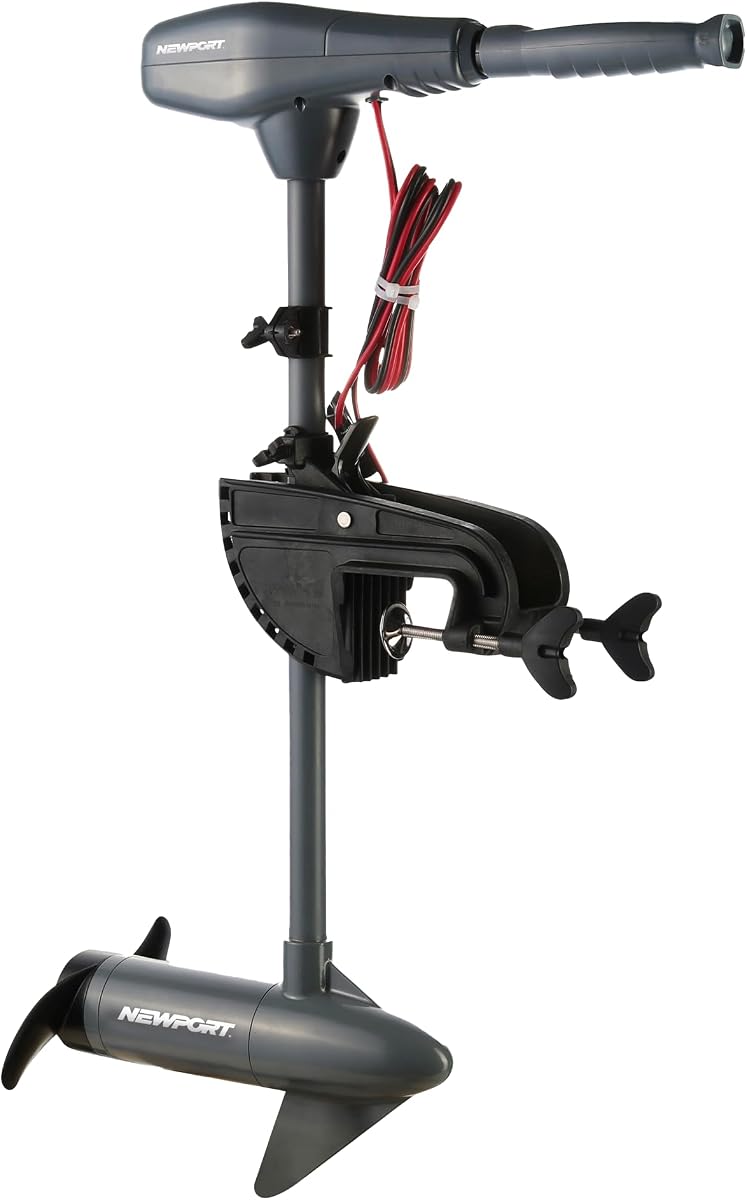
The Newport NV-Series is rated at 46 pounds of thrust and holds a 4.6 rating. Its balance of power, corrosion-resistant construction, three-blade propeller, and simple tiller control makes it a versatile option for canoes, inflatables, and small boats operating in freshwater or saltwater.
We may earn a commission when you buy through this link, at no additional cost to you.
Five forward and three reverse speeds support slow fishing maneuvers and quicker repositioning. The three-blade propeller is designed to improve thrust and control in wind or light current, while the LED battery indicator gives operators a quick view of remaining power. Power configurations are offered in 12V and 24V variants, allowing more flexibility in battery selection.
As with any transom-mounted motor, a canoe will need a suitable rear mounting point or a carefully engineered adapter. The motor and battery are separate components, so users must consider both the power package and its total weight. It is also important to match the voltage and battery configuration correctly rather than assuming every listing includes the same electrical setup.
This is a strong all-around recommendation for a paddler who wants meaningful thrust, corrosion resistance, and uncomplicated speed control. It handles both environments, responds well to changing conditions, and offers enough authority for a loaded canoe without reaching the power level of the largest outboard systems in the comparison.
The three-blade propeller supports stronger, smoother movement in wind and light current. It is a useful middle ground for canoe users who often paddle near exposed water or fishing areas with moving water.
Available 12V and 24V configurations let buyers select a battery arrangement that suits their range and weight goals. Matching the motor to a correctly sized deep-cycle battery is essential for sustained operation.
We may earn a commission when you buy through this link, at no additional cost to you.
The VEVOR Electric Trolling Motor delivers a stated 55 pounds of thrust from a 12V system and carries a 4.1 rating. It is one of the more explicitly canoe-compatible options in the list, with adjustable shaft height, a movable transom bracket, and a handle designed for both seated and standing operation.
We may earn a commission when you buy through this link, at no additional cost to you.
Five forward and three reverse settings provide useful control, and the three-blade propeller is intended to provide low-speed torque and reduce tangling. The handle extends from 6.3 to 10.6 inches, while both shaft height and bracket position can be modified for different water depths and dense vegetation.
Its aluminum-alloy shaft and sealed aluminum motor head are designed for corrosion resistance and durability in freshwater or saltwater. However, it remains a manually adjusted, battery-dependent system rather than a compact self-contained package. The 4.1 rating is also lower than that of several leading alternatives, so buyers should consider the overall package carefully.
For canoe owners seeking substantial thrust and broad compatibility at a practical entry point, the VEVOR is compelling. It is best for paddlers willing to handle a conventional trolling-motor installation and position the battery carefully for stability.
Independent shaft and bracket adjustments help the motor suit changing depths and vegetation conditions. This flexibility is particularly useful when one canoe is used across rivers, lakes, and shallow fishing areas.
The adjustable telescoping handle supports seated and standing operation. That range is useful in a canoe, where the paddler's position may change as the craft is loaded or maneuvered.
We may earn a commission when you buy through this link, at no additional cost to you.
This 55-pound-thrust trolling motor combines a stated 0.48 to 0.83 horsepower output with a 4.4 rating. Its 24-pound listed weight and compact format make it a practical option for small craft, including canoes, when substantial freshwater thrust is desired without moving to a large outboard.
We may earn a commission when you buy through this link, at no additional cost to you.
Five forward and three reverse speeds are selected through a six-inch telescoping handle. The adjustable 30-inch shaft allows placement at different depths, while the three-blade propeller is designed to improve propulsion efficiency and reduce drag. A built-in LED indicator helps users avoid unexpected depletion by showing remaining charge.
The fiberglass-composite shaft and die-cast aluminum head provide strength, flexibility, and resistance to wear and bending. The central limitation is clear: the product is intended for freshwater durability and cannot be used in saltwater. Its separate battery requirement also means users must calculate the weight of the complete propulsion package.
This motor is best for freshwater anglers and paddlers who value a useful combination of thrust, moderate weight, and simple controls. It is less suitable for coastal users, but on inland water it offers a generous power rating and practical adjustment features.
The stated 24-pound weight is meaningful for small craft. Even so, paddlers should include the battery, cables, and mounting hardware when assessing how the motor affects portability and trim.
The composite shaft and aluminum head are designed for freshwater durability. Owners must follow the explicit saltwater restriction because corrosion can quickly undermine electrical and structural performance.
We may earn a commission when you buy through this link, at no additional cost to you.
The 68lb Thrust Trolling Motor offers the greatest rated push among the conventional transom-mounted models here. Its 4.4 rating, 20.72-pound listed weight, and focus on protection and adjustment make it a strong choice for a loaded canoe operating in freshwater with noticeable wind or current.
We may earn a commission when you buy through this link, at no additional cost to you.
The copper-core motor and upgraded wiring support the stated thrust, while the thermal design is intended to promote consistent performance. Users receive five forward and three reverse speeds, an LED voltage display, a twist-grip tiller, and a low-voltage cutoff intended to reduce over-discharge. The listed 50Ah-or-greater deep-cycle battery requirement reflects the system's substantial power needs.
The bracket rotates through 90 degrees and locks in ten positions, improving steering control. A collar-release shaft adjustment and tool-free three-blade propeller simplify installation and maintenance, while the collapsible handle helps with storage. Its inability to operate in saltwater is the main limitation.
Paddlers who want strong freshwater authority, precise steering positions, and battery monitoring should give this model serious consideration. The battery system will be substantial, so the complete package should be weighed and positioned before taking the canoe into the water.
The rotatable, ten-position bracket gives the operator more control over thrust direction. This can improve maneuverability in tight spaces where a fixed transom mount feels restrictive.
The low-voltage cutoff and real-time LED display support more disciplined battery use. They are particularly relevant with a high-thrust system that can consume stored energy quickly.
We may earn a commission when you buy through this link, at no additional cost to you.
The Newport NT300 is a 36V electric outboard with 1,300 watts of power and a stated 110 pounds of thrust. Those numbers place it far above the transom trolling motors in this guide, making it suitable for a larger, heavier canoe or a small boat that needs serious propulsion and long-range capability.
We may earn a commission when you buy through this link, at no additional cost to you.
A digital throttle with an LCD display gives the operator more precise control than a basic tiller. The 24.6-inch shaft, 9.8-inch two-blade composite propeller, and selectable trim and tilt angles allow the motor to be configured for different conditions. Its stated top speed is 6.5 MPH, with range stated as far as 66 miles and maximum runtime of 30 hours.
The performance figures depend on boat weight, conditions, and battery use, so they should be treated as stated specifications rather than guaranteed results. The NT300 requires an external 36V battery with a recommended minimum capacity of 30Ah, and that battery, motor, and wiring add substantial weight. It is therefore less practical for a lightweight solo canoe.
Choose the NT300 for a high-capacity canoe or small craft used on long trips where range, thrust, and refined electronic control justify the complexity. For smaller canoes, one of the lighter 12V systems will generally be easier to carry and balance.
The 36V system and field-oriented control technology are intended to balance power and efficiency. Its claimed range makes it appealing for anglers traveling between distant fishing areas.
The digital throttle and LCD provide clearer operating information than a conventional tiller. These controls are especially useful when the craft is heavy, loaded, or moving in stronger conditions.
We may earn a commission when you buy through this link, at no additional cost to you.
The Newport NK300 is a 1,300-watt brushless direct-drive motor designed specifically for kayak anglers. It carries a 4.0 rating and emphasizes quiet operation, compact construction, and extended range, making it an interesting high-end option for paddlers willing to manage a 36V battery system.
We may earn a commission when you buy through this link, at no additional cost to you.
Its 25.5-pound listed motor weight is lower than many full-size outboards, while the 24.6-inch shaft, 9.8-inch two-blade composite propeller, and multiple trim and tilt positions provide adaptable handling. At a stated 40 decibels, the motor is designed to minimize disturbance to fish, wildlife, and people nearby.
The system requires an external 36V battery with a recommended minimum of 30Ah and draws 37 amps. That battery will dominate the total carried weight, making careful placement essential in a kayak and particularly important in a canoe. The claimed 66-mile range and 30-hour runtime remain dependent on the craft, operating speed, conditions, and battery configuration.
The NK300 is best for an angler who prioritizes quiet, efficient travel and can accommodate the high-voltage power system. Canoe users should weigh the complete battery package and confirm whether the supplied mounting concept can be adapted safely to their hull.
The brushless direct-drive design operates at a stated 40 decibels, making the system attractive for anglers who want to approach wildlife and fishing areas with minimal noise.
Optimized efficiency and a 36V architecture support the stated long-range figures. Actual performance depends heavily on hull shape, paddler and gear weight, speed, wind, and current.
We may earn a commission when you buy through this link, at no additional cost to you.
The Bixpy K-1 Outboard Kit combines a 400-watt motor, a 33-pound thrust rating, and a 25.2V battery in a package weighing approximately 10 pounds. Its compact, cordless format is especially attractive for canoes and kayaks because it avoids a separate battery, long cables, and a fixed transom mount.
We may earn a commission when you buy through this link, at no additional cost to you.
Wireless Bluetooth control provides 12 forward and three reverse speeds, including a Warp Speed mode for brief bursts of acceleration. The quick-release mounting system and selection of more than 30 adapters allow users to install or remove the unit without drilling, wiring, or permanent modifications, which preserves hull flexibility.
The kit is described as marine-grade and suitable for saltwater, dirt, and demanding outdoor use. Stated runtime reaches up to 80 minutes at top speed and up to 12 hours at slower speeds. The tradeoff is that maximum-speed endurance is relatively limited, and the exact canoe fit depends on the selected adapter.
Choose the K-1 for portability, quick installation, and wireless operation. It is especially well suited to canoe owners who want to remove the motor between trips or share one craft between paddling and powered fishing.
The plug-and-play adapter approach and quick-release mount let users attach the motor in seconds. A canoe can retain its unpadded, traditional character while gaining optional electric propulsion.
Combining motor and battery at approximately 10 pounds simplifies transport. The battery is part of the system, so users do not need to work around separate cables or a large stationary battery.
We may earn a commission when you buy through this link, at no additional cost to you.
The Bixpy K-1 Angler Pro is the highest-rated product in this comparison, with a 4.8 rating. It combines 450 watts of motor output, 38 pounds of thrust, a high-capacity 768Wh battery module, and wireless remote control in a package designed for kayaks, inflatables, and small boats.
We may earn a commission when you buy through this link, at no additional cost to you.
Its waterproof housing is built to resist salt, sand, dirt, and impact, making it appropriate for demanding marine environments. Multiple forward and reverse speeds plus a Warp Speed mode allow fine control during fishing and quick acceleration when repositioning is necessary. The plug-and-play system offers more than 30 mounting adapter options for broad personal-watercraft compatibility.
The motor and battery together weigh under 25 pounds, which is manageable but noticeably heavier than the standard K-1 package. The 25.6V power module is designed for extended operation at both high and low speeds, although rapid high-speed use will still consume stored energy more quickly. Users must select an adapter that securely fits the canoe and does not compromise paddling clearance.
The Angler Pro is an excellent premium choice for serious anglers who want wireless control, strong thrust, durable construction, and tool-free versatility. Its rating, feature set, and all-in-one power design make it a standout for a canoe that will be used as a serious fishing platform rather than merely a lightly powered craft.
The integrated motor, battery, and remote eliminate separate cable routing and simplify deployment. This makes the Angler Pro more convenient than conventional transom systems for owners who value rapid setup and removal.
Sealed, impact-resistant, and corrosion-conscious construction suits exposed fishing environments. The 768Wh module also offers a larger energy reserve than the standard K-1 kit for extended outings.
We may earn a commission when you buy through this link, at no additional cost to you.
The right electric motor for canoe depends on hull size, intended water conditions, available mounting space, and the paddler's tolerance for carrying a battery. Thrust ratings are useful comparisons, but fit, control, and a secure, balanced installation matter just as much as maximum power.
Thrust should be sufficient to move the canoe, paddler, gear, and battery without draining the power supply too quickly. Models in this guide range from 30 to 110 pounds of stated thrust. A canoe used primarily on calm freshwater water may operate efficiently with a lower figure, while wind, current, heavy fishing gear, and a larger hull call for more authority.
Choose thrust that comfortably matches the loaded craft rather than automatically selecting the highest number available.
Canoes rarely have a traditional transom, so the included mounting system may not attach directly. A fixed transom bracket requires a secure stern plate, rail, or carefully designed adapter. Cordless quick-release systems can be less invasive and easier to remove, but the adapter must prevent movement, rotation, and contact with the hull.
Prioritize a stable, removable, paddle-clear mounting design.
Battery capacity affects runtime, charging logistics, and the amount of weight a paddler must carry. Lead-acid systems are widely available but heavy, while integrated lithium packages are lighter and simpler to deploy. A 36V arrangement can provide strong performance and range but requires more specialized battery configuration than a 12V system.
Balance runtime against total moving weight in the canoe.
Shaft length determines how deep the propeller can sit and how much clearance remains between the motor and canoe hull. Shorter shafts suit shallow water and compact craft, while longer adjustable shafts offer more flexibility. The angle of the motor also affects thrust direction, propeller clearance, and the possibility of drawing debris into the prop.
Match shaft length to typical depth and paddling conditions.
A telescoping tiller provides quick, intuitive speed and steering control for traditional trolling motors. Digital throttles, LED voltage displays, and wireless remotes can add precision and convenience, but they also introduce electronics that require power and may be less appealing to minimalist paddlers. For a shared canoe, remote control can let the operator maintain a steady course while handling other tasks.
Select controls that remain easy to use while paddling.
Saltwater accelerates corrosion, especially around connectors, bearings, fasteners, and the motor head. Models explicitly rated for saltwater are better suited to coastal trips, while freshwater-only motors should not be exposed to marine environments. Even a saltwater-ready product benefits from rinsing with fresh water after use and regular inspection of exposed hardware.
Match the motor's environmental rating to every expected water type.
A three-blade propeller can provide stronger, smoother propulsion and improved low-speed control, while a debris-resistant design is useful around weeds, sticks, and shallow shorelines. Paddlers should also consider whether exposed blades pose a hazard. Keep the motor away from paddles, hands, clothing, and lines whenever it is running.
Choose a propeller suited to typical water clutter.
Motor weight is only one part of portability; battery size, cable length, and mounting hardware also affect what must be carried. Compact integrated kits are convenient for solo paddlers and frequent launch changes. Larger transom systems offer more conventional controls and power but require a battery, cables, and more installation hardware.
Compare the complete packed system, not the motor alone.
Before installation, inspect the motor, shaft, propeller, cables, battery, and mounting adapter for damage. Confirm that the battery voltage matches the motor requirement, electrical connections are secure, and the propeller turns freely. Position the battery low and near the center of the canoe, then confirm that the finished craft remains level. Secure the motor so it cannot shift or rotate under thrust.
Begin with a low forward setting in open water. Learn how the tiller, remote, reverse function, and battery indicator behave before operating near vegetation, shorelines, or other traffic. Keep the propeller clear of paddles, hands, clothing, and loose lines. Stop and reverse away from obstructions when necessary, and reduce speed in crosswinds or current rather than overpowering the craft unnecessarily.
After each outing, switch the motor off, disconnect power as appropriate, and remove the battery when transport or storage conditions warrant it. Rinse a saltwater-capable motor with fresh water and allow it to dry before reassembly. Check fasteners, cable connections, corrosion, shaft alignment, and propeller condition. Store the system dry, secure the loose cable, and use the manufacturer's battery-care guidance for long periods between trips.
Many trolling motors can be adapted to a canoe, but the standard transom bracket may not fit its hull directly. A stern-mounted plate, rail, or purpose-built adapter can provide a secure attachment. Verify hull width, motor clearance, propeller depth, and the space needed to remove and store the system.
The correct figure depends on the loaded weight of the canoe and the conditions encountered. A modest unit may suit calm freshwater trips, while wind, current, fishing gear, and heavier loads justify more thrust. Compare the manufacturer's guidance with the fully loaded craft rather than relying only on hull length.
Only if the manufacturer explicitly states that the motor is saltwater compatible. Saltwater can corrode electrical contacts, fasteners, bearings, and the motor head, and damage may develop quickly. If a model is freshwater-only, use it only in non-saline water and keep it away from spray or brackish conditions.
They can if they are mounted poorly or operated at excessive speed near the paddler. A secure mounting system, sufficient legroom, careful line management, and a low starting speed will reduce conflicts. Paddle on the opposite side from the motor and maintain clear space around the propeller whenever it is running.
A 12V system is usually simpler and uses a single common battery type, while 24V and 36V arrangements can provide greater performance and efficiency with heavier battery configurations. Choose a voltage already supported by the motor and use the specified battery capacity and wiring arrangement. Do not substitute a different voltage without manufacturer approval.
A remote can improve steering precision and allow the operator to maintain a consistent course, but it is not inherently safer in every situation. The paddler must still know how the motor responds, keep clear of the propeller, and retain manual control. Practice in a clear area before relying on remote functions in current or traffic.
Place it low, near the centerline, and securely so it cannot slide when the hull changes direction. Even a portable battery can affect trim and stability if it is placed high or off-center. Include the battery's full weight when evaluating the motor's handling and carry burden.
Adapter-based systems can fit multiple small craft when the correct accessory is available. The adapter must match the hull or rail and maintain proper propeller clearance. Even when a motor is portable, buyers should check mounting geometry and steering performance separately for every craft they intend to use.
The VEVOR 55lb model stands out as a capable budget-oriented conventional motor, while the Newport NV-Series offers a balanced combination of thrust, corrosion resistance, and simple controls. The Bixpy K-1 Angler Pro represents the premium pick for paddlers who prioritize wireless operation, portability, and a complete battery system.
The most important decision is not simply the largest thrust rating. Choose a mounting method that fits the canoe, position the battery to preserve stability, and verify that the shaft and propeller suit the water depth. Saltwater anglers should prioritize explicitly marine-rated construction, while freshwater paddlers can focus on the balance between power, weight, and endurance.
Before ordering, review the latest product details, battery requirements, mounting compatibility, warranty information, and current pricing. Product specifications and market conditions can change, so checking the live listing helps ensure that the selected electric motor for canoe remains the right fit for the intended craft and trips.