
Sony STRDH190
4.5Editor score
100 watts per stereo channel
Four-speaker A/B switching
Bluetooth and phono input
Cheap AV Receiver picks compared for surround sound, HDMI support, connectivity, power, ease of setup, and overall home theater value.
A cheap AV receiver can still provide the central hub for an impressive home entertainment system, but the strongest options balance useful power, modern connectivity, surround-sound decoding, and straightforward setup. The right model depends heavily on your speakers, television, gaming habits, and whether music listening matters as much as movies and television.
We compared all ten products by examining channel configuration, amplifier power, HDMI and audio features, wireless connectivity, room calibration, streaming support, and the compromises associated with budget-focused designs. The list covers traditional two-channel stereo receivers, versatile home theater amplifiers, gaming-oriented models, and karaoke-equipped systems.
Each pick reveals what it does best, whether that means decoding modern surround formats, supporting the latest television standards, serving two speaker zones, or providing straightforward Bluetooth music playback. Product listings and prices can change over time, so readers should confirm current specifications, compatibility, and availability before purchasing.
4.5Editor score

4.0Editor score

4.2Editor score
The comparison table highlights the differences that matter most across these budget receivers, including channel count, amplifier configuration, video capability, and wireless connectivity. It is a quick way to separate dedicated home theater models from stereo and karaoke-oriented amplifiers.


The Sony STRDH190 is a traditional two-channel stereo receiver with a 4.5 rating, and it stands out for delivering substantial amplifier power without bringing unnecessary home theater complexity into the picture. Its rated output of 100 watts per channel at 8 ohms and 1 kHz gives it more headroom than many similarly positioned stereo amplifiers. That makes it a practical choice for demanding bookshelf speakers, floorstanding speakers, or a larger listening room.
We may earn a commission when you buy through this link, at no additional cost to you.
The receiver can operate two speaker pairs independently through A/B switching, or all four speakers together if the room and amplifier allow. That flexibility is unusually valuable: one system can serve a main living area and another pair of speakers in a kitchen, office, or adjacent room. A built-in Bluetooth receiver supports convenient streaming, while a phono input gives turntable owners a direct option without requiring an external phono preamp.
Connectivity is intentionally traditional rather than home theater focused. The model includes four stereo RCA inputs, a 3.5 mm input, a stereo RCA output, an FM radio with 30 presets, and a full-size headphone jack. Its low-profile enclosure is only about 5.25 inches tall, making it easier to place in conventional AV furniture than many full-size surround receivers.
This is the best budget pick for listeners who want a capable music amplifier rather than a complete cinema processor. It is best suited to a two-speaker room, especially one with existing analog sources or a turntable. Buyers seeking Dolby Atmos, gaming HDMI features, or decoded surround sound should choose a 5.2-channel model instead. Within its stereo-focused category, however, the Sony offers an unusually practical combination of power, dual-zone control, compact dimensions, and wireless convenience.
The 100-watt-per-channel specification gives the STRDH190 useful authority for music, and its 6–16 ohm speaker impedance range gives users some flexibility. Actual loudness still depends on speaker sensitivity, room acoustics, and amplifier quality, so matching the amplifier to the speakers remains important.
A/B switching lets the receiver control as many as four speakers, with separate zones or all-on playback. This is one of the model's most useful features for multi-room listening and distinguishes it from simpler two-speaker-only amplifiers.
We may earn a commission when you buy through this link, at no additional cost to you.
The Yamaha RX300A is a 5.2-channel home theater receiver rated at 4.0, combining surround decoding, current-generation HDMI capabilities, room correction, and flexible speaker layouts. It is the most complete all-around option in this guide for buyers who want modern home theater features without moving into a much higher equipment category.
We may earn a commission when you buy through this link, at no additional cost to you.
Dolby Atmos and DTS Virtual:X provide more dimensional sound than conventional channel mixing. Its amplifier can support configurations including 3.1.2 channels, allowing compatible overhead or up-firing height speakers to be used with the main front and surround channels. Room calibration uses an included microphone to measure speaker characteristics and room acoustics, allowing the receiver to optimize its output rather than relying entirely on factory settings.
Video support is particularly competitive at the budget level. The HDMI section supports 4K at 120 Hz and 8K at 60 Hz, Dolby Vision, HDR10+, eARC, ARC, ALLM, and VRR. These features benefit compatible televisions, streaming devices, and modern gaming consoles. Bluetooth Multipoint can maintain connections to two source devices, making it easier to switch between music and video sources without repeatedly repairing the receiver.
The main limitations are the modest five-channel amplifier and the absence of built-in streaming-service applications. The receiver is therefore most compelling when music comes from Bluetooth, a phone, a computer, or an external streamer. It suits first-time home theater builders and gaming-focused households that want object-based surround and modern HDMI standards without needing a much larger power budget.
Support for 4K120, 8K60, VRR, and ALLM helps the RX300A serve newer consoles and capable televisions. A single-HDMI eARC connection can also simplify television audio return, although the complete range of benefits depends on source-device and display support.
The included setup microphone gives the receiver a practical way to measure the listening room. Automatic correction can help balance the speakers and improve surround playback, making the system easier to tune than relying on manual level adjustments alone.
We may earn a commission when you buy through this link, at no additional cost to you.
The Denon AVR-S570BT carries a 4.2 rating and stands out as a well-equipped 5.2-channel hub for living rooms where source switching and picture support matter. It offers four HDMI 2.1 inputs, one HDMI output, and eARC up to 40 Gbps, providing ample room for a television, game console, streaming box, disc player, and other connected equipment.
We may earn a commission when you buy through this link, at no additional cost to you.
Its format support includes HDR, HLG, Dolby Vision, HDR10+, Dynamic HDR, VRR, Quick Frame Transport, DTS HD Master, Dolby TrueHD, and 5.1 surround decoding. That makes it well suited to current high-resolution television setups and lossless movie soundtracks. Bluetooth is included for music, and the listing specifically identifies compatibility with services such as Spotify, TIDAL, and Pandora when used with a compatible source device.
Setup is guided by an on-screen HD Setup Assistant. Denon also provides specific EQ settings intended to help optimize surround performance for movies, music, television, and gaming. The receiver can be controlled through a compatible smart television remote or through the Denon Remote App for iOS and Android, reducing dependence on the included physical controls.
Although the Denon lacks Dolby Atmos decoding, it remains a compelling premium budget pick for listeners who prioritize HDMI flexibility, broad high-resolution format support, and straightforward operation over height-channel audio. Its 70-watt-per-channel rating should suit typical living-room speakers, though buyers with demanding floorstanding speakers or a large room may prefer a receiver with more amplifier capacity.
Four HDMI 2.1 inputs reduce the need to constantly reconnect game consoles, streaming boxes, and disc players. The receiver also supports eARC, allowing compatible televisions to return digital audio through the same HDMI connection used for video.
Dolby Vision, HDR10+, HLG, Dynamic HDR, VRR, and high-resolution pass-through make the AVR-S570BT well matched to modern displays and game consoles. Source components and television models must also support each format for the complete feature to be available.
We may earn a commission when you buy through this link, at no additional cost to you.
The Pyle 5.2-Channel Hi-Fi Home Theater Receiver has a 4.0 rating and combines a surround-style amplifier, Bluetooth streaming, 4K Ultra HD pass-through, and digital connectivity. It is a broad-purpose option for users who want more channels and media flexibility than a conventional stereo amplifier but do not necessarily need advanced object-audio processing.
We may earn a commission when you buy through this link, at no additional cost to you.
Its 5.2-channel architecture can support five main speakers and a subwoofer, which is a useful foundation for conventional surround playback. The included 4K Ultra HD pass-through allows a compatible television to receive higher-resolution video through the receiver rather than requiring a direct connection for every source. The receiver also supports MP3/USB media functionality according to its product information.
A notable feature is the DAC digital interface, which allows a computer's digital audio signal to be connected directly. That can reduce unnecessary digital-to-analog conversion on the computer side, although the exact interface and required cable should be verified before purchase. Bluetooth provides a straightforward method for streaming from phones, tablets, and computers.
Protection against overcurrent, short circuit, and overvoltage helps guard the amplifier and connected equipment. The main caution is the headline 1000-watt maximum figure, which should not be interpreted as continuous power for every channel. As a result, this Pyle is best for consumers seeking a feature-rich, straightforward surround amplifier, while careful buyers should check continuous channel ratings and their speakers' power requirements.
The DAC interface gives computer users a direct way to feed a digital signal into the amplifier. This can be appealing for desktop listening, although buyers should confirm connector compatibility and the supported digital format before relying on it.
Built-in overcurrent, short-circuit, and overvoltage protection can reduce electrical risk to the amplifier and connected components. These safeguards complement, rather than replace, correct speaker impedance and appropriately wired connections.
We may earn a commission when you buy through this link, at no additional cost to you.
The Donner MAMP4 is a 5.1-channel amplifier with a 4.1 rating, built around straightforward power ratings and extensive source options. It supports five speakers and one subwoofer, with 60 watts RMS per left or right channel at 4 ohms and 25 watts RMS for each of the three surround or center channels. Those continuous ratings are easier to interpret than exaggerated maximum-power claims.
We may earn a commission when you buy through this link, at no additional cost to you.
Input flexibility is the model's defining strength. Bluetooth 5.3, USB storage up to 64 GB, RCA, AC-3, AUX, FM radio, optical fiber, and coaxial connections cover phones, computers, televisions, and local media. The lack of HDMI is a major consideration for anyone planning to route a modern television's picture and sound through the receiver. Optical or coaxial audio can carry television sound, but the receiver does not act as a full modern HDMI switch.
Two quarter-inch microphone inputs support karaoke, while Echo and Talk Over controls help music ducks beneath singing or speech. Treble, midrange, and bass controls are available from the receiver and remote. The MAMP4 can retain input, volume, and EQ selections between power cycles, reducing repeated setup work.
Most importantly, the MAMP4 supports PCM decoding only; Dolby and DTS formats are not decoded. It is best suited to homes that need a powerful multi-speaker amplifier for music, parties, karaoke, or conventional surround signals rather than a cinematic processor for modern lossless soundtracks.
The receiver handles PCM audio but does not support Dolby or DTS decoding. Owners should therefore feed it an already decoded signal when using modern surround formats, or use it with standard stereo and multichannel sources that the amplifier can handle directly.
Two microphone inputs, adjustable Echo, independent microphone volume, and Talk Over make the MAMP4 especially useful for parties, hosting, and singing. These controls also add value to rehearsal spaces and casual event setups.
We may earn a commission when you buy through this link, at no additional cost to you.
The Donner MAMP6 is a six-channel audio amplifier with a 3.9 rating, designed primarily for flexible multi-speaker, party, and karaoke use. Its headline 1000-watt peak rating corresponds to 25 watts RMS across six channels, so buyers should evaluate the continuous rating rather than treating the peak figure as the everyday output available from every amplifier.
We may earn a commission when you buy through this link, at no additional cost to you.
Each channel can be controlled independently, and the system can support as many as six groups totaling 12 speakers when wired within the stated 4–16 ohm range. This provides more routing flexibility than a conventional five-channel home theater receiver and makes the MAMP6 appealing to users who want distributed sound in several areas or a larger wired speaker setup.
Sources include Bluetooth 5.3, USB storage up to 64 GB, two pairs of RCA, AUX, optical, coaxial, and FM radio. Optical and coaxial inputs can simplify connection to compatible televisions, but there is no HDMI input. That means the receiver cannot switch a full modern HDMI video signal or pass through 4K or high-resolution gaming features.
Two quarter-inch microphone inputs, Echo, Talk Over, and adjustable treble, midrange, and bass provide solid support for karaoke and events. Settings can be saved between startups. The MAMP6 is therefore best for an entertainment space that prioritizes many wired speakers, music control, and microphone use rather than dedicated home theater processing or the latest television standards.
Independent channel control and support for numerous speaker groups make the MAMP6 useful beyond a conventional living room. It can suit party spaces, rehearsal rooms, restaurants, or a home where several wired playback zones are required.
The receiver provides 25 watts RMS per channel with a 1000-watt peak claim. Comparing continuous RMS output is more meaningful for judging headroom than comparing headline peak numbers across unrelated amplifiers.
We may earn a commission when you buy through this link, at no additional cost to you.
The Sony STRDH590 has a 4.3 rating and provides a conventional 5.2-channel home theater platform in a recognizable Sony design. It supports four HDMI inputs, one HDMI output, Audio Return Channel, 4K HDR pass-through, HDCP 2.2, Bluetooth, and digital audio, making it a practical option for users who want Sony's established receiver design without requiring the newest HDMI generation.
We may earn a commission when you buy through this link, at no additional cost to you.
Its S Force PRO feature can create a virtual surround presentation from only two speakers. That is useful for smaller rooms, secondary television areas, or listeners who do not have space for a complete five-speaker layout. With a full 5.2 system, the receiver can power the front, center, and surround speakers while handling a subwoofer through its dedicated output.
Bluetooth Standby allows the unit to turn on from a phone, and the receiver includes an FM tuner plus a quarter-inch headphone jack. It has four stereo RCA audio inputs and separate optical and coaxial digital outputs. The product information lists a 725-watt specification, 6-ohm support, and 0.9 percent total harmonic distortion at 1 kHz, although buyers should not treat the aggregate wattage as continuous output for every channel.
The main compromise is age. It predates the newest HDMI standards found on newer budget receivers, including the broad 8K and gaming feature sets available from the Yamaha RX300A and Denon AVR-S570BT. It remains a well-regarded choice for standard home theater use, particularly for buyers who value Sony's established control experience, virtual surround flexibility, and simpler 4K-era connectivity.
S Force PRO can produce a wider surround impression from a two-speaker arrangement. It cannot fully reproduce the physical soundstage of dedicated rear speakers, but it offers a convenient way to improve movie presentation where a complete 5.1 layout is impractical.
Four stereo RCA inputs plus optical and coaxial outputs provide convenient routes for source components and television audio. This mix is useful for established systems, although newer HDMI-centric components may require additional adapters.
We may earn a commission when you buy through this link, at no additional cost to you.
The Yamaha R-S202BL is a compact two-channel stereo receiver with a 4.4 rating. Its strengths center on music-focused operation, a clean brushed-aluminum design, and the ability to control two separate speaker systems. It offers Bluetooth streaming for compatible devices and a tuner with 40 AM and FM presets.
We may earn a commission when you buy through this link, at no additional cost to you.
The speaker selector and separate speaker terminals make it possible to choose between two speaker pairs without rewiring the system. That can be especially useful in an apartment or multipurpose room where one pair serves casual listening and another provides better stereo separation or fuller coverage. An automatic power standby function helps reduce unnecessary operation when the receiver has been inactive.
The listed input sensitivity for CD is 500 mV/47 k ohms, and the specified frequency response extends from 10 Hz to 100 kHz with stated tolerances. A dedicated headphone terminal supports private listening, while advanced circuitry and the simple front-panel layout reinforce the model's focus on uncomplicated analog operation.
This Yamaha is best for people building a music-first two-speaker system rather than a surround home theater. Its 4.4 rating is among the strongest in the guide, and its two-system control adds practical flexibility. Those seeking television return, surround decoding, gaming features, or many media inputs should choose one of the 5.2-channel receivers instead.
The R-S202BL keeps its operation focused on core stereo listening, radio, Bluetooth, and speaker selection. That restraint makes it approachable for music listeners who do not need a dense home theater interface or surround-processing menus.
Separate terminals and a speaker selector let users alternate between two pairs of speakers. The feature is useful for comparing favorites, dividing listening across adjacent rooms, or selecting a more powerful pair for serious listening.
We may earn a commission when you buy through this link, at no additional cost to you.
The JBL MA310 is a 5.2-channel AV receiver with a 4.0 rating, offering a direct route to conventional home theater. It powers five main channels at 60 watts each and handles a subwoofer through a 5.2 configuration. The receiver is designed for straightforward integration with televisions, game consoles, streaming boxes, and cable boxes.
We may earn a commission when you buy through this link, at no additional cost to you.
Four HDMI inputs and one output provide enough switching capacity for a typical living-room system, while ARC makes it easier to return compatible television audio to the receiver. Native five-channel decoding of Dolby and DTS formats supports familiar surround content without requiring the user to depend on a separate processor.
Bluetooth 5.1 with Low Energy provides convenient wireless music playback from compatible phones and tablets. The product information emphasizes integration with smart televisions and common source components, reflecting its role as a practical central hub rather than an enthusiast-grade processing platform.
The JBL is best for buyers who want a recognizable, uncomplicated 5.2 receiver for conventional movies, television, and music. Its specification sheet is less detailed regarding advanced gaming features, object-audio formats, automatic room correction, and app control, so buyers prioritizing those functions should compare the Yamaha RX300A or Denon AVR-S570BT. For a straightforward 5.2 system with 4K video support, the MA310 remains a credible option.
With five 60-watt channels and subwoofer support, the MA310 targets the conventional speaker layouts most often used with 5.1 and 5.2 source material. Its relatively restrained specification is easier to understand than an all-channel peak-power claim.
Four HDMI inputs, one HDMI output, and ARC cover the main needs of a modern television setup. They also make the receiver a natural central hub for cable boxes, consoles, and streaming components.
We may earn a commission when you buy through this link, at no additional cost to you.
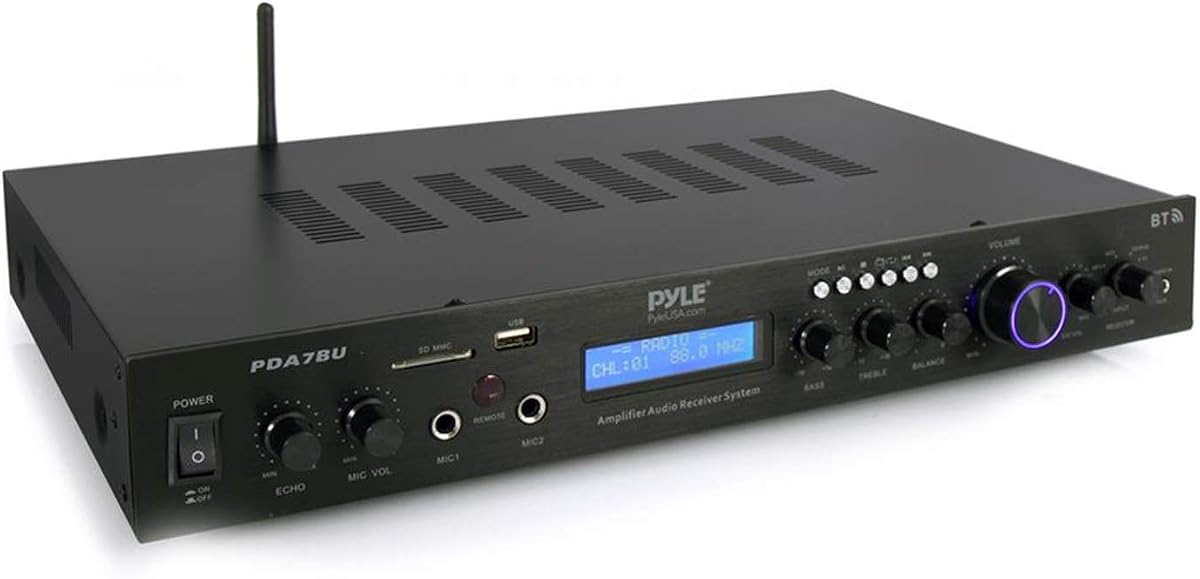
The Pyle PDA7BU is a compact home theater amplifier with a 4.1 rating and a 200-watt listed output across five channels. It supports front left, front right, center, surround left, and surround right speakers, along with a dedicated subwoofer output. It is one of the most approachable choices for building a wired surround or party-speaker system on a limited budget.
We may earn a commission when you buy through this link, at no additional cost to you.
Bluetooth allows convenient streaming from iPads, iPhones, Android devices, and other compatible products. Local media can be played through USB or SD-card connections using the built-in MP3 player, while three RCA inputs and a front-facing 3.5 mm AUX input cover additional analog sources. An FM radio and a display with a remote control round out the package.
Two 6.35 mm microphone inputs support karaoke, with adjustable Echo and microphone volume. Detachable rack mounts are included, allowing the amplifier to be incorporated into a conventional equipment rack. The slim enclosure also makes it useful in a media cabinet, rehearsal room, shop, or other space where a full-size home theater receiver would be excessive.
This is not a modern HDMI switching or surround-decoding solution. Its strengths are basic amplification, flexible local and wireless sources, and karaoke functions. It is best for budget-conscious users who want to power multiple wired speakers and prioritize music or party use over lossless movie formats, television return, gaming standards, and sophisticated room calibration.
Two wired microphone inputs, microphone level control, and adjustable Echo make the PDA7BU practical for singers and hosts. The included rack hardware adds flexibility for permanent event installations.
USB and SD playback joins Bluetooth, auxiliary, and RCA connectivity. This variety is useful for parties and casual listening where serving music directly from a computer or phone is more important than HDMI video switching.
We may earn a commission when you buy through this link, at no additional cost to you.
The best inexpensive AV receiver is not simply the model with the most listed watts or features. Channel layout, decoding, source connections, room size, speaker sensitivity, and intended use should guide the decision.
Start with the number of speakers you actually intend to use. A two-channel receiver is ideal for a stereo music setup and may be the most appropriate choice when space is limited. A 5.2-channel model provides front left, front right, center, two surrounds, and a subwoofer, which is the conventional starting point for home theater. Neither layout automatically creates a convincing surround field; speaker placement, room acoustics, and compatible content all influence the result. Match the receiver to the layout you can realistically install rather than paying for unused processing or channels.
Amplifier power claims can be misleading when a single large maximum number is used to represent several channels. Continuous RMS output at a stated speaker impedance provides a more useful comparison than peak power. A receiver producing 60 or 70 watts RMS per channel can work well with typical sensitive bookshelf speakers in a normal living room, while high-output floorstanding models may demand more. Speaker sensitivity also affects perceived loudness, so two systems with identical wattage can behave very differently. Consider room size, speaker design, listening distance, and safe headroom rather than focusing on the largest number in the listing.
HDMI support determines whether the receiver can act as a central switch for a television, console, disc player, and streaming box. Four or more inputs are useful in a modern setup, while eARC or ARC can simplify television audio return. For newer televisions and game consoles, look for 4K at higher refresh rates, 8K support, Dolby Vision, HDR10+, VRR, and ALLM where supported by the source device. Older 4K pass-through systems may work perfectly for standard viewing but leave advanced gaming capabilities unavailable.
Surround decoding determines which movie soundtracks the receiver can process directly. Dolby Atmos adds height effects, while DTS Virtual:X creates a similar dimensional impression with compatible speaker layouts. Lossless formats such as Dolby TrueHD and DTS HD Master can preserve high-quality theatrical audio, although source availability varies. Some budget amplifiers accept multichannel PCM but do not decode Dolby or DTS streams. If modern cinema sound is important, verify the exact format list rather than assuming that a 5.1 or 5.2 channel count implies complete decoding support.
Room correction can make a modest speaker system sound more balanced by measuring speaker distances, levels, and room characteristics. An included microphone and guided setup process are especially helpful for first-time home theater builders. Not every inexpensive receiver includes automatic calibration, and some rely on basic EQ controls instead. Consider how much guidance you want. A compact receiver with a clear assistant may be easier to operate, while a dedicated cinema receiver may provide deeper menus that experienced users can use for fine-tuning.
Bluetooth is useful for casual music, podcasts, and audiobooks, but it is not a substitute for a full streaming platform inside the receiver. Multipoint Bluetooth allows two devices to remain connected, which is convenient when switching between a phone and computer. Some models also provide app control, while others rely on a physical remote and television-control integration. If your sources already use streaming apps, a receiver with Bluetooth and multiple HDMI inputs may be sufficient. If you want the receiver to run streaming services directly, confirm that specific platform support is included.
Modern entertainment systems rely heavily on HDMI, but optical and coaxial audio remain useful for televisions and older source components. RCA inputs support analog devices, turntables, and legacy stereo equipment, while phono inputs save users from buying a separate preamplifier. USB, SD-card, and front auxiliary inputs are common on party-oriented amplifiers. Karaoke users should look for two microphone jacks, microphone volume, and echo control. The most useful receiver is the one that connects the sources you already own without requiring several adapters.
Dual-zone speaker control can serve two areas, virtual surround can make a two-speaker setup more cinematic, and microphone inputs can turn an amplifier into a karaoke or event system. These features are valuable when they solve a specific need and unnecessary when they add setup complexity. Consider cabinet size, ventilation, physical controls, rack hardware, and white finishes as well. A receiver that fits the room, offers understandable operation, and meets the required connection needs is often a better value than one with a longer feature list.
Begin by placing the receiver in a ventilated position, particularly within a cabinet. Connect speakers with power off, observe correct polarity, and confirm that each speaker's impedance falls within the manufacturer's supported range. Connect source components, television, and subwoofer, then complete the setup guide or room-calibration process before making extensive EQ adjustments. Assigning meaningful input names and saving preferred sound modes can make daily operation much simpler.
For everyday listening, choose an input matching the connected source and set the receiver volume to a moderate level before making changes. Use the receiver's room correction or manual EQ to balance the speakers, then make small tonal adjustments based on preference rather than repeatedly boosting extreme frequencies. When switching between movies, music, and games, test the corresponding sound mode with familiar content. Bluetooth streaming is generally simplest for casual listening, while HDMI and digital audio should be preferred for home theater.
Keep the ventilation openings unobstructed, use a surge protector appropriate for the equipment, and avoid placing the receiver where cables may be pulled or where moisture and excessive heat can accumulate. Do not exceed speaker or wiring limits, and avoid leaving the unit operating with inputs disconnected during setup. Periodically check cables for damage, update any available control-app or receiver software, and consult the installation guide if a protection feature activates or an unusual fault appears.
A stereo receiver primarily powers two left and right speakers and focuses on music playback. An AV receiver manages multiple surround channels, decodes movie audio, connects to a television through HDMI, and often provides room calibration and gaming features. A stereo receiver is usually simpler and may suit a dedicated music system, while an AV receiver is the better choice for a television-based home theater.
Yes. A 5.2-channel receiver supports five main speakers and one subwoofer, making it a practical foundation for conventional surround sound. It can also provide virtual surround or object-style effects when supported by the model and content. If you later want dedicated overhead speakers and advanced height-channel audio, confirm that the receiver supports the required format and speaker layout.
The right amount depends on room size, speaker sensitivity, design, and how loudly you listen. Many budget receivers provide 60–70 watts RMS per channel, which can suit bookshelf speakers and typical living rooms. Large floorstanding speakers or a spacious room may benefit from more power. Compare continuous RMS ratings and match the amplifier to the speakers rather than relying on peak wattage.
No. A 5.2-channel configuration can support surround formats without Dolby Atmos, and some budget receivers omit height-channel decoding entirely. The Yamaha RX300A in this list specifically supports Dolby Atmos and DTS Virtual:X. Always check the full format list, not just the channel count, before purchasing for an Atmos-capable library.
Usually, yes, through optical or coaxial digital audio when the television offers those outputs. Such a connection can return television sound but will not carry video to the television. You would connect the picture directly from each source to the television and send audio to the receiver separately. An adapter may be needed if your sources only provide HDMI audio.
It is convenient for casual listening, podcasts, and many everyday music sessions. Bluetooth compression can reduce fidelity compared with a wired digital or analog connection, and codec support varies between source devices and receivers. For serious critical listening, use the best wired input available; for convenient everyday playback, Bluetooth Multipoint or standard Bluetooth is generally practical.
eARC allows a compatible television to send its audio back to the receiver through the same HDMI cable used for video. It can simplify connections and support high-quality surround formats in suitable systems. Both the television and receiver must support the feature, and the source still needs to provide compatible audio. ARC is the older, more limited alternative.
They can be, especially when their input and speaker arrangements match your system. Models such as the Donner MAMP4 and Pyle PDA7BU include multiple channels, subwoofer support, and useful microphone controls. However, many lack HDMI and modern surround decoding, so they are best for casual surround, music, parties, or systems using externally decoded audio.
The Sony STRDH190 stands out as the best budget option for a powerful, compact two-speaker system, while the Yamaha RX300A is the most complete general recommendation for modern home theater. Its Dolby Atmos support, modern HDMI capabilities, room correction, and flexible layouts offer an unusually useful feature set for the category. The Denon AVR-S570BT is the best premium pick for buyers who prioritize four HDMI 2.1 inputs, extensive video formats, app control, and detailed surround EQ.
Prioritize the features your system will actually use. A Bluetooth stereo receiver is more appropriate for music than a cinema processor, while a 5.2-channel model is a better foundation for surround. Confirm decoding formats, HDMI capabilities, speaker impedance, continuous amplifier power, and the availability of inputs for existing equipment before buying. Room calibration, dual-zone speakers, karaoke microphones, and virtual surround can all be useful, but only when they match your room and listening habits.
Specifications and prices can change as manufacturers update products and retailers revise listings. Before purchasing, confirm the current package contents, dimensions, power requirements, port availability, and warranty details. Most importantly, check that the receiver supports your television, gaming console, streaming devices, and preferred audio formats so the purchase delivers the capabilities you actually expect to use.