
UGREEN DXP4800 GT
4.6Editor score
Ryzen Embedded processor
Dual 10GbE networking
Built-in Surveillance Center
A NAS for Plex can turn a scattered collection of movies, shows, photos, and home videos into a private, accessible media library. The best model balances transcoding power, reliable networking, expandable storage, quiet operation, and enough application flexibility to keep the media server running smoothly.
This guide compares ten NAS options based on processor capability, memory, drive bays, networking, supported applications, storage features, and suitability for Plex. It includes capable enclosures, ready-made bundles, and internal hard drives so readers can evaluate both complete systems and storage upgrades.
The selections show why there is no universal winner: one model prioritizes affordability, another balances expansion and throughput, and premium options serve demanding libraries or active creators. Product specifications, ratings, features, and availability can change, so confirm current details before purchasing.
4.6Editor score
4.6Editor score

4.5Editor score
As an Amazon Associate we earn from qualifying purchases.
The table below compares all ten products by their most important Plex-related characteristics, including application support, networking, expandability, and product type.




The UGREEN NAS DXP2800 earns a 4.6 rating and stands out as the most balanced recommendation in this guide. Its Intel N100 quad-core processor, 8GB of DDR5 memory, 2.5GbE connection, and dual M.2 NVMe slots provide enough capability for Plex, Docker, virtual machines, backups, and broader home data management without moving into a large four-bay system.
We may earn a commission when you buy through this link, at no additional cost to you.
Plex performance depends on transcoding demands, client formats, and network behavior, but the N100 gives this model a stronger foundation than a basic file-only NAS. 2.5GbE is also a meaningful upgrade over gigabit Ethernet when loading large files or supporting multiple users. The NVMe slots can accelerate app data, metadata, or selected workloads, while two hard-drive bays create a straightforward foundation for a personal media library.
The compromise is that storage expansion is limited compared with four-bay models. Drives are also sold separately, so buyers must select compatible hard drives or SSDs themselves. Intel N100-based hardware cannot satisfy every demanding workload, and virtual-machine use may eventually exceed the included memory. Even so, the feature set is unusually complete for a two-bay NAS aimed at creators and advanced home users.
This is the best choice for someone who wants serious Plex flexibility without a large enclosure. It suits households with several users, mixed file types, Docker applications, and a desire for faster wired networking. Choose the DXP2800 when transcoding headroom, compact dimensions, and application flexibility matter more than maximum bay count.
The Intel N100 and 8GB of DDR5 give Plex more processing headroom than a simple storage appliance. They also leave room for Docker and virtual-machine workloads, subject to the demands and configuration of each application.
A 2.5GbE port can accelerate large media transfers, while the dual M.2 slots provide options for SSD acceleration and app data. Compatible clients, switches, cabling, and drive configuration remain important to realizing the full benefit.
We may earn a commission when you buy through this link, at no additional cost to you.
The UGREEN NAS DH2300 carries a 4.5 rating and is the least complicated model in the comparison. It is designed for beginners and personal users who want centralized files, phone backups, photo organization, and a private alternative to scattered external storage. For a basic Plex library, it can provide a practical path into owning a NAS without the feature overhead of the DXP line.
We may earn a commission when you buy through this link, at no additional cost to you.
Its high-performance processor, 4GB of onboard RAM, and 1GbE port make it more practical than a bare drive enclosure. The supplied data says transfers can reach up to 125MB/s under favorable conditions, although actual results depend on the router, drives, files, and network. Automatic backups work across Windows, macOS, iOS, and Android, while AI features help tag faces, locations, text, and objects in photos.
The important limitation is application support. The DH2300 does not support Docker or virtual machines, and the supplied information explicitly says Plex cannot be run through Docker. That makes this model less attractive if you intend to build a broad self-hosted application environment. Its gigabit Ethernet may also become the bottleneck when several people access large media files simultaneously.
Choose the DH2300 if your primary goal is straightforward file storage and a small Plex collection, especially if you value a simple interface and local ownership of data. It is a sensible budget entry point, but buyers who know they will need Docker-based applications, virtual machines, or faster networking should move up.
The DH2300 focuses on the fundamentals: centralized files, automatic device backups, cross-platform access, and a two-bay storage design. That makes it approachable for households moving away from cloud accounts or loosely managed external drives.
Plex support is not the same as Docker support. The DH2300 does not provide Docker or virtual-machine capability, so prospective buyers should confirm the exact Plex deployment method available for their chosen operating system before buying.
We may earn a commission when you buy through this link, at no additional cost to you.
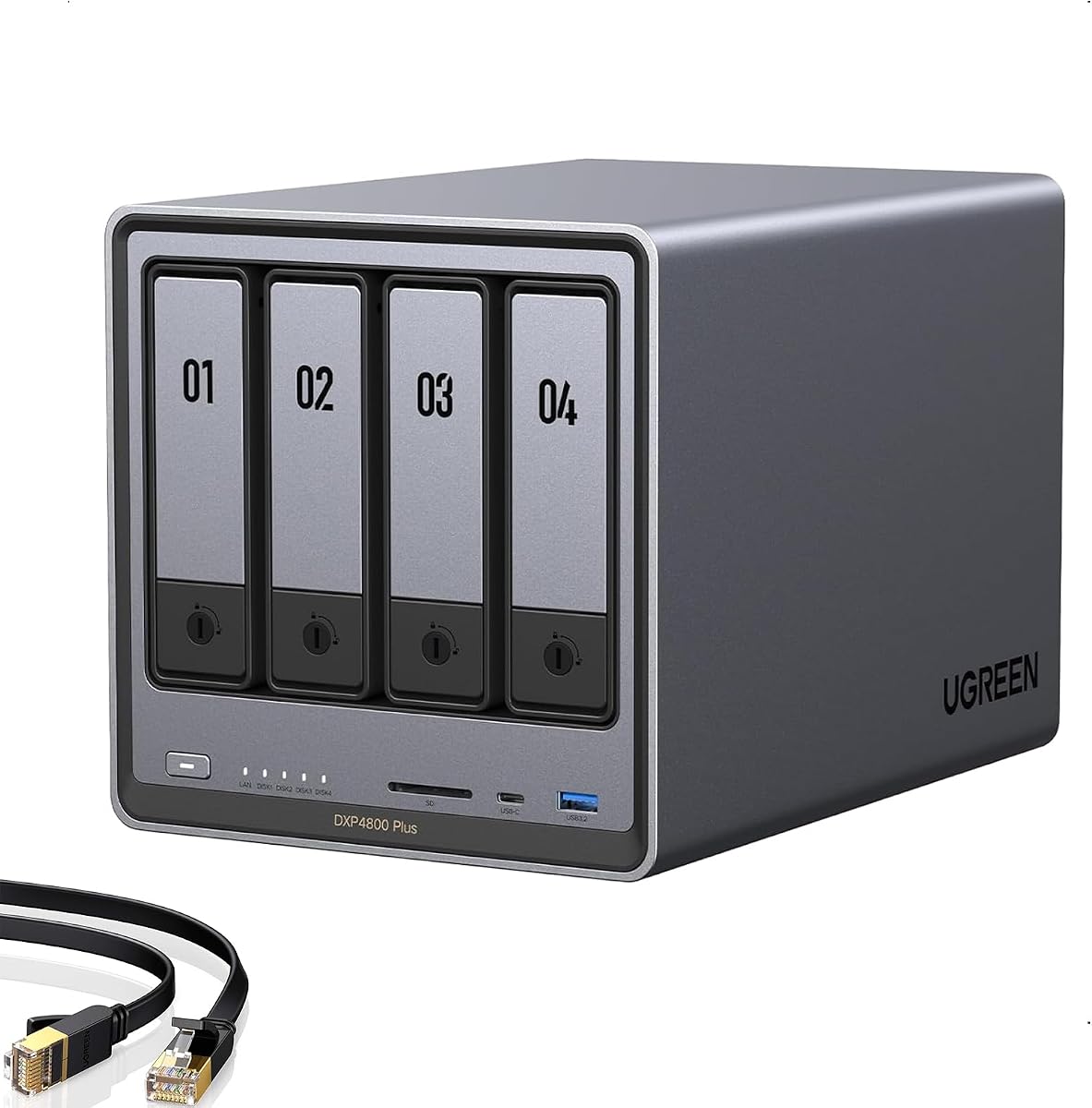
The UGREEN DXP4800 Plus has a 4.6 rating and provides one of the strongest combinations of Plex readiness, storage expansion, and networking in the roundup. Four drive bays make it easier to grow a substantial media collection, arrange drives according to a chosen RAID strategy, or add capacity over time without replacing the enclosure.
We may earn a commission when you buy through this link, at no additional cost to you.
Its standout feature is the 10GbE port, supported by 10Gbps USB connections and Docker and virtual-machine support. The supplied information says a 1GB backup can complete in less than a second under suitable conditions, although real-world speeds depend on the client, storage, router, switch, file size, and network configuration. That high bandwidth helps when Plex clients need rapid access to large local media.
The enclosure also supports centralized storage, automatic backups, remote access, RAID options, permissions, and encryption. AI photo organization recognizes faces, scenes, objects, and locations, while compatibility extends across Windows, macOS, Linux, iOS, Android, web browsers, and smart TVs. Hard drives are not included, and maximum advertised capacity depends on compatible drives and the selected RAID configuration.
This is the recommendation for families, creators, and small teams who want more than a basic media box. It is particularly attractive when a library includes 4K content, several users need simultaneous access, or the NAS will also host backups and other applications. Choose it when the extra expansion and networking potential justify a larger, more capable system.
Four bays offer more flexibility than a two-bay enclosure, allowing users to combine capacity, redundancy, and expansion according to their needs. The stated maximum of 144TB is based on compatible drive configurations and should be considered alongside RAID and backup planning.
10GbE is particularly relevant for local 4K libraries, rapid backups, and multi-user environments. A compatible network path is essential because an older gigabit switch or client can prevent the NAS from delivering its full potential.
We may earn a commission when you buy through this link, at no additional cost to you.
The UGREEN NAS DH4300 Plus is a four-bay model aimed at home users, families, and remote workers. Its 4.2 rating reflects a capable general-purpose NAS with a useful mix of media, backup, and application features. It supports Docker, allowing Plex to run through Docker according to the supplied information, which makes it more flexible than the DH2300.
We may earn a commission when you buy through this link, at no additional cost to you.
A 2.5GbE port, 8GB of LPDDR4X memory, and a high-performance processor make it better equipped for simultaneous tasks than a basic network drive. The supplied information reports that a 1GB file can transfer in approximately three seconds under favorable conditions. Its 4K HDMI output also adds flexibility for direct media playback, while AI albums, duplicate removal, semantic search, and automatic phone backups suit family libraries.
Virtual machines are not supported, so the model lacks one area available in the DXP series. Its four bays offer room for larger libraries and more flexible RAID arrangements, but advertised capacity assumes compatible storage and a RAID 0 configuration. The enclosure also supports wired Ethernet only; Wi-Fi requires an external adapter.
The DH4300 Plus is a good middle ground for a household that wants four-bay expansion, Docker-based Plex deployment, and faster networking without moving to the highest-tier DXP models. It is well suited to media, photo backups, and shared family storage, but advanced users who need virtual machines should choose a DXP enclosure instead.
Automatic phone backups, real-time photo and video support, AI recognition, and duplicate removal help organize a family collection. Direct HDMI output is another useful option for local playback without relying entirely on a separate streaming client.
Docker support opens the door to Plex and other containerized services. The lack of virtual-machine support narrows the scope for experimentation, but it also keeps the platform focused for mainstream home users.
We may earn a commission when you buy through this link, at no additional cost to you.
The UGREEN DXP4800 GT earns a 4.6 rating and is the premium choice for creators, technical users, and office teams. Its AMD Ryzen Embedded R2514 processor has four cores and eight threads with speeds up to 3.70GHz, while the included 8GB of DDR4 memory is expandable to 64GB. That platform provides substantial headroom for Plex transcoding, backups, Docker services, and concurrent workloads.
We may earn a commission when you buy through this link, at no additional cost to you.
Dual 10GbE ports are the defining networking feature. Each supports up to 10Gbps, and compatible equipment can use link aggregation for up to 20Gbps aggregate bandwidth. Four drive bays support large SATA libraries, U.2 NVMe options, and M.2 SSD expansion. USB-A and USB-C 10Gbps ports, USB 2.0, 4K HDMI, and an SD card slot further improve creator workflows.
Plex can run via Docker, but the supplied information says setup is manual. The model also includes a Surveillance Center for compatible ONVIF or RTSP cameras, live multiview, event detection, recording, and timeline playback. Security features include TLS/SSL, RSA, AES, SHA-512, permission management, and RAID redundancy. The preinstalled RAM is non-ECC, so users who want ECC error correction need compatible memory.
This is the right NAS for demanding media workflows, large active teams, creators editing high-resolution footage, and users who value modern networking. It may be excessive for a small family with light Plex use, but for heavy workloads the processor, memory expansion, dual 10GbE, and broad application support provide a more convincing foundation.
The Ryzen Embedded platform gives Plex more processing headroom, especially when several clients require simultaneous access or transcoding. Expandable memory further helps when Docker, virtual machines, and media services run concurrently.
Two high-speed ports benefit large transfers, balanced multi-user access, and advanced creative workflows. Link aggregation can increase aggregate bandwidth when the NAS, switch, clients, and configuration all support it.
We may earn a commission when you buy through this link, at no additional cost to you.
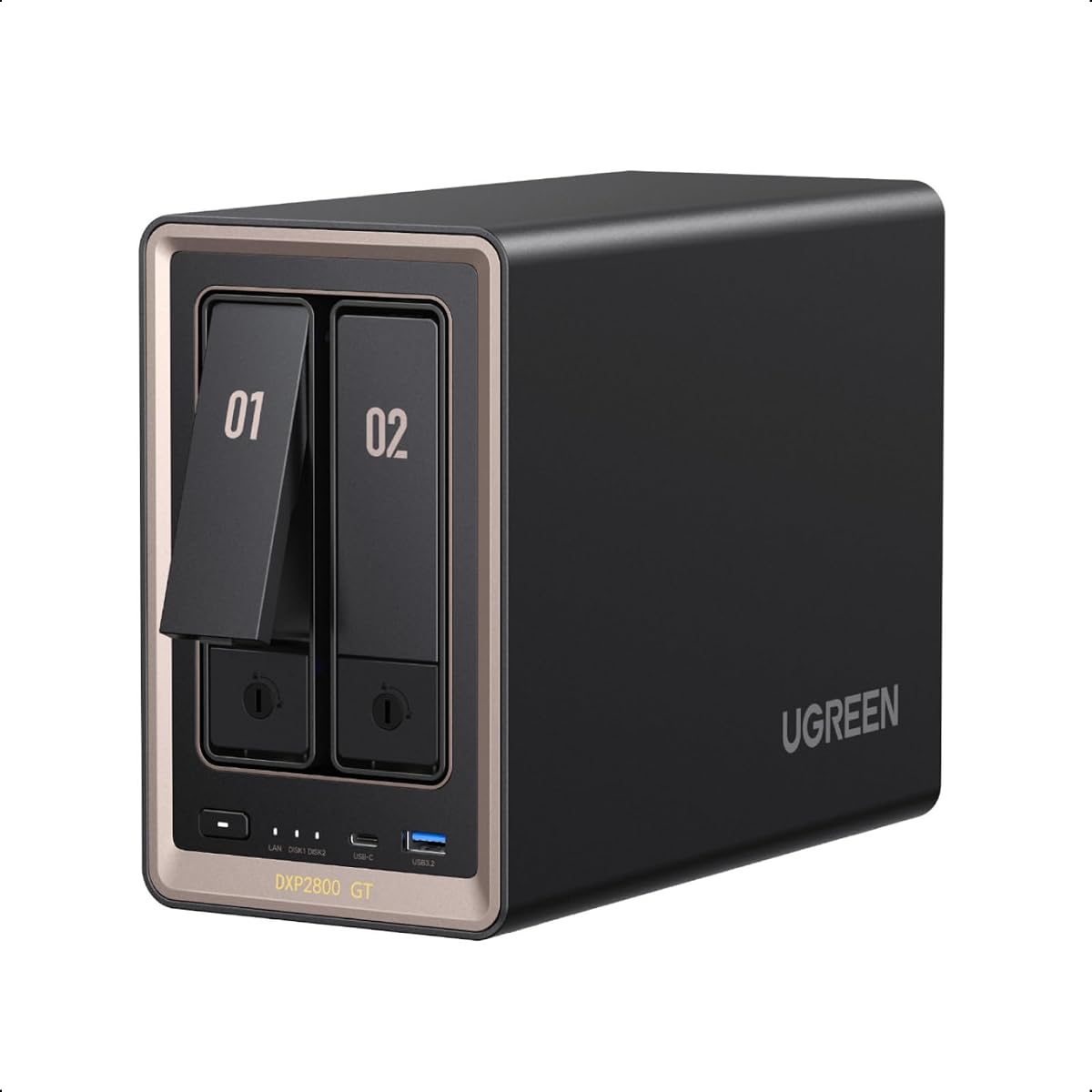
The UGREEN DXP2800 GT combines a compact two-bay format with the same Ryzen Embedded R2514 processor found in the premium four-bay model. Its 4.3 rating and specifications position it for smart-home enthusiasts, freelancers, creators, and users who prioritize performance over a large number of drive bays. Plex can run via Docker, although setup is manual.
We may earn a commission when you buy through this link, at no additional cost to you.
The four-core, eight-thread processor can reach 3.70GHz, and 8GB of DDR4 memory is expandable to 64GB. A 10GbE connection supports rapid file movement, while Docker, virtual machines, and SAN Manager broaden the platform beyond media storage. The built-in Surveillance Center can work with compatible ONVIF or RTSP IP cameras for live viewing, recording, event detection, and playback.
Two SATA bays hold up to 32TB drives each, while compatible U.2 NVMe and two M.2 slots can add SSD capacity, with an advertised maximum of 80TB. RAID 1 is supported for redundancy. The lack of built-in Wi-Fi reinforces its focus on reliable wired networking, and ECC error correction requires a compatible memory upgrade because the installed RAM is non-ECC.
Choose this model if you want premium-class processing and 10GbE in a smaller footprint than a four-bay NAS. It is especially attractive to power users who run cameras or self-hosted services along with Plex. Buyers focused on maximum archive capacity should instead consider a larger enclosure with more drive bays.
The Ryzen processor, expandable memory, and application support make the two-bay chassis suitable for more than simple file storage. Plex, home automation, and other self-hosted services can share the platform when configured carefully.
Integrated camera support keeps surveillance footage on local hardware under the owner's control. It works with compatible ONVIF or RTSP cameras and supports live multiview, detection, recording, and timeline review.
We may earn a commission when you buy through this link, at no additional cost to you.
The Seagate IronWolf Pro 24TB is not a NAS enclosure, but it is an important component for a Plex library that needs serious capacity. Its 4.4 rating, 24TB capacity, conventional magnetic recording technology, and 7200 RPM spindle speed make it a high-capacity option for sequential media access, RAID arrays, and multi-bay systems.
We may earn a commission when you buy through this link, at no additional cost to you.
The drive is designed for 24/7 use and carries a workload rating of up to 550TB per year, a stated MTBF of 2.5 million hours, and a five-year limited warranty. AgileArray firmware, dual-plane balancing, time-limited error recovery, and rotational-vibration sensors are intended to support dependable behavior in multi-bay NAS environments. IronWolf Health Management adds prevention, intervention, and recovery recommendations.
For Plex, raw capacity is valuable because high-resolution movies can consume considerable room, while transcoding caches and other temporary files need room to operate. Nevertheless, a NAS enclosure must still be selected, and its compatibility list should be checked. Capacity, RAID layout, noise, power draw, and drive performance also need to match the user's tolerance and hardware environment.
This drive is best for users building a multi-bay high-capacity library who value workload endurance and rescue support. It is excessive for a small collection or quiet living-room system. Pair it with a compatible four-bay NAS such as the UGREEN DXP4800 Plus or DXP4800 GT, and remember that no single drive replaces a separate backup strategy.
A 24TB drive can reduce the number of disks needed to house extensive movie, photo, or creator collections. Pairing large drives also creates more opportunities for a RAID configuration that balances usable capacity and redundancy.
AgileArray, rotational-vibration sensors, health management, and enterprise workload ratings reflect a focus on sustained multi-bay operation. Compatibility with the chosen enclosure, cooling arrangement, and drive bay remains essential.
We may earn a commission when you buy through this link, at no additional cost to you.
The Synology DS223j 8TB Bundle is a ready-to-use starting point because it combines a two-bay Diskstation with two 4TB Seagate IronWolf drives. Its 4.4 rating reflects a well-established NAS platform aimed at storing, sharing, protecting, and remotely accessing documents, photos, and media. That convenience differentiates it from every diskless enclosure in this roundup.
We may earn a commission when you buy through this link, at no additional cost to you.
The DS223j uses a Realtek RTD1619B four-core processor operating at 1.7GHz and includes 1GB of non-ECC DDR4 memory. It has one 1GbE LAN port and two USB 3.2 Gen 1 ports. Those specifications are modest compared with the UGREEN DXP models, making the bundle more appropriate for a modest Plex library and general household storage than intensive multi-user transcoding.
Synology's software ecosystem remains attractive to buyers who value a defined NAS interface and established administration tools. The included drives offer an immediate capacity allocation, while RAID and backup options add flexibility. However, real-world network throughput is constrained by the gigabit Ethernet interface, and the one-gigabyte memory limit offers little room for demanding add-on workloads.
Choose this bundle when simplicity and immediate readiness matter more than maximum performance. It is a practical option for a first NAS, a small household library, or users who want the drives and enclosure together. For heavy 4K transcoding, multiple users, Docker flexibility, or faster networking, one of the more powerful UGREEN systems will be a better fit.
The enclosure and two IronWolf drives arrive as a bundle, simplifying initial setup for buyers who are unfamiliar with drive compatibility. Users still need to create their storage configuration and establish an appropriate backup plan.
A four-core processor can handle everyday NAS duties, but 1GB of memory and gigabit Ethernet limit advanced flexibility. Buyers should assess their media formats and client count before choosing it for intensive transcoding.
We may earn a commission when you buy through this link, at no additional cost to you.
The Ubiquiti Four-Bay NAS is a compact enclosure with four 2.5-inch and 3.5-inch hard-drive slots, 2.5GbE networking, USB-C connectivity, and two M.2 NVMe SSD cache slots. No customer rating was supplied for this product, so its position in the guide rests on the stated hardware rather than a numerical review score.
We may earn a commission when you buy through this link, at no additional cost to you.
The combination of four bays and NVMe cache slots could appeal to buyers who want a space-efficient NAS with SSD acceleration. Plex users may benefit from caching frequently accessed media and metadata, while 2.5GbE offers more headroom than a basic gigabit connection for local file delivery and backups.
The supplied information is limited, however, and does not state processor specifications, memory capacity, supported applications, RAID options, or whether Plex can run directly or through Docker. Those omissions make a detailed workload recommendation difficult. Drive compatibility, cache behavior, and the availability of relevant software should be verified with the manufacturer before purchase.
This enclosure is worth watching for compact home and office setups, particularly if it will sit near Ubiquiti networking equipment or serve a small local media collection. It is not the safest choice for someone who needs clearly documented transcoding specifications today. Confirm the final hardware and Plex workflow before relying on it for a primary media server.
Two dedicated M.2 slots are designed for cache or acceleration functions, which can benefit frequently accessed files. Exact cache modes, supported drives, and recommended configuration should be confirmed before installation.
Four drive bays provide more expansion options than a two-bay NAS without moving to a full-size desktop enclosure. Its 2.5GbE connection helps avoid the immediate network limitations of gigabit-only alternatives.
We may earn a commission when you buy through this link, at no additional cost to you.
The WD Red Plus 8TB is a straightforward NAS hard drive for Plex builders who need more capacity than a small personal drive provides. It has a 4.5 rating, 8TB capacity, CMR recording, SATA 6Gb/s connectivity, 256MB of cache, and a 5400 RPM performance class. It is a storage component rather than a complete NAS enclosure.
We may earn a commission when you buy through this link, at no additional cost to you.
Its main strength for Plex storage is conventional magnetic recording, which is generally well suited to RAID rebuilding and sustained workloads. The supplied information lists support for up to eight bays, a workload rate of up to 180TB per year, and NASware firmware for compatibility. A three-year limited warranty adds some reassurance for a drive expected to operate continuously.
The 5400 RPM class and single 8TB capacity may be less attractive than newer high-capacity alternatives for large libraries. Users must separately select a compatible NAS, and the enclosure's drive list should be checked. Noise, heat, vibration, backup strategy, and RAID configuration also influence whether this drive fits a particular home environment.
This is a sensible standard drive for a two-bay or four-bay Plex NAS that is already planned around conventional hard drives. It provides ample room for a typical personal collection while supporting CMR-based RAID behavior. Buyers seeking the newest performance or highest density should compare it with current enterprise NAS drives, while all users should maintain an independent backup.
CMR technology supports predictable RAID rebuilding behavior, which matters when the drive is part of a redundant media array. The NAS enclosure's compatibility list remains the authority on supported configurations.
The 5400 RPM class can suit a home environment where lower acoustic output and moderate power use are priorities. Sequential transfer demands, drive density, and network speed will influence the overall Plex experience.
We may earn a commission when you buy through this link, at no additional cost to you.
The right NAS for Plex depends on library size, client count, desired applications, network speed, and tolerance for setup complexity. Evaluate these factors together rather than focusing on a single specification.
The processor affects how comfortably a NAS can scan libraries, analyze media, run other services, and transcode incompatible formats for active Plex clients. An Intel N100 in the DXP2800 provides a modern four-core foundation, while the Ryzen Embedded R2514 models provide four cores and eight threads for heavier concurrent workloads. The Synology DS223j uses a 1.7GHz Realtek quad-core processor, and the DH2300 is intended for more modest personal use. High-resolution content and multiple simultaneous users raise the value of additional processing power.
Choose processing headroom that exceeds your present library needs. Faster transcoding can prevent buffering and improve direct-play compatibility, but processor capability alone does not guarantee smooth playback.
Memory determines how comfortably the NAS can handle file indexing, metadata, thumbnails, databases, applications, and background tasks. The roundup includes models with 1GB, 4GB, and 8GB of memory, plus DXP and GT systems that support expansion. Docker can provide access to Plex and other self-hosted services, while virtual machines add another layer of flexibility but require more memory and configuration.
Prioritize Docker compatibility if you want containerized applications, and check whether Plex is supported directly or through Docker. Treat the one-gigabyte Synology configuration as more modest than the memory-rich UGREEN alternatives.
Two bays are often enough for a personal Plex collection, while four bays provide easier expansion and more flexibility in grouping disks. RAID can improve availability or usable capacity depending on the selected scheme, but it does not replace a backup. Advertised capacities frequently assume RAID 0 and compatible high-capacity drives, so the stated maximum should not be treated as guaranteed usable storage.
Select a bay count that matches your collection and expected growth. If you need long-term archiving, a four-bay system is usually easier to expand than a two-bay model.
Network speed determines how quickly clients retrieve large media files and how quickly backups move. The included options range from 1GbE to dual 10GbE. The DXP2800 and DH4300 Plus use 2.5GbE, while the DXP4800 Plus and both GT models provide 10GbE capabilities. Faster ports only help when compatible clients, switches, cables, and routing are present.
Use wired Ethernet for predictable performance, especially for 4K libraries. Remote streaming is limited by internet speed rather than local network speed, while local playback benefits directly from a faster LAN.
NVMe or M.2 slots can provide cache, app storage, or additional capacity depending on the model and its configuration software. The DXP2800 has dual M.2 NVMe slots, the Ubiquiti enclosure advertises two cache slots, and the GT models support both M.2 and U.2 NVMe options. SSD acceleration can improve metadata operations and repeated access, but it is not a substitute for sufficiently sized hard-drive media storage.
Choose a model with SSD expansion when metadata performance, app responsiveness, or a mixed SSD-and-HDD storage plan matters. Confirm supported drive types, usable modes, and slot sharing before buying.
A useful Plex NAS should make media easy to add, monitor, and share. The UGREEN models include AI-assisted photo organization, semantic search, duplicate detection, phone backup, cross-platform access, and remote file sharing. The Synology bundle offers a defined NAS management environment with file access and sharing. These companion features matter because Plex is only one part of a household's data-management setup.
Prioritize the organization features you will actually use. Photo indexing and mobile backups are valuable for families, while administrators may care more about permissions and multi-user collaboration.
Some listings include the NAS and storage, while most UGREEN enclosures and both standalone drives are sold without drives or as individual components. A complete bundle reduces initial friction but may not offer the best flexibility for upgrading. The 8TB WD Red Plus and 24TB IronWolf Pro are strong components for building capacity, while the 8TB Synology bundle arrives with two 4TB IronWolf drives.
Plan the complete system, including drives, RAID configuration, backup destination, and networking. A diskless enclosure may offer better long-term flexibility, while a bundle is more convenient for first-time users.
A NAS may run continuously, so cooling, acoustic output, power efficiency, and access to reliable power matter. The 5400 RPM WD Red Plus and 7200 RPM IronWolf Pro have different characteristics, and enterprise NAS drives may be better suited to sustained multi-bay workloads. RAID helps with availability, but regular backups, surge protection, and drive monitoring remain necessary.
Choose a drive and enclosure combination appropriate for the room and expected operating pattern. Always keep a separate copy of irreplaceable media and configuration data.
Begin by checking the NAS compatibility list and selecting compatible drives of the intended type and capacity. Install the drives according to the manufacturer's guidance, connect the enclosure to the network with Ethernet, power it on, and complete the initial setup. Create the administrator account, apply firmware updates, and configure a RAID arrangement only after understanding how it affects capacity, rebuild time, and recovery options.
Install or enable Plex according to the model's supported method. Organize media into clearly named folders, then create or connect the appropriate libraries and point Plex at their locations. Give each client correct file permissions, test direct play and transcoding on several devices, and avoid unnecessary transcoding by keeping formats compatible with the clients in your home. Use the NAS app or administration interface to monitor indexing, storage use, and application health.
Maintain the NAS by keeping firmware and applications updated, monitoring drive health, reviewing backup jobs, and checking SMART information on a regular schedule. Keep at least one independent backup of important media and configuration. Do not treat RAID as a backup, and do not interrupt rebuilds or power off the system during critical storage operations. Dust, heat, and unstable networking can affect long-term reliability, so place the enclosure in a ventilated, secure location.
A streaming box usually provides playback, while a NAS stores and organizes the media library and runs the server. If your existing device can host Plex and access all of your files, a NAS may not be essential. It becomes valuable when you want local storage, automated backups, multi-device access, and a dedicated always-on media server.
That depends on the operating system and the specific NAS. Some platforms offer a dedicated Plex application, while others require Docker or a manual installation method. The supplied information specifically says the UGREEN DH2300 cannot run Plex via Docker, so buyers should confirm native support before choosing it. The DXP and GT models are described as supporting Plex through Docker.
A single 1GbE connection can handle one suitable high-bitrate 4K stream in many situations, but it offers limited headroom for several users or large file transfers. Direct-play files still need to travel across the network. A 2.5GbE or 10GbE network provides more capacity for demanding libraries, multiple clients, and rapid backups.
The required capacity depends on the resolution, codecs, and length of your collection. High-resolution movies can require many gigabytes each, while transcoding caches and temporary files need additional room. Buying expandable storage is usually more practical than maximizing every bay immediately, but users should account for RAID overhead and retain headroom for future media.
Two drives are commonly used in a NAS for RAID 1 mirroring, which duplicates data and allows continued operation if one drive fails. However, RAID is not a backup and does not protect against deletion, malware, enclosure failure, or accidental removal. Critical media should also be copied to an independent backup system or location.
Hard drives can store Plex media effectively, but SSD cache or app storage may improve responsiveness when metadata, thumbnails, and frequently accessed files are involved. The benefit depends on the NAS implementation and workload. For large libraries, a hybrid setup can work well, with SSDs handling active or metadata-intensive tasks and hard drives providing bulk capacity.
Most capable NAS platforms support remote access, either directly or through a secure application or relay service. The UGREEN models emphasize cross-platform and remote access, while the Synology DS223j is designed to make files and media accessible from anywhere. Remote performance depends on upload bandwidth and whether the client format avoids unnecessary transcoding.
A bundle is convenient for beginners because the enclosure and compatible drives arrive together. An empty enclosure offers more choice over drive capacity, generation, and performance, but requires additional research and installation. For Plex, consider whether you need high-capacity CMR hard drives, SSD acceleration, quiet operation, or a future upgrade path before deciding.
The UGREEN DXP4800 Plus is the strongest all-around choice because it combines four bays, 10GbE networking, Docker and virtual-machine support, and strong cross-platform features. The UGREEN DXP4800 GT is the premium option for creators and demanding multi-user workloads, while the UGREEN NAS DH2300 is the budget-friendly starting point for a smaller and simpler library.
Prioritize the combination of processing power, compatible application support, storage expansion, and network infrastructure. Two bays and 1GbE may be sufficient for a small personal collection, but four bays and faster networking offer a better foundation for 4K media, multiple users, active backups, and additional self-hosted applications. Check Docker or native Plex support before buying any enclosure.
Finally, review current specifications, drive compatibility, ratings, and pricing before placing an order. NAS components and configurations change, and the right choice depends on both today's library and the way you expect it to grow.