
K&F Concept EF EF-S to E Mount Adapter
4.4Editor score
Brass and aluminum construction
Manual focus operation
Infinity focus support
Our Canon to Sony E Mount Adapter guide compares 10 options for autofocus, manual focus, aperture control, EXIF transmission, stabilization, and camera fit.
A Canon to Sony E Mount Adapter lets photographers combine Canon EF or EF-S lenses with compatible Sony mirrorless cameras. The right adapter can preserve aperture control, autofocus, stabilization, and EXIF data, while a simpler manual model may suit photographers who value deliberate focus and rugged construction.
We compared all ten adapters by examining lens support, electronic communication, focusing behavior, stabilization compatibility, EXIF transmission, aperture control, camera compatibility, construction, and the practical differences between full-manual and electronically connected designs.
Each review identifies the adapter best suited to a particular workflow, from manual-focus photography to electronic Canon EF or EF-S lenses on newer Sony bodies. Product ratings and availability can change, and current prices should be checked before buying.
4.4Editor score

4.3Editor score

4.2Editor score
The list covers both full-manual adapters for deliberate photography and electronic adapters for autofocus, aperture control, stabilization, and EXIF communication. Compatibility varies considerably by camera model and lens, so the table should be treated as a starting point rather than a substitute for the manufacturers' current compatibility lists.



The EF/EF-S Lens to Sony E Mount T Smart Adapter combines Canon EF or EF-S glass with a broad selection of Sony E-mount bodies, and its 4.3 rating reflects a capable feature set. It supports contrast-detect and phase-detect autofocus, transfers EXIF information, and provides a built-in USB port for firmware updates.
We may earn a commission when you buy through this link, at no additional cost to you.
Its strongest distinction is camera-side aperture adjustment, allowing compatible lenses to respond to exposure settings rather than remaining at a fixed aperture. Electronic contacts also support EXIF transmission, while the listed stabilization function can help maintain steadier images with compatible Image Stabilization lenses. The adapter is designed for Sony A7, A9, A6000, A6300, A6500, and A5300 families, along with selected NEX and FS-series bodies.
The important limitation is that adapter compatibility does not guarantee that every autofocus feature behaves exactly as it does on a native Sony lens. Actual results can depend on the camera, lens, firmware, and shooting mode. A manual mode remains useful for checking focus, and buyers should still consult the current camera list before committing.
This is the most balanced recommendation for a photographer who wants electronic communication without paying for the premium-tier Urth option. It particularly suits users of Canon EF and EF-S lenses who need aperture control, autofocus, stabilization, and recorded exposure information. The firmware-upgrade interface adds a useful layer of support for changing camera and lens combinations.
Camera-side aperture control makes this adapter more useful for everyday exposure control than a purely mechanical unit. The supplied description also reports EXIF transfer and stabilization support, allowing compatible lenses to retain more of their normal electronic features.
The adapter provides CDAF and PDAF modes, giving photographers a choice between contrast detection and phase detection. Its listed support for high-speed autofocus makes it a sensible option for moving subjects and video work when the camera-and-lens combination is supported.
We may earn a commission when you buy through this link, at no additional cost to you.
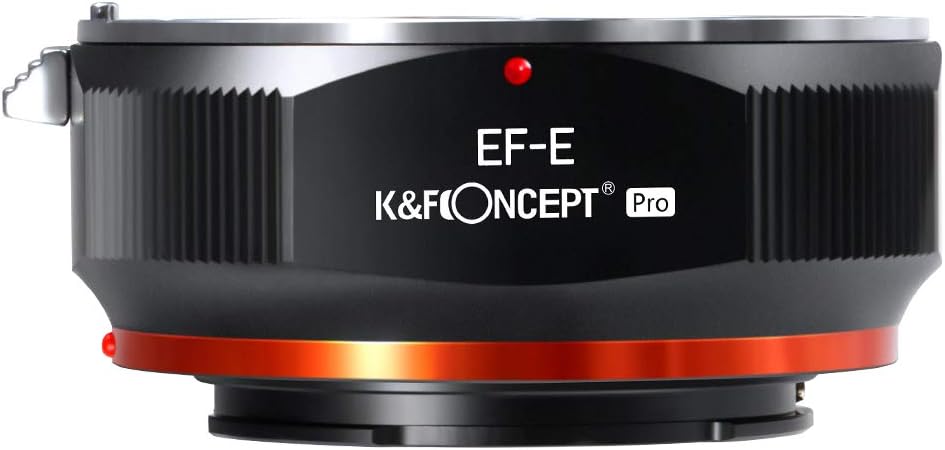
The K&F Concept EF EF-S to E Mount Adapter is a straightforward manual adapter rated 4.4 by users. It joins Canon EF or EF-S lenses to compatible Sony NEX and E-mount bodies without electronic contacts, giving photographers complete control over focus while avoiding dependence on powered autofocus communication.
We may earn a commission when you buy through this link, at no additional cost to you.
Construction combines brass and anodized aluminum rather than relying on plastic alone. Focus is adjusted on the lens, infinity focus is permitted, and the aperture is controlled manually when the lens offers a suitable ring. Because most modern Canon EF lenses use electronic aperture control, the lens may stop down to its smallest aperture when operated through this type of adapter.
That fixed-aperture behavior can make exposure adjustment less convenient because ISO and shutter speed become essential controls. The product description also gives specific cautions for certain Sony bodies, including the a7S, a7 II, a7S II, and a7R II. Telephoto infinity markings may also shift slightly, making visual confirmation important.
This adapter is best for photographers who deliberately prefer manual focus, work with a suitable lens that supports manual diaphragm adjustment, or want a simple mechanical bridge between systems. It is less appropriate for fast-action shooting, video, or users who expect aperture control and autofocus to function from the Sony body.
Brass and anodized aluminum provide a substantial feel and help the adapter maintain a secure fit. Because there are no electronic contacts, it is useful for photographers who want a straightforward connection rather than a firmware-dependent electronic accessory.
Focus remains on the lens, which can appeal to portrait, landscape, macro, and still-life photographers who prefer tactile adjustment. The absence of autofocus and electronic aperture control is the central trade-off, so the shooting style must suit those limitations.
We may earn a commission when you buy through this link, at no additional cost to you.
The Urth Canon to Sony E electronic adapter is the premium-oriented choice in this roundup, earning a 4.2 rating. It combines Canon EF or EF-S lenses with Sony E-mount cameras while emphasizing fast autofocus and support for most automatic functions.
We may earn a commission when you buy through this link, at no additional cost to you.
Its defining advantage is physical construction. The adapter is machined from hardened aluminum and copper, finished with an anti-reflective matte coating, and designed to create a snug, light-sealed, secure connection. The simple mounting process also reduces friction when moving between a native Sony lens and a Canon optic.
Although premium construction may suggest universal capability, an electronic adapter still depends on communication with the camera and lens. Users should verify the current compatibility of their exact camera and lens combination, particularly when relying on advanced autofocus, stabilization, or exposure functions. The stated lifetime warranty also makes support history an important part of the value proposition.
Choose this adapter when a secure fit, refined construction, fast autofocus, and long-term warranty matter more than minimizing spending. It is well suited to a serious mixed-system setup in which the Canon lens will be used regularly rather than reserved for occasional experiments.
A snug, light-sealed connection helps minimize play and supports dependable handling. The hardened aluminum and copper construction is designed to resist warping, impact, and environmental wear during regular lens changes.
The electronic design reports fast autofocus and support for most automatic functions. Its lifetime warranty gives buyers a differentiator that extends beyond the adapter's physical materials and everyday usability.
We may earn a commission when you buy through this link, at no additional cost to you.
The K&F CONCEPT EF EF-S Lens to NEX Adapter Plus is a manual adapter with a 4.4 rating and one of the broadest camera lists in the group. It supports Canon EF and EF-S lenses on a wide range of Alpha E-mount and NEX cameras, making it a flexible choice for mixed-system collections.
We may earn a commission when you buy through this link, at no additional cost to you.
Precision-machined aluminum alloy and brass components are designed to create a secure, wobble-free fit. The adapter also supports infinity focus and may reduce the minimum focusing distance, creating potential for close-up or macro-style results with lenses that can physically reach that range.
Because it is a non-electronic adapter, most Canon EF and EF-S lenses will default to their smallest aperture. Photographers will need to manage exposure with ISO and shutter speed, and the absence of autofocus may limit the adapter's appeal for action or video. The broad compatibility list should still be checked against the exact body before purchase.
This is an attractive choice for portrait, landscape, still-life, and macro photographers who value a durable manual adapter and already know how to focus without electronic confirmation. Its 4.4 rating also makes it one of the strongest-reviewed products here, though the manual format is a deliberate workflow choice rather than a universal solution.
The listed camera coverage includes Alpha, a3000, a5000, a6000, NEX, VG, and FS families. That breadth can simplify a setup that includes several generations of Sony mirrorless hardware.
The metal construction and precision fit are useful advantages for a heavily used adapter. However, the lack of contacts means the lens will not communicate autofocus, aperture, or electronic stabilization data to the camera.
We may earn a commission when you buy through this link, at no additional cost to you.
The EF/EF-S Lens Mount Adapter is an electronic converter for Canon EF and EF-S lenses on Sony E-mount cameras. Its 3.5 rating is the lowest among the ten products, yet the listed capabilities include dual autofocus modes, video autofocus, stabilization support, EXIF transmission, and a dust- and water-resistant design.
We may earn a commission when you buy through this link, at no additional cost to you.
Its compatibility list is notably broad, covering Alpha A9, A7R, A7M, A7C, APS-C, NEX, and ZV-E bodies. Phase detection is presented as the faster focusing mode, while contrast detection emphasizes focus success. The gold-plated contacts are intended to maintain effective signal transmission between the lens and camera.
Weather resistance adds confidence for outdoor use, but it should not be treated as permission to expose the assembly to water beyond its stated level. The lower user rating also makes it prudent to confirm the exact camera-and-lens pairing and review the current compatibility list before buying.
This converter is worth considering for users who value a long camera list, video autofocus, and environmental resistance. It may be particularly attractive to owners of a mixed Alpha and ZV-E setup, provided the specific body appears in the published compatibility information.
The supplied compatibility list spans full-frame Alpha bodies, APS-C models, NEX cameras, and several ZV-E bodies. Buyers should still consult the detailed list because adapter firmware and body revisions can affect behavior.
Gold-plated contacts support reliable signal transmission for EXIF and stabilization functions. The listed dust and water resistance adds useful protection for travel and outdoor photography, subject to careful handling.
We may earn a commission when you buy through this link, at no additional cost to you.
The 7artisans EF-SE Lens Adapter is built for photographers who want modern tracking features from Canon lenses on compatible Sony bodies. Its 3.4 rating is the lowest in the group, but the feature list includes real-time tracking, video real-time eye focus, aperture adjustment, EXIF transfer, stabilization, and firmware updates.
We may earn a commission when you buy through this link, at no additional cost to you.
Dual focus modes allow users to switch between phase detection and contrast detection. The adapter also contains electronic contacts and data chips intended to communicate aperture settings and image metadata. A built-in USB interface can update firmware to accommodate new camera models and lenses.
The product information does not present as extensive a camera compatibility list as several alternatives, which is an important drawback for a category built around cross-brand combinations. Buyers should verify that the exact Sony body and Canon lens work together before purchase. Marketing claims about tracking and eye focus should also be understood in the context of supported hardware and firmware.
This is most compelling for a photographer who actively values eye detection, subject tracking, and firmware expansion rather than simple mechanical operation. It is less attractive as an all-purpose choice because the lower rating and less explicit compatibility information demand more pre-purchase research.
Real-time tracking and video eye focus are the standout functions in the supplied information. They can be valuable for portraits, events, and videos involving recognizable faces when the camera and lens combination is fully supported.
The USB firmware interface provides a path for adding support for new bodies and lenses. This is useful for owners who expect to update their equipment regularly, although current compatibility should be confirmed before purchase.
We may earn a commission when you buy through this link, at no additional cost to you.
The K&F CONCEPT FD to E Mount Lens Mount Adapter Plus has the highest rating in the roundup at 4.6. It is designed for Canon FD and FL manual-focus lenses rather than the electronic EF and EF-S lenses covered by most other products in the comparison.
We may earn a commission when you buy through this link, at no additional cost to you.
Its full metal construction combines aluminum alloy and brass in a precision fit designed to resist wobble. The smooth mounting surface, infinity focus support, and manual diaphragm control suit photographers who enjoy operating older glass directly. A long list of Alpha, NEX, VG, and FS cameras provides broad Sony-side flexibility.
Because FD and FL lenses predate electronic communication, the lack of autofocus and electronic aperture control is inherent rather than a defect. This adapter is most relevant to photographers specifically seeking vintage Canon manual glass, often for character, compactness, distinctive rendering, or lower-cost lens-building possibilities.
For anyone asking specifically for a Canon to Sony adapter for FD or FL glass, this is the standout selection and the highest-rated product here. It is not a substitute for an EF adapter, but for the right lens family it offers a strong rating, durable construction, and a deliberate manual shooting experience.
The adapter gives classic FD and FL lenses access to modern Sony E-mount bodies. Manual operation can provide a more involved and deliberate connection between photographer, lens, and camera.
Aluminum alloy and brass components create a rigid, low-play connection. The broad listed camera support and infinity focusing make it practical for both everyday and specialist manual-focus photography.
We may earn a commission when you buy through this link, at no additional cost to you.
The Canon EF/EF-S Autofocus Adapter is a 4.2-rated electronic option covering Canon EF and EF-S lenses and a wide selection of Sony E-mount bodies. It includes CDAF, PDAF, and video autofocus support, along with IS and EXIF signal transmission.
We may earn a commission when you buy through this link, at no additional cost to you.
A major strength is the range of listed Sony cameras, including A9, A7M, A7C, recent A7R bodies, and APS-C models such as the A6400 and A6600. The adapter uses a high-strength metal mount and gold-plated brass contacts intended to resist oxidation and maintain dependable communication.
Setting autofocus takes a deliberate step: the C/P button is held while attaching the lens, allowing the camera to recognize it and offer autofocus in photo and video modes. The button does not need to be used during normal shooting, but the initial procedure may feel unfamiliar to first-time users.
This adapter is a solid all-around choice for a Canon lens collection used on a modern Sony body. It is especially relevant for photographers who want stabilization, metadata, and autofocus rather than the simplicity of a fully manual adapter. Confirming exact camera and lens compatibility remains essential.
Electronic communication allows compatible lenses to retain practical features such as autofocus, aperture operation, stabilization, and EXIF information. That makes the adapter more suitable for regular shooting than a unit with manual-only communication.
The high-strength metal mount supports a stable connection, while gold-plated brass contacts are designed to withstand oxidation and corrosion. These construction details are especially useful for photographers who change lenses frequently.
We may earn a commission when you buy through this link, at no additional cost to you.
The EF/EF-S Lens Mount Adapter Speedbooster Converter Ring is a 4.1-rated electronic adapter for Canon lenses on a broad selection of Sony E-mount bodies. It includes phase- and contrast-detection autofocus, stabilization support, and gold-plated electrical contacts.
We may earn a commission when you buy through this link, at no additional cost to you.
The listed compatibility includes Alpha full-frame and APS-C cameras, from A9 and A7R models through A6700, A6600, A6500, A6400, and A6300 bodies. The adapter's plated metal bayonet and electronic contacts are designed for durability and signal transmission, while IS support is intended to improve stability with compatible lenses.
The seller explicitly discourages use with Sony NEX cameras because achieving the desired autofocus result may be difficult. As with other C/P-equipped electronic adapters, changing the default focus mode requires a specific button-and-mounting sequence, which adds a learning step.
This product is well suited to a modern Alpha or current APS-C body and a working collection of Canon EF or EF-S optics. It is less suitable for someone who expects smooth results from older NEX cameras or wants an adapter that operates without any setup procedure.
The adapter's contacts are designed to support autofocus modes, stabilization, and reliable communication. Its broad Alpha and APS-C camera list makes it practical for photographers who have upgraded through several Sony generations.
A plated metal bayonet is intended to withstand repeated mounting while maintaining a secure connection. Users should avoid older NEX bodies if dependable autofocus is the priority, according to the supplied guidance.
We may earn a commission when you buy through this link, at no additional cost to you.
The Urth Lens Mount Adapter Compatible with Canon to Sony E is another premium electronic option, earning a 4.2 rating. It allows Canon EF and EF-S lenses to be paired with Sony E-mount cameras and supports fast autofocus along with most automatic functions.
We may earn a commission when you buy through this link, at no additional cost to you.
Physical design receives particular emphasis. The adapter is machined from hardened aluminum and copper, receives an anti-reflective matte finish, and is designed for a snug, light-sealed, secure fit. Its easy mounting and dismounting process supports a smooth transition between Canon and native Sony lenses.
The broad claim of supporting most automatic functions still depends on the individual camera, lens, and feature. Stabilization, advanced autofocus modes, and metadata transfer should not be assumed for every combination without checking current support information. As with any electronic bridge, firmware revisions can influence operation.
The lifetime warranty is a meaningful advantage for a frequently handled component. Photographers who value construction, fit, and long-term support should examine this option closely, while buyers focused only on the lowest purchase cost may find the premium electronic alternatives more economical.
Meticulous machining supports a light-sealed fit that should feel stable during handling. The hardened metals are also intended to resist warping and environmental wear over a long service life.
The straightforward mounting process reduces the effort needed to move between lenses from different systems. Automatic function support and fast autofocus make the electronic design suitable for active mixed-system workflows.
We may earn a commission when you buy through this link, at no additional cost to you.
The right Canon to Sony adapter depends first on the exact lens family and camera body, then on whether autofocus, aperture control, stabilization, and EXIF communication are important to your workflow.
Canon has used several lens mounts, and an adapter designed for one family cannot be assumed to work with another. Most options in this guide accept EF and EF-S lenses, but the K&F Concept FD to E is specifically intended for older FD and FL manual-focus glass. Selecting the wrong mount category can prevent the lens from mounting correctly and may create avoidable damage if forced.
Check the lens barrel markings, model documentation, and the adapter's supported lens list before ordering. If you own multiple generations of Canon glass, make separate shopping lists for EF, EF-S, FD, and FL equipment rather than assuming every Canon lens is interchangeable through the same adapter.
Sony E mount covers many camera generations, but that shared bayonet does not guarantee identical electronic behavior. NEX, Alpha, APS-C, full-frame, ZV-E, and professional FS models may appear differently across compatibility lists, and some products explicitly caution against older NEX bodies. Compare the complete model designation, including Roman numerals and major revisions, with the manufacturer's support information.
The camera model also affects autofocus features, menus, firmware, stabilization behavior, and whether a particular electronic adapter is recommended. If a listing directs buyers to check a full compatibility list, treat that list as part of the product rather than optional guidance.
A manual adapter is mechanically simple and puts focus directly on the lens, but it cannot provide electronic autofocus or aperture communication. Electronic adapters use contacts and firmware to support functions such as body-controlled aperture adjustment, phase- or contrast-detection autofocus, stabilization, and EXIF transfer. The choice should follow your preferred shooting process and the characteristics of the lenses you already own.
For portraits, landscapes, still lifes, or deliberate video work, a manual adapter can be highly satisfying. For moving subjects, rapid exposure changes, or a general-purpose setup, an electronic model is usually more convenient. The higher cost of an electronic adapter reflects its more complex functionality and support requirements.
Autofocus support should be evaluated beyond a simple yes-or-no label. Some adapters offer CDAF, others list PDAF, and several support both. A phase-detection mode may focus more quickly, while contrast detection may be useful for maintaining focus success in certain situations. The 7artisans model also lists real-time tracking and video eye focus, but those advanced features depend on the exact supported camera and lens.
Read the mounting instructions as well. Several electronic adapters require the camera's C/P button to be held while attaching the lens to activate or change the default autofocus mode. This setup is not a sign of defective hardware, but it is a workflow detail that should be understood before the adapter leaves the box.
Most modern Canon EF and EF-S lenses use electronic aperture control. A fully manual adapter generally cannot command the diaphragm, so it may remain at the smallest setting, forcing photographers to compensate with ISO and shutter speed. Electronic adapters that support aperture adjustment from the camera body offer a much more familiar exposure workflow.
Check whether the lens itself has a manual aperture ring, especially if a manual adapter is your preference. Manual diaphragm control is naturally more compatible with older FD and FL lenses, while modern EF glass is often better served by an electronic adapter. Also review minimum aperture, exposure warnings, and how the camera displays the selected value.
Image Stabilization support can be valuable with long telephoto lenses, low-light cameras, and handheld video, but it must be supported by the specific lens and adapter combination. EXIF transmission is also useful for organizing images by aperture, shutter speed, ISO, and other exposure information. Several electronic adapters in this list explicitly support one or both functions.
A manual adapter will not supply these electronic features, while an electronic model may still have limitations on particular bodies. Check whether the camera's image information display appears complete and whether stabilization is selected through the expected menu. These checks help prevent a technically compatible adapter from creating workflow surprises.
An adapter is a precision interface between two sensitive optical systems. A stable, low-play fit reduces the risk of alignment issues, while durable metals are better suited to repeated mounting than a loosely fitted plastic design. Products using brass, copper, or aluminum make different combinations of weight, strength, and environmental resistance.
Look for a smooth bayonet, clean locking mechanism, and secure light-sealed interface. The Urth adapter emphasizes these physical qualities and includes a lifetime warranty, while the K&F manual adapters use brass and aluminum for a similarly durable approach. A well-made adapter should also remain easy to remove without force.
Electronic adapters depend on communication software, and their usefulness can improve when new bodies or lenses are added. A built-in USB firmware interface appears on the EF/EF-S T Smart Adapter and the 7artisans EF-SE Adapter. Firmware support is particularly useful in a rapidly changing camera system, but it is not a substitute for checking whether a particular body is currently compatible.
Also consider the availability of seller or manufacturer support. A limited warranty and step-by-step instructions are helpful, while a lifetime warranty adds long-term reassurance. Keep the adapter's firmware current when updates are offered, and follow the stated procedure rather than interrupting an update or using an unsuitable USB connection.
Begin with both the camera and lens in their normal safe handling positions, and confirm that the exact mount and camera model are supported. Remove the Sony body cap, align the red mounting marks, and rotate the adapter until it locks. For electronic adapters that require a C/P button, follow the supplied sequence while attaching the Canon lens so the camera recognizes it correctly.
After mounting, check the camera display for lens recognition, aperture information, autofocus options, and stabilization status. Manual adapters require the photographer to adjust focus and may leave the aperture at its smallest setting. Electronic adapters should be tested with the intended camera and lens while using a safe shutter speed before beginning a serious session.
Remove the adapter whenever it is not needed, keep the contacts and mount surfaces clean, and avoid forcing a lens if the fit appears incorrect. Do not touch the electronic contacts with oily fingers, and keep dust away from the bayonet. Store the adapter in a dry, protected place, update firmware when instructed, and use a lens cap or suitable cover during transport.
Yes, a compatible Canon EF to Sony E Mount Adapter can allow EF lenses to be mounted on many Sony E-mount cameras. The adapter must support the specific body and lens, and electronic features such as autofocus and camera-controlled aperture will work only when the product and camera combination are supported. Manual adapters can still enable focus, but their operating limitations are different.
It depends on the adapter. Electronic models such as the EF/EF-S T Smart Adapter, Canon EF/EF-S Autofocus Adapter, and Urth adapter list autofocus support, while the K&F EF adapters are explicitly manual. Even with an electronic adapter, exact camera and lens compatibility should be verified because menu access, tracking modes, and firmware behavior can vary.
An electronic adapter uses metal contacts to exchange information with the camera and lens. It may support autofocus, aperture control, stabilization, and EXIF transmission. A manual adapter has no electronic communication, so focus must be adjusted on the lens and aperture behavior depends on the lens. Manual adapters can be simpler and may suit deliberate, traditional shooting.
Most EF adapters in this list are designed to support both EF and EF-S lenses because EF-S lenses use the Canon EF mount. The key requirement is the physical lens mount, not the APS-C or full-frame designation. Camera and lens compatibility lists should still be checked for electronic adapters because support can vary by combination.
Yes, the K&F CONCEPT FD to E Mount Lens Mount Adapter Plus is specifically designed for Canon FD and FL lenses. These are older manual-focus lenses, so the adapter is also manual and does not add electronic aperture, autofocus, stabilization, or metadata communication. It is a separate option from the EF and EF-S adapters.
Most modern Canon EF and EF-S lenses control their aperture electronically rather than through a manual ring. A non-electronic adapter cannot pass aperture commands between the camera and lens, so the lens may default to its smallest aperture. You can compensate with ISO and shutter speed, or consider an electronic adapter that supports camera-side aperture adjustment.
No. EXIF transmission requires an electronic adapter that explicitly supports metadata communication, and it must work with the selected body and lens. Several products in this roundup list EXIF transfer, while fully manual adapters cannot provide it. The camera's information display should be checked after mounting to confirm that data is being received.
Some adapters, including products in this roundup that use C/P switching, require the camera's C/P button to be held while the Canon lens is attached. This tells the camera that an adapted lens is present and can enable the available autofocus modes. The exact procedure should be followed from the product instructions because menus, cameras, and adapter controls can differ.
The EF/EF-S T Smart Adapter is the strongest all-around recommendation for photographers who want autofocus, camera-side aperture control, EXIF transmission, stabilization support, and firmware updating. The K&F Concept EF EF-S to E Mount Adapter is a capable budget choice for deliberate manual-focus work, while the Urth electronic adapter stands out for premium machining and lifetime warranty coverage.
Prioritize exact camera and lens compatibility before focusing on any individual feature. Manual shooters should choose based on focus handling and aperture behavior, while electronic users should verify autofocus, stabilization, metadata, and aperture support for the precise Sony body and Canon lens they intend to use. The FD and FL option serves a different lens ecosystem and should not be confused with EF adapters.
Ratings, firmware, and availability can change, so check the current product listing and compatibility chart before ordering. Current prices also fluctuate, making it useful to compare the final cost with the features and workflow improvements that matter most. With the right match, an adapter can make an existing Canon lens collection far more versatile on Sony E-mount cameras.