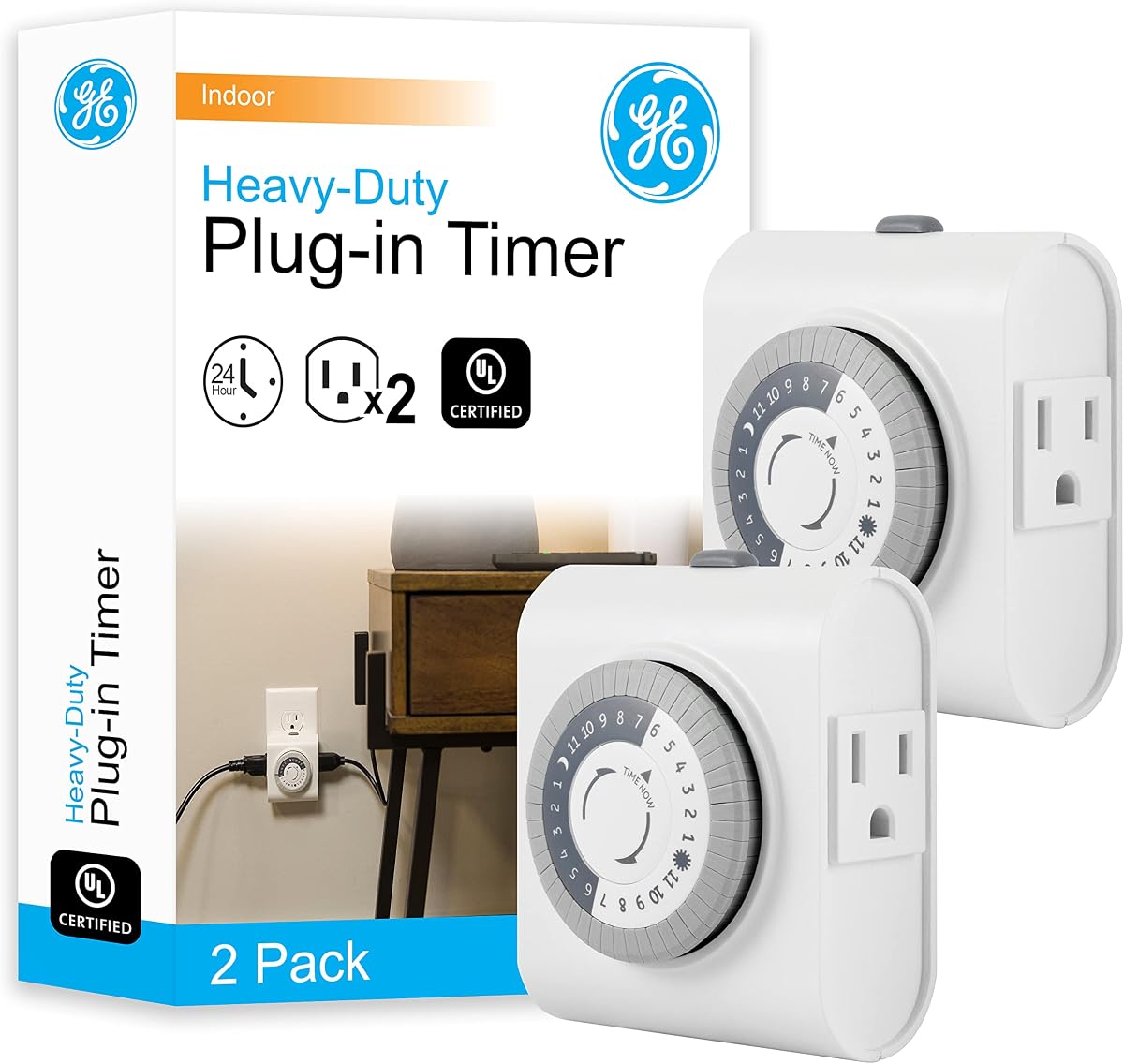
GE 24-Hour Plug-in Mechanical Timer Outlet
4.5Editor score
Thirty-minute scheduling intervals
Two grounded timed outlets
Simple pushpin programming
Our Timer for Light Socket guide compares 10 indoor, outdoor, mechanical, digital, smart, and sensor-based options for easier, automatic lighting control.
A timer for a light socket can simplify everything from holiday displays to everyday lamps by turning connected lights on and off automatically. The right model depends on location, scheduling method, outlet design, and whether you need remote, voice, or light-sensor control.
We compared ten products across mechanical, digital, smart, and photocell-based designs, focusing on practical features such as daily programming, grounded outlets, weather resistance, remote operation, and ease of setup. The list includes indoor timers, outdoor models, and socket-based lighting controls.
Each review explains what a product does best, where its limitations matter, and which type of user it suits. Ratings reflect the supplied customer feedback, while product details and availability can change, so readers should confirm current specifications and purchase terms before ordering.
4.5Editor score

4.6Editor score

4.4Editor score
The table below compares all ten options by control method, scheduling system, outlet or socket format, and intended setting. It makes it easier to distinguish basic daily timers from programmable, remote-controlled, smart, and dusk-to-dawn alternatives.


The BN-LINK Outdoor 24-Hour Mechanical Timer Outlet is a straightforward choice for anyone who wants dependable daily control without apps or complicated menus. It has a 4.4 rating and stands out for its 48-pin programming system, two grounded outlets, and 24-hour repeating cycle. The weather-resistant enclosure is designed for lights and other suitable outdoor equipment.
We may earn a commission when you buy through this link, at no additional cost to you.
Programming is based on 30-minute intervals, which is fine for holiday strings, porch lighting, landscape lighting, and other loads that do not need minute-level control. Users set the pins once and the timer repeats the same on-and-off pattern every day. The two grounded outlets make it possible to operate more than one connected device from a single receptacle, while a 15A, 1/2HP rating supports appropriate landscape lighting applications.
The main limitation is that the schedule repeats without variation. It cannot create different programs for weekdays and weekends, respond to a voice command, or automatically adjust to changing daylight. Installation also requires attention because the supplied guidance calls for upright mounting at least two feet above the ground, which helps preserve the intended outdoor performance.
This is a good match for seasonal decorations, a garden light set, or a pool pump that needs a consistent schedule. Buyers who value uncomplicated setup, dual outlets, and continued settings after a power failure will find the mechanical design refreshingly straightforward. It is less suitable for users seeking remote access or multiple independent daily programs.
The pin-based system makes programming visible and repeatable. Once the desired daily windows are selected, the timer runs the same cycle automatically, eliminating the need for a phone, WiFi connection, or account setup.
Two grounded outlets give the timer greater practical value when a porch light and decorative string both need the same schedule. The stated 15A, 1/2HP capacity also makes it more flexible than a basic single-outlet light timer, provided connected loads remain within its limits.
We may earn a commission when you buy through this link, at no additional cost to you.
The TiFFCOFiO Indoor Mechanical Outlet Timer is a compact two-pack designed for people who want simple automation in several areas. Its 4.4 rating, grounded three-prong plug, and 30-minute intervals make it particularly approachable for indoor holiday lights, lamps, and other plug-in devices.
We may earn a commission when you buy through this link, at no additional cost to you.
The operational model is easy to understand: pins pulled up represent off periods, while pushed-down pins represent on periods. Because each interval covers 30 minutes, users can combine different pins to establish a daily lighting window. The timer then repeats that pattern every day without an app, cloud service, or complex programming sequence.
Its primary limitation is location. This is explicitly an indoor model, so it should not be treated as a weather-resistant solution for yard lights, exposed holiday displays, or other outdoor installations. It also lacks separate programs for different days and offers no remote control, which may make it feel limited for advanced users.
The two-pack makes it useful for controlling separate indoor strings or keeping a spare on hand. It is especially attractive for a household that wants uncomplicated timers for Christmas decorations without installing a wall switch. Those seeking outdoor durability, fine-grained timing, or app-based control should choose a more specialized option.
Two units allow separate rooms or separate lighting groups to operate on different schedules. That flexibility makes the bundle more useful than a single timer when the goal is to automate several indoor decorative setups.
The output is positioned beneath the timer to help reduce its footprint around a wall receptacle. Combined with the plug-in format, this makes the device convenient where a permanently installed timer would be inconvenient.
We may earn a commission when you buy through this link, at no additional cost to you.
The DEWENWILS Indoor 24 Hour Programmable Digital Timer Outlet offers more scheduling flexibility than the basic mechanical models. It carries a 4.5 rating and supports three daily repeating groups, including Always On, Auto, and Always Off modes. Minute-level programming and a visible screen make it useful for precise indoor routines.
We may earn a commission when you buy through this link, at no additional cost to you.
Its digital interface is a meaningful upgrade for users who want different on-and-off windows rather than one simple daily pattern. Silent switching is particularly suitable for bedrooms, reading areas, and other spaces where a mechanical timer could produce noticeable clicks. The stated memory function can preserve programming for up to three months if power is interrupted or the timer is unplugged.
The trade-off is that this model remains an indoor plug-in timer with one outlet, rather than a two-outlet or outdoor device. It also requires more deliberate setup than a pushpin timer, though the large display and four-button controls make the process more precise. Users should also account for the need to maintain or replace the backup battery.
This is a strong recommendation for indoor lamps, plant lights, holiday decorations, and electronics that benefit from precise timing. It suits anyone willing to spend a little more time configuring a schedule in exchange for multiple programs, quiet operation, and outage memory.
Multiple daily groups allow a household to accommodate different lighting periods within the same day. Always On, Auto, and Always Off modes make it possible to reserve one program for a normal cycle, another for an irregular routine, and a third for complete shutdown.
Digital timing to the minute gives users finer control than a 30-minute mechanical interval. Silent operation adds another advantage in bedrooms and quiet living areas where mechanical clicks could be distracting.
We may earn a commission when you buy through this link, at no additional cost to you.
The GHome Smart Plug is the most connected option in this guide, bringing app control, recurring schedules, remote access, and voice-assistant compatibility to a light timer. Its 4.4 rating reflects a practical smart-home design for lamps, fans, humidifiers, and Christmas lights.
We may earn a commission when you buy through this link, at no additional cost to you.
Users can connect through Bluetooth or a 2.4GHz WiFi network, then control the plug through the GHome, Smart Life, or Tuya app. Timers can be set to run on a fixed or randomized basis, while group controls and sharing features make the plug useful in a multi-person household. Alexa and Google Assistant users can issue voice commands after the initial network and app configuration is complete.
The trade-offs are inherent to smart hardware. A stable network is necessary, the product must first be added to the app, and the 2.4GHz limitation prevents it from using newer WiFi-only networks. Voice control also requires compatible ecosystem setup rather than working immediately out of the box.
This plug is best for users who want to manage lights remotely, integrate them into a broader smart-home setup, or add randomization when away. It is less appropriate for someone seeking a simple, network-free timer, but it offers the broadest control options in this roundup.
The companion apps let users turn connected equipment on or off and establish recurring schedules without being near the receptacle. Grouping and sharing features also reduce the effort of controlling several compatible plugs across a household.
Alexa and Google Assistant compatibility adds hands-free control after setup. Because the plug must first join the network and app, buyers should follow the connection sequence carefully rather than expecting direct assistant pairing.
We may earn a commission when you buy through this link, at no additional cost to you.
The GE 24-Hour Plug-in Mechanical Timer Outlet is a balanced indoor option with a 4.5 rating. It combines two grounded outlets, simple pushpin programming, and 30-minute intervals, making it especially useful for controlling multiple lights or small plug-in devices from one receptacle.
We may earn a commission when you buy through this link, at no additional cost to you.
The timer supports a flexible daily cycle without requiring an app, wireless network, or account. An override switch lets a user temporarily pause the programmed cycle, which is helpful when a light needs to remain on outside its normal schedule. The two-pack provides more than simple redundancy: each timer can operate a different indoor area or lighting group.
Its limitations are typical of a mechanical indoor timer. The schedule repeats every day, so it cannot distinguish weekdays from weekends, and the 30-minute resolution is less precise than a digital model. The indoor-ready construction also means it should not be selected for exposed outdoor installations.
This is a compelling recommendation for users who want dependable automation without smart-home complexity. It works particularly well for indoor holiday decorations, lamps, fans, and appropriate small appliances. Buyers prioritizing multiple outlets, easy handling, and a two-pack configuration will find the design especially versatile.
Each timer controls two grounded outlets, allowing connected lights to share a schedule. This is useful for coordinating a floor lamp with decorative lighting or running two seasonal displays from a single wall receptacle.
A convenient master override pauses the cycle when an unscheduled change is needed. Users can return to normal operation without relearning a complicated menu or disturbing the configured daily pattern.
We may earn a commission when you buy through this link, at no additional cost to you.
The DEWENWILS Outdoor Timer for Lights is an adaptable outdoor controller with a 4.6 rating, the highest among the ten products. It combines a light sensor, several timed durations, two outlet controls, and a 100-foot remote, giving outdoor lights more ways to operate.
We may earn a commission when you buy through this link, at no additional cost to you.
The timer can remain on or off, run from dusk to dawn, or switch on at dusk and remain active for 2, 4, 6, or 8 hours. It can also repeat its selected schedule daily. This makes it useful for holiday decorations, yard lights, lamps, fountains, and other appropriate outdoor equipment.
The remote is a meaningful convenience because it allows users to change settings without going outside in bad weather. The stated 100-foot radio-frequency range works in line of sight and can carry through doors, windows, or walls, although obstacles and environmental conditions can affect real-world performance.
This model is best for outdoor households that want both sensor-based and manually selected timing, particularly when operating the timer from indoors would be inconvenient. It is less suitable for complex conditional schedules because it does not offer the minute-by-minute or multi-program flexibility of a digital or smart model.
The photocell can trigger operation at dusk, while the duration options determine when the connected equipment stops. This gives users more control than a simple all-night or all-day setting.
With a stated 100-foot line-of-sight range, the remote makes it possible to adjust connected lights from a room or nearby building. That is particularly helpful during heavy rain, snow, or late-night troubleshooting.
We may earn a commission when you buy through this link, at no additional cost to you.
The G-Homa 24-Hour Mechanical Timer Outlet is a practical indoor timer with a 4.4 rating. It provides two grounded outlets, 48 possible on-and-off settings, 30-minute intervals, and a top-mounted master override, making it a capable alternative to other pushpin-style models.
We may earn a commission when you buy through this link, at no additional cost to you.
Its schedule can be configured by moving the appropriate pins, and the selected pattern repeats each day. The two outlets are useful for indoor lamps, seasonal decorations, and other plug-in equipment that should follow the same daily routine. The master switch provides a quick way to override the programmed cycle.
The mechanical format is easy to understand but less flexible than a digital timer. It cannot set different schedules for different weekdays, and it does not retain minute-level precision. The supplied information also places emphasis on indoor use, so it should not be substituted for a weatherproof outdoor model.
This timer is a solid option for users who value two outlets, direct manual control, and a familiar mechanical interface. It works particularly well for indoor holiday lighting or everyday lamps, while users needing weekend-specific programming or remote adjustment should consider a digital or connected alternative.
Forty-eight selectable on-and-off positions allow several different lighting windows to be combined within one day. The half-hour resolution is suitable for common household routines and decorative displays.
A top-mounted master switch makes temporary changes easy. It provides a simple way to keep a connected lamp running when the programmed cycle does not fit a temporary need.
We may earn a commission when you buy through this link, at no additional cost to you.
The Light Sensor Socket Dusk to Dawn with Timer is the most direct match for a timer built around a light socket rather than a wall plug. It has a 4.6 rating, installs like a bulb holder, and uses a photocell to turn the connected light on at night and off around sunrise.
We may earn a commission when you buy through this link, at no additional cost to you.
A separate 12-hour shutoff provides a safeguard when clouds or nearby lights interfere with the sensor. The photocell can rotate through 300 degrees, helping users direct its detection zone away from porch fixtures, streetlights, and other sources of artificial light that might otherwise cause false triggering.
The socket accepts E26 and E27 bulbs up to 150W, including common LED, incandescent, and CFL types. Installation is direct: the socket screws into an existing fitting, and the bulb goes into the timer. It is not suitable for frosted or opaque shades that prevent the sensor from detecting ambient light, nor is it intended for outdoor floodlight fixtures.
This product is ideal for a homeowner seeking automatic nighttime illumination without replacing an entire fixture. It works well for porch, garage, patio, entryway, and front-door lights where the socket is exposed enough for the sensor to operate. The two-pack allows the same approach across two fixtures.
The built-in photocell responds to darkness without a daily schedule to maintain. This makes the socket suitable for users who want lights to follow natural dusk-to-dawn conditions rather than fixed clock times.
The 300-degree adjustment helps position the detection area more precisely. Users can reduce unwanted triggering from adjacent fixtures, nearby street lighting, or shadows around the fixture.
We may earn a commission when you buy through this link, at no additional cost to you.
The TiFFCOFiO Outdoor Timer Outlet is designed for dependable, repeatable control of outdoor equipment. Its 4.4 rating, weather-resistant structure, 15A and 1/2HP rating, two grounded outlets, and six-inch heavy dual cord make it especially relevant for garden lighting, pool pumps, and seasonal displays.
We may earn a commission when you buy through this link, at no additional cost to you.
Scheduling follows the familiar 48-pin, 30-minute interval system. Once the desired daily on-and-off windows are established, the timer repeats them automatically. A slide control moves the unit into timer mode, and the two grounded receptacles allow compatible equipment to be connected without splitting the schedule across separate timers.
Proper placement is important. The instructions call for vertical mounting at least two feet above the ground to help maintain the intended waterproof performance. While the product offers strong outdoor-oriented construction, it remains a mechanical device with one repeating daily program and no remote, app, or daylight-sensor control.
This model is best for homeowners who want a physical, dependable schedule for outdoor lights and compatible powered equipment. It is especially useful where a cord gives more placement flexibility than a direct-plug model. Users who need automatic dusk detection or off-site control should look toward a sensor or remote timer instead.
The six-inch dual cord and 15A, 1/2HP rating make the timer more adaptable for garden equipment than a compact indoor model. It can support two suitable grounded loads while following a shared daily program.
The housing uses waterproof-oriented materials and a new structural design for outdoor use. Mounting it vertically and at least two feet above ground is essential to preserve the intended performance.
We may earn a commission when you buy through this link, at no additional cost to you.
The BN-LINK Indoor 7-Day Programmable Digital Timer Outlet is designed for users who need a more detailed weekly routine. It has a 4.3 rating and supports up to eight on-and-off programs, individual day selection, and one-minute minimum timing intervals.
We may earn a commission when you buy through this link, at no additional cost to you.
Both grounded outlets operate simultaneously, which makes it convenient for controlling coordinated devices such as lights and fans. Daylight Savings mode offers a one-button adjustment, while the backup battery helps preserve settings during a power outage. The random vacation mode can vary the activation pattern to make a home appear occupied.
One important limitation is that the two outlets share the same schedule rather than operating independently. The timer also requires a working backup battery for dependable outage protection. Like the other indoor digital options, it offers more precise control but less immediate simplicity than a mechanical pushpin timer.
This product is a good fit for households with different routines on different days of the week. It is especially useful for lights, coffee machines, and fans used on a regular but nuanced schedule. Users who need one-minute precision will appreciate it, while those wanting independent outlet programs should choose a different design.
Users can select individual days or use convenient preset combinations, allowing weekday and weekend behavior to differ. This is a meaningful advantage over fixed 24-hour mechanical timers that repeat one pattern throughout the week.
Random mode makes scheduled lighting less predictable when the home is unoccupied. The long-lasting backup battery also helps maintain programmed settings if the receptacle loses power.
We may earn a commission when you buy through this link, at no additional cost to you.
The most useful timer is the one that matches the installation location, lighting schedule, and level of control you need. Compare these factors before choosing a mechanical, digital, remote, smart, or sensor-based design.
Start by deciding exactly where the light and its connected equipment will operate. A model explicitly designed for indoor use should not be installed in rain, damp ground-level areas, or exposed outdoor locations. Outdoor-capable timers generally use weather-resistant housings, sealed connections, and placement instructions that keep the unit away from water and direct exposure. A socket-based photocell timer is also affected by whether its sensor can see ambient light clearly.
Choose an indoor model for protected wall receptacles and an outdoor model for holiday strings, garden lights, pool pumps, fountains, and similar equipment. Always follow the supplied mounting orientation and elevation guidance.
Mechanical timers use movable pins to establish a repeating schedule, making them intuitive and dependable without network setup. Digital timers provide clearer displays, finer timing, multiple schedule groups, and week-based programming. Smart plugs add app access, remote control, voice-assistant integration, and randomized schedules, but require compatible networks and setup. Sensor-based sockets respond to darkness rather than a fixed clock schedule.
Choose mechanical for simplicity, digital for precision, smart for remote flexibility, and sensor control when daylight-based automation is the priority. The most capable system is not automatically the most convenient for every household.
Mechanical models commonly operate in 30-minute intervals and repeat one daily pattern. That is sufficient for holiday displays and basic lighting routines, but it cannot distinguish different days unless the device is reset. Digital timers may support one-minute schedules, multiple daily groups, and separate weekday or weekend programs. Smart plugs can add circular or randomized schedules and allow changes from an app.
Consider how precise your routine must be. Choose 30-minute increments for broad lighting windows, minute-level programming for exact daily activities, and weekly controls when a household follows a changing weekly routine.
A timer with two grounded outlets can operate two compatible devices on the same schedule, reducing the need for additional wall receptacles. Single-outlet designs are better for one light or when keeping the setup compact. Also compare voltage, amperage, wattage, and motor-related ratings against the equipment you intend to connect. A light string and a pump or other motor-driven device do not necessarily create the same demand.
Select enough grounded outlets for the intended setup, and verify that every connected load remains within the timer's stated capacity. Never assume a model is appropriate solely because it is marketed for lights or pool pumps.
A photocell timer can turn lighting on when darkness is detected and off around sunrise. This approach is useful when sunrise and sunset times shift throughout the year. Adjustable sensors help direct detection away from other illuminated fixtures, while fixed-duration modes can ensure the light eventually turns off even if the sensor is affected by clouds or interference.
Choose a sensor model for automatic nighttime illumination, but ensure the socket has a clear view of changing ambient light. Opaque or frosted shades and enclosed fixtures can interfere with reliable detection.
Remote control makes outdoor equipment more convenient to adjust because you can avoid walking outside in poor weather. App-based systems extend that convenience to any location with an internet connection, and voice control can make everyday operation hands-free. These features also introduce network requirements, setup steps, and dependence on compatible software ecosystems.
Choose remote control if convenience within the property is the priority. Choose app and voice support if you want off-site access and smart-home integration, and verify the required network band, apps, and assistant setup before purchasing.
Power interruptions can erase a timer schedule or leave a connected light in an unexpected state. Mechanical models with retained pin settings, digital timers with backup memory, and smart plugs with stored app schedules each address this concern differently. The useful question is whether the device restores the intended schedule without requiring a complete reprogramming session.
Check for memory or backup-battery features, particularly for holiday lights, security lighting, or equipment that must resume automatically after an outage. For a digital or smart model, plan to maintain the backup battery as part of routine care.
A socket timer must physically match the light fixture and bulb base. The Light Sensor Socket in this guide uses a standard E26 socket and supports E26 and E27 bulbs up to 150W, including common LED, incandescent, and CFL types. It may not fit enclosed outdoor floodlights or fixtures with opaque shades that block the sensor. Plug-in timers avoid some bulb-fit concerns but occupy a wall receptacle.
Check socket dimensions, wattage limits, shade material, and fixture restrictions before ordering. If the light already uses a standard screw socket and leaves the photocell exposed, a sensor socket can be the cleanest installation.
Install the timer only on a suitable receptacle or fixture, following the manufacturer's orientation and placement instructions. For outdoor models, mount the unit upright and at least two feet above the ground. For a bulb socket timer, verify that the fitting is compatible, that the bulb does not exceed the stated limit, and that the sensor is not hidden beneath an opaque shade.
Program the device before connecting important loads. Mechanical timers require moving pins into the desired on-and-off pattern, while digital timers use their display and buttons to select days, times, and modes. Smart plugs should first join a stable 2.4GHz network and the appropriate app, after which schedules, groups, and voice-assistant access can be configured.
Test the setup with a low-risk light, confirm that the first on-and-off period matches your intent, and then reconnect the remaining equipment. Periodically inspect outdoor cords and connections, keep battery-backed digital timers maintained, and clean sensor-based sockets carefully so dust or debris does not interfere with light detection.
A mechanical timer uses movable pins or a dial to set recurring on-and-off periods, usually in 30-minute increments. A digital timer uses buttons and a display to create more precise schedules, often with minute-level timing, multiple daily groups, or different settings for different days. Mechanical models are simpler to operate, while digital models provide more precise and varied control.
It depends on the number of timed outlets and the electrical ratings of the timer. Models in this guide with two grounded outlets can operate two compatible devices on the same schedule. Both connected loads must remain within the stated amperage, wattage, and motor-related limits, so an ordinary light string and a pump may not present the same demand.
No indoor timer should be assumed suitable for an exposed outdoor installation. Outdoor holiday strings, garden lights, and other exposed equipment should use a timer designed for outdoor conditions and follow the required mounting orientation and elevation. Weather resistance does not eliminate the need to protect connections and position the unit where water cannot collect around it.
A dusk-to-dawn timer primarily uses a light sensor to turn the light on when darkness is detected and off around sunrise. Many sensor models also include a maximum-duration function so the light shuts off after a fixed period even if cloudy conditions or interference keep the sensor active. It is best suited to fixtures where the sensor can see ambient light clearly.
The GHome Smart Plug supports Alexa and Google Assistant after it has first been connected to a compatible network and the GHome app. It requires a stable 2.4GHz WiFi network and the appropriate app configuration. Voice control is therefore not an immediate out-of-the-box function, and the plug cannot be connected directly to the assistant before setup.
That depends on the model. The BN-LINK outdoor mechanical timer retains its pin settings, while the DEWENWILS digital timer can preserve programming for up to three months and the BN-LINK 7-day digital timer uses a backup battery. Smart plugs may restore stored schedules through their app, but users should confirm that the device and network are operating correctly after an outage.
No. A screw-in sensor socket must match the fixture's base and bulb requirements, and its photocell needs an unobstructed view of ambient light. It is also unsuitable for frosted or opaque shades and outdoor floodlight fixtures that do not meet the product's installation conditions. Check the socket, bulb wattage, shade, and fixture type before purchasing.
A 30-minute mechanical interval is usually sufficient for broad routines such as turning lights on at dusk and off late at night. Minute-level digital scheduling is more useful when lighting needs to align closely with work, sleep, or household activity. Sensor-based control is often preferable for exterior lights that should follow changing daylight throughout the year.
The DEWENWILS Outdoor Remote Timer offers the most versatile outdoor control in the group, combining a light sensor, several duration modes, two outlets, and a remote. The GE 24-Hour Mechanical Timer is a versatile indoor value, while the GHome Smart Plug serves users who want app, voice, and off-site control.
Prioritize the installation environment first, then choose the scheduling method that matches the routine. Mechanical pins are dependable and simple, digital programming offers precision, smart connectivity provides remote flexibility, and a photocell socket is ideal when lighting should respond directly to darkness. Outlet count, load ratings, memory, and fixture compatibility deserve equal attention.
Customer ratings and product details provide a useful starting point, but they do not replace checking the current listing, instructions, and compatibility information. Confirm the latest specifications, warranty terms, and current purchase cost before choosing the timer that best fits your lights and space.