
Floriogra Electronic Ear Protection
4.4Editor score
Five-times safe sound amplification
Rapid active gun-noise reduction
Lightweight weather-resistant design
Compare the best electronic ear protection for shooters across sound amplification, noise reduction, comfort, connectivity, and field use in this guide.
Electronic ear protection gives shooters a valuable balance between dangerous-noise attenuation and awareness of range commands, conversations, wildlife, and environmental cues. The right pair should protect hearing without making it difficult to hear what matters, while remaining comfortable through long range sessions, hunting trips, and training sessions.
This guide compares ten electronic earmuffs based on their supplied noise-reduction ratings, sound amplification, active protection, microphone design, controls, battery configuration, comfort features, connectivity, and shooting-oriented construction. It includes conventional models, compact options, rechargeable designs, and premium modular systems for different shooters and budgets.
The selections reveal where each product stands out: Walker’s emphasizes compactness and convenient listening features, Peltor focuses on controlled sound processing, PROHEAR offers substantial battery life, and Sordin provides advanced modes and modular construction. Marketplace pricing and availability can change, so check the current listing before buying.
4.4Editor score

4.8Editor score

4.6Editor score
This side-by-side comparison covers the ten shortlisted electronic earmuffs, highlighting their published noise reduction, amplification, microphone configuration, power source, and shooter-focused features so the strongest option for each type of session is easier to identify.



The Walker's Razor Slim Electronic Muff combines a strong 4.8 customer rating with a compact profile that is especially useful around rifles and shotguns. Its defining strengths are extra-slim ear cups, two high-gain omnidirectional microphones, and controls that can be operated without removing the earmuffs. It is a versatile choice for range days, hunting, and noisy work environments where both hearing protection and environmental awareness matter.
We may earn a commission when you buy through this link, at no additional cost to you.
Sound amplification is designed to make conversations, range commands, and other safe sounds easier to hear, while enhanced low-end frequencies help produce a more natural presentation. At the same time, the protective cups and sound-dampening composite housing are intended to reduce hazardous noise. The recessed external volume knob is a thoughtful detail because it remains accessible while reducing the chance that a sleeve, glove edge, or rifle stock will brush against and change the setting.
The audio input jack adds another layer of usefulness. A shooter can connect a phone or another sound source and use the earmuffs as conventional headphones with hearing protection. The rubberized coating, padded metal-wire headband, and external battery door make the product look suitably durable for regular field use, although the supplied specifications do not list a numerical NRR or battery runtime, so buyers seeking specific certified attenuation figures should check the product labeling.
Overall, the Razor Slim is the most balanced recommendation in this guide. It suits shooters who need a narrow profile, dependable external controls, broad environmental pickup, and the flexibility to listen to connected audio. It may be less compelling than the Walker's Razor Quad for Bluetooth users or the Sordin Supreme X2 for modular premium features, but its combination of simplicity, compactness, and everyday versatility makes it an excellent primary choice.
Extra-slim ear cups reduce bulk under or beside a rifle stock, which can be a decisive advantage during target practice. The padded wire-frame headband and secure cup design also help keep the protectors in place while preserving a relatively unobtrusive silhouette.
The external audio input turns the muffs into protected headphones for phone music, instruction, or other compatible audio. This useful feature separates the model from basic electronic earmuffs that only manage ambient sound and gun noise.
We may earn a commission when you buy through this link, at no additional cost to you.
The Floriogra Electronic Earmuffs offer one of the most feature-rich configurations in the group for shooters seeking a cost-conscious option. They carry a 4.4 rating, a published 23 dB NRR, five-times sound amplification, and a stated ANSI S3.19 and CE EN 352-1 certification. The model is designed for gun ranges, hunting, and other noisy tasks, with active protection that reacts when noise exceeds 82 dB.
We may earn a commission when you buy through this link, at no additional cost to you.
Its most notable strength is the balance between amplification and attenuation. Two high-gain microphones provide omnidirectional pickup, allowing users to hear conversations and low-volume environmental sounds more clearly. Low-end frequency enhancement is intended to support a natural presentation. When dangerous noise appears, the active system reduces it to below 82 dB in approximately 0.01 second, which is especially relevant in situations where a shot is sudden and the shooter needs protection without losing awareness.
Comfort and weather resistance are unusually well documented for this class. The earmuffs weigh 0.6 pounds, use wide ultra-soft cushions, and have a telescopic padded headband. Cutaways and slim cups support shooting positioning, while an IPX4 rating gives added confidence around water, sweat, and dust. The single control remains accessible with gloves, and the folding structure makes the product easier to carry in a range bag.
The Floriogra is a strong budget recommendation for target shooters who want meaningful amplification, a stated certification, and active protection in a lightweight package. Its rating trails the highest-rated options, and the supplied data does not mention wireless connectivity or an included battery set. Even so, the combination of five-times amplification, 23 dB attenuation, and field-oriented comfort makes it a compelling entry for regular use.
The stated 0.01-second response is intended to reduce hazardous sound quickly after it exceeds 82 dB. This helps preserve useful lower-volume cues while addressing the abrupt noise pattern created by firearms.
A 0.6-pound weight, telescopic padded headband, and soft cushions are intended to reduce pressure during longer sessions. Low-profile cup cutaways also balance hearing protection with a more practical shooting position.
We may earn a commission when you buy through this link, at no additional cost to you.
The Peltor Sport Tactical 100 is a refined, feature-focused electronic protector with a 4.6 rating and a stated 22 dB NRR. It is positioned for indoor and outdoor shooters as well as hunters. Its primary distinction is user control over both volume and gunshot suppression, allowing listeners to tune the response for different environments rather than relying on a single fixed processing profile.
We may earn a commission when you buy through this link, at no additional cost to you.
Variable suppression time is particularly useful inside enclosed ranges, where the abrupt report of a shot and its echo can make natural listening difficult. By adjusting suppression, the shooter can reduce echo without unnecessarily sacrificing every lower-level sound. The background-noise filtering system is designed to clarify communication and commands, which is valuable when instructors, range staff, or shooting partners are nearby.
Physical design details are also well considered. Recessed microphones are less exposed to accidental contact, potentially reducing damage and wind-related noise. Low-profile cups improve compatibility with rifles and shotguns, while the adjustable padded headband supports a stable, comfortable fit. A low-battery indicator and two-hour automatic shutoff help avoid the common problem of returning to unused earmuffs only to find that their batteries have drained.
The Peltor is the premium pick here because it offers refined environmental control rather than simply adding more amplification. Two AAA batteries are required but not included, and no Bluetooth or wired entertainment input is listed in the supplied specifications. For shooters who prioritize clean communication, adjustable indoor suppression, and a traditional low-profile shape, however, it is a highly compelling choice.
Separate controls for volume and gunshot suppression make the Tactical 100 adaptable to both indoor and outdoor settings. This is especially helpful at enclosed ranges where echo and reflected gunfire can make ordinary passive protection feel less natural.
Recessed microphones help protect sensitive components and limit wind noise. The automatic shutoff and low-battery indicator support more consistent operation, although shooters should still establish a routine for checking power before a session.
We may earn a commission when you buy through this link, at no additional cost to you.
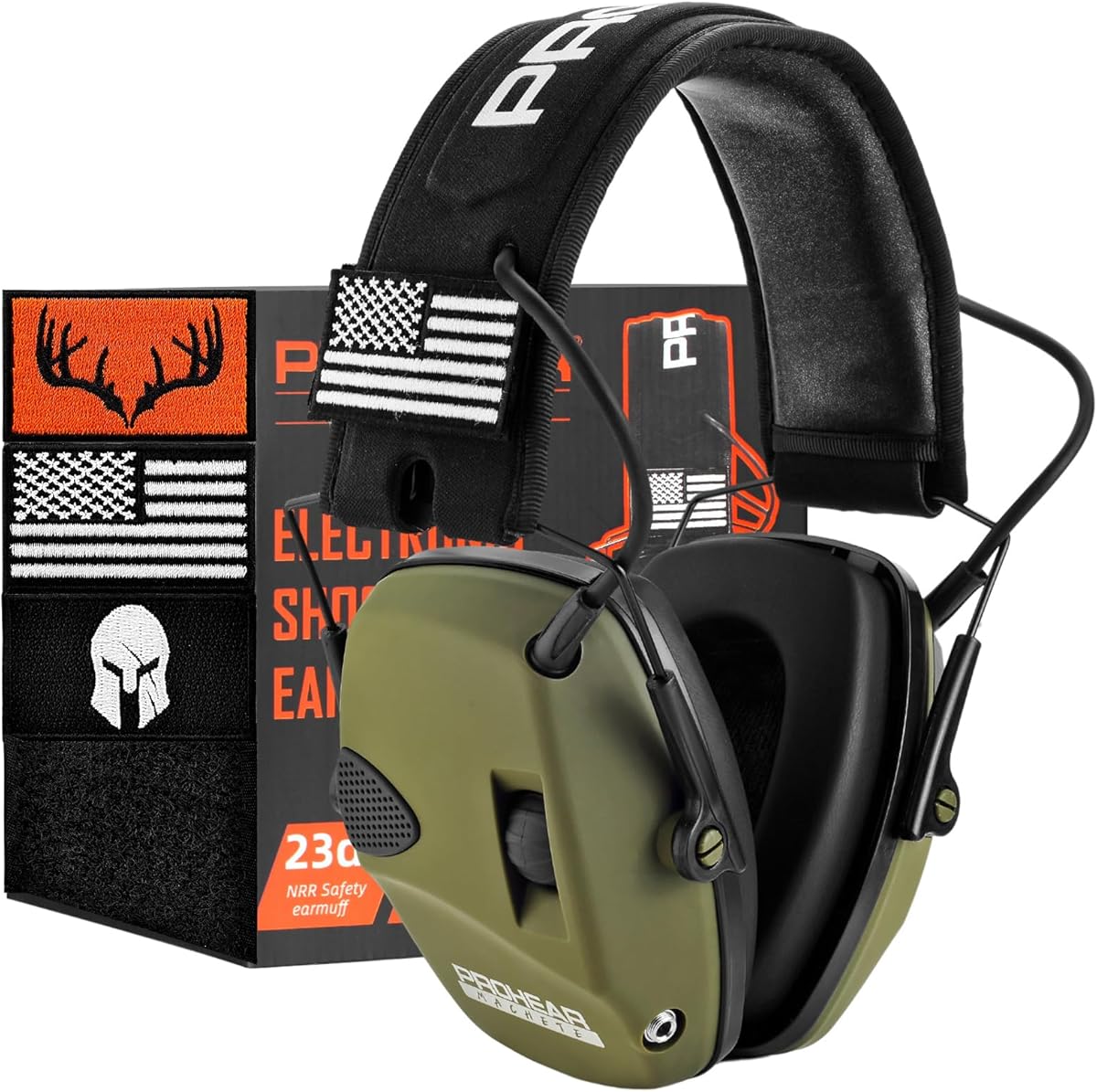
The PROHEAR Electronic Earmuffs are distinguished by a claimed battery life of up to 300 hours, making them an attractive option for shooters who would rather not worry about frequent battery changes. They have a 4.6 rating, four-times sound amplification, a published 23 dB NRR, and a stated ANSI S3.19 compliance. The supplied information positions them as multipurpose protection for ranges, hunting, woodworking, mowing, and chainsaw use.
We may earn a commission when you buy through this link, at no additional cost to you.
The active system is designed to suppress harmful sounds such as gunshots in under 0.01 second while amplifying lower-level sounds up to four times their natural volume. That combination helps a wearer hear conversations, environmental cues, and range instructions without treating every sound as equally important. A single tactile control knob can be adjusted even while wearing gloves, and the exterior battery door supports straightforward maintenance.
Comfort is a major selling point. The earmuffs are listed at 0.6 pounds, with wide cups, ultra-soft cushions, and a telescopic padded headband. The low-profile cups incorporate cutaways intended to improve shooting comfort and accuracy positioning. An IPX4 rating adds resistance to water, sweat, and dust, while a folding design makes the earmuffs easier to store between sessions.
PROHEAR is a compelling recommendation for high-use shooters and anyone who values battery endurance over wireless connectivity. The stated 300-hour figure is particularly attractive, though it depends on the electronics and operating conditions, and two AAA batteries are not included. The package also supplies a carrying pouch, 3.5 mm cable, hook-backing patches, and several decorative patches, adding utility and customization options.
A stated battery life of up to 300 hours is the defining advantage here. It reduces the need to carry spare cells or recharge between routine range visits, provided the earmuffs are switched off when not in use.
The low weight, cushioned cups, adjustable headband, and cup cutaways work together to keep the protection practical during shooting positions. Weather resistance further supports use in hunting and outdoor work environments.
We may earn a commission when you buy through this link, at no additional cost to you.
The CyberMuff E is built around spatial awareness, with two stereo speakers, dual omnidirectional microphones, and a published 24 dB NRR—the highest stated noise-reduction figure among these ten products. Its 4.3 rating places it below the leading models, but the technical configuration offers a clear reason to consider it for range use and hunting, where locating a sound source can be as important as hearing it.
We may earn a commission when you buy through this link, at no additional cost to you.
The smart sound control system amplifies low-level sounds such as voices and range commands while automatically compressing hazardous noise above 82 dB within milliseconds. Stereo output and omnidirectional microphone pickup are intended to give the wearer a more natural sense of direction. This can help a shooter identify where a person or animal is located rather than receiving a completely flat mix of surrounding sounds.
Comfort features include a padded adjustable headband, soft memory foam cushions, and a breathable fit intended for long sessions. The electronics use two AAA alkaline batteries, which are not included, and an automatic four-hour shutoff conserves power. A single knob combines on, off, and volume functions, simplifying operation at the range without requiring a separate control for every setting.
The CyberMuff E is a good fit for shooters who want more directional information than ordinary mono amplification can provide. It also includes a 3.5 mm stereo input and cable for connected audio devices, plus a protective carrying bag. Its lower rating and lack of listed Bluetooth support may discourage buyers seeking the most polished feature set, but its 24 dB NRR and stereo design provide a clear technical identity.
Separate stereo speakers and dual omnidirectional microphones create a sound field intended to help users identify direction. That capability is particularly relevant in hunting, field training, and busy ranges where position awareness can improve safety.
A combined power, volume, and off control keeps operation straightforward. The folding frame and supplied carrying bag make it easier to transport the earmuffs without exposing the cups or electronics to unnecessary impact.
We may earn a commission when you buy through this link, at no additional cost to you.
The Walker's Razor Quad is a strong all-around option for shooters who want more comprehensive microphone pickup and wireless device connectivity. It carries a 4.5 rating, a 23 dB noise reduction rating, four high-gain omnidirectional microphones, and Bluetooth support. The additional microphones are intended to capture sound from all directions, improving situational awareness around the shooter.
We may earn a commission when you buy through this link, at no additional cost to you.
Bluetooth is the key distinction from the Razor Slim. Users can connect a phone or other compatible device while independently adjusting the volume of ambient sound from the connected audio. A built-in microphone supports communication, making the earmuffs useful for calls or conversations when the wearer does not need to remove the hearing protection.
The active protection system uses frequency tuning, advanced noise reduction, and sound-activated compression in 0.02 second. A sound-dampening composite enclosure and recessed volume controls are designed for durability and fewer accidental adjustments. The product also has comfortable pads and headband, ultra-low-profile cups, a compact folding structure, and a rubberized coating. Two AAA batteries are included, which simplifies initial setup.
The Razor Quad is a natural selection for shooters who value 360-degree pickup and wireless flexibility. It is more specialized than a basic range muff because of its Bluetooth electronics and four-microphone layout, and it offers fewer details about battery runtime in the supplied information. Even so, the combination of fast compression, independent connected-audio control, and broad microphone coverage makes it a strong choice for mixed range, hunting, and everyday listening use.
Four omnidirectional microphones are intended to provide 360-degree sound detection. This can improve awareness of movement and conversation in multiple directions, making the design appealing to shooters who work in varied environments.
Bluetooth connectivity allows a phone to remain connected for communication or media, while the ambient volume can be adjusted separately. That separation helps preserve range awareness without forcing the shooter to choose between hearing the surroundings and hearing a connected device.
We may earn a commission when you buy through this link, at no additional cost to you.
The Walker's Rechargable focuses on convenient power management. It has a 4.6 rating, a stated runtime of up to 80 hours, and USB Type-C charging with a cable included. An LED battery-level indicator helps users check remaining power, removing much of the inconvenience associated with disposable cells. Its protection is rated at 21 dB, the lowest NRR stated in this comparison.
We may earn a commission when you buy through this link, at no additional cost to you.
Sound performance combines advanced noise reduction and frequency tuning with two high-gain omnidirectional microphones. These microphones pick up ambient sound and deliver it through full dynamic high-definition speakers. A 0.02-second sound-activated compression system is designed to reduce sudden loud noise quickly, supporting communication and situational awareness during a shooting session.
The housing uses a durable sound-dampening composite with a rubberized finish. A comfortable headband is intended to keep the earmuffs secure during rigorous training, while the collapsible design makes storage and transport more convenient. A 3.5 mm audio jack also allows connected electronics to be used with the hearing protection.
This is a practical recommendation for shooters who want rechargeable convenience and dislike carrying spare AAA batteries. The lower 21 dB NRR deserves attention, particularly for users comparing it directly with the 23 and 24 dB alternatives in this list. Within that context, the long stated runtime, included charging cable, battery indicator, and straightforward media connection make it especially appealing for frequent training and range use.
USB Type-C charging and a stated runtime of up to 80 hours simplify long-term ownership. The included cable and LED indicator make it easier to keep the earmuffs ready for regular sessions without planning around disposable batteries.
A rubberized composite housing, secure padded headband, and collapsible form support use in training and field settings. The 3.5 mm jack adds a straightforward route for phone audio while the earmuffs continue to provide their intended hearing protection.
We may earn a commission when you buy through this link, at no additional cost to you.
The Sordin Pro-X is a premium electronic ear defender designed for outdoor shooters and hunters, with a 4.5 customer rating. Its central feature is a choice of four audio modes for hunting, focus, shooting, and communication. This lets the wearer change the balance of ambient awareness and attenuation rather than using one processing setting for every environment.
We may earn a commission when you buy through this link, at no additional cost to you.
The product supports a one-to-four amplification ratio, meaning quiet environmental sounds can be made more audible while dangerous noise is attenuated. In hunting mode, the intended result is greater awareness of game and calls from companions. Shooting mode is designed to muffle gunfire while retaining useful communication, and the other profiles provide alternatives for focused listening and conversation.
Construction details support outdoor use. The Pro-X includes waterproof electronics, a camouflage textile headband, and gel pads that contribute to comfort and a close fit. It is made entirely in Sweden and meets the stated EN 352 quality standard. These details position it as a rugged, premium alternative to battery-simple recreational earmuffs.
The Sordin Pro-X is worth considering for shooters who move between range, field, and hunting environments and want task-specific sound profiles. The supplied information does not provide a numerical NRR, which makes label verification important for anyone making a protection-centered decision. Its mode selection, waterproof electronics, and high amplification ratio nevertheless make it one of the most specialized products in the guide.
Separate hunting, focus, shooting, and communication modes provide a more nuanced way to manage sound. A shooter can select a profile suited to the immediate task rather than relying on a single fixed compromise between awareness and protection.
Waterproof electronics add confidence in wet or unpredictable outdoor conditions. The camouflage textile band and gel pads support the product's hunting identity while retaining the protection expected for shooting.
We may earn a commission when you buy through this link, at no additional cost to you.
The Sordin Supreme X2 is a premium modular hearing protector with a 3.8 customer rating, a published 23 dB NRR, and an emphasis on long-term customization. It uses SordinHEAR2 software with four audio profiles, allowing quiet sounds to be amplified while loud sounds are reduced. The electronic system therefore provides both protection and task-specific listening control.
We may earn a commission when you buy through this link, at no additional cost to you.
Its most distinctive feature is the SordinFLEX suspension system. Users can change suspension types and add compatible accessories without tools, creating a setup that can evolve with different head shapes, environments, and shooting needs. Because accessories are available separately, current availability and compatibility should be confirmed when planning a complete configuration.
The included suspension uses a leather headband, while the ear cups use gel pads designed to create a closed seal around the ear. Slim, low-profile cups are suitable for rifle users, including those who wear glasses, and the design accommodates left- or right-handed shooting positions. ABS cups, stainless steel components, and waterproofed microphones and battery compartment add durable, weather-conscious construction.
The Supreme X2 is a compelling premium system for shooters willing to invest in a tailored setup. Its rating is the lowest in the list, however, and the modular ecosystem may not be necessary for someone who simply wants dependable electronic protection. For users who value interchangeable suspension, refined audio profiles, leather comfort, and a serviceable platform, it remains one of the most ambitious choices.
The tool-free SordinFLEX platform allows the suspension style to be changed and compatible accessories to be added. This makes the earmuffs adaptable to different users, headwear, and shooting scenarios without replacing the complete unit.
Gel pads create a close seal while the leather headband distributes weight. Low-profile cups help with rifle-stock clearance and are designed to work with glasses, reducing some of the positioning conflicts common to bulkier protectors.
We may earn a commission when you buy through this link, at no additional cost to you.
The Howard Leight by Honeywell Impact Sport Earmuffs combine a 4.7 customer rating with a long operating life and a straightforward shooting design. Built-in directional microphones amplify range commands and other ambient sounds to a safe 82 dB, while active sensing shuts off amplification when the environment reaches that level. The stated NRR is 22 dB.
We may earn a commission when you buy through this link, at no additional cost to you.
The design treats hearing protection and awareness as a changing problem. During ordinary range activity, directional amplification helps the shooter hear instructions and conversations. When a firearm discharges, the electronics are intended to stop amplifying the unsafe level and rely on the protective cups for attenuation. This makes the model a familiar option for shooters who want simple automatic operation.
Low-profile ear cups improve clearance around a firearm stock, and the adjustable headband supports a secure fit. A compact folding design makes storage convenient. The integrated power and volume knob avoids a complicated control layout, while an auxiliary input and included 3.5 mm connection cord support MP3 players and scanners.
The Impact Sport is an excellent choice for users who value established-style simplicity, a strong rating, and very long battery operation. Two AAA batteries are included, and the stated runtime is approximately 350 hours with a four-hour automatic shutoff. It does not list Bluetooth, multiple sound modes, or modular suspension, but its focused feature set, directional microphones, and low-profile shape make it a well-rounded range companion.
The microphones amplify commands and ambient sounds up to 82 dB, then stop amplification when the environment reaches that threshold. The design provides a clear switching point without asking the wearer to adjust the volume in the middle of a shot.
A stated runtime of approximately 350 hours, included AAA batteries, and a four-hour automatic shutoff reduce maintenance. The power and volume functions share one integrated knob, keeping the controls accessible and uncomplicated.
We may earn a commission when you buy through this link, at no additional cost to you.
The most useful electronic earmuffs combine verified attenuation with rapid noise processing, natural directional sound, secure comfort, and controls that remain easy to use around a shooting range. Comparing those factors against your typical session is more meaningful than focusing on a single specification.
The Noise Reduction Rating, or NRR, estimates how much a properly fitted protector can reduce environmental noise and is expressed in decibels. In this group, the stated ratings range from 21 dB for the Walker's Rechargable to 24 dB for the CyberMuff E, while several products do not provide a numerical figure in the supplied information. A higher published rating is useful for comparison, but correct fit, consistent use, and the manufacturer's instructions are equally important. Treat an unlisted NRR as a reason to verify the physical label rather than assuming a level of protection. Shooters should also consider whether they will use the earmuffs for firearm noise, power equipment, chainsaws, lawn mowers, or a combination of environments.
Electronic earmuffs use microphones and speakers to make safe sounds more audible while attenuating dangerous noise. The Floriogra offers five-times amplification, while the PROHEAR provides four times; Walker's Rechargeable and the Peltor Tactical 100 emphasize balanced sound and filtering instead of a prominently advertised maximum ratio. Directional microphones can clarify commands, and omnidirectional microphones can provide broad coverage but may make it harder to locate a source. Stereo output, enhanced low frequencies, and sound-activated processing all affect how natural the result feels. Shooters should favor a system that lets them adjust the mix rather than one that simply makes everything louder.
Firearm noise arrives suddenly, so the processing speed of electronic protection matters. The Floriogra and PROHEAR state a response of under 0.01 second, while Walker's Razor Quad and Rechargeable advertise 0.02-second sound-activated compression. These figures indicate how quickly the electronics are designed to begin reducing hazardous noise. Faster response can help preserve awareness immediately around a shot, but it should be considered alongside verified attenuation, fit, and microphone quality. A device with excellent processing still cannot compensate for poor seal or incorrect placement around the ears.
Long sessions are easier with a stable headband, comfortable cushions, and cups that do not interfere with a rifle stock. Slim and low-profile models such as the Walker's Razor Slim, Peltor Tactical 100, and Sordin Supreme X2 are especially relevant to rifle and shotgun users. The Floriogra and PROHEAR list a weight of 0.6 pounds, while the CyberMuff E uses memory foam cushions. Glasses compatibility, the position of cutaways, temple pressure, and whether a shooting hat or earmuff can be worn together also deserve attention. A technically capable protector is less useful if it shifts, pinches, or prevents a natural shooting position.
Most models in this guide use two AAA batteries, but the charging arrangements differ significantly. The Walker's Rechargeable uses USB Type-C, includes a cable, offers an LED battery indicator, and is stated to run for up to 80 hours. PROHEAR claims up to 300 hours, while the Howard Leight Impact Sport lists approximately 350 hours. Peltor, Floriogra, CyberMuff E, and PROHEAR do not include batteries according to the supplied data, while the Walker's Razor Quad and Impact Sport do. Automatic shutoff is present on several models. Frequent shooters may prefer rechargeable simplicity, while occasional users may simply choose a reliable disposable-battery setup.
Connectivity varies from a basic 3.5 mm input to Bluetooth and proprietary app-based profiles. The Walker's Razor Quad supports Bluetooth, permits separate ambient and device volume, and includes a built-in communication microphone. The Walker's Razor Slim, Rechargeable, CyberMuff E, and Impact Sport offer wired audio connections, while the Sordin Supreme X2 supports four software profiles. Wired connections avoid pairing and charging complications, whereas Bluetooth adds convenience for calls and media. App-based controls can provide deep customization, but they may also create dependence on a supported phone for some settings. Consider how much connected listening matters beyond hearing range commands.
Range earmuffs face repeated handling, vibration, sweat, dust, and occasional weather exposure. The Floriogra and PROHEAR have IPX4 ratings, the Sordin Pro-X has waterproof electronics, and the Sordin Supreme X2 uses waterproofed microphones and battery compartment. Rubberized coatings, recessed microphones, stainless steel, and folding structures add further protection. Hunting users should think beyond the range and consider temperature, moisture, brush, and storage in a vehicle or pack. Match the construction to the environment rather than assuming that every indoor range earmuff will handle prolonged outdoor exposure equally well.
Simple single-knob operation is easy to master, while multi-mode systems allow a more tailored listening experience. The Peltor Tactical 100 lets users adjust volume and gunshot suppression separately, which can be helpful indoors. The Sordin Pro-X offers hunting, focus, shooting, and communication modes, while the Supreme X2 provides four SordinHEAR2 profiles and tool-free suspension changes. Recessed knobs reduce accidental changes, and glove-accessible controls are useful outdoors. Additional features such as carrying pouches, cables, hook-backing patches, modular suspension, and optional accessories improve convenience but should be balanced against the core need for reliable protection and awareness.
Before the first use, read the manufacturer's instructions and inspect the ear cups, headband, cushions, microphones, battery door, and controls. Install the correct batteries or fully charge a rechargeable model, confirm that the sound controls work, and connect any wired or wireless audio before entering a range. If the protector includes a certification label, verify that the NRR information and intended use match your environment.
Place the muffs so the cushions form a complete seal around your ears, then adjust the headband so the device feels secure without excessive pressure. Keep the microphones unobstructed and avoid placing the protector directly against a speaker or other source of intense amplified sound. Learn the volume and mode settings before handling a firearm, and maintain awareness of the sounds being reduced rather than treating electronic protection as permission to ignore other range hazards.
After a session, switch off the electronics and remove the batteries if the manual recommends doing so. Wipe the cups and cushions with a clean, slightly damp cloth, remove debris, and let every part dry before storage. Keep the earmuffs in their supplied pouch or case, inspect the cable and charging port when applicable, and replace damaged cushions or cables. Periodic function checks help reveal weak batteries, blocked microphones, or electronics that no longer respond correctly.
Passive earmuffs rely entirely on their physical materials to block sound, while electronic models add microphones, signal processing, and speakers. Electronic protection can make safe sounds easier to hear and reduce dangerous noise more quickly when a shot occurs. It does not eliminate the need for a proper fit, correct settings, or compliance with range safety rules.
No. A higher NRR is one part of the comparison, but comfort, fit, microphone clarity, response time, battery life, and usability also matter. A protector with a slightly lower published NRR may be more effective in practice if it is worn consistently and does not interfere with a shooter's position. Always compare products using verified labels and stated standards.
Many can, but the fit depends on the headband, temple width, and cup shape. Low-profile models may create less conflict between glasses arms and cushions, while bulky cups can press the frames inward. If you wear glasses regularly, test the earmuffs while wearing them and adjust the headband so the seal does not shift.
They can be, particularly when the model offers safe sound amplification, a weather-resistant design, and task-specific modes. The Sordin Pro-X includes a hunting mode, while other models emphasize natural ambient pickup. Hunters should consider battery endurance, weather resistance, wind noise, and whether their movement or clothing will interfere with the controls.
Runtime varies substantially by model and use. The supplied information lists up to 300 hours for PROHEAR, approximately 350 hours for the Howard Leight Impact Sport, and up to 80 hours for the Walker's Rechargeable. Amplification demands, volume, feature use, battery chemistry, and automatic shutoff behavior can affect actual results.
Wired models are straightforward and avoid pairing or wireless battery concerns, making them practical for range sessions. Bluetooth is more convenient for calls, media, and communication, but it introduces charging, pairing, and device compatibility considerations. Choose based on how often you expect to use connected audio while maintaining ambient awareness.
Follow the manufacturer's cleaning instructions and avoid immersing the electronics. Wipe the cups with a clean, slightly damp cloth, remove dirt from around microphones and controls, and let the earmuffs dry fully before storage. Do not use harsh chemicals unless the manual specifically permits them, since they may damage cushions, coatings, or seals.
Indoor acoustics can create echoes and reflected gunfire, so a fixed sound profile may sound unnatural compared with outdoor shooting. Products with adjustable suppression timing or multiple modes can help address this difference. Begin with moderate volume, compare settings in a safe area, and make adjustments before beginning a firing sequence.
The Walker's Razor Slim is the strongest all-around recommendation because it combines a low-profile shape, external controls, broad microphone pickup, and wired audio flexibility. The Floriogra stands out as a capable budget option with five-times amplification, fast active protection, a stated 23 dB NRR, and lightweight weather-resistant construction. For shooters who value refined control and reliable background-noise filtering, the Peltor Sport Tactical 100 is the premium option in this group.
Other priorities can change the ideal choice. PROHEAR is the standout for its stated 300-hour battery life, the Walker's Razor Quad for Bluetooth and four-microphone pickup, and the Walker's Rechargable for USB Type-C convenience. The CyberMuff E emphasizes stereo direction awareness, while the Sordin Pro-X and Supreme X2 suit hunters and users who want selectable profiles or modular premium construction.
Whichever model you choose, verify the current manufacturer information, NRR labeling, battery requirements, and intended applications before purchasing. Marketplace prices, promotions, and availability can change, so review the current listing and confirm the included accessories before placing an order. Proper fit, regular maintenance, and consistent use remain as important as the specifications on the box.
