
Govee LED Smart Light Bulbs
4.6Editor score
Over 1000 lumens
54 available scene modes
Matter, Alexa, Google support
Our Matter compatible smart lights guide compares 10 color-changing bulbs for brightness, app control, automation, Matter support, and ease of setup at home.
Matter compatible smart lights give a connected home a practical way to combine lighting from different brands. A useful bulb should offer more than attractive colors: dependable connectivity, responsive controls, useful automation, and straightforward setup matter just as much when choosing fixtures for bedrooms, living areas, kitchens, or offices.
The products in this guide were compared using their stated Matter support, brightness, color controls, dimming range, app and voice-platform compatibility, network requirements, and special features. The list covers A19 and A21 bulbs in single and multipack formats, with particular attention to options that suit different routines and installation needs.
Each pick below highlights a different reason to consider it, from broad app features and music synchronization to high output, wide color-temperature ranges, and motion-assisted automation. Ratings and specifications can change over time, while retailer availability and prices fluctuate, so readers should confirm current details before purchasing.
4.6Editor score

4.5Editor score

4.7Editor score
This side-by-side overview compares the ten bulbs by output, color capability, Matter integration, control methods, and notable features, making it easier to identify the right model for a particular room or smart-home setup.




This Linkind bulb combines Matter compatibility with extensive lighting features, earning a 4.5 rating. It supports Apple Home, Alexa, and Google Home while also offering direct control through the AiDot app. The result is a versatile option for people who want colorful lighting without limiting themselves to a single smart-home ecosystem.
We may earn a commission when you buy through this link, at no additional cost to you.
Its most impressive feature set includes 16 million RGB colors, 104 preset scenes, and music synchronization. The music mode uses the phone's microphone to detect the rhythm and adjust color and brightness, making the bulb useful for gatherings as well as everyday mood lighting. An 800-lumen output is equivalent to a 60W traditional bulb, while the stated lifespan exceeds 25,000 hours.
The principal limitation is network compatibility. This model supports only 2.4GHz Wi-Fi, and traditional dimmer switches are not supported because they may cause flickering, buzzing, or premature failure. Users who need a traditional wall dimmer or a 5GHz-only network should look elsewhere, while everyone else gains a useful balance of features.
This is the strongest all-around recommendation because it supports the most widely used voice platforms, provides direct app access, and includes more creative presets than many alternatives. It is especially suitable for mixed-ecosystem households, party spaces, and users who want color-changing light without sacrificing everyday dimming through apps or voice commands.
Matter support means the bulb can join a broader smart-home setup instead of remaining tied to one manufacturer. Apple Home, Alexa, Google Home, and the AiDot app provide several ways to control the same light, which is helpful for households with different devices and routines.
The extensive preset library and music-responsive effects go beyond basic on-and-off operation. Users can quickly move from focused task lighting to a colorful gathering setup, although custom effects depend on the app and phone microphone permission.
We may earn a commission when you buy through this link, at no additional cost to you.
This four-pack earns a 4.4 rating and stands out for households that want to equip several rooms or fixtures at once. Each A19 bulb combines RGB color, dimmable white, and tunable temperatures from warm 1800K to cool 6500K, providing enough range for evening relaxation as well as brighter everyday illumination.
We may earn a commission when you buy through this link, at no additional cost to you.
Matter connectivity allows local operation even when the internet is unavailable, a useful characteristic for routine lighting. Bulbs can be added to Alexa, Google Home, Apple Home, SmartThings, or the AiDot app by scanning the Matter QR code. Music synchronization includes Party, Dynamic, Calm, and Auto Rhythm modes for different listening experiences.
The pack uses only 2.4GHz Wi-Fi, and the manufacturer warns that ordinary dimmer switches can produce flickering, buzzing, or burn out the bulbs. Dimming therefore belongs in the app, a compatible hub, or another supported control route. Buyers should also check that their lamps accept A19 bulbs before ordering.
This is a compelling choice for new installations involving several lamps, especially when synchronized room lighting is the goal. Its local Matter operation and wide white range are meaningful advantages, while the four-pack format makes it more convenient than sourcing identical bulbs individually.
Buying a matched four-pack simplifies group control and makes it easier to create uniform lighting across a living room, bedroom, hallway, or dining area. The bulbs can be grouped and adjusted together through the supported smart-home platforms.
Matter devices within the local network are designed to continue operating smoothly without internet access. This local capability helps maintain essential lighting control even when the broadband connection is temporarily unavailable.
We may earn a commission when you buy through this link, at no additional cost to you.
This Linkind model has a 4.4 rating and is tailored to users who care more about natural white light, precise dimming, and routines than full RGB entertainment. It supports Matter-enabled control through Apple Home, Alexa, Google Home, or AiDot, offering broad compatibility with established smart-home platforms.
We may earn a commission when you buy through this link, at no additional cost to you.
White light can shift from 2700K to 6500K and dim smoothly from 1% to 100%. The stated CRI above 90 supports accurate color rendering in living rooms, kitchens, and workspaces. Wi-Fi and Bluetooth connectivity also allows local AiDot control when the Wi-Fi connection is unavailable, although initial setup requires both.
Its main compromise is that this version focuses on tunable white rather than the full color spectrum offered by the first Linkind pick. It also supports only 2.4GHz Wi-Fi and should not be connected to a traditional wall dimmer. A compatible Linkind remote button is available separately.
This is the most useful option for readers building dependable schedules around work, study, meals, and sleep. If adjustable white temperature, low-level dimming, and automated routines are the priorities, this model offers a focused feature set without requiring a separate hub for AiDot use.
Schedules can turn lights on or off at set times, while presets such as Reading, Family, and DIY provide convenient starting points. Groups make it easy to control several bulbs together when moving between everyday activities.
The wide 2700K–6500K range supports a progression from warm evening light to cooler task illumination. This makes the bulb suitable for spaces where comfort, concentration, and changing daytime needs are important.
We may earn a commission when you buy through this link, at no additional cost to you.
This Sengled A19 has a 4.3 rating and offers a straightforward entry into Matter lighting. It works with Google Assistant, Apple HomeKit, and Samsung SmartThings, while voice and app controls cover switching, brightness, color adjustment, groups, and scheduled routines.
We may earn a commission when you buy through this link, at no additional cost to you.
The bulb produces 800 lumens at 9 watts, offering a familiar 60W-equivalent level for everyday rooms. Its multicolor capability makes it possible to change the atmosphere of a bedroom, kitchen, or living area without moving to another fixture. The manufacturer also points to its lighting-industry awards and two-year warranty.
The package includes only one bulb, so users covering several lamps will need multiple orders or another multipack option. It supports 2.4GHz Wi-Fi only. The listed specifications are less detailed than those of some feature-rich competitors, making the product most appropriate for shoppers prioritizing uncomplicated installation and core controls.
This is a sensible pick for a first smart bulb or a single-room trial. It covers the essential Matter functions, delivers familiar brightness, and supports the most common control routines without emphasizing elaborate music modes or extremely wide color-temperature ranges.
The app supports the functions most households need: turning lights on or off, changing brightness and colors, creating groups, and assigning routines. This focused approach makes the bulb approachable for users new to connected lighting.
An 800-lumen output at 9 watts closely follows the brightness of a common 60W incandescent bulb while using substantially less energy. It is a practical level for lamps and ceiling fixtures that do not require unusually bright illumination.
We may earn a commission when you buy through this link, at no additional cost to you.
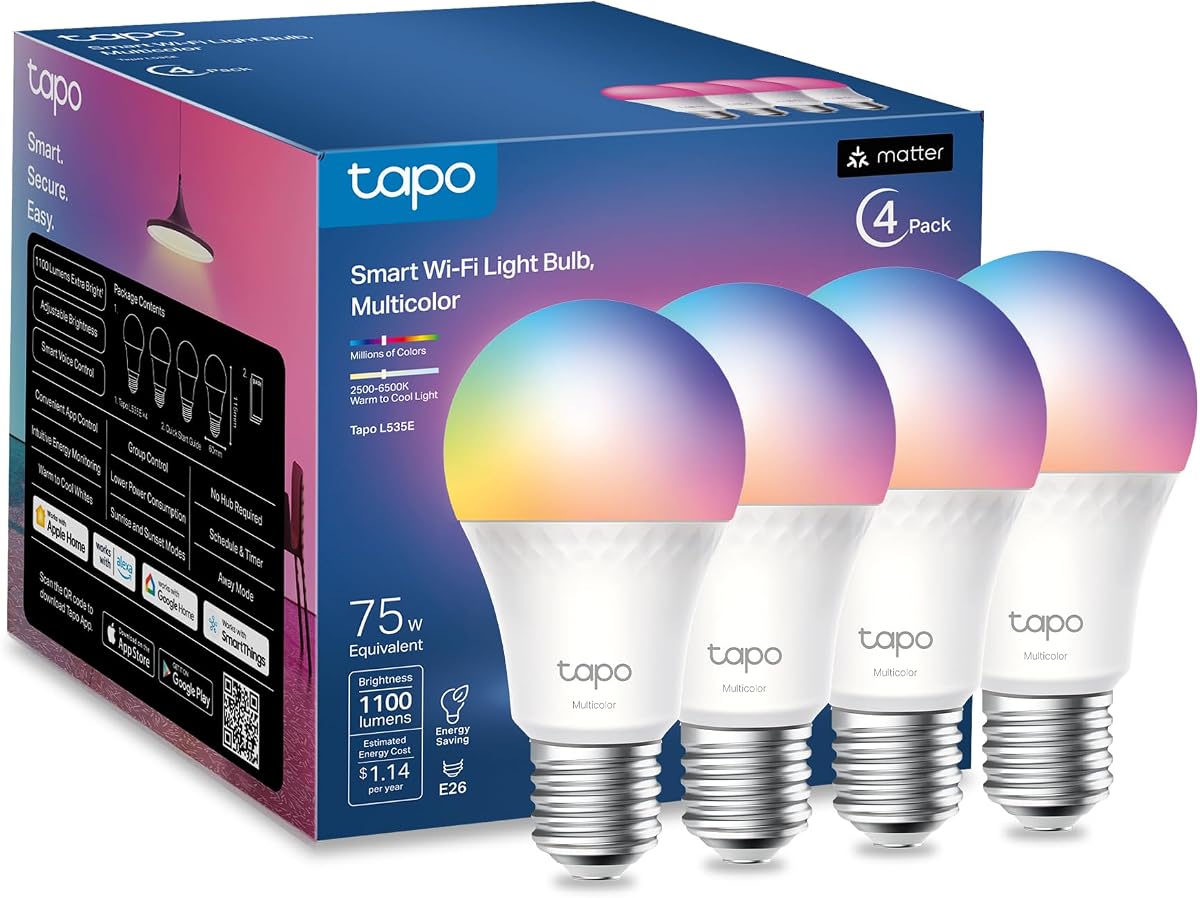
The Tapo L535E has a 4.3 rating and combines a four-bulb package with 1100-lumen multicolor output. That makes it a value-oriented choice for readers who want to color several rooms without buying a separate bulb for every fixture.
We may earn a commission when you buy through this link, at no additional cost to you.
Matter certification provides compatibility with Apple Home, Alexa, Google Home, and SmartThings. Devices within the local network can work even if the home internet goes offline, and Matter Multi-Admin allows trusted people to manage the system. Brightness adjusts from 1% to 100%, while white light ranges from 2500K to 6500K.
Its 1100 lumens exceed the output of many 800-lumen color smart bulbs, making it more useful in living rooms, kitchens, and activity areas where visibility matters. The trade-off is that users should confirm their preferred smart-home platform and account setup is compatible before installation.
This is our budget-oriented top pick because it packages high output, full color, tunable white, and strong Matter platform coverage together. It is especially attractive for buyers who want a uniform four-light installation and value flexible dimming, vivid scenes, and local control.
The 1100-lumen output provides a useful advantage over common 800-lumen alternatives. It can serve as primary room lighting while still offering color, dimming, and scene changes for different times of day.
Matter Multi-Admin makes it possible to grant access to trusted individuals without requiring every user to rely on the same manufacturer account. That can be helpful in shared homes, family routines, and managed properties.
We may earn a commission when you buy through this link, at no additional cost to you.
This Govee two-pack has a 4.6 rating, making it one of the strongest-rated products in the group. It provides more than 1000 lumens at 120V, equivalent to a 75W traditional bulb, with CRI 90+ for vibrant colors and a wide selection of white tones.
We may earn a commission when you buy through this link, at no additional cost to you.
Its app experience is a major selling point. The Govee Home app offers up to 54 scene modes, music synchronization, timers, and sunrise and sunset routines. An AI lighting bot can turn spoken or typed ideas into lighting effects, while Matter, Alexa, and Google Assistant support cover more conventional controls.
There are some configuration limitations. The bulbs cannot be used with smart switches, and saving presets requires a Wi-Fi-connected setup with Bluetooth turned off. They also use 2.4GHz Wi-Fi. Users who want a dedicated wall dimmer or operate exclusively on 5GHz will need another option.
This is an excellent choice for users who enjoy experimenting with app-designed scenes and synchronized effects. It combines useful brightness with a generous creative feature set, while the two-pack format provides matched bulbs for a pair of lamps or one room.
Scene selection, custom colors, timers, and rhythm modes make the app a central part of the experience. The AI lighting assistant adds a conversational route for users who want effects without navigating many menus.
More than 1000 lumens and CRI 90+ support colorful entertainment, decorative lighting, and practical illumination. It is well suited to rooms where visual impact matters as much as general brightness.
We may earn a commission when you buy through this link, at no additional cost to you.
This Linkind model carries a 4.7 rating and is the most technically ambitious option in the guide. Its dual-band 2.4GHz and 5GHz Wi-Fi 6 connection distinguishes it from most competitors, while Matter certification supports Alexa, Google Home, and other major smart platforms.
We may earn a commission when you buy through this link, at no additional cost to you.
The color-temperature range extends from 1000K candlelight to 20000K blue-white light. At 1100 lumens, the bulb combines useful room illumination with richer color output. LumiSync compatibility allows synchronized motion effects with Linkind light strips, and the Dotis AI feature can create custom effects from spoken ideas.
A Matter-compatible hub is required, which narrows its appeal for buyers seeking completely hub-free operation. It is designed for 120V systems, does not support wall dimmers, and lacks Thread support. It is also not compatible with Tuya, Smart Life, or non-Linkind LumiSync products.
This premium recommendation is ideal for a crowded network, a home already equipped with a Matter controller, or users who want the broadest white-light spectrum. The dual-band connection and entertainment integration make its additional complexity worthwhile for the right setup.
Dual-band Wi-Fi 6 allows the bulb to use either 2.4GHz or 5GHz, offering flexibility in homes where the 2.4GHz band is congested. The stated emphasis on bandwidth, response time, and interference resistance is particularly relevant to busy connected homes.
The 1000K–20000K range covers candlelight, warm residential light, neutral task light, cool daylight, and blue-white entertainment. That versatility gives one bulb the ability to serve many moods and activities.
We may earn a commission when you buy through this link, at no additional cost to you.
This WiZ three-pack has a 4.3 rating and focuses on automation that responds to real household movement. The SpaceSense feature can turn lights on or off when motion is detected without installing separate sensors, provided at least two WiZ devices are used.
We may earn a commission when you buy through this link, at no additional cost to you.
Sunset-to-sunrise automation is another useful feature for entryways, hallways, and outdoor-facing rooms connected through compatible services. The bulbs also support Alexa, Google Home, and Apple HomeKit, plus direct control through the WiZ app or a WiZ remote. No separate hub or gateway is required.
The output is 800 lumens, with full color, tunable white, dimming, 16 million colors, schedules, and mood presets. The three-bulb pack is convenient for coordinated lighting, but the motion feature's two-device minimum means it is not an option for a single-bulb installation.
This is a strong recommendation for people who want responsive lighting in halls, living areas, or other frequently used spaces. It combines practical motion behavior with Matter compatibility and avoids the need to purchase sensors for basic presence-based activation.
SpaceSense uses participating WiZ devices to detect movement and trigger the connected bulbs. This simplifies entryway and hallway lighting, although users must have at least two compatible devices for the feature.
Sunrise and sunset routines can align lighting with the local day cycle. When used with a compatible platform, this reduces the need to operate switches manually at changing times of day.
We may earn a commission when you buy through this link, at no additional cost to you.
This Philips four-pack offers a coordinated approach to home lighting, with each A19 bulb producing 800 lumens in a 60W-equivalent format. It has a 4.3 rating and adds full color, tunable white, dimming, schedules, and preset moods to a convenient four-bulb package.
We may earn a commission when you buy through this link, at no additional cost to you.
Matter certification allows the bulbs to join Apple Home, Alexa, or Google Home without a separate hub or gateway. Setup involves screwing in a bulb, opening the WiZ app, and connecting to Wi-Fi. The package can be installed across bedrooms, living areas, kitchens, or home offices as needed.
SpaceSense provides motion-based switching when at least two Philips Smart bulbs are present, allowing the system to react without dedicated motion sensors. The important limitation is that these bulbs are not compatible with Philips Hue, so existing Hue users should not expect the two ecosystems to work together.
This is a good option for households planning a broader coordinated installation. The four matched bulbs, broad automation, and hub-free Matter operation make it particularly suitable for readers who want a consistent lighting system across several standard fixtures.
Four matching bulbs make it easier to create a uniform look and manage groups. The standard A19 E26 format supports installation in many common household fixtures, subject to checking bulb and fixture compatibility.
The bulbs connect to the WiZ app and support major platforms without an added hub or gateway. This keeps installation approachable while still allowing integration with other Matter-certified devices.
We may earn a commission when you buy through this link, at no additional cost to you.
This Govee A21 two-pack has a 4.4 rating and leads the group in raw brightness at 1600 lumens. The 100W-equivalent output is intended for spaces that need substantial illumination, particularly larger rooms, work areas, and fixtures where lower-output smart bulbs may feel dim.
We may earn a commission when you buy through this link, at no additional cost to you.
LuminBlend+ is presented as supporting consistent color quality at different brightness levels, while CRI 90+ improves color fidelity. Adjustable white covers a broad 1000K–10000K range, and the RGBWW format supports full customization through colors, brightness, preset scenes, schedules, and music synchronization.
The A21 shape is larger than a standard A19 and may not fit every enclosed or compact fixture. The bulbs do not support 5GHz Wi-Fi and should not be used with dimmer switches. App firmware should also be updated to the stated version to access the full feature set.
This is the recommended choice for buyers who prioritize brightness and high-output color accuracy. Its Matter, Alexa, Google Assistant, and SmartThings support gives it broad smart-home reach, while the two-pack makes it practical for matching lamps or fixtures.
At 1600 lumens, this bulb provides more light than the standard 800-lumen choices found elsewhere in the guide. The higher output is especially relevant for large rooms, detailed tasks, and fixtures that serve as a room's main source of light.
LuminBlend+ is intended to keep the appearance of colors stable as output changes. Combined with CRI 90+, this makes the bulb a practical option for decorative lighting, content viewing, and everyday task illumination.
We may earn a commission when you buy through this link, at no additional cost to you.
The most useful Matter bulb is one that fits your existing network, preferred voice platform, fixtures, and lighting habits. Comparing these practical factors before ordering helps prevent setup frustration and produces a more useful smart-home system.
Matter is the common standard intended to help devices from different manufacturers work within a broader smart-home ecosystem. Confirm that the bulb is Matter certified or explicitly Matter enabled, then verify compatibility with the platform you already use, such as Apple Home, Alexa, Google Home, SmartThings, or a manufacturer app. A bulb may support Matter through a compatible hub or controller, so the complete setup path matters as much as the logo on the box.
Most products in this guide use 2.4GHz Wi-Fi, which is broadly compatible but can become congested on a busy network. The Linkind dual-band model also supports 5GHz and Wi-Fi 6, while several other products offer direct app control without a hub. Check whether initial setup requires Bluetooth, whether local control survives an internet outage, and whether your router separates the two Wi-Fi bands. These details can determine whether a bulb feels reliable in daily use.
Brightness should match the room and the fixture's role. Around 800 lumens suits many reading, bedside, and decorative lamps, while 1100 lumens offers stronger general illumination. The 1600-lumen A21 option is intended for larger spaces and more demanding task lighting. Also check the A19 or A21 shape, E26 base, wattage, and whether the bulb will fit enclosed fixtures or compact shades before ordering.
Color-changing bulbs can create atmosphere, but tunable white is often more important for everyday comfort and work. Look for a suitable Kelvin range, a high Color Rendering Index, smooth dimming, and a CRI of 90 or above when accurate color rendering matters. The models here range from a focused 2700K–6500K white spectrum to unusually broad 1000K–20000K and 1000K–10000K ranges.
Schedules, sunrise and sunset routines, groups, and scene presets can make a smart bulb more valuable than one used only for manual control. Motion-assisted automation is especially useful in hallways and entries, but some products require at least two bulbs. Consider whether routines should be handled locally, in the manufacturer app, or through your chosen Matter platform, and select the option that fits the household's established control method.
Music synchronization can add impact to gatherings, gaming, and media rooms. Several options detect sound through a phone microphone, while Govee and Linkind products also support broader scene and light-show functions. Users should consider whether a separate compatible light strip or other accessory is needed for synchronized room-wide effects, because cross-brand synchronization is not guaranteed even when the individual products support Matter.
Most smart bulbs in this category should not be used with traditional wall dimmers, and the products with dimming support generally should not be paired with smart switches. Physical dimmers can cause flickering, buzzing, or reduced bulb life, especially on low-cost or poorly matched models. Plan to dim through the app, voice assistant, remote, or compatible hub instead. If in-wall dimming is essential, verify compatibility explicitly before installation.
Multipacks are convenient for coordinated rooms and reduce the need to match bulbs purchased later, but they can be excessive for a single lamp. The guide includes two-, three-, and four-bulb options alongside single bulbs. LED efficiency also matters over long service periods: these products use considerably less power than traditional incandescent bulbs, with several using only 9 watts while producing 800 lumens.
Begin by confirming the bulb shape, base, voltage, and physical fit, then install it in an ordinary on-and-off wall switch rather than a traditional dimmer. If the fixture is controlled by a smart switch, remove that switch from the setup because smart bulbs generally expect standard power and manage their own dimming.
For setup, power the home's 2.4GHz Wi-Fi, install the manufacturer's app, and create or sign into the appropriate account. Some bulbs require Bluetooth during initial pairing even if normal control happens over Wi-Fi. Follow the QR-code or discovery process, add the bulb to Apple Home, Alexa, Google Home, SmartThings, or another supported Matter controller, and give each bulb a recognizable room and name.
Afterward, test basic control, dimming, color temperature, scenes, groups, and schedules. Update the app firmware when instructed, especially when a new firmware version unlocks stated features. For long service life, avoid frequently cutting power directly at the wall switch, keep bulbs within their specified voltage and temperature limits, and replace a bulb promptly if its enclosure becomes hot, cracked, or damaged.
It depends on the bulb and the platform being used. Several products in this guide can be controlled directly through their manufacturer apps or supported platforms without a separate hub, while others specify that a Matter-certified controller is required for Apple Home, Alexa, or Google Home. Always read the setup requirements for the exact model, particularly before purchasing a product intended for an existing smart-home system.
The 2.4GHz band generally offers broad device compatibility and often stronger coverage indoors, but it can become crowded with many connected products. The 5GHz band can offer more available bandwidth, though not every smart bulb supports it. The Linkind dual-band model supports both, while most other choices in this guide specify 2.4GHz-only connectivity.
Most Matter smart bulbs should be used with a standard on-and-off wall switch. The product information for several models specifically warns that traditional dimmers may cause flickering, buzzing, or premature failure. Use app, voice, remote, or hub-based dimming instead, and check the product instructions if your current wall control is dimmable.
Lumens describe the total light output, so a higher number is useful for brighter general or task lighting. An 800-lumen bulb corresponds roughly to a 60W traditional bulb, while the 1600-lumen Govee A21 is equivalent to 100W. Room size, fixture design, shade transparency, and the desired level of brightness should guide the choice.
Many bulbs support more than one ecosystem because Matter is designed around interoperability, but exact support varies by product. Linkind and OREiN models list several major platforms, while others name a smaller selection. Add the bulb through a Matter controller or manufacturer app and then link the relevant account to the voice platform you want to use.
Several products are designed to continue operating locally through Matter when the internet is unavailable, provided the necessary controller, hub, local network, and device setup are present. Remote access from outside the home and cloud-dependent routines may still stop working. This makes local Matter support valuable for essential lighting, but it does not guarantee every feature remains available.
A high CRI helps colors appear more accurate under the light, which matters for kitchens, work areas, artwork, makeup, and detailed hobbies. Products with CRI 90 or above are especially attractive for those uses. Brightness and color quality are separate considerations, so a high-output bulb can still be less suitable if its color rendering is weak.
Several bulbs in this guide support music-responsive color and brightness effects. The Linkind and OREiN products provide dedicated rhythm modes, while the Govee options also include synchronization with other compatible Govee products. Setup generally requires granting the manufacturer app access to the phone's microphone, and room-wide synchronization may depend on matching accessories from the same brand.
The Linkind RGB Matter Bulbs are the strongest all-around option because they combine broad voice-platform support, direct app control, extensive scenes, and music synchronization. The Govee RGBWW two-pack stands out for its high rating, 54 scene modes, and app-centered creative tools, while the dual-band Linkind model is the premium choice for busy networks and unusually broad color-temperature control.
Prioritize the requirements that will affect daily use: verify your Wi-Fi band and hub needs, confirm the bulb fits its fixture, check whether you need color or tunable white, and understand how you want to dim it. A bulb offering motion activation, music effects, or high output is most valuable when those functions solve a real routine rather than merely adding options to an app.
Before purchasing, compare the current listing, app requirements, platform support, and retailer details because hardware revisions and software features can change. Ratings, promotion availability, and prices also fluctuate, so checking the live product page can prevent surprises and help ensure the selected bulb remains a good fit for the intended room and smart-home network.