
NBVOICE Portable All-in-One PA System
4.2Editor score
Eight-channel detachable mixer
Two eight-inch speakers
Bluetooth 5.3 streaming
Cables and microphone included
PA speakers for bands must balance enough output and low-end response with the portability, connectivity, and control needed for rehearsals, small venues, and mobile performances. The right system can place clear vocals above instruments without occupying an entire stage, while a broader bundle may provide a faster all-in-one solution.
We compared all 10 products by examining driver size, amplification, input selection, mixer integration, wireless functions, feedback control, portability, and intended applications. The list covers complete portable systems, individually powered loudspeakers, a battery-powered model, and a passive pair for users who already operate an amplifier.
Each review identifies the configuration that makes the speaker most useful to a band, while also noting important limitations. Ratings and specifications can change over time, and market prices fluctuate, so readers should verify the current listing details and compare their own mixer, room, and power requirements before purchasing.
4.2Editor score

4.8Editor score

4.6Editor score
As an Amazon Associate we earn from qualifying purchases.
The comparison below highlights each product's core format, driver configuration, power class, control features, and wireless or connectivity options, making it easier to match a speaker to a rehearsal room, mobile show, or full PA bundle.




The NBVOICE Portable All-in-One PA System is a budget-oriented solution for bands that want vocals, instruments, playback, stands, cables, and a microphone without assembling a complex system from individual parts. Its 4.2 rating reflects a practical package with a useful set of features, although buyers should understand the limits of its 300-watt fixed configuration.
We may earn a commission when you buy through this link, at no additional cost to you.
The core system includes two eight-inch, two-way speakers rated at 300 watts, a detachable eight-channel mixer, foldable stands, a wired microphone, speaker cable, microphone cable, and wireless remote. Mixer controls give performers separate access to multiple sound sources, while four combo XLR and quarter-inch inputs, four balanced TRS inputs, RCA connections, and a 3.5 mm jack cover common band requirements.
Bluetooth 5.3 allows tracks to be streamed between songs or used for recorded accompaniment. A hidden compartment in the main mixer speaker stores the remote, cables, and smaller accessories, which is particularly useful for rehearsals in different rooms. The important limitation is that the mixer outputs are line-level and cannot power additional passive speakers, so this is a fixed system rather than an expandable modular rig.
This package is best for a duo, trio, acoustic act, classroom, worship team, or mobile presenter that wants a straightforward two-speaker setup. It offers the strongest budget value when everything must arrive ready to use. Bands needing separate stage monitors, more output, or the ability to add passive cabinets should choose an individually powered speaker or a more flexible system.
The included mixer, stands, microphone, and cables remove most of the shopping required for a first PA. The suitcase-style construction also helps a band keep the components together between rehearsal spaces, parties, and small events.
Bluetooth streaming and a wide selection of wired inputs support both live performers and recorded material. However, the line-level mixer output cannot power passive speakers, so the system is best used exactly as supplied.
We may earn a commission when you buy through this link, at no additional cost to you.
The Mackie Thrash15v2 is a powered 15-inch loudspeaker built for bands that need more low-end weight than a compact 12-inch model can provide. Its 5.0 rating makes it a strong choice for larger rooms, outdoor events, DJ sets, and dance-floor reinforcement where the ability to move significant bass is valuable.
We may earn a commission when you buy through this link, at no additional cost to you.
The step-up 15-inch woofer is the speaker's defining feature, providing deeper low end for rooms and stages that need more energy below the vocal range. Four voicing modes let the user select a sound suited to music, speech, or floor-monitor duty, while the integrated feedback eliminator helps address common microphone squeal before it becomes a major distraction.
This is a powered loudspeaker, meaning it can operate without a separate amplifier rack and is designed to link wirelessly to a second Thrash speaker. A mic and line combo input supports stage sources, Bluetooth handles background music, and the rugged frame with metal carry handles is better suited to equipment moving between shows than a delicate home speaker.
The Thrash15v2 is a strong front-of-house choice for a band whose guitars, kick drum, and vocals need more physical impact. It may be less attractive for a small rehearsal room or a musician who must carry a single cabinet frequently. Even as a powered model, it does not provide the multichannel mixing convenience of an all-in-one PA bundle.
The 15-inch woofer gives the Thrash15v2 a clear advantage when low-frequency definition matters. It is better suited to filling an audience area than providing intimate near-field monitoring at the back of a small stage.
Four voicing modes allow the loudspeaker to change character for music, speech, or monitor use. The feedback eliminator is particularly useful during live vocal reinforcement, although good microphone technique remains essential.
We may earn a commission when you buy through this link, at no additional cost to you.
The Mackie Thump12v4 combines a 12-inch powered cabinet with 1400 watts of peak output, offering a balance between portability and performance capability. Its 4.9 rating reflects a particularly strong showing, and the design is aimed at users who want quick setup without carrying separate amplifier racks.
We may earn a commission when you buy through this link, at no additional cost to you.
Mackie describes the loudspeaker as light enough for one hand and loud enough for a full room. SoundCheck DSP performs the tuning through application-specific voicing modes, reducing the need to make a series of manual adjustments before every show. Bluetooth supports streaming, linking a second speaker, and app control, giving performers several ways to manage a compact stereo setup.
The twelve-inch format is more approachable than a large 15-inch cabinet and can still provide enough output for a working band or DJ. It is also a more flexible front-of-house option than a fixed all-in-one package because musicians can determine their own mixer and source configuration. Its trade-off is that it does not include a full multichannel mixer.
This Thump model is well suited to solo performers, duos, rehearsal rooms, and moderately sized venues that want serious output in a portable powered package. Choose it when quick sound checks and app-assisted control matter. Bands needing numerous mic channels, EQ options, and a rack of effects should add a separate mixer or select a complete PA system.
The 12-inch powered format gives users a practical balance of cabinet size and high output. That makes it easier to carry between rehearsals while retaining enough capability for a full-room application.
SoundCheck voicing modes automate much of the initial tuning process. The result is a faster setup, though a familiar monitor mix and a proper gain structure remain necessary for consistent live performance.
We may earn a commission when you buy through this link, at no additional cost to you.
The Mackie Thrash12v2 is a versatile powered loudspeaker for solo acts, DJs, and small venues. Its 4.8 rating, 12-inch format, and 1300-watt peak output make it one of the most straightforward options for a band that wants substantial sound reinforcement without a permanently installed system.
We may earn a commission when you buy through this link, at no additional cost to you.
Unlike a bundled PA, the Thrash12v2 gives performers the freedom to create their own signal path. It connects to a second Thrash speaker wirelessly, accepts microphones and line sources through a combo input, and streams via Bluetooth. Four voicing modes adapt the output for music, speech, or floor-monitor duty, allowing the same cabinet to serve different roles during a show.
The integrated feedback eliminator is a useful safeguard when vocals are amplified in a reflective room. Output is described as loud and clear without requiring a mixer or amplifier rack, although the speaker still benefits from balanced levels and appropriate processing. The rugged enclosure and metal carry handles are suited to frequent transport and stage environments.
The Thrash12v2 is a strong front-of-house pick for a band that already owns a compact mixer or wants to add speakers incrementally. It is less convenient than an all-in-one system for a first-time user and less powerful in low end than the 15-inch Thrash. Within a twelve-inch powered category, however, it offers an effective combination of output, mode selection, and connectivity.
Wireless linking means a band can build from one Thrash12v2 to two without changing the basic speaker type. That scalability makes it easier to adapt the rig as the audience size or available space changes.
Music, speech, and floor-monitor voicing options help one powered cabinet serve different parts of a performance. Bluetooth adds convenient access to recorded material, while the combo input handles conventional stage sources.
We may earn a commission when you buy through this link, at no additional cost to you.
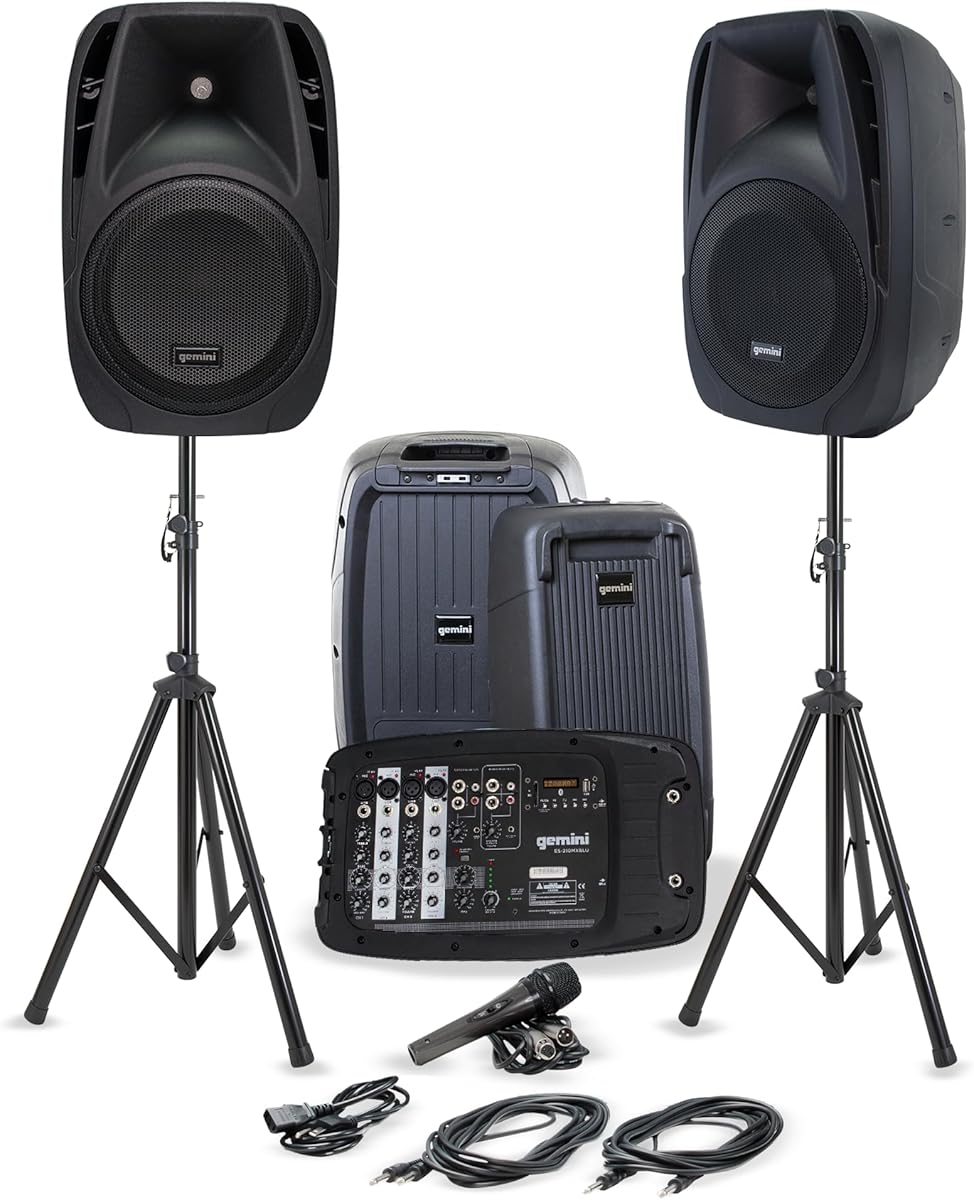
The Gemini ES-210MXBLU-ST is a complete portable PA package built around two passive 10-inch speakers, a powered six-channel mixer, adjustable stands, a wired dynamic microphone, and all necessary cables. Its 4.2 rating reflects a versatile package for bands that want meaningful mixer control without buying individual components.
We may earn a commission when you buy through this link, at no additional cost to you.
Four XLR mic and line channels each provide bass, treble, echo, and volume controls. Phantom power supports condenser microphones, while a separate stereo auxiliary channel handles RCA and 1/8-inch sources. This leaves the performance channels available for singers, instruments, and other live sources, while peak LEDs and a master limiter help maintain a controlled mix.
Playback options extend beyond Bluetooth to USB, SD card, and built-in FM radio, with MP3, WAV, and FLAC support. Monitor outputs and a headphone jack help the operator check the mix. The wide-dispersion horns and stated 35 Hz to 20 kHz frequency range are designed to deliver even audience coverage with clear vocals and defined low end.
The package is a good fit for mobile DJs, worship groups, karaoke acts, school functions, and bands that want a complete wired rig. The complete system weighs 48.5 pounds, and the speakers are passive, so both must remain connected to the powered mixer. Its many input and media options make it more flexible than a simple presentation-oriented bundle.
Four dedicated XLR channels, individual tone controls, and phantom power give singers and instrumentalists more control than a basic media speaker. The auxiliary channel also keeps playback sources from occupying precious microphone inputs.
Impact-resistant ABS cabinets, built-in handles, and a storage compartment for the mixer, microphone, and cables help organize transport. The two included tripod stands raise the speakers above seated listeners.
We may earn a commission when you buy through this link, at no additional cost to you.
The Fender Passport Venue S2 is a compact portable PA bundle aimed at bands, DJs, presenters, and community events. Its 4.6 rating and 600-watt power rating make it an appealing middle ground between a lightweight personal speaker and a larger full-stack system.
We may earn a commission when you buy through this link, at no additional cost to you.
The built-in powered mixer gives every channel individual volume, bass, treble, and reverb controls. Thirteen total inputs include XLR and quarter-inch combo connections, a mic and line pad, phantom power, a high-impedance instrument input, and Bluetooth. That assortment is especially useful for an acoustic singer-guitarist, a small band with several vocal microphones, or a performer who wants to connect an instrument directly.
A dedicated subwoofer output with an automatic high-pass filter permits a more capable low-frequency system without unnecessarily sending full-range bass to the sub. The suitcase-style enclosure is designed for fast setup and transport. The bundle also includes compact speaker stands, a cardioid-pattern microphone with clip and cable, and an instrument cable.
This is a practical choice for rehearsals, small venues, classrooms, meetings, and acoustic events. The integrated design is much easier to deploy than separate components, while the 13-input mixer offers greater performance flexibility than a basic Bluetooth speaker. Bands requiring broad stereo control, more substantial output, or professional touring construction should look toward a larger powered system.
The input assortment supports microphones, line sources, instruments, and Bluetooth playback in one compact enclosure. A high-impedance instrument input is particularly convenient for guitarists who want to move directly into the mixer.
The included stands, microphone, and instrument cable give a new band the essentials needed for a first rehearsal or event. The suitcase format also reduces the number of separate items that need to be organized and transported.
We may earn a commission when you buy through this link, at no additional cost to you.
The JBL EON715 is a 1300-watt powered 15-inch multipurpose PA speaker with a 4.5 rating. It is positioned for bands and event teams that need a substantial front-of-house cabinet without relying on a separate amplifier, making it a potential alternative to the other large powered speakers in this guide.
We may earn a commission when you buy through this link, at no additional cost to you.
Its two-way design uses a large 15-inch driver for the main loudspeaker workload, while JBL Waveguide technology is intended to shape dispersion across the audience area. Bluetooth integration allows convenient streaming of recorded music without occupying a wired input, and the powered format means the cabinet can be connected directly to a mixer or suitable source.
The EON715 is a single-speaker product rather than a ready-made two-speaker PA, so a complete front-of-house system normally requires at least a second cabinet for stereo coverage. It also does not include a multichannel mixer. Those limitations make it more appropriate for musicians who already own mixing equipment or want to build a scalable powered system.
Choose the EON715 for a room that needs a large driver, solid maximum output, and controlled audience coverage. Its size makes it less attractive for tiny rehearsal spaces and musicians who optimize every kilogram of their rig. Still, for a band moving into small clubs or outdoor events, a matched pair offers more headroom and a more even sound field than one lone cabinet.
The 15-inch format and waveguide design are aimed at projecting a unified sound across an audience area. Matching a pair of cabinets generally produces more balanced coverage than relying on a single speaker.
Built-in amplification removes the need for a separate amp rack. The speaker still needs a suitable mixer and source, but existing band equipment can be connected without introducing another powered component into the signal chain.
We may earn a commission when you buy through this link, at no additional cost to you.
The Bose S1 Pro+ is the premium mobile PA in this group, combining a powered speaker, integrated three-channel mixer, rechargeable battery, and wireless RF receiver support. Its 4.6 rating reflects a polished option for acoustic performers, presenters, and bands that regularly perform in places without easy access to mains power.
We may earn a commission when you buy through this link, at no additional cost to you.
The speaker can be placed vertically, tilted back, horizontally, or on a standard 35 mm stand. Automatic EQ adjusts to those positions, while the ergonomic handle and 14.4-pound weight support genuinely mobile use. Two mixer channels accept microphones and instruments, and a third is dedicated to music playback, giving performers a clear and compact control surface.
Optional wireless mic and instrument RF transmitters can connect to the integrated receivers and charge when stored in the speaker. Those transmitters are not included, so wireless operation requires an additional purchase. The Bose app provides control over volume, EQ, reverb, and the ToneMatch preset library, making tonal changes possible without walking back to the speaker.
The rechargeable lithium-ion battery is stated to provide up to 11 hours of playtime, although actual duration depends on content, volume, and temperature. The S1 Pro+ is ideal for street performances, mobile acoustic sets, pop-up events, and rehearsals without outlets. It is less suitable for a loud full band that needs the sustained output and bass impact of large mains-oriented speakers.
The internal battery removes the need to find power for mobile shows. It gives acoustic performers and presenters freedom to perform in locations where cables and outlets would otherwise limit the setup.
Automatic EQ responds to four physical orientations, helping the speaker maintain its intended tonal balance as it changes from floor use to stand or vertical placement. App control adds remote access to EQ, reverb, volume, and presets.
We may earn a commission when you buy through this link, at no additional cost to you.
The Mackie Thump15v4 is a 1400-watt powered loudspeaker with a 15-inch cabinet, combining high output with DSP-driven setup. Its 4.9 rating makes it a compelling front-of-house or monitor option for bands moving from solo acoustic performances to DJ sets and busy outdoor events.
We may earn a commission when you buy through this link, at no additional cost to you.
SoundCheck DSP provides voicing modes for music, speech, monitor use, and outdoor operation. That final outdoor preset is particularly relevant because open-air sound behaves differently from a controlled indoor room. Bluetooth supports streaming, linking two speakers wirelessly, and control through an app, giving a band several options for expanding coverage or changing settings.
Pole mounting and integrated fly points broaden the speaker's installation options, which is useful for fixed positions and elevated stage use. The 15-inch driver provides deeper low end than a 12-inch alternative and can better support a drummer, bassist, or DJ source. The cabinet is still a substantial object, so a one-hand transport claim is more appropriate to smaller Thump models.
This loudspeaker is a strong choice for outdoor gigs, small-to-medium venues, and bands that need a high-output powered cabinet. It does not include a full mixer, so a multi-source band should pair it with an appropriate console. Compared with the Thrash15v2, the Thump15v4 emphasizes SoundCheck DSP and app-based control, while the Thrash highlights voicing modes and a feedback eliminator.
Music, speech, monitor, and outdoor modes make setup more direct for common applications. The DSP handles the initial voicing, but performers should still check gain and feedback with a sound check.
A pole mount and fly points support more permanent positioning than a basic stand-only speaker. These features are valuable for bands that can leave equipment set up between rehearsals or performances.
We may earn a commission when you buy through this link, at no additional cost to you.
The 8-Inch Passive Speaker Pair is a flexible option for bands that already own a suitable amplifier and mixer. Its 5.0 rating reflects a straightforward passive design built around an 8-inch woofer, a 3-inch tweeter, and a two-way crossover intended for clear vocals and balanced reproduction.
We may earn a commission when you buy through this link, at no additional cost to you.
Each cabinet handles up to 800 watts of peak power at 8 ohms, making careful amplifier matching essential. The speakers do not have built-in amplification, and the required cables and mounting accessories must be purchased separately. Despite that limitation, the passive format allows the speakers to work with different amplifier types and can avoid the electronics inside an active speaker.
The pair can serve as front-of-house speakers, stage monitors, home-audio components, or karaoke systems. A 2-way crossover separates the low- and high-frequency duties, while the 8-inch woofer supplies the main body of the output. The thick MDF enclosure is designed to minimize unwanted resonance, and full-copper voice coils support consistent component performance.
This pair is best for an experienced band that values a simple signal chain and already has an amplifier, mixer, cables, and stands. It can also be a good route to a stereo pair because two cabinets are included. Beginners who want a ready-to-play system will find an all-in-one package easier, while bands needing more low end should look toward larger 12-inch or 15-inch drivers.
Because the cabinets are passive, performers can pair them with compatible amplifiers they already own. That makes the system economical for users building equipment over time, though amplifier compatibility must be checked carefully.
Two speakers provide a natural foundation for left-right coverage or matching monitor placement. Overhead suspension, desk placement, and stand mounting offer additional uses, with the appropriate hardware purchased separately.
We may earn a commission when you buy through this link, at no additional cost to you.
Choosing a PA for a band means balancing output, portability, connections, mix control, and room coverage. The right choice depends on how many performers and sources must be handled, where the system will be used, and whether the band values a ready-made package or the flexibility to build its own rig.
A powered loudspeaker includes its own amplification and connects directly to a mixer or other source. This reduces the number of components a band must carry and makes setup faster, but it also fixes the internal amplification choices. A passive speaker requires a compatible external amplifier, which can offer greater system-building flexibility and may appeal to musicians who already own a rack.
In short, choose powered speakers for convenient mobile use, or passive speakers when you want an established custom signal chain. Do not connect passive cabinets to a line-level mixer output unless that output is specifically designed to power them.
Driver size is one of the clearest indicators of a loudspeaker's intended use. Eight-inch models prioritize portability and speech or acoustic support, while 12-inch and 15-inch models move more air and generally provide stronger bass impact. A larger driver is useful for drums, bass guitar, DJ playback, and outdoor events, but it also increases cabinet size, weight, transport effort, and cost.
Match the driver to the room rather than simply choosing the largest model available. An 8-inch system may cover a rehearsal room effectively, while a 15-inch pair is better suited to a small club or outdoor audience. Consider how often the system must be moved before prioritizing maximum low end.
A band running vocals, guitars, keyboards, and playback needs more usable mixer channels than a presenter with a single microphone. Look for XLR and quarter-inch combinations, dedicated line inputs, balanced TRS connections, RCA or 3.5 mm playback inputs, and instrument inputs where appropriate. Independent bass, treble, volume, and effects controls provide better control than a basic two-level mixer.
Count every source before buying. Leave a little room for future performers, but avoid paying for a large mixer that will remain difficult to operate. The most convenient choice is the smallest mixer that comfortably supports the number of microphones, instruments, and playback devices the band actually uses.
Bluetooth is primarily convenient for recorded music, sound checks, and casual playback, and it can reduce cable clutter. Some powered speakers also support linking between two units or app-based control. Systems with integrated RF receivers may accept dedicated wireless microphone or instrument transmitters, although those accessories can be separate purchases.
Choose wireless functions according to the workflow. Use Bluetooth for playback between sets, app control for faster adjustments, and RF wireless for live microphone mobility. A wired connection remains the most consistent choice when latency, dropout concerns, or complex routing are important.
Portable PA systems are judged partly by what arrives in the box. Speaker stands, a microphone, instrument cable, speaker cables, and a storage case can make a complete package more useful than a bare powered speaker. Suitcase-style enclosures, folding stands, built-in handles, and accessory compartments reduce setup and transport friction.
Check the complete weight and the number of separate pieces that must be carried. A lightweight speaker with a larger mixer may still be difficult to move alone. Bands should favor sturdy handles, secure storage, and a layout that allows the complete rig to be assembled quickly at the venue.
Digital signal processing can provide useful starting points for music, speech, monitor use, and outdoor operation. These modes simplify setup, but they do not replace a proper gain structure, equalization, or microphone placement. A feedback eliminator may reduce unwanted squeal, yet it should be treated as a safeguard rather than a substitute for correct operation.
Look for a speaker with controls relevant to the intended role. Front-of-house speakers benefit from stable voicing and feedback reduction, while stage monitors may need a dedicated monitor mode. Compare the available modes with the environments in which the band performs.
Coverage depends on driver size, cabinet design, waveguide or dispersion characteristics, placement, and the room itself. Wide-dispersion cabinets can cover an audience more evenly, while a single speaker may leave hot and cold areas. Raising speakers on stands also changes how sound reaches the audience, especially in a crowded room.
Use a matched pair for consistent stereo coverage and plan the speaker position before the audience arrives. If the band regularly performs in very different spaces, choose a portable system that can be scaled from one speaker to two rather than a fixed arrangement designed for one room.
Battery operation is valuable for mobile performers because it removes dependence on electrical outlets. Review the stated playback time with realistic expectations, since output type, volume, and temperature affect runtime. Pole mounts, fly points, standard 35 mm sockets, and suspension options make it easier to reuse equipment across stages, rehearsal rooms, and permanent installations.
Consider the complete setup rather than one feature. A speaker with excellent mounting hardware may be more useful over time, while an all-in-one case is valuable to a new band. Identify whether the system must expand with additional speakers, a subwoofer, or a larger mixer before making the final choice.
Begin by identifying every source that will enter the system, including vocals, instruments, playback devices, and wireless accessories. Arrange the speakers before the audience arrives, position them on stable stands, and angle them toward the listening area. Keep the front grille unobstructed, route cables away from walkways, and ensure that every cabinet is securely mounted before performing.
Set microphone and instrument levels conservatively, then raise the master output to a comfortable level. Select the voicing mode that most closely matches the application, make EQ adjustments gradually, and listen for feedback at the actual microphone positions. During the show, avoid repeatedly pushing the output level upward if the mix feels weak; check gain staging and balance each source instead.
After the performance, power down and disconnect cables gently rather than pulling on connectors. Wipe surfaces with a dry cloth, keep moisture away from the grilles and electronics, and inspect stands, mounts, and cables for damage. Store batteries according to their manufacturer instructions, transport powered cabinets carefully, and confirm that accessories remain in their designated compartments between shows.
A small band can often begin with a pair of 10-inch or 12-inch powered speakers and a mixer with enough XLR and line inputs for the lineup. Eight-inch systems can work for rehearsal rooms and acoustic performances, while 15-inch models are better suited to louder clubs, DJ sets, and outdoor events. The right choice depends as much on room size and transport needs as on maximum output.
One powered speaker can reinforce a solo act, acoustic performance, DJ, or small rehearsal session, but a matched pair usually provides more even stereo coverage and greater headroom. A band with several microphones and instruments also benefits from a dedicated mixer, even when each speaker includes basic controls. Begin with one only if the application is genuinely small and portable.
A mixer is strongly recommended for most bands because it lets you control the relative levels of microphones, instruments, and playback. Powered speakers may accept a mixed signal or individual connections, but they usually do not provide enough channels for a full band. A separate mixer also makes it easier to set gain, apply effects, and monitor the overall balance.
Powered speakers contain internal amplification and can be connected directly to a mixer or suitable source. Passive speakers require an external amplifier or receiver with an appropriate power rating and impedance. Powered systems are easier to transport, while passive systems can be attractive to musicians who already own compatible amplification and want a customized rig.
Standard Bluetooth is mainly intended for convenient playback and is not the usual choice for a live vocal microphone. For wireless vocals, look for a dedicated system with RF transmitters and receivers, such as the optional RF accessories supported by the Bose S1 Pro+. Wired microphones remain the simplest and most consistent option for many live band setups.
No. Larger drivers usually provide more bass impact and output, but they also take up more space, weigh more, and may be unnecessary in a small rehearsal room. A compact powered system can be more practical when transportation happens frequently. Choose based on the typical venue, required low end, mixer complexity, and how much equipment the band can comfortably carry.
Two speakers are the standard starting point because they provide left-right coverage and more output than a single cabinet. Some portable all-in-one products include a fixed pair, while individually powered models can be purchased and linked according to the band's needs. Very small acoustic setups may use one speaker, but a matched pair is usually the more flexible choice.
No. A subwoofer output is specifically identified on the Fender Passport Venue S2, which also includes an automatic high-pass filter for the main speakers. Other systems may support low-frequency expansion through compatible line-level or dedicated connections, but buyers should verify the manual and manufacturer specifications before adding one.
The NBVOICE all-in-one system stands out as the best budget route for a new band because it includes two speakers, an eight-channel mixer, stands, a microphone, and essential cables. The Mackie Thrash12v2 is the editor's choice for a balanced powered loudspeaker, while the Bose S1 Pro+ takes the premium position through battery operation, flexible positioning, app control, and wireless RF receiver support.
Above all, match the system to the number of performers, available inputs, room size, and transport burden. Bands should prioritize clear vocal support, a mixer they can operate, and coverage suited to their usual venues rather than focusing only on peak wattage. Larger drivers and all-in-one convenience are valuable, but neither is more important than a practical signal chain.
Ratings, configurations, and product details can evolve, and market prices change over time. Before ordering, confirm the current listing, included accessories, input types, power requirements, and compatibility with any existing mixer or amplifier. Those checks will help ensure that the chosen PA speaker system fits the band and remains practical for rehearsals, travel, and live performance.