
OBD1 to OBD2 12-Pin Adapter
5.0Editor score
Copper-core signal conductors
Sixteen-inch flexible cable
Broad 12-pin vehicle support
Compare the best OBD1 to OBD2 Adapter options for GM, Ford, and BMW, including connector fit, protocol compatibility, construction quality, and ease of use.
An OBD1 to OBD2 adapter connects a vehicle’s older diagnostic port to a modern 16-pin scanner or code reader. A worthwhile cable must match the correct vehicle connector, provide dependable data communication, and work with the protocols supported by your diagnostic equipment.
This guide compares ten adapters designed for 12-pin GM vehicles, 7-pin Ford vehicles, and 20-pin BMW vehicles. We evaluated connector type, vehicle fit, stated protocol compatibility, materials, installation requirements, portability, and the degree to which each product addresses connector wear.
Each review identifies the strongest use case and the important limitations, including scanner compatibility and protocol caveats. The picks range from general-purpose cables to manufacturer-specific adapters, and current market prices can change, so shoppers should confirm the latest listing and vehicle compatibility before buying.
5.0Editor score

4.5Editor score

4.0Editor score
The following side-by-side comparison covers all ten adapters, with particular attention to connector configuration, supported vehicle applications, construction, compatibility cautions, and practical diagnostic functions.




The Autel Original OBD1 to OBD2 GM Adapter Cable is a 12-pin-to-16-pin conversion cable designed to bridge a compatible GM vehicle and an existing OBD2 diagnostic tool. Its 3.8 rating reflects a practical product with a clear vehicle focus, although successful use depends on the scanner and vehicle supporting the required protocols. It is a cable, not a diagnostic scanner, and the manufacturer explicitly makes that distinction.
We may earn a commission when you buy through this link, at no additional cost to you.
The strongest feature is its construction. Autel describes precision injection molding, metal and plastic materials, and extensive plugging and unplugging testing. The product also acts as a short extension, reducing repeated direct contact with the vehicle's diagnostic receptacle. That can help protect the port while giving the user more room to position a scanner inside the cabin.
The central limitation is electrical rather than physical. This 12-pin OBD1 port does not supply power, so the scanner must have an appropriate built-in or external power source. The adapter also cannot add protocol support that the scanner lacks. Checking the scanner's compatibility with the exact GM vehicle and required functions is essential before ordering.
This is a sensible choice for GM owners who already own a suitable 16-pin scanner and want a durable, purpose-built adapter. It is less suitable for someone expecting a diagnostic package or a plug-and-play cure for scanner communication problems. For correctly matched equipment, it offers solid construction and a useful reduction in connector wear.
The adapter is explicitly designed for GM vehicles using a 12-pin OBD1 socket. Its 12-pin male end connects to the vehicle, while the 16-pin female end accepts a compatible OBD2 diagnostic tool, creating a straightforward physical bridge.
Its extension function can reduce wear on the vehicle's diagnostic connector by preventing a bulky scanner from being plugged directly into the receptacle. Metal and plastic materials add useful rigidity, while the molded construction is intended to withstand repeated handling.
We may earn a commission when you buy through this link, at no additional cost to you.
This OBD1 Scanner GM Adapter is a 12-pin-to-16-pin cable intended to connect a GM vehicle's OBD1 connector with a 16-pin OBD2 scanner. It carries a 3.7 rating and occupies a useful middle ground in the category, offering a straightforward extension with a claimed ability to support scanning software and stable communication.
We may earn a commission when you buy through this link, at no additional cost to you.
One notable feature is the possibility of daisy-chaining multiple cables for greater reach. That makes the adapter potentially more versatile than a very short fixed cable, particularly when the vehicle diagnostic port and scanner display are not conveniently positioned. The metal-and-PVC construction is also intended to provide flexibility and resist breakage during normal use.
As with every physical adapter in this roundup, it does not add diagnostic intelligence. It cannot read codes, perform bidirectional tests, or communicate with a vehicle unless the connected scanner and vehicle support the relevant protocol. The listed 3.7 rating suggests reasonable user satisfaction, but it does not provide evidence that every scanner or GM model will establish a connection.
Buyers who want more working room between the diagnostic port and scanner may appreciate the daisy-chain feature. It is a better fit for an existing compatible OBD2 tool than for a first-time owner seeking a complete diagnostic solution. Confirm the 12-pin GM layout, your scanner's protocol support, and the vehicle's connector shape before purchasing.
The ability to connect multiple cables in sequence is a practical distinction for cramped engine compartments or dashboard-mounted scanners. Extra reach can improve positioning without requiring a permanently installed adapter.
Installation requires no driver or complicated wiring. The GM-side 12-pin connector attaches to the vehicle, and the 16-pin end joins the scanner, allowing the existing tool to perform the actual diagnosis.
We may earn a commission when you buy through this link, at no additional cost to you.
The Autel 7 Pin OBD1 to 16 Pin OBD2 Diagnostic Adapter Cable is designed for Ford vehicles from 1985 through 1991 that use a 7-pin OBD1 interface. It has a 3.9 rating and offers a narrowly focused solution for owners trying to connect an early Ford EFI vehicle to a modern universal scanner.
We may earn a commission when you buy through this link, at no additional cost to you.
The cable is especially clear about protocol limitations. Autel states that it performs a physical interface conversion but cannot guarantee communication with every scanner. Diagnostic success still depends on support for earlier Ford protocols, including Ford EEC-IV. That honest warning is more useful than implying that every 16-pin scanner will work immediately.
Its stated installation process is direct: attach the 7-pin end to the vehicle's diagnostic port, connect the 16-pin end to the scanner, and begin the diagnostic session. The manufacturer also describes polished interfaces intended to promote stable data transfer, as well as a length and thickness designed to serve as a practical connection bridge.
This adapter makes the most sense for someone who has confirmed both the 7-pin Ford connector and scanner protocol support. It is not a broad solution for modern vehicles, and the product listing does not claim it works with every Autel scanner. For an early Ford EFI owner with appropriate equipment, it provides a targeted cable with clear support terms.
The product is intended for older Ford EFI vehicles with a 7-pin diagnostic socket, often found in the area around the brake master cylinder. Matching the physical connector is only the first step in determining whether it will suit your vehicle.
A 16-pin plug does not automatically make a scanner compatible with a legacy vehicle. Checking for Ford EEC-IV or other required protocol support helps prevent the most common source of failed connections.
We may earn a commission when you buy through this link, at no additional cost to you.
This OBD1 to OBD2 Adapter is a compact 12-pin-to-16-pin cable for vehicles with the appropriate OBD1 socket. It carries a 3.4 rating, the lowest among the ten products here, so buyers should give its broad compatibility claims more scrutiny than they would a more precisely documented model.
We may earn a commission when you buy through this link, at no additional cost to you.
The product uses wear-resistant PVC and is described as rugged, resistant to deformation, and capable of stable transmission. Its compact 16.14-by-1.83-inch size makes it easy to carry in a vehicle or store in the trunk, which is useful for owners who want a compact diagnostic accessory rather than a large kit.
Its install process is simple: the 12-pin male connector joins the vehicle's socket, and the 16-pin female connector accepts the existing scanner. The package contains only the cable. Despite the phrase for most models, the exact 12-pin layout, TCS tool compatibility, and required protocols must still be verified before use.
This cable is a practical choice for a confirmed 12-pin vehicle and compatible scanner because it is inexpensive in function, easy to store, and intended to reduce repeated wear on the vehicle port. Its lower rating and less specific vehicle wording make it less compelling when a manufacturer-specific or better-documented adapter is available for your exact car.
The short cable dimensions make this adapter easy to keep with a code reader, tool case, or emergency kit. Its small footprint also avoids adding substantial clutter around the working area.
Using the cable as an intermediary can reduce repeated contact between the scanner plug and the vehicle receptacle. That is particularly useful for owners who scan frequently or use a bulky diagnostic tool.
We may earn a commission when you buy through this link, at no additional cost to you.
The OBD1 to OBD2 Adapter for Ford 7 Pin to 16 Pin OBD2 Diagnostic Cable is built for Ford vehicles with a 7-pin OBD1 connector. It has a 4.0 rating and is especially appealing to owners who already use an ELM327-based OBD2 scanner and want a clean, purpose-built connection.
We may earn a commission when you buy through this link, at no additional cost to you.
Its defining feature is the stated compatibility with ELM327 scanners and code readers. Once connected, users can access real-time vehicle data, fault codes, and more advanced diagnostic functions through the scanner's capabilities. The plug-and-play arrangement avoids installation tools, while the compact construction supports storage, transport, and mobile use.
The main drawback is that the description focuses on the connector type and ELM327 compatibility without providing a detailed model-year list. Owners should still verify that their Ford has the matching 7-pin diagnostic port and that their scanner supports the communication protocol required by the vehicle. The cable itself does not supply scanning software or a power source.
This is a strong choice for DIY mechanics, professional technicians, and Ford enthusiasts working with an older 7-pin vehicle and a compatible ELM327 tool. Compared with options that make broader claims, it offers a more recognizable scanner standard. It remains best suited to physical conversion rather than unsupported protocol translation.
ELM327 is a widely used scanner platform, so this cable is practical for owners who already own or plan to use an ELM327-based reader. That makes the adapter useful without requiring a specialized proprietary connector.
The compact design makes the cable easier to carry between vehicles or store beside a compact scanner. It is particularly relevant to independent technicians who already have suitable diagnostic hardware.
We may earn a commission when you buy through this link, at no additional cost to you.
The OBD1 Scanner Connector is a 40-centimeter, 12-pin-to-16-pin diagnostic extension intended to connect OBD1 vehicles with OBD2 scanners. Its 3.0 rating is the lowest in this list, making careful compatibility verification especially important for anyone considering it.
We may earn a commission when you buy through this link, at no additional cost to you.
The extra cable length provides useful flexibility when the diagnostic port is recessed or the scanner display is positioned awkwardly. The product is described as using quality materials for repeated use, while the stable interface is intended to support clear data transfer. Installation requires only connecting the two ends in their respective sockets.
The broad statement that it is compatible with most cars using OBD1 is less precise than the model-specific documentation offered by some alternatives. A 12-pin connector does not cover every OBD1 layout, and the adapter cannot solve an unsupported protocol. The cable also has no scanner, software, or independent power supply.
The product is best for a user who has visually confirmed a compatible 12-pin OBD1 port, needs a 40-centimeter extension, and owns a scanner known to support the vehicle's protocol. The flexible reach is convenient, but the low rating and general wording mean it should not be selected blindly for a specialized vehicle.
A 40-centimeter length offers more placement freedom than a very short connector while remaining easy to coil for storage. It helps when the diagnostic socket is deep under a dashboard or partially obstructed.
The adapter provides a physical bridge, while the scanner handles code reading and data interpretation. Compatible protocols and a suitable power arrangement remain necessary for a successful session.
We may earn a commission when you buy through this link, at no additional cost to you.
The CERRXIAN OBD1 to OBD2 GM Adapter is a 12-pin-to-16-pin cable intended for GM vehicles. Its 3.5 rating reflects a straightforward accessory with unusually specific information about the electrical configuration: pins 4, 5A, 7M, 7K, and 16G are connected, while the remaining pins are not.
We may earn a commission when you buy through this link, at no additional cost to you.
That transparency is useful because not every 16-pin socket uses every contact for every purpose. The adapter is designed to connect a vehicle's 12-pin OBD1 port to an existing 16-pin diagnostic tool, allowing tasks such as reading or clearing codes and performing broader system diagnostics when the scanner supports them.
The product does not provide power, so the connected scanner must have a built-in or suitable external power supply. It can also serve as a port protector, reducing wear from repeated direct plugging and unplugging. However, the limited connected-pin configuration and absence of a scanner mean that buyers should review the specifications against their specific equipment.
This cable is most appropriate for a GM owner who understands the required pin mapping and already owns a suitable OBD2 scanner. Its documentation is a positive, but the lack of independent power and unconnected contacts rule it out as a universal solution. It is a targeted adapter rather than a complete diagnostic package.
Identifying the connected contacts helps buyers assess whether the cable matches their scanner and vehicle setup. This is more transparent than relying only on the number of pins printed on the connector.
Because the adapter itself is passive, the connected diagnostic tool must provide appropriate power. Users should verify this arrangement before relying on the cable for a roadside or prolonged diagnostic session.
We may earn a commission when you buy through this link, at no additional cost to you.
This Ford 7-Pin Diagnostic Cable is an OBD1-to-OBD2 adapter for Ford vehicles with a 7-pin socket, with the listing specifically noting compatibility across 1985 through 1993 applications. It has a 3.5 rating and is positioned as a durable connector replacement for code readers and scan tools.
We may earn a commission when you buy through this link, at no additional cost to you.
The construction combines metal and PVC with precision injection molding. That combination is intended to provide rigidity, environmental resistance, and a long service life while remaining manageable in a toolbox. The physical connection is straightforward: the 7-pin end goes into the Ford diagnostic port and the 16-pin end connects to the scanner.
Compatibility is narrower than the phrase for most Ford EFI vehicles may initially suggest. The product explicitly excludes the 1992 Ford F350, and buyers are encouraged to compare the pictured interface with their vehicle before purchasing. As a cable-only product, it does not include a scanner or address every possible protocol mismatch.
This adapter suits owners of an eligible older Ford EFI who need a replacement connector or a way to connect a modern diagnostic tool. It is a sensible supporting accessory for a technician or enthusiast with suitable scanning equipment. Those with the excluded model or a different diagnostic-port layout should look elsewhere.
The metal-and-PVC build and molded housing are intended to withstand regular handling. These attributes suit technicians who repeatedly connect scanners or owners who keep diagnostic tools in a vehicle.
The stated incompatibility with the 1992 Ford F350 is important because connector appearance can be deceptive. Comparing the socket and keying against the product image reduces the chance of an unsuitable purchase.
We may earn a commission when you buy through this link, at no additional cost to you.
The Autel Original 20 Pin to 16 Pin OBD2 Cable for BMW is a 20-pin-to-16-pin adapter for selected BMW vehicles with an OBD1-style diagnostic socket. It carries a 4.5 rating, the highest among the manufacturer-specific cables, and stands out for the unusually broad list of compatible BMW models.
We may earn a commission when you buy through this link, at no additional cost to you.
The stated applications include E28, E30, E32, E34, E36, E38, E39, E46, E52, E53, R50, R52, and R53. Its 15.75-inch, or 40-centimeter, length adds useful reach while helping reduce wear on the vehicle's connector. Autel also describes industrial-grade heavy-duty materials and extensive plugging and unplugging testing.
The cable is passive and does not provide power, so the scanner must be suitably powered and compatible with the vehicle's functions. It also cannot make a scanner that lacks the required protocol support work with an older BMW. Confirming the 20-pin port, vehicle model, and scanner capabilities remains essential.
This is the most convincing choice for a BMW owner whose vehicle appears in the compatibility list and who already has a capable OBD2 tool. It combines a strong rating, a substantial model range, serious construction claims, and practical port protection. The restriction to the correct BMW connector prevents it from serving as a universal adapter, but that focus is precisely what makes it useful.
The model list spans numerous BMW chassis codes, giving the cable broader documented relevance than many vehicle-specific alternatives. Buyers should still verify their exact year, model, and diagnostic-port format before ordering.
Industrial-grade materials, precision molding, and a 40-centimeter extension support dependable handling. The added length also keeps a bulky scanner from repeatedly engaging the vehicle's receptacle directly.
We may earn a commission when you buy through this link, at no additional cost to you.
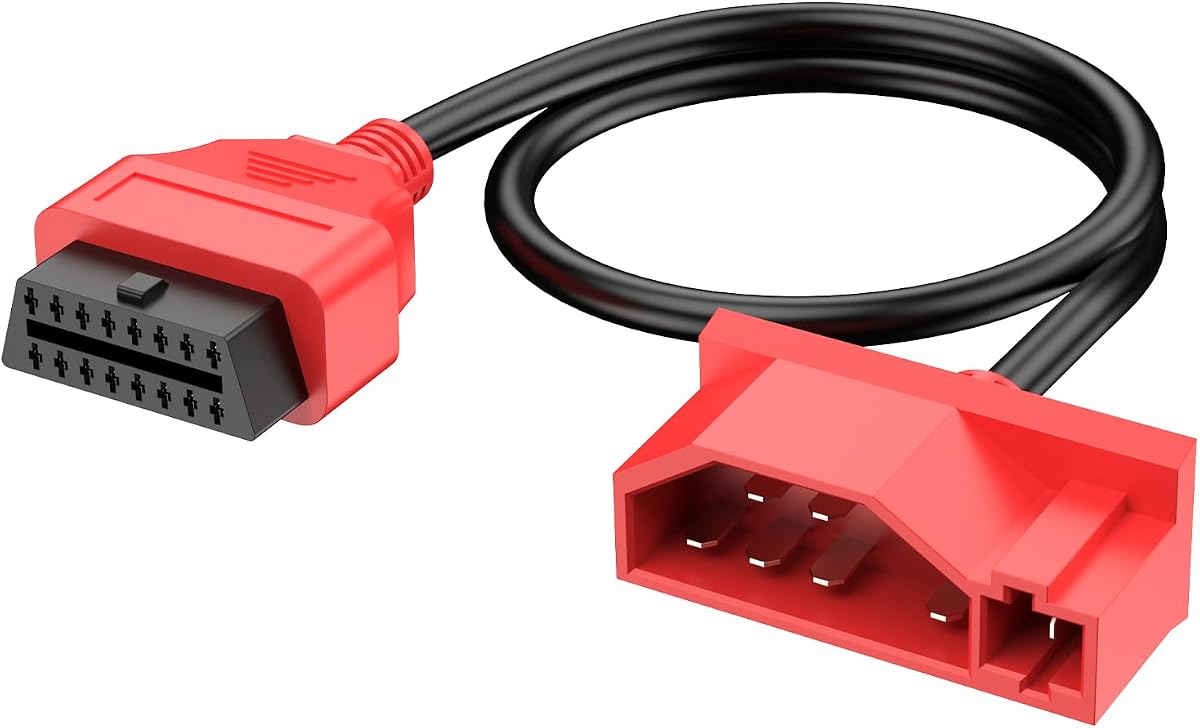
The OBD1 to OBD2 Adapter with 12-pin and 16-pin ends is a general-purpose diagnostic extension for vehicles using a 12-pin OBD1 interface. It has a 5.0 listed rating, making it a compelling option on customer feedback alone, although the relatively small review base associated with such a rating should still be considered.
We may earn a commission when you buy through this link, at no additional cost to you.
Its construction details are among the strongest in this roundup. The listing identifies copper cores, a flame-retardant PVC housing, and anti-interference characteristics intended to support stable signal transmission. A 16-inch total length offers enough reach for common diagnostic positioning without becoming cumbersome.
The product supports fault-code reading, live-data monitoring, and sensor-status checks when used with a compatible OBD2 tool. It applies to cars, trucks, and SUVs with the relevant 12-pin OBD1 connector. As with other adapters, however, physical compatibility does not guarantee that every scanner supports the protocols required by the vehicle.
This cable is a strong general-purpose pick for a DIY owner who has confirmed a 12-pin vehicle port and owns a suitable scanner. Its copper-core specification, clear dimensions, and excellent listed rating make it especially appealing. It is less appropriate for someone seeking a complete diagnostic system or a specialized Ford or BMW solution.
Copper cores are intended to support efficient electrical conduction, while the flame-retardant PVC housing provides a durable protective shell. These choices make the cable relevant for owners who expect repeated diagnostic use.
The stated applications include passenger cars, trucks, and SUVs. That breadth makes the adapter useful for a mixed fleet, provided each vehicle has the correct physical connector and a compatible communication protocol.
We may earn a commission when you buy through this link, at no additional cost to you.
The right adapter depends on three linked issues: the vehicle's exact diagnostic connector, the protocol supported by the scanner, and the cable's physical construction. Comparing those details before ordering prevents most compatibility disappointments.
Choose the cable that explicitly matches your vehicle connector, not merely one marketed as compatible with most models.
Verify both the adapter's stated protocol coverage and the scanner's supported vehicle protocols before purchasing.
Prefer an adapter with clear pin documentation, especially if you need more than basic diagnostic communication.
Select enough length for comfortable tool placement, but favor a flexible cable that remains easy to store.
Confirm that your scanner can operate with the adapter's passive connection and the vehicle's available power.
Prioritize secure contacts, durable housings, and a cable that reduces repeated direct use of the vehicle port.
Look for clear technical documentation and dependable after-sales support, not brand recognition alone.
Match the adapter, scanner, vehicle, and intended diagnostic task as a complete system.
Start with the vehicle turned off, identify the correct diagnostic port, and inspect both the vehicle socket and adapter for dirt, bent contacts, or damage. Seat the OBD1 connector gently in its proper orientation. Never force a connector that appears keyed incorrectly, because incorrect insertion can damage the vehicle's diagnostic receptacle.
Connect the 16-pin OBD2 end to the scanner and verify that the scanner is powered according to its instructions. Turn on the vehicle or ignition as directed by the scanner, establish communication, and then select the correct vehicle, engine, and system before reading codes or live data. If communication fails, disconnect both ends and recheck the connector fit rather than assuming the adapter has failed.
After the session, disconnect the scanner before removing the adapter from the vehicle. Store the cable loosely in a dry location away from sharp tools, excessive heat, and hanging stress. Periodically inspect the connector housings and cable for cracks or corrosion, and replace the adapter if contacts become loose, discolored, or intermittent.
No, an adapter is only a physical connection cable. You still need a compatible OBD2 scanner or code reader to read codes, display live data, or perform service functions. This guide covers cable-only products, and each listing should be checked to confirm its package contents.
No. The adapter may provide the correct physical connector, but the scanner must also support the vehicle's communication protocol. Legacy systems such as Ford EEC-IV can require specific scanner support. Check both the adapter's stated vehicle applications and the scanner's protocol list before buying.
Look at the shape and number of pins in the vehicle's diagnostic socket, then compare it with the adapter photographs. Common applications in this guide include 12-pin GM, 7-pin Ford EFI, and 20-pin BMW connectors. Year and model are useful clues, but physical verification remains important because configurations can vary.
The most likely causes are an unsupported protocol, incorrect connector orientation, inadequate scanner power, or a vehicle that does not actually use the advertised OBD1 layout. Disconnect everything, inspect the contacts, verify the scanner's supported protocols, and confirm that the vehicle is in the operating state requested by the scanner.
It may not. Several adapters in this roundup are passive and do not provide power, so the scanner may need its own built-in or external supply. This is especially important for small ELM327-style code readers that normally rely on the diagnostic port for operating power.
Yes. Using the cable as an extension means the scanner's larger plug is not inserted directly into the vehicle receptacle as often. This can reduce wear on the port, provided the adapter is seated correctly and the cable is not routed under strain.
No. Older vehicles may use different OBD1 layouts even within the same brand. Confirm the connector shape, number of contacts, model year, and required protocol. Broad phrases such as compatible with most models are less dependable than a clearly matching connector and vehicle description.
Store it loosely coiled in a dry, temperature-moderate location, away from sharp edges and tools that could damage the contacts. Avoid hanging the cable by one connector, and periodically check for cracked housings, corrosion, or a connector that no longer seats firmly.
The OBD1 12-Pin Diagnostic Cable is the strongest general-purpose value, combining a 5.0 listed rating with copper-core construction and a useful 16-inch design. The Autel Original 20-Pin BMW Cable is the editor's choice for its 4.5 rating, extensive listed BMW model coverage, and heavy-duty construction, while the Ford 7-Pin OBD2 Adapter earns the premium distinction for its clear ELM327 compatibility.
Your first priority should be the exact vehicle connector, followed by the protocol support of the scanner you already own or intend to buy. Construction, cable length, power requirements, and pin documentation matter next. A well-built cable will feel more durable and provide convenient tool placement, but none of those benefits compensates for a mismatch at the connector or protocol level.
Before placing an order, compare the vehicle socket with the product images, review the listed exclusions, and confirm the functions your scanner must support. Current market prices and seller details can change, so check the latest listing and return terms at the time of purchase. With those checks completed, the right adapter becomes a small but essential link in a much more capable diagnostic setup.