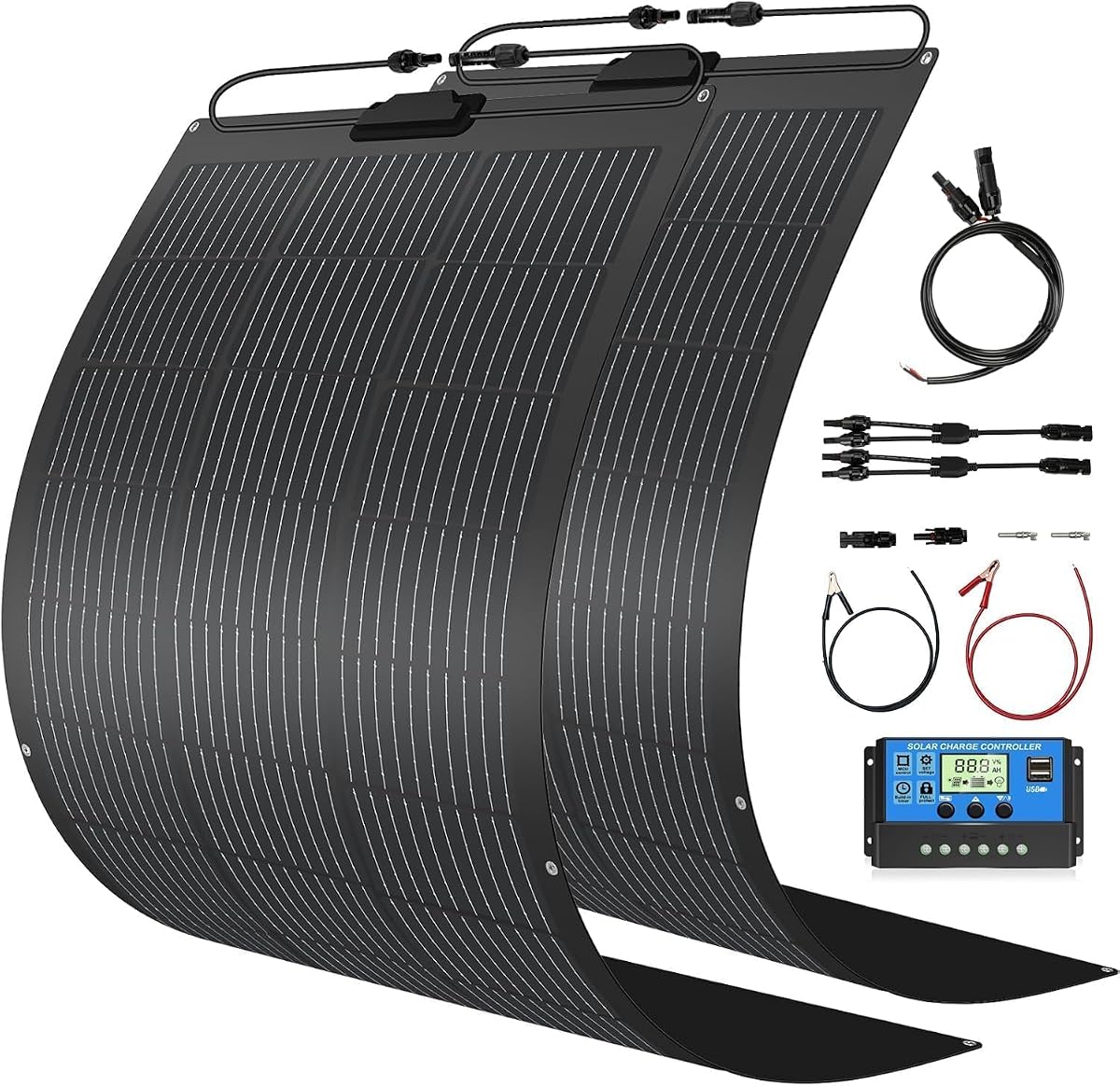
800W Flexible RV Solar Kit
5.0Editor score
Two flexible 400W panels
ETFE surface protection
Bends to 30 degrees
Works with 12V or 24V
Discover the best 800W solar panel options for RV, boat, off-grid, and portable power systems, compared for efficiency, flexibility, durability, and ease of
An 800W solar panel system can provide substantial charging capacity for RVs, boats, cabins, backup power, and off-grid installations, but the right configuration depends heavily on available space, mounting method, battery voltage, and portability needs. The best choices balance usable solar conversion, durable construction, manageable wiring, and compatibility with appropriate charge controllers and inverters.
This guide compares rigid and flexible two-panel systems, bifacial and conventional monocrystalline options, portable folding designs, and complete kits with charge controllers. We evaluated the supplied specifications, construction details, electrical characteristics, installation features, application fit, and customer ratings to show how each option differs without overlooking important trade-offs.
The list highlights one product at each rank while the top selections identify the strongest overall, budget-oriented, and premium choices. Output figures are based on standard test conditions and real-world results vary with sunlight, temperature, orientation, shading, wiring, and controller configuration. Product listings, availability, warranties, and current prices can change, so verify the latest details before purchasing.
5.0Editor score

4.5Editor score

4.3Editor score
This side-by-side comparison covers ten high-output solar panel sets, highlighting panel construction, nominal power, efficiency, electrical compatibility, mounting style, and included equipment so buyers can match the right system to their installation.
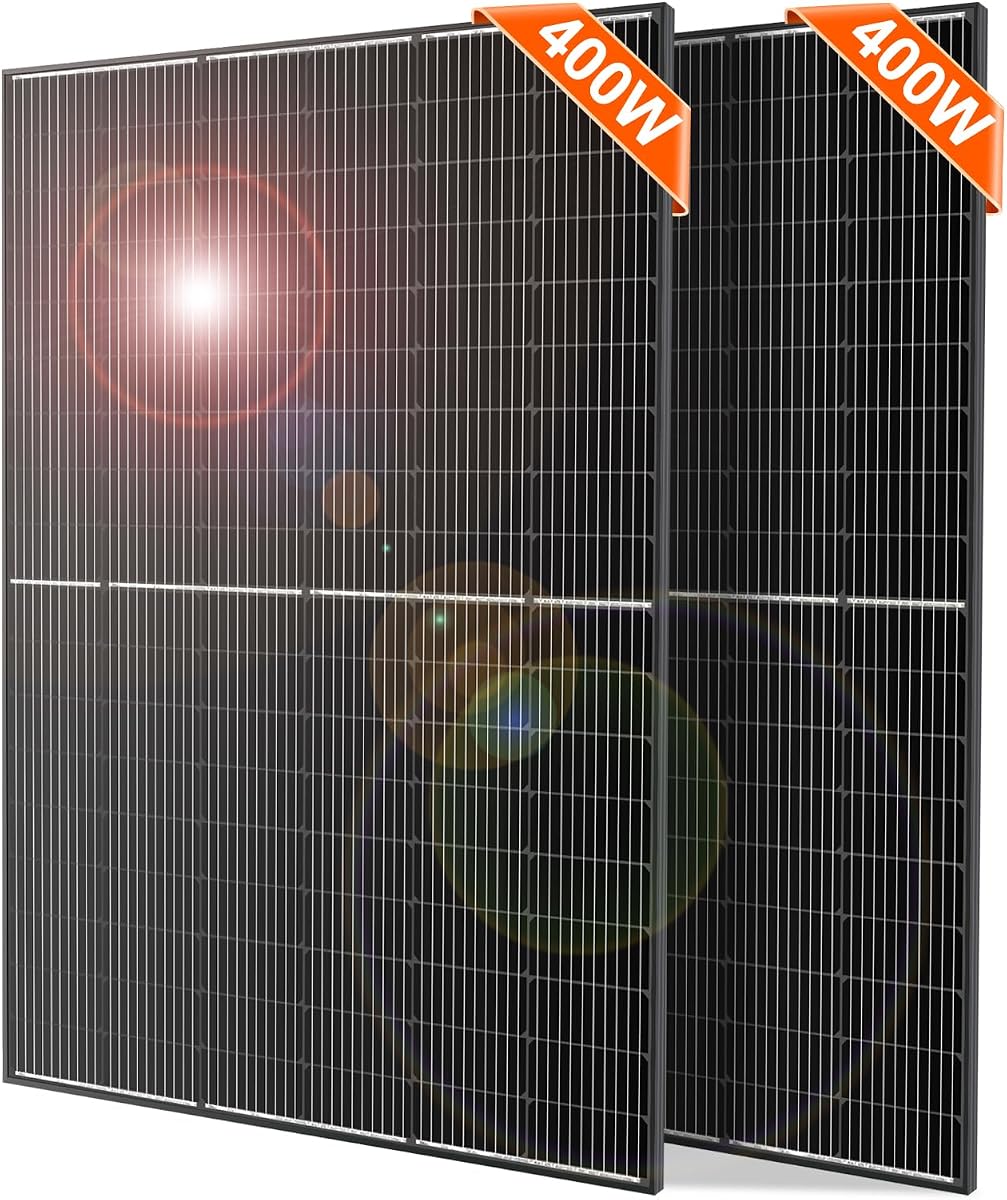


The DOKIO 800W Solar Panels two-pack combines two 400W, 31V rigid panels into a high-output array for 12V and 24V installations. Its 4.1 rating reflects a straightforward design aimed at reducing the number of panels and branch connections commonly associated with an equivalent array of smaller modules.
We may earn a commission when you buy through this link, at no additional cost to you.
Each panel uses tempered glass, an aluminum frame, and a sealed junction box for outdoor deployment. The supplied nine-foot, or three-meter, MC4 leads give installers more freedom when reaching a combiner or charge controller. Compatibility with AGM, gel, and LiFePO4 batteries through suitable PWM or MPPT controllers broadens the practical applications for home backup, off-grid cabins, RVs, and remote equipment.
The main trade-off is electrical-system complexity. Two 400W panels can produce substantial current under strong sunlight, so the charge controller and inverter must be sized for their combined output. Parallel wiring is the safer starting point for a 12V bank, while series operation depends on the controller's allowable input voltage. The panels also provide no built-in portability.
This is a strong choice for buyers who value fewer connections, generous cable reach, and conventional rigid construction. It is especially practical for stationary installations where a larger roof or ground-mount footprint is acceptable. Confirm battery-bank voltage, controller limits, wiring layout, and mounting requirements before ordering.
Using two larger modules reduces the number of branch connectors and panel-to-panel joints compared with arranging eight 100W units. That can simplify routing, shorten installation work, and reduce potential connection points, although each panel still requires correct series or parallel configuration.
The three-meter MC4 cables on each panel help reach a distant controller without immediate extensions. This is valuable on an RV roof, cabin, boat, or ground installation where mounting positions are separated from the electrical enclosure.
We may earn a commission when you buy through this link, at no additional cost to you.
The DOKIO 800W Solar Panel Set is a pair of 400W, 31V rigid modules intended primarily for 24V off-grid systems. It carries a 4.1 rating and focuses on the same core benefits as the closely related DOKIO listing: high nominal output, fewer physical modules, and a relatively clean installation.
We may earn a commission when you buy through this link, at no additional cost to you.
Tempered glass, an aluminum frame, and sealed junction boxes suit permanent outdoor installations. A three-meter MC4 lead on each panel makes it easier to route power toward a remotely mounted controller without introducing extra connector pairs immediately. The larger panels also reduce the number of mounting locations and branch connections needed relative to many smaller units.
Its 24V orientation means buyers need to understand electrical configuration rather than treating it as a universally plug-and-play product. Series and parallel arrangements affect voltage and current at the controller. An MPPT controller is strongly recommended by the product information, and any inverter must also accommodate the connected battery bank's nominal voltage and anticipated solar input.
The set is best for installers building a stationary off-grid array with a 24V battery bank. It suits buyers who want straightforward rigid panels and manageable cable runs but do not need a portable folding format or flexible roof coverage. Match the array to a properly sized controller and inverter before installation.
Targeting 24V systems makes this set most relevant for off-grid homes, larger cabins, boats, and stationary installations where a higher bank voltage reduces current for a given power level. The panels still require correct configuration and appropriate power electronics.
Two 400W modules occupy fewer mounting points than a much larger collection of lower-wattage panels. Combined with the supplied long leads, this can produce a tidier installation with fewer branches to inspect and maintain.
We may earn a commission when you buy through this link, at no additional cost to you.
The Renogy Bifacial Solar Panel 800W N-Type set combines two 400W modules using 16BB N-Type cells and a stated efficiency of up to 25%. Its 4.3 rating and premium feature set make it an advanced option for buyers seeking high conversion efficiency and more resilient performance in partially shaded environments.
We may earn a commission when you buy through this link, at no additional cost to you.
Bifacial construction allows each module to collect direct sunlight from the front and reflected light from the rear. The listing cites potential gains of up to 30% in reflective surroundings such as snow, sand, concrete, light gravel, and pale roofs. Actual gains depend on mounting height, ground reflectivity, spacing, tilt, and obstructions behind the panels.
Each 400W module operates through two independently functioning power zones, helping one section continue generating when leaves, branches, vents, or chimneys shade another. The larger modules also reduce the number of panels, branch connectors, and wires compared with a system assembled from many smaller modules, although appropriate parallel and series configuration remains essential.
This set is best for a permanent home, RV, boat, or off-grid installation where space is limited, partial shade exists, and reflective surfaces can support bifacial gain. Buyers should provide good airflow behind the modules, avoid incompatible mounting arrangements, and select a charge controller and inverter that handle the full electrical output.
Bifacial performance depends on the installation environment. Elevated mounting over a reflective surface can give the rear faces a meaningful light source, while a dark or obstructed location will limit the benefit.
The independent power zones can preserve some output when one portion of a module is obstructed. This does not eliminate shading losses, but it makes the pair more practical for roofs where vents, branches, or other structures inevitably interrupt direct sunlight.
We may earn a commission when you buy through this link, at no additional cost to you.
This flexible 800W kit pairs two 400W monocrystalline ETFE panels for RVs, boats, vans, cabins, and remote sites. Its 5.0 rating is the highest in the group, and the supplied specifications emphasize high efficiency, low weight, rapid battery charging, and installation without rigid mounting frames.
We may earn a commission when you buy through this link, at no additional cost to you.
The semi-flexible construction bends to a stated 30-degree curvature, making it useful on curved RV and boat roofs where standard glass panels sit awkwardly. Each panel weighs only 4.4 pounds, and the listed 0.1-inch thickness reduces roof load and removes the need for drilling. ETFE is described as offering strong UV resistance and better light transmission than PET-style surfaces.
The panels carry an IP68 waterproof rating and salt-spray corrosion resistance, supporting RV and marine use. They are compatible with 12V and 24V lead-acid or LiFePO4 battery systems when paired with suitable controllers, including Renogy and Victron models mentioned in the product information. Output and environmental performance still depend on installation and weather.
This is the most compelling choice for a lightweight mobile installation where roof curvature, weight, and drilling are major concerns. It is less appropriate for a permanent ground array requiring a precise fixed tilt. Review adhesive or fastening methods carefully, provide an uninterrupted surface, and confirm controller compatibility before purchase.
At 4.4 pounds per panel and a stated thickness of 0.1 inch, the flexible format can be easier to handle and less demanding on a roof. It also allows panels to follow curved surfaces instead of creating an elevated rigid frame.
The ETFE surface is described as UV resistant, impact resistant, and better at transmitting light than PET alternatives. Its stated waterproofing and corrosion resistance are particularly relevant for boats, vans, and exposed travel applications.
We may earn a commission when you buy through this link, at no additional cost to you.
The Foldable Portable 800W Solar Panel set consists of two 400W panels with 39V nominal output, 23% efficiency, and a folding design for travel. Its 4.2 rating reflects a straightforward portable package aimed at campers, RV travelers, and users who need to position solar power wherever sunlight is available.
We may earn a commission when you buy through this link, at no additional cost to you.
SunPower cells are used to improve conversion efficiency, while an ETFE surface adds durability and impact resistance. Four adjustable kickstand angles—30, 40, 50, and 80 degrees—allow the panels to be repositioned as the sun moves or the installation environment changes. The entire two-panel set is listed at 20 pounds, which remains portable while delivering substantial nominal capacity.
The folding structure is a clear trade-off. It is easy to deploy, but it is not a permanent rigid roof module and the kickstands need stable, level ground. A portable panel may also be positioned incorrectly when users focus on available space rather than unobstructed sun exposure. The IP67 rating supports outdoor use, but exposed connectors and weather should still be managed carefully.
This product makes the most sense for mobile power where setup speed, adjustable positioning, and compact storage matter more than permanent roof integration. It can suit campground charging, RV travel, and remote work locations. Pair it with a controller and power station or inverter that accepts the system's voltage and combined current.
The four kickstand positions let users change the sun angle without rebuilding an installation. Adjusting the panels during the day can improve capture, although the best setting depends on location, season, and the panel's orientation.
The folding design reduces the space required for storage and allows the panels to be separated when positioning them. That flexibility is valuable for travel, while permanent users may favor rigid modules that can be fixed at a precise tilt.
We may earn a commission when you buy through this link, at no additional cost to you.
The 800W MPPT RV Kit combines two 400W monocrystalline panels with a 30A MPPT charge controller for a 12V system. Although the package includes important core equipment, its 1.0 rating gives buyers a clear signal to examine recent customer feedback and verify compatibility before committing.
We may earn a commission when you buy through this link, at no additional cost to you.
The panels use 10BB N-Type monocrystalline cells and are described as reaching up to 25% efficiency under full sunlight. Built-in MC4 connectors simplify panel-to-controller wiring, while pre-drilled holes support common mounting arrangements on RVs, rooftops, and other structures. A 30A MPPT controller adds useful voltage-tracking functionality for a 12V installation.
The included controller may not automatically make the kit right for every battery bank or array arrangement. Input voltage, current, polarity, battery type, and series-parallel configuration must all be confirmed. The listing also notes that real output changes with sunlight intensity and other environmental factors. Batteries, inverter, cables, and additional mounting hardware may need to be sourced separately.
This package is most appropriate for a DIY builder who wants the panels and controller together but still plans to size the rest of the system personally. The low rating makes it less attractive as an all-in-one purchase than a more complete off-grid solution. Read customer feedback, confirm current specifications, and validate the full electrical design before installation.
MPPT control can improve energy capture by tracking the panel's operating point more precisely than basic PWM regulation. Its benefit still depends on correct input limits, battery chemistry, and appropriate array wiring.
MC4 connections and pre-drilled holes streamline the physical setup. They do not replace correct fusing, cable sizing, grounding decisions, battery protection, or compatibility checks.
We may earn a commission when you buy through this link, at no additional cost to you.
This 800W set includes two 400W rigid modules built with N-Type monocrystalline cells and 16BB half-cell technology. Its 4.4 rating is among the strongest in the comparison, and the product information emphasizes efficient light utilization, reduced internal loss, and dependable low-light performance.
We may earn a commission when you buy through this link, at no additional cost to you.
Outdoor construction combines tempered glass, a corrosion-resistant aluminum frame, and IP68-rated connectors. Stated load ratings of 2400Pa for wind and 5400Pa for snow make the pair suitable for demanding RV, boat, cabin, home, and off-grid environments. Pre-installed MC4 connectors, bypass diodes, and approximately one-meter cables support a conventional professional installation.
The shorter lead length may be less convenient than the three-meter leads offered by some DOKIO sets. Installers may need extensions or careful cable routing, and every added connection should be protected from moisture. Electrical performance also depends on correct controller sizing and configuration. N-Type characteristics improve operating behavior, but they do not guarantee the same output in every climate.
This is a well-rounded pick for a permanent or semi-permanent installation where durability, mounting flexibility, and robust outdoor construction are priorities. Its load ratings and broad bracket compatibility are especially attractive for RV, marine, and exposed off-grid use. Confirm dimensions, cable reach, and charge-controller requirements before ordering.
The stated wind and snow load ratings, combined with IP68 connectors, support use in demanding outdoor locations. A suitable mounting system remains essential because panel strength ratings cannot compensate for weak brackets or incorrect attachment.
N-Type cells are described as reducing recombination losses and improving temperature performance and low-light response. These qualities make the pair attractive where consistent daily energy is more important than minimizing module count.
We may earn a commission when you buy through this link, at no additional cost to you.
The Flexible 40A Controller Kit pairs two 400W monocrystalline flexible panels with a 40A solar charge controller. It is aimed at camping, off-grid battery charging, and boat installations where a flexible surface can conform to irregular structures and remote locations.
We may earn a commission when you buy through this link, at no additional cost to you.
The panels can be mounted on RVs, sailboats, yachts, trucks, cars, coaches, cabins, campers, tents, trailers, and golf carts. A sealed, waterproof junction box supports outdoor use, while six grommet holes allow attachment with fasteners or installation using silicone and adhesive tape. That mounting flexibility reduces the need for rigid frames on curved or unconventional surfaces.
The product information offers fewer quantified efficiency and durability details than several competing sets. It also does not provide a customer rating, so there is no visible rating history to help gauge owner satisfaction. The included 40A controller must still be checked against battery chemistry, panel voltage, array configuration, and the electrical demands of the intended load.
This kit is best for mobile or irregular installations where surface conformity is the main priority. It may be particularly useful for supplementing power in locations without reliable grid access. For permanent systems, buyers should investigate thermal behavior, adhesive quality, cable protection, and long-term panel performance before relying on it as the primary energy source.
Flexible construction is useful when a rigid frame would create an uneven or stressful mounting point. The panels can follow boats, camper roofs, trailers, and other surfaces where compact, low-profile placement matters.
Bundling a 40A controller gives DIY users one of the essential balance-of-system components. Confirm that its voltage range, battery settings, and input current handling align with the intended panels and battery bank.
We may earn a commission when you buy through this link, at no additional cost to you.
This Flexible Monocrystalline Kit combines two 400W flexible solar panels with a 40A solar charge controller for camping, marine, and off-grid battery charging. The listing has no customer rating, which makes careful comparison of its technical information especially important for prospective buyers.
We may earn a commission when you buy through this link, at no additional cost to you.
Its flexible construction is designed for curved and irregular surfaces, including RV roofs, boats, yachts, trucks, cars, trailers, cabins, campers, tents, and golf carts. A sealed junction box and water-resistant design support outdoor deployment, and six mounting grommets offer multiple attachment methods using fasteners, silicone, or adhesive tape.
The main limitation is the amount of quantified information provided. Although the panels are described as high-efficiency monocrystalline units with good low-light characteristics, the listing does not state a comparable efficiency percentage, weight, bend rating, or detailed connector protection rating. The included 40A controller should still be matched carefully with the battery system and intended array configuration.
The kit is most suitable for mobile users who prioritize flexible mounting and want a controller included in the package. It can complement power at remote camps, boats, and irregular off-grid structures. Buyers should prepare the mounting surface meticulously, protect exposed connections, and avoid assuming flexible adhesive-mounted panels provide the same service life as rigid framed modules.
The flexible format avoids bulky raised frames and can fit where conventional panels would not sit evenly. That makes it useful on curved boat roofs, camper surfaces, and other irregular structures.
Adhesive and grommet mounting can simplify installation, but clean surfaces and compatible fasteners are essential. A poorly prepared or uneven surface may stress the panel and compromise the attachment over time.
We may earn a commission when you buy through this link, at no additional cost to you.
The EPOCH 860W Bifacial Solar Panels set uses two 430W modules, giving it the highest nominal capacity among the options in this guide. Its 4.5 rating is also the highest numerical customer rating, and the product information emphasizes premium cell quality, bifacial collection, rugged construction, and long-term warranty coverage.
We may earn a commission when you buy through this link, at no additional cost to you.
Each panel uses Grade A+ monocrystalline cells, a 16BB half-cut design, and bypass diodes. The stated cell efficiency reaches up to 25%, while light transparency is listed at up to 91.5%. Capturing light from both sides can improve total energy yield in reflective settings, although rear-side gains vary according to mounting height, ground material, spacing, and nearby obstacles.
Durability is a major strength. The panels carry an IP68 junction box, IP67 MC4 connectors, a 2400Pa negative wind-load rating, and a 5400Pa snow-load rating. Every panel undergoes electroluminescence testing for microcracks, and the set includes a 12-year quality warranty and a 25-year linear power-output warranty. Installation hardware is not necessarily included, but the panels accept common Z-brackets, corner brackets, pole mounts, and tilt mounts.
This is a strong choice for buyers who want the most nominal power and a long-horizon warranty in a rugged rigid package. It is especially relevant to permanent rooftop, ground-mount, marine, RV, and off-grid projects. The array must still be matched to a controller and inverter that can safely handle the combined current and configured voltage.
Two 430W modules provide more nominal power than the other two-panel sets compared here. That makes the pair attractive for space-conscious installations, although the remaining balance-of-system components must be capable of accepting its output.
A 12-year quality warranty and 25-year linear output warranty provide useful coverage for a permanent installation. Warranty terms should be read directly through the seller, and regular inspection, clean panels, sound wiring, and proper mounting remain essential.
We may earn a commission when you buy through this link, at no additional cost to you.
Choosing an 800W solar panel set involves matching electrical output, physical construction, and installation demands to the intended battery system. The most important decisions are system voltage, available mounting space, portability, shading conditions, and whether the package includes appropriate charge-control equipment.
Most products in this comparison are sold as two 400W modules, while the EPOCH set uses two 430W panels. These wattage figures represent output under standard test conditions rather than a continuous real-world rate. Actual generation changes with sunlight intensity, panel temperature, angle, shading, dirt, and system losses. A larger rated figure can reduce the number of modules needed, but it also raises the current that cables, connectors, fusing, controllers, and inverters must handle.
Prioritize usable daily energy and reliable performance rather than comparing headline wattage alone. Two panels with an efficient cell design, sensible low-light behavior, and a layout that avoids obstruction may produce more practical value than a nominally larger set placed in poor conditions.
A panel's electrical behavior must be compatible with the battery bank and charge controller. Some sets explicitly support 12V and 24V systems, while others are framed around a particular voltage. The nominal 31V or 39V panel figures describe each module, and series or parallel wiring changes the voltage and current reaching the controller. Do not choose an array solely from the battery label.
Check the controller's maximum input voltage, allowable input current, battery chemistry support, and any manufacturer-specific configuration guidance. The EPOCH, DOKIO, Renogy, and flexible RV options support off-grid or mobile use, but each still requires a properly sized controller and an inverter matched to the battery bank.
Rigid glass-and-aluminum panels generally suit permanent rooftop and ground installations because they provide a stable shape and are commonly paired with tilt brackets. Their weight and flat profile may be less attractive on a curved RV or boat roof. Flexible panels follow irregular surfaces, reduce visual bulk, and often avoid drilling, but mounting quality and airflow become especially important.
Choose rigid modules when a precise tilt, long service life, and conventional mounting are priorities. Choose flexible modules when weight, low profile, and surface conformity matter more. Products with stated bend limits, such as the flexible ETFE kit's 30-degree capability, should be installed within those limits.
Bifacial panels collect light on the front and can also generate from reflected light reaching the rear. This can be useful on pale roofs, concrete, sand, gravel, or snow, provided panels are elevated and the rear surface is not blocked. The potential gain depends on reflectivity and mounting height, so the advertised maximum should be treated as a best-case scenario rather than a guaranteed increase.
The Renogy and EPOCH sets are the bifacial choices here. They are worth considering for permanent installations with reflective surroundings. If the rear will sit directly against a dark roof or remain obstructed, a conventional monofacial panel may deliver a more predictable layout and simplify mounting.
Even partial shade can affect the output of a panel depending on its cell and busbar arrangement. The Renogy set's dual-module design is explicitly intended to maintain production in two independent power zones when one area is shaded. Other panels include bypass diodes, which help limit the effect of localized obstructions, but no design completely removes the need to minimize shade.
Map the installation's sun path before ordering. Look for roof vents, antennas, trees, chimneys, storage compartments, and structural supports that may cast shadows. If shade is unavoidable, favor a layout with independent operating sections, keep panels clear of obstructions, and avoid placing multiple modules where one shadow can cover multiple circuits.
Long pre-installed leads can reduce the need for extensions, but cable length is only one part of a safe installation. The DOKIO sets include three-meter MC4 leads, while the N-Type 16BB set lists approximately one-meter cables. Shorter leads may require extension cables, adding connector pairs that should remain dry, strain-free, and compatible with the system's current.
Use MC4-compatible connections, ensure proper polarity, and include appropriate overcurrent protection. Keep connectors out of standing water and avoid placing unnecessary bends or strain on cables. A charge controller, inverter, battery bank, fusing, grounding strategy, and disconnect may all be required in addition to the panels.
Some listings are panel-only, while others include a charge controller. The two 40A flexible kits and the 800W MPPT RV kit bundle a controller, which can reduce the number of separate purchases for a DIY installation. However, an included controller is not automatically the right controller. Verify input voltage, current handling, battery selection, and whether it supports the intended charging strategy.
Most buyers will also need an inverter for AC appliances, appropriately sized battery cables, fusing, a disconnect, mounting hardware, and possibly additional adapters. Kits marketed for RVs, boats, or off-grid homes may not include every component required for a safe, operational system.
Portable folding panels are convenient for camping and travel because they can be deployed quickly and adjusted through several kickstand angles. They are less suitable for a permanent installation than rigid modules. Flexible RV panels serve a similar mobile niche but remain installed on a surface, while marine and exposed rooftop products benefit from strong connector protection and load ratings.
Look for IP ratings, tempered glass, corrosion-resistant frames, sealed junction boxes, wind ratings, and snow ratings. The EPOCH and N-Type 16BB sets provide especially detailed environmental specifications. These claims do not eliminate the need for secure mounting, routine cleaning, connector inspection, and protection from prolonged standing water.
Before installation, map the available area, confirm sun exposure, select the correct battery-bank voltage, and verify the charge controller and inverter ratings against the combined panel output. Determine whether the panels will operate in series or parallel according to the controller's instructions. Use compatible MC4 connectors, observe polarity, and install appropriate overcurrent protection and disconnects as required by local electrical guidance.
Mount the panels securely at the intended angle and location. Rigid panels benefit from appropriate brackets and airflow behind the modules, while flexible panels require a clean, smooth surface and careful use of permitted adhesives, sealant, or fasteners. Bifacial panels need unobstructed rear exposure to benefit from reflected light. Portable folding sets should be placed on stable ground, with their kickstands adjusted toward the sun.
Maintain the array by cleaning the surfaces as dirt and debris accumulate, checking connectors for corrosion or moisture, and inspecting mounts for movement or damage. Avoid shading the panels and review charging performance during different weather conditions. Do not exceed controller limits, and consult the seller or a qualified solar installer if electrical behavior, panel damage, or installation safety is uncertain.
Two 400W panels can offer practical advantages because they may be easier to handle, mount on separate surfaces, or wire as independent sections. One 800W panel, however, can reduce the number of modules and connections. The better choice depends on available space, weight limits, shading, controller configuration, and whether independent operation is important.
It should normally be connected through a charge controller rather than wired directly to a battery. The controller regulates charging, protects the battery, and accommodates the panel voltage and current. You must also confirm whether the panels should be wired in series or parallel and whether the controller supports that configuration.
The controller must handle the maximum current and voltage produced by the connected panels under the intended configuration. Several bundles include 30A or 40A controllers, but panel voltage, battery-bank voltage, and the manufacturer's guidance remain decisive. Do not select a controller solely by its advertised wattage.
No. Bifacial panels can gain additional output when their rear faces receive reflected light, but darker surfaces, close mounting, shading, or poor spacing limit that benefit. Standard panels may be more predictable and easier to mount in locations without reflective surroundings.
Flexible panels can conform well to RV roofs and are often chosen to reduce weight and avoid raised frames. Their adhesive and fasteners must be installed properly, and the surface should be clean and compatible with the recommended sealant. Review the manufacturer's mounting instructions and any stated bend limitation.
The rated output occurs under standard test conditions and is usually higher than continuous real-world production. Sun angle, temperature, shade, dust, wiring, and controller efficiency all affect results. Two large panels can also overwhelm a smaller battery bank, so battery capacity and charging limits should match the array.
An inverter is needed if you want to power standard AC appliances from a DC battery bank. It is not required for charging DC batteries or powering compatible DC equipment. The inverter must match the battery bank's voltage and support the intended load.
Marine users should prioritize corrosion resistance, secure low-profile mounting, water-resistant connections, and compatibility with the boat's battery voltage. The EPOCH and N-Type 16BB sets offer detailed rigid-panel environmental ratings, while flexible options can suit curved surfaces. Any installation should preserve ventilation, avoid trapped water, and use marine-appropriate wiring practices.
The EPOCH 860W Bifacial Solar Panels set stands out for the highest nominal capacity, detailed environmental ratings, bifacial capability, and long warranty coverage, making it a strong premium choice. The Flexible ETFE RV Kit leads the value-oriented selection with low weight, curved-surface installation, broad battery compatibility, and a 5.0 rating, while the Renogy set offers premium N-Type efficiency and dual-zone shade resilience.
The right choice for the rest of the list depends on the installation: DOKIO sets suit buyers wanting rigid panels and longer wiring leads, folding panels serve mobile users, and flexible 40A controller bundles prioritize adaptable mounting. In every case, prioritize controller compatibility, battery-bank voltage, real shading conditions, connector protection, and a secure mounting plan rather than focusing only on the 800W label.
Before ordering, verify the latest product specifications, included accessories, warranty terms, seller information, and current prices on the linked listing. Installation requirements and system design can vary considerably, so use the manufacturer's current instructions and consult a qualified professional for complex electrical work.