Amzonly 4Pack Kayak Lights
4.4Editor score
Four battery-operated LED lights
Two IPX8 waterproof bags
Three practical lighting modes
Elastic straps and clip mounts
Our expert LED Navigation Light for Kayak guide compares 10 options for brightness, waterproofing, mounting, power, visibility, modes, and safer nights.
An LED navigation light for kayak helps other boaters recognize your position, heading, and presence after darkness falls. A useful light should combine appropriate red, green, and white signals with dependable waterproofing, flexible mounting, and enough battery life for the length and conditions of your outing.
We compared these ten products by examining their stated lighting output, color configurations, visibility claims, water-resistance ratings, power systems, installation methods, and included accessories. The list covers clip-on battery kits, rechargeable lights, wired bow lights, flexible strips, and a retractable pole-and-flag system.
Each review explains who the product is best suited to, where its design stands out, and where paddlers may encounter trade-offs. Ratings reflect the supplied customer feedback, while availability, configuration details, and prices can change, so confirm the current listing before buying.
4.4Editor score

4.4Editor score

4.4Editor score
The comparison below highlights the major differences in power source, light colors, water resistance, mounting style, and visibility design across the ten shortlisted LED navigation lights for kayaks.


This four-piece kit combines red, green, and white navigation lights with rechargeable 330mAh lithium batteries, making it a strong all-around option for night kayaking and other low-light activities. Its 4.4 rating reflects generally favorable customer feedback, while the supplied USB charging cables add convenience for paddlers who want to prepare multiple lights before leaving shore.
We may earn a commission when you buy through this link, at no additional cost to you.
Each light contains five SMD LEDs and offers full brightness, chase, quick chase, and flashlight modes. The light count and range of modes make the kit useful not only as a navigation-light system but also as visibility equipment for walking, running, cycling, camping, or marking bags and gear. A one-touch dismount button allows the lamp to be removed without dismantling the entire bracket.
Installation is centered on silicone straps with four buckle positions and adjustable hinge angles. That flexibility should help the lights fit around kayak rails, handles, poles, or other round structures, although the quality of the final attachment depends on the chosen surface and strap tension. Unlike some simpler kits, this set also includes two safety whistles, reflective lanyards, and waterproof tape.
This is the recommendation for paddlers who want a rechargeable, multi-use package rather than disposable cells. It is particularly attractive for mixed-use households because the same lights can move from a kayak to a bicycle, helmet, backpack, stroller, or dog collar. Choose it when convenient USB charging, adjustable placement, and multiple lighting modes matter more than a specified long-range visibility figure.
Each light uses a rechargeable 330mAh lithium battery and can be charged through its supplied USB cable from a power bank, computer, or compatible AC or DC adapter. This is useful for outings that involve repeated nights on the water because the lights can be topped up between trips.
Four buckle positions and an adjustable hinge let users tailor the light to poles and circular attachment points. The quick-release arrangement also makes it practical to remove a light when the kayak is not in use without repeatedly reinstalling the full bracket.
We may earn a commission when you buy through this link, at no additional cost to you.
These flexible red and green bow lights are among the strongest choices for a kayak or small boat that already has access to a DC 12V electrical system. The 4.7 rating is the highest among the products in this guide, and the listing emphasizes brightness, flexible installation, and the ability to improve visibility while boating or docking.
We may earn a commission when you buy through this link, at no additional cost to you.
The strips use eighteen imported 5050 LED chips and are claimed to produce visible light up to four miles. Their flexible silicone shells are designed to follow the corners of a pontoon, Jon boat, dinghy, or kayak. The manufacturer recommends marine-grade silicone adhesive for long-term placement, which is an important consideration because strong double-sided tape alone may not provide the same permanence.
Unlike clip-on portable kits, this product requires wiring to a 12V source. That makes it less convenient for a recreational paddler who does not want to modify a kayak's electrical system, but it removes the need to carry and replace batteries during an outing. Its IP67 waterproof rating also makes it better suited to permanent installations than a light with an exposed battery compartment.
Choose this set if your kayak or small craft already has suitable electrical power and you want bright, bendable bow lights rather than a removable kit. It is particularly useful for users focused on night fishing, docking, or maintaining a fixed marine lighting setup. Those without a 12V system should favor a battery-powered alternative.
The bendable housing is intended for corners and curved surfaces that can challenge rigid light housings. This makes the strips a natural fit for boat bows, pontoon edges, and compact hulls where a low-profile installation is preferred.
Eighteen 5050 LED chips provide the most assertive brightness specification in this group. The listing also describes the lights as useful for illuminating a dock, giving paddlers an additional visual cue while approaching a landing.
We may earn a commission when you buy through this link, at no additional cost to you.
The KayaLuma kit is a compact three-light set designed specifically with kayaks, canoes, paddleboards, and small boats in mind. Its 4.3 rating indicates solid but not exceptional customer feedback, while the included three-light configuration supplies the familiar red, green, and white combination used to communicate position and direction.
We may earn a commission when you buy through this link, at no additional cost to you.
Each unit offers steady, flash, and strobe modes. The listing claims visibility of more than 1,000 feet and battery life of up to 100 hours, making it appealing for repeated outings or emergency use. Six extra CR2032 batteries, a mini screwdriver, and three hook-and-loop fasteners are included, giving owners a practical way to change cells and adapt the attachment points.
The compact cases fit kayak ropes, handles, rails, and paddleboard structures, and the product is described as providing 360-degree visibility with weather-resistant construction. However, the stated IPX5 rating is a lower level of water protection than the IP67 or IPX8 products elsewhere in this guide. It should therefore be treated as water-resistant rather than suitable for prolonged submersion.
This kit is a good choice for paddlers who value long stated runtime and small, unobtrusive lights over a formal long-distance navigation claim. It works especially well when users change batteries periodically or keep spare cells with other gear. For harsh spray, heavy rain, or repeated immersion, a model with a higher stated water-resistance rating is the safer choice.
An advertised runtime of up to 100 hours and six included replacement batteries make the kit appealing for repeated use. Actual runtime will vary with the selected mode, but the stated design emphasizes endurance over rechargeable convenience.
The low-profile units are designed to attach to ropes, handlebars, and rails without taking up much deck space. Hook-and-loop fasteners provide several possible positions when the exact attachment point changes with the kayak or paddleboard.
We may earn a commission when you buy through this link, at no additional cost to you.
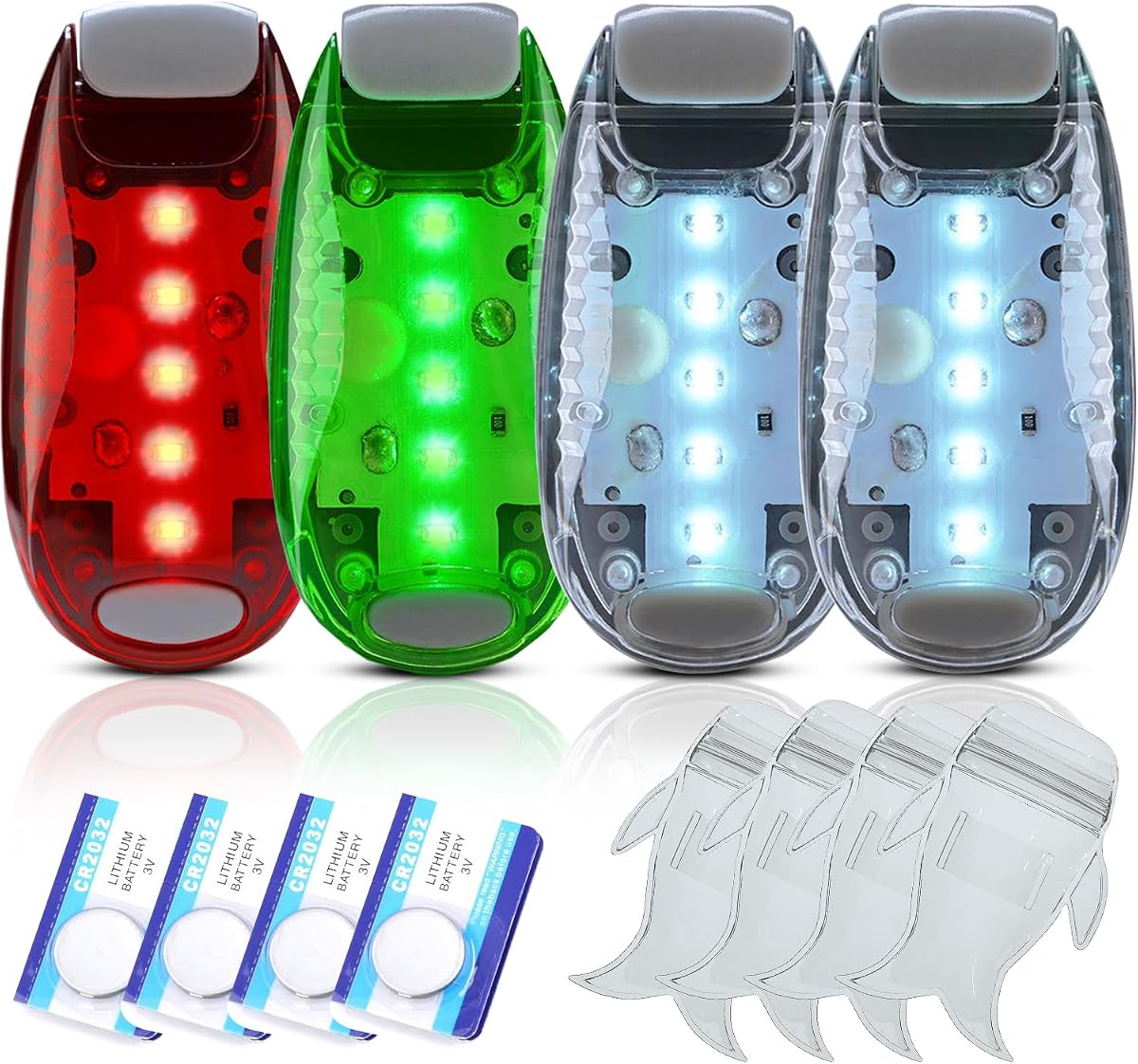
This four-light battery kit provides a useful red, green, and white lighting arrangement at an accessible entry point in the category. Its 4.4 rating suggests broadly positive customer feedback, and the package includes twelve batteries, four elastic straps, a magnetized-tip screwdriver, and two fish-shaped IPX8 waterproof bags.
We may earn a commission when you buy through this link, at no additional cost to you.
Every light has five SMD LEDs and supports steady, flash, and strobe modes. One of the four lights is a spare white unit, while the others cover the standard red, green, and white arrangement. The IPX8 bags give the battery compartments added protection when spray, rain, or accidental immersion would otherwise be a concern.
Attachment is handled with a rear clip, short elastic straps, and one extra-long adjustable strap that expands to 25 inches. That range supports use on kayak poles, tubes, bicycles, arms, or legs. The waterproof bags are a compromise rather than an integrated waterproof housing, so users still need to place the light inside the bag correctly and close it securely.
This is the budget recommendation for paddlers who want several lights, spare cells, and stronger water protection than a basic exposed battery unit. It also suits people who want one light for navigation and another for general visibility. Choose it if replaceable batteries and included protective bags are preferable to a rechargeable design.
The supplied IPX8 fish-shaped bags are intended for use in wet environments and can protect the light's battery compartment from spray or immersion. Their separate design also lets the same kit support non-water activities such as running, cycling, and walking.
Twelve batteries and a dedicated screwdriver make it possible to replace cells during a longer trip. Users should keep spare batteries dry and remember that the protection bag must be properly closed around the light.
We may earn a commission when you buy through this link, at no additional cost to you.
This four-piece kit uses two red and two green battery-operated lights for night visibility on dinghies, canoes, jet skis, and kayaks. It carries a 4.3 customer rating and is built around straightforward operation, replaceable CR2032 cells, and a generous supply of spare batteries and safety whistles.
We may earn a commission when you buy through this link, at no additional cost to you.
Each light has two bright LEDs and offers flash, slow flash, and steady modes through a one-touch switch. The listing states an effective visibility of more than 0.6 mile, which is less ambitious than the claims made by some wired and high-output products in this guide. For close-range identification around a launch, dock, or slower-moving craft, that may still be useful.
Flexible silicone bodies and double hooks allow attachment to kayak rails or ropes. The package includes twelve extra batteries and two whistles, making it a self-contained safety kit rather than a set of lights alone. Users must accept the limited color arrangement, as there is no white stern light specified in the product data.
Choose this option if simplicity, abundant spare cells, and audible safety accessories are priorities. It is well suited to recreational night fishing and paddling where portability matters more than a formal nautical visibility rating. Paddlers seeking a complete red-green-white arrangement should choose a kit that explicitly includes the missing color.
The generous battery supply is one of the kit's most useful features for repeated outings. Because each light uses commonly sized CR2032 cells, keeping a replacement set with other paddling equipment helps prevent a low battery from ending visibility early.
A single control cycles through flash, slow flash, and steady illumination. This simple interface is useful in darkness because the user does not need to navigate a complicated control panel to change the operating pattern.
We may earn a commission when you buy through this link, at no additional cost to you.
The six-light version of this kit is designed for owners who want more placement options and dedicated backups. Its 4.4 rating is favorable, and the package includes six five-LED lights, twenty-four batteries, six IPX8 waterproof bags, six elastic straps, and a magnetized-tip screwdriver.
We may earn a commission when you buy through this link, at no additional cost to you.
The lighting set includes red and green units for the bow, white units for the stern, and extra units that can serve as backups. Every light supports steady, flash, and strobe modes. This is a generous configuration for group outings, larger boats, or anyone who wants to place lights on more than one craft without sharing a single fixture.
Mounting relies on a rear clip and adjustable elastic straps. A longer strap can expand to 25 inches, allowing the lights to fit around poles, tubes, limbs, bags, and other suitably sized structures. The six waterproof bags improve wet-weather protection, although they must be correctly closed and should not be treated as a substitute for proper battery compatibility.
This kit makes more sense for users who value redundancy and versatility than a minimal setup. The number of pieces can feel excessive for a single kayak, but it is useful for group paddling, night fishing, boating, and broader visibility applications. Select it if extra lights, protective bags, and replacement batteries are worth the added bulk.
Six units make it possible to distribute lights across a kayak, spare craft, paddles, or other visibility points. Dedicated backups are especially helpful on long outings, where a damaged or depleted light would otherwise be difficult to replace immediately.
Each light receives a fish-shaped IPX8 bag, allowing the same kit to serve wet boating and non-water activities. The protective pouches also reduce the need to purchase separate waterproof storage solutions for each unit.
We may earn a commission when you buy through this link, at no additional cost to you.
This battery-powered navigation light is designed for paddlers who want remote operation, adjustable brightness, and a timer. It has a 4.3 rating and is claimed to meet US Coast Guard standards with a two-nautical-mile visibility range, while its three-AA power system avoids permanent wiring.
We may earn a commission when you buy through this link, at no additional cost to you.
A separate battery box is attached with double-sided adhesive, and the light itself may be mounted with adhesive or screws. The remote control adjusts brightness and activates the timer, which can prevent the lamp from remaining on after a paddler leaves the boat. The product information notes that the AA batteries are not included.
The housing is aluminum, consumes 6 watts, and has an IP67 waterproof rating. It is also described as having passed a 72-hour salt-spray test and using an LED optical design intended to provide brightness with limited heat. These construction details make it a more structured alternative to small clip-on battery lamps.
Choose this model if remote convenience and adjustable output are priorities and you are comfortable adding AA batteries. It is particularly compelling for users who might switch the light on or off after leaving the kayak unattended, although the need to carry the remote means it is not quite as streamlined as a one-touch kit.
The remote lets the user change brightness or activate the timer without reaching the mounted light. That is useful when the lamp is fixed near the bow and is not easy to access from the cockpit.
The integrated timer is intended to prevent accidental overnight operation when the boat is left unattended. It also supports the product's battery-powered approach by reducing unnecessary runtime.
We may earn a commission when you buy through this link, at no additional cost to you.
These compact red and green bow lights combine a 4.7 customer rating with a stated three-nautical-mile visibility range. Designed for kayaks, canoes, pontoons, bass boats, and Jon boats, they use 12V power and 22AWG wiring for installation into a boat's electrical system.
We may earn a commission when you buy through this link, at no additional cost to you.
High-intensity LEDs and a stated 50,000-hour lifespan are central to the product's appeal. The flexible housings use ultra-strong adhesive backing, allowing them to follow curved surfaces without drilling. This installation method is useful for owners who want a clean appearance and do not want to puncture the hull or deck permanently.
The lights are rated IP67 for water resistance and use marine-oriented materials. They can function as bow navigation or running lights, assist with docking visibility, and illuminate water during night fishing. The included 32-inch total wire length provides some flexibility for routing power, although the system still demands a suitable 12V connection.
This is a strong choice for a kayak with existing electrical wiring or for a paddler building a permanent lighting setup. Its high visibility claim and installation without drilling are the main attractions. Users seeking a standalone, removable system should instead consider a battery-operated model.
The flexible units are designed to follow curved surfaces and attach without permanent holes. This can preserve the appearance of a kayak or small boat while still providing a fixed bow-light position.
A stated three-nautical-mile range and high-intensity LEDs make the pair useful for nighttime recognition. The product data also identifies dock illumination and night-fishing applications as added benefits.
We may earn a commission when you buy through this link, at no additional cost to you.
This premium system combines a high-brightness white LED with an orange safety flag on a telescoping pole, offering visibility beyond a conventional bow-light arrangement. Its 4.4 rating reflects positive feedback, and the complete mounting package is designed for kayaks, fishing boats, sailboats, and small yachts.
We may earn a commission when you buy through this link, at no additional cost to you.
The light provides high and low brightness settings selected with a single button. Its 360-degree presentation is reinforced by a 19.7-by-5.5-inch tear-resistant Oxford flag, which can help paddlers stand out in darkness, fog, and low-light conditions. The aluminum-alloy pole adjusts from 24.9 to 55.5 inches, allowing users to select an appropriate height.
Installation supports track mounting, pole-bracket mounting, and base-fixed installation, with hardware and instructions included. The assembly is sealed against dust and water, carries an IP67 rating, and uses long-life LED chips. It runs on three AAA batteries, which are not included, and detaches for more compact storage.
This is the premium recommendation for paddlers who want maximum daytime and nighttime conspicuity rather than only conventional colored navigation signals. The flag and elevated light are especially useful around busy waterways, but the larger assembly is less convenient for minimalists. It is best for owners of compatible kayaks who can accommodate a secure pole or base mount.
The large orange flag raises the light's visual profile above the kayak and adds a non-flashing color cue. This is valuable in fog, low contrast, or situations where a small deck-mounted lamp may be difficult to distinguish.
Track, pole-bracket, and fixed-base options make the system adaptable to different craft and attachment preferences. The detachable telescoping assembly also folds down for storage when the full height is not required.
We may earn a commission when you buy through this link, at no additional cost to you.
The Obcursco pair is a fixed 12V bow-light set with red and green LEDs, a stated 225-degree illumination angle, and a 4.6 customer rating. It is marketed for vessels under 12 meters, including pontoon boats, fishing boats, skiffs, kayaks, and small yachts.
We may earn a commission when you buy through this link, at no additional cost to you.
Its compact ABS housing is paired with a durable PC lens and sealed to an IP67 waterproof rating. The listing describes the materials as suitable for both freshwater and saltwater environments, which makes the lights relevant to paddlers who move between different types of water.
Installation uses a compact surface mount measuring approximately 3.1 by 3.9 by 1.7 inches, and mounting hardware is included. The LEDs draw approximately 6 watts while providing stable output for port and starboard identification. Because the system is rated for DC 12V, it is best suited to craft with an existing electrical connection.
Choose this set for a fixed, wide-angle bow installation on a wired kayak or boat. Its favorable rating, sealed construction, and low power consumption make it a credible alternative to other 12V lights. Paddlers needing a portable product or complete red-green-white arrangement will receive more flexibility from a clip-on battery kit.
The stated 225-degree illumination angle helps the red and green signals remain noticeable across a broader field than a narrowly aimed lamp. This can improve recognition when other craft approach from varying angles.
An IP67-rated enclosure protects the LEDs and lens against rain, splashes, and waves. Corrosion-resistant ABS and the PC lens are also designed for use in both freshwater and saltwater settings.
We may earn a commission when you buy through this link, at no additional cost to you.
The right choice depends on your kayak's electrical system, the expected water exposure, the number of lights needed, and how you balance visibility, runtime, portability, and ease of installation.
A conventional boating light arrangement uses red and green signals at opposite sides of the bow and a white light toward the stern. The purpose is to communicate basic orientation to other boaters. Several products in this guide provide that three-color combination, while others offer only red and green lights and therefore function more as side markers than complete navigation-light sets.
Match the light set to the type of craft and intended use. A complete red-green-white arrangement is more appropriate for a full navigation-light setup, while red and green units may be sufficient for a small kayak using additional supplementary visibility equipment. Always verify the supplied colors and quantities before ordering.
Battery-operated lights are easiest to add to a recreational kayak because they do not require electrical modifications, and many kits include replacement cells. Rechargeable systems offer convenient USB charging, while replaceable batteries can be useful when no charging point is available. Wired 12V products suit boats with an existing electrical system and avoid routine battery changes.
Choose the power method based on convenience rather than brightness alone. Consider charging access, battery availability, expected trip length, and willingness to carry spare cells. A wired installation may be more dependable for frequent use, but it requires compatible wiring and more careful sealing at electrical connections.
Water-resistance ratings describe different levels of protection. IP67 products are sealed against dust and temporary immersion, while IPX8 systems offer stronger protection when properly closed. An IPX5 rating is suitable for water-resistant use but should not be treated as submersible protection. Kayak lights may be exposed to rain, paddle splash, spray, and accidental falls into the water.
For frequent open-water use, favor a high-rated integrated housing or a light paired with a properly sealed protective bag. Check the rating for the complete assembly, not just an individual component, and make sure battery compartments or waterproof pouches are fully closed before launch.
Visibility can be assessed through the stated distance, number of LEDs, optical design, and angle of the emitted light. Some products make formal or numerical claims, while others describe only brightness or 360-degree visibility. A longer claim does not guarantee that a light will be seen in every condition, since fog, glare, background lights, and water movement all affect recognition.
Prioritize a strong LED arrangement, appropriate color, and a visible mode that works with your surroundings. A light with steady, flash, and strobe choices gives you flexibility, but the mode should remain easy to activate in darkness. Look for 360-degree visibility when other craft may approach from any direction.
Clip-on lights are convenient for kayaks without accessory tracks, while straps can fit poles, tubes, ropes, handles, and rails. Adhesive-backed products avoid drilled holes and can follow curved surfaces. More permanent pole, bracket, or base systems may work better on compatible hulls but require suitable mounting points and careful assembly.
Inspect the kayak before buying and identify where a light can sit without interfering with paddling, lines, cargo, or seats. Check the dimensions, strap range, wire length, and included hardware. Test attachment on a dry kayak first so the light cannot shift or fall into the water during the outing.
Steady light, flash, slow flash, strobe, chase, and flashlight modes serve different visibility needs. Continuous illumination is easy to identify, while flashing patterns can draw attention in darkness. A one-touch control is especially useful for a wet or gloved paddler who does not want to manipulate a small button in difficult conditions.
Choose a product with at least a steady mode and one flashing mode for flexibility. Remote control is useful for a fixed light, but it adds another item to carry. Dimmable output can help balance visibility with battery conservation, and a timer is valuable if the kayak may be left unattended.
Runtime depends on battery capacity, LED load, selected mode, and environmental conditions. A stated maximum of up to 100 hours describes an ideal-use figure rather than a guarantee, and high-output or flashing modes may consume power faster. Spare batteries, a suitable screwdriver, and clear replacement instructions add meaningful support for longer trips.
Look for a kit with enough spare cells for the expected number of outings and choose a replacement format you can obtain locally. Rechargeable kits reduce routine cell replacement but require a USB source. A practical accessory kit may also include reflective lanyards, waterproof tape, or whistles, although those extras should not replace primary navigation planning.
A compact clip-on light is easy to move between a kayak, bicycle, backpack, helmet, or campsite. A complete kit with many batteries, pouches, and straps takes more storage space but offers redundancy. Telescoping systems and fixed bow lights generally require more room and a more deliberate installation process.
Balance the number of components against the places where they will be used. If one compact light is enough for your usual outing, a multi-piece safety kit may be unnecessary. If you share equipment among several craft or paddlers, extra units and spare mounting options can be more valuable than additional modes.
Before the first outing, test every light in a dark location and confirm that the button, switch, or remote works. Install fresh or fully charged batteries, close every battery cover, and inspect adhesive mounts, straps, clips, wires, and waterproof pouches. Arrange red and green lights on their appropriate sides and position a white stern light where it can be seen, if the set includes one.
Check attachment points during the first few minutes on the water and again after changing position. Straps should be snug but should not abrade the hull, while adhesive surfaces must be clean and dry. Keep battery compartments away from standing water, use the supplied protective bags when appropriate, and never operate a damaged light with exposed wiring.
After the trip, switch off or unplug the lights, remove them from the kayak, and wipe salt and mud from the housings. Dry the equipment fully before opening any compartment, replace depleted batteries, and recharge reusable models. Inspect corrosion, yellowing, loose seals, and worn straps, and store the lights in a dry place away from prolonged direct sunlight.
The standard arrangement uses a red light on the port side, a green light on the starboard side, and a white light toward the stern. These colors communicate basic orientation to other boaters. A kit containing only red and green lights may be useful as a side-marker system, but it is not the same as a complete three-color setup. Check local boating rules for the exact requirements that apply to your craft.
Clip-on lights are among the most practical choices because they are portable and usually require no drilling or electrical modifications. They work particularly well when attached to a rail, handle, rope, or pole. The attachment must resist vibration and splashing, and a light should not be positioned where it can interfere with paddles, lines, or cargo. Test the fit before heading onto the water.
Rechargeable lights are convenient when USB power is readily available and you prefer not to carry spare cells. Replaceable-battery products can be more practical for remote trips or anyone who wants to keep spare power on hand. Neither approach is universally better. Consider charging access, expected runtime, the availability of compatible batteries, and how often the light is used.
IP67 indicates protection against dust and temporary immersion, while IPX8 represents a stronger waterproof level when the product is closed and used according to its instructions. These ratings are most meaningful for integrated, properly sealed assemblies. A light placed inside a separate waterproof bag may still depend on the pouch being closed correctly, so inspect both the light and its enclosure before use.
Bow placement helps red and green side lights communicate the kayak's orientation, while a stern light is generally positioned at the rear. A complete system should follow the orientation of the craft and remain visible from relevant directions. Some products can also be attached to paddles, poles, bags, or other structures for supplementary visibility, but those placements should not replace correctly positioned navigation signals.
Yes, many compact kits are also marketed for cycling, running, hiking, camping, boats, and paddleboards. Clips, hooks, straps, and protective bags make these lights adaptable beyond a kayak. Confirm that the attachment and water-protection method suit the new environment, and switch off the light when it is no longer needed to conserve power.
Brightness should be considered together with visibility distance, viewing angle, color, flash pattern, and ambient conditions. A light that looks bright close up may not offer a useful advantage if it points into the water or is poorly mounted. More LEDs and a high-intensity design can improve recognition, but stable positioning and correct color are just as important for dependable navigation.
Portable clip-on models are generally easier to remove, while adhesive and fixed installations may be left on a boat. Removing portable lights reduces exposure to theft, accidental damage, and battery drainage. If a light remains aboard, switch it off, remove the batteries if practical, and ensure the housing and mounting points remain dry and secure.
The Amzonly rechargeable four-light kit stands out as the most versatile all-around choice because it combines three navigation colors, four modes, flexible mounting, and USB charging. The Amzonly four-light waterproof kit is a compelling budget-oriented option for paddlers who favor replaceable batteries and IPX8 protective bags, while the 360 Degree Light and Flag Pole offers the most conspicuous premium design.
Prioritize correct color placement, dependable water protection, and a secure fit over secondary features such as a remote or additional flash mode. Battery-powered clip-on kits are easiest to add to a kayak, 12V systems suit craft with existing wiring, and elevated pole systems are best for owners who want strong visual presence. Always match the product to the expected water exposure and length of the trip.
Customer ratings and product configurations provide a useful starting point, but the current listing should be checked before ordering. Availability, included accessories, electrical requirements, and prices can change over time, and local boating rules may affect the required lighting arrangement. Review the latest product details carefully before making a final selection.