
API Freshwater pH Test Kit
4.6Editor score
Accurate 6.0-7.6 reading range
Supports approximately 250 tests
Includes color comparison card
Aquarium pH Testers are compared for accuracy, ease of use, range, maintenance, and suitability across freshwater and saltwater tanks.
Aquarium pH Testers help aquarists measure the acidity or alkalinity of aquarium water, identify unstable conditions, and make better-informed water changes. A useful tester should be accurate within its stated range, simple to operate, and appropriate for the type of aquarium being monitored.
This guide compares ten aquarium pH testing options, including broad multi-parameter strips, liquid test kits, digital pens, combination meters, and continuous freshwater monitors. The evaluation focuses on the supplied specifications, measuring range, calibration requirements, readability, maintenance needs, and practical aquarium applications.
Each pick reveals how a particular tester fits different routines, from inexpensive weekly checks to continuous monitoring and more precise electronic measurement. Product listings, specifications, and commercial terms can change, so readers should confirm the latest details and current availability before purchasing.
4.6Editor score

4.3Editor score

4.4Editor score
The comparison covers strip-based tests, liquid kits, digital pens, multifunction meters, and a continuous monitor, with each entry assessed for aquarium suitability, pH range, calibration needs, and ease of use.



The AAwipes 8-in-1 Aquarium Test Kit combines pH measurement with seven other water-quality parameters in a convenient strip format. Its 4.3 rating reflects a practical balance of useful coverage and straightforward operation. The kit is especially attractive to aquarists who want one product for monitoring several aspects of aquarium health rather than maintaining separate tools for every need.
We may earn a commission when you buy through this link, at no additional cost to you.
The strip checks free chlorine, nitrate, nitrite, hardness, sodium chloride, total alkalinity, pH, and ammonia nitrogen. That breadth makes it useful for freshwater tanks, ponds, pools, shrimp tanks, and saltwater environments. Its standard immersion process takes only two seconds for pads 1 through 7, while the ammonia pad receives a separate five-second dip and a longer reading period, reducing the chance of applying one timing procedure to every pad.
There are trade-offs. A visual color chart is less exact than a calibrated electronic probe or a properly performed liquid test, and the multiple-pad process demands attention to timing and sample handling. The ammonia measurement also takes substantially longer to read. Nevertheless, the kit avoids calibration, liquid reagents, and separate purchases, making it a practical choice for routine monitoring and quick troubleshooting.
This is the strongest pick for aquarists who want broad water screening in a simple format. It is especially useful for new tanks, routine maintenance checks, and owners who need to look for pH alongside ammonia, nitrite, nitrate, and other common warning signs. Buy it when convenience and complete-at-a-glance monitoring matter more than laboratory-grade precision.
The eight-parameter design is the kit's defining advantage. Instead of checking pH in isolation, aquarists can screen several interconnected water conditions in one routine, making unusual results easier to investigate.
The three-step process requires no calibration and is suitable for twice-weekly monitoring. Careful attention to the separate ammonia immersion and reading times remains essential for dependable interpretation.
We may earn a commission when you buy through this link, at no additional cost to you.
The VIVOSUN Digital pH Meter TDS EC Meter offers a broader measurement package than a dedicated pH-only tool. It has a 4.1 rating and combines pH, total dissolved solids, and electrical conductivity functions in a lightweight handheld format. This makes it a logical choice for aquarists who also maintain hydroponic systems, pools, or other water-testing applications.
We may earn a commission when you buy through this link, at no additional cost to you.
Its pH range spans 0 to 14, providing enough coverage for normal freshwater aquarium monitoring and many general-purpose testing tasks. The supplied information lists a TDS and conductivity range from 0 to 9990 ppm or microsiemens per centimeter, with accuracy of plus or minus 2 percent. Three calibration buffers are included, and the protective case improves portability and storage.
The critical limitation is clearly stated: this meter cannot test seawater. The pH and TDS readings are not interchangeable, so a digital measurement should not be treated as a complete substitute for a marine-specific salinity test. Electronic probes also need regular cleaning, proper storage, and periodic calibration to remain dependable.
Choose this model if you want one electronic device for pH and additional water-quality measurements in a freshwater setup. It is less suitable for marine tanks and for people who want a pH-only tool with minimal controls. Its multifunction design provides better overall value for aquarists whose testing needs extend beyond the aquarium.
The integrated TDS and conductivity functions expand the device beyond a single-purpose aquarium meter. Those readings can help aquarists understand broader water conditions, although they do not replace separate assessments of salinity or specific contaminants.
The stated inability to test seawater keeps the product best suited to freshwater systems. For freshwater tanks, pools, hydroponics, and general household applications, its multifunction format adds useful flexibility.
We may earn a commission when you buy through this link, at no additional cost to you.
The API Freshwater pH Test Kit combines a strong 4.6 rating with a straightforward liquid-testing format. It is designed specifically for freshwater aquariums and accurately reads from pH 6.0 to 7.6, making it appropriate for many common community, planted, and ornamental freshwater tanks.
We may earn a commission when you buy through this link, at no additional cost to you.
The kit includes one bottle of testing solution, a color card, and a capped test tube. It can support approximately 250 tests and is intended for weekly monitoring or use when water-quality or fish-health problems appear. Its ability to detect pH fluctuations associated with fish waste, uneaten food, and tap-water additions makes it a useful diagnostic companion rather than merely a one-time setup check.
The limited reading range is the main consideration. Aquariums with naturally alkaline water, marine systems, or species requiring readings above 7.6 may need a different kit. As with all liquid color tests, technique and lighting can influence how closely the sample matches the chart, but the method remains approachable and does not involve a fragile electronic probe.
This is the best budget option for aquarists who want a focused, dependable freshwater pH test. It is particularly appropriate for routine weekly checks, new aquarium cycling, and troubleshooting after a water change. Choose it when you value a large test capacity, a straightforward procedure, and a proven freshwater-focused design.
The 6.0-7.6 range covers the pH conditions associated with many popular freshwater aquarium species. Buyers should verify the needs of their livestock and local water supply before assuming every tank is covered.
With a stated capacity for approximately 250 tests, the kit suits a regular monitoring schedule. Its included tube and color card provide the basic tools needed to compare a treated sample against a reference.
We may earn a commission when you buy through this link, at no additional cost to you.
The API High Range pH Test Kit is a strong choice for aquariums whose expected pH lies on the alkaline side. Its 4.6 rating matches the standard freshwater kit, while its 7.4 to 8.8 reading range gives it a distinct purpose. The stated ideal uses include goldfish, marine aquariums, and African cichlids.
We may earn a commission when you buy through this link, at no additional cost to you.
The kit includes a bottle of testing solution, a color card, and a capped test tube. It can support approximately 160 tests and works with both freshwater and saltwater samples. That dual-aquarium compatibility makes it more versatile than a standard freshwater-only kit, although it remains specialized rather than a universal 0-to-14 tester.
Its most obvious limitation is the restricted range. Tanks with acidic conditions, including many planted aquariums and biotopes, may need a different test. Users must also follow the reagent procedure carefully and compare the sample under consistent lighting to avoid a misread.
This kit is best for marine aquariums, goldfish systems, and other alkaline freshwater environments. It is also useful as a second API test for aquarists whose water falls near or above the upper boundary of the standard kit. Choose it when the tank's target range, not the broadest possible range, is the deciding factor.
The 7.4-8.8 range provides finer relevance in alkaline aquariums than a general-purpose tester. It aligns particularly well with the stated needs of marine systems, goldfish, and African cichlids.
Freshwater and saltwater compatibility is a meaningful convenience for mixed-use households. A color-based liquid test still requires careful technique, but it avoids relying on a digital probe outside its stated conditions.
We may earn a commission when you buy through this link, at no additional cost to you.
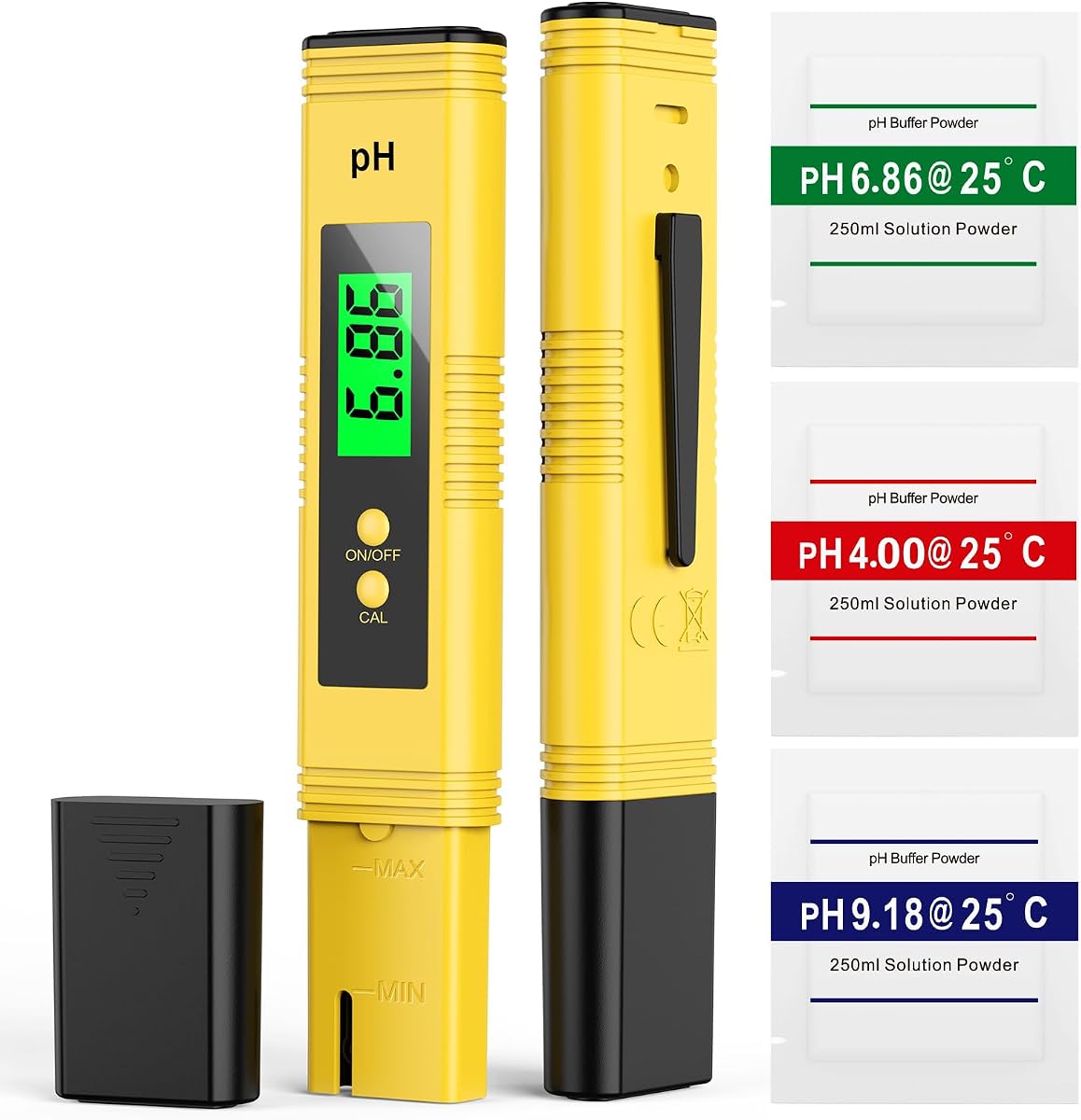
This yellow digital pH pen combines a 0-to-14 measuring range with a stated accuracy of plus or minus 0.01. It has a 3.9 rating and is marketed for drinking water, pools, aquariums, hydroponics, reverse-osmosis systems, travel, and outdoor use. Its pocket-sized design makes it one of the more convenient choices for testing away from a home workstation.
We may earn a commission when you buy through this link, at no additional cost to you.
The meter arrives pre-calibrated, so an aquarist can begin using it without completing the optional calibration procedure first. When calibration is needed, the instructions call for holding the calibration button for five seconds and using standard solutions in a specified sequence: 6.86, 4, and 9.18. Immersing the probe, gently stirring, and waiting for the displayed value to stabilize are the primary operating steps.
The listing acknowledges that readings may vary slightly with water conditions and the environment, which is common with glass-electrode pH meters. Regular electrode care, correct storage, and timely recalibration are therefore important. A digital display can make results easier to read than a color chart, but it does not remove the need for good technique.
Choose this pen for portable freshwater testing and quick numerical readings. It is a good fit for aquarists who want broad range and a compact format but do not want a full multifunction meter. Confirm the measurement needs of the livestock and follow the complete calibration instructions whenever accuracy matters most.
The pocket-size design is ideal for checking water in different locations around the home. It can move between an aquarium, pool, and hydroponic reservoir without taking up much storage space.
Factory calibration offers a convenient starting point, while the three-solution procedure provides a way to restore accuracy when conditions change. Users should recalibrate according to the manufacturer's guidance rather than assuming the pre-calibration is permanent.
We may earn a commission when you buy through this link, at no additional cost to you.
The VIVOSUN Digital pH Meter is a lightweight pen-style tester intended for residential or commercial water measurement. Its 3.8 rating is the lowest among the API kits and digital meters in this roundup, but the product includes practical features such as a backlit LCD, automatic temperature compensation, and a pocket-sized design for use around aquariums, pools, spas, labs, and hydroponic systems.
We may earn a commission when you buy through this link, at no additional cost to you.
The automatic temperature compensation function adjusts the reading for water temperature, allowing the meter to produce a result almost instantly. The supplied data does not provide a separate measurement-accuracy figure beyond the product title's reference to 0.01 accuracy, so buyers should not treat the title as a complete description of the technical specifications.
Three pH buffer powders, a user manual, and two installed button cells are included. The main maintenance concern is the probe. Consistent cleaning, correct storage, and periodic calibration become more important as an aquarium's pH changes, and calibration solutions must be used in the correct order and concentration.
This meter makes sense for an aquarist who wants a compact, backlit pH display and automatic temperature compensation. It is less compelling when a backlit screen is unnecessary or when a broader multi-parameter meter would better serve the user's testing routine. For most practical applications, the included accessories provide a reasonably complete starting kit.
The backlit LCD is useful when the aquarium area is dim or lighting is inconsistent. A clear digital display can reduce uncertainty when comparing a probe reading with a target range.
Automatic temperature compensation allows the meter to adjust readings as water temperature changes. This is particularly helpful in aquariums where seasonal temperature shifts can accompany pH fluctuations.
We may earn a commission when you buy through this link, at no additional cost to you.
This digital pH meter is positioned as a ready-to-use general water tester for drinking water, swimming pools, aquariums, reverse-osmosis systems, spas, and hydroponics. It carries a 3.9 rating and covers a full 0-to-14 pH range. The meter is factory calibrated and includes a battery, making it convenient to start using for routine aquarium checks.
We may earn a commission when you buy through this link, at no additional cost to you.
Automatic temperature compensation is one of its most useful features for aquarium owners. The operating instructions say to place the tester in a calibration solution and press the calibration control for three seconds, then use the corresponding 6.86, 4.00, and 9.18 buffer powders to complete calibration. For actual testing, the probe is immersed and stirred until the value stabilizes.
As with other probe-based meters, the glass electrode can be affected by residue and requires appropriate care. The small design is portable, but a compact body also means the display and controls are intended for occasional measurements rather than elaborate data logging. The product's general-purpose positioning does not establish marine-specific suitability, so aquarists should verify compatibility for specialized uses.
This is a practical recommendation for freshwater aquarists who want a numerical meter, automatic temperature compensation, and minimal initial setup. It suits users who already understand calibration or are willing to follow the included procedure. It is most competitive in a home setup where portability and simple controls outweigh advanced instrument features.
Factory calibration and an installed battery reduce the initial setup tasks. Users should still activate or prepare the probe as directed and verify that a known solution produces a sensible result before relying on aquarium readings.
The meter applies beyond aquariums to pools, spas, hydroponics, and reverse-osmosis systems. Buyers who need several water measurements may find this broader application list more valuable than added aquarium-specific features.
We may earn a commission when you buy through this link, at no additional cost to you.
The MEXYBE digital pH meter offers a full 0-to-14 range and stated 0.01 precision, making it an inexpensive entry into electronic aquarium testing. Its 3.8 rating is tied with the VIVOSUN pen for the lowest customer rating in the group, but the included calibration powders, user manual, and preinstalled batteries create a reasonably complete package.
We may earn a commission when you buy through this link, at no additional cost to you.
The activation instructions are unusually important to the stated workflow. For first use, the electrode should be soaked in the liquid to be tested for 30 minutes. If the meter has not been used for more than a day, a 15-minute soak is recommended. The probe is then immersed between the minimum and maximum marks, switched on, lightly stirred to remove bubbles, and read after stabilization.
This preparation routine can make the meter feel slower than a simple strip or liquid test. It also places more responsibility on the user for correct activation, cleaning, storage, and recalibration. The stated UL certification and multi-purpose application list are useful, but certification should not be confused with a claim that the meter is specifically designed for marine aquariums.
Choose this model when budget-conscious aquarists want a digital meter, a wide reading range, and the supplied materials needed for calibration. It is best for users willing to follow the soaking instructions. Those who need immediate readings with minimal preparation may find a strip or color-card kit more convenient.
The recommended soaking periods are central to getting stable readings. First-time users should treat activation as part of the setup rather than skipping directly to testing for a more convenient but potentially less reliable result.
Three pH buffer powders are supplied, allowing the owner to perform calibration without a separate purchase. The calibration process still requires correct solution preparation, immersion time, and careful rinsing between steps.
We may earn a commission when you buy through this link, at no additional cost to you.
The Seachem pH Alert takes a different approach from the other products by continuously monitoring freshwater pH. It has a 4.2 rating and uses Seachem sensor technology without tests or strips. Instead of a hand-held reading, it provides an ongoing indication that can help aquarists notice changes between scheduled water tests.
We may earn a commission when you buy through this link, at no additional cost to you.
This format is especially useful for freshwater tanks where pH stability is important and the owner wants less repetitive testing. It avoids handling test tubes, comparing reagent colors, and reading a strip chart at a specific moment. Because the device is intended for continuous placement in an aquarium, it can serve as an early warning system when paired with more detailed water tests.
It is limited to freshwater and does not offer a general-purpose numeric display, calibration workflow, or multi-parameter analysis. Sensor life, placement, and maintenance will also differ from operating a handheld meter. Aquarists should follow the included directions regarding installation and replacement, and they should not treat a continuous monitor as a substitute for ammonia or nitrite testing.
This is the pick for aquarists who want passive freshwater monitoring rather than a handheld tester. It is a useful companion for established aquariums, sensitive species, and anyone focused on pH stability. Choose it when continuous awareness is the main goal and the dedicated freshwater use is appropriate.
Continuous sensing can reveal fluctuations that occasional checks may miss. It is particularly helpful during acclimation, seasonal changes, or periods when an aquarist is troubleshooting unusual behavior.
A pH monitor does not identify ammonia, nitrite, nitrate, or other water conditions. Pairing it with periodic liquid tests or strips gives aquarists a broader picture of aquarium health.
We may earn a commission when you buy through this link, at no additional cost to you.
The APERA AI209 Value Series PH20 is the premium instrument in this roundup, combining a stated accuracy of plus or minus 0.1 pH with automated calibration features and a rugged carrying case. Its 4.4 rating makes it one of the strongest-rated products here, while the extended operating time and stable-value recognition make it suited to regular, repeated measurement.
We may earn a commission when you buy through this link, at no additional cost to you.
Automatic buffer recognition simplifies calibration by helping identify the appropriate buffer solution. The kit includes pH 4 and 7 buffers, and automatic temperature compensation operates across a stated range of 32 to 122 degrees Fahrenheit. The low-impedance Apera sensor is designed for a fast response rate, while automatic recognition of stable values reduces the need to guess when a measurement has settled.
Although the stated accuracy is plus or minus 0.1, the model prioritizes automated handling, durability, and repeatable readings rather than displaying two decimal places. That is a sound approach for routine aquarium management, where small changes may matter less than consistency and ease of use. The meter is powered by AAA batteries and is listed for up to 2,000 hours of continuous operation.
This is the best choice for an aquarist who wants a more instrument-like tester without navigating a complicated interface. It suits regular monitoring, aquaculture-related checks, and users who value automatic calibration and stable-reading detection. Choose it when reliability, accessories, and repeat use outweigh the appeal of a lower-cost pen.
Buffer recognition reduces one common source of user error in probe calibration. The included pH 4 and 7 buffers make it easier to maintain the meter regularly.
The stable-value detection, long operating time, protective case, and lanyard support a tool intended to be used repeatedly. These details give the AI209 a more professional feel than a basic disposable strip routine.
We may earn a commission when you buy through this link, at no additional cost to you.
The right aquarium pH tester depends on tank type, desired precision, maintenance commitment, and how often you want to check water. Consider the following factors before choosing a format.
Color strips are the fastest and least technical option, making them useful for frequent screening across several parameters. Liquid kits provide a controlled color comparison but require careful sample preparation. Digital meters offer numerical readings and greater convenience for trend tracking, while continuous sensors are useful when an owner wants passive monitoring between manual tests. The best format is the one the user will operate consistently and interpret correctly.
In short, prioritize a method that fits your routine. A more advanced tester has limited value if its maintenance and calibration are ignored.
A tester should cover the range expected in your aquarium without sacrificing useful resolution. The API standard kit focuses on 6.0 to 7.6, while the API High Range kit covers 7.4 to 8.8. Digital meters in the roundup generally cover 0 to 14. Verify the tank's expected conditions and the needs of the livestock before choosing a limited-range kit.
In short, select a range that brackets the intended pH. A broader range is useful for mixed testing, but specialized kits can make matching results clearer.
Not every meter supports every aquarium type. The VIVOSUN combination meter explicitly cannot test seawater, while the API High Range liquid kit supports both freshwater and saltwater. The AAwipes strips are also described as suitable for both. Digital meters also require confirmation that their stated use includes marine water if that is your intended application.
In short, saltwater compatibility is a must-check feature. A wide pH range alone does not prove that a meter is designed for marine chemistry.
Some digital listings advertise 0.01 precision, while the APERA AI209 states plus or minus 0.1 accuracy. More decimal places do not automatically guarantee better aquarium decisions because calibration, electrode condition, temperature, and technique can influence the result. Compare accuracy specifications carefully, but also consider whether the display is easy to read and the maintenance routine is realistic.
In short, do not equate displayed precision with overall accuracy. A well-maintained meter with straightforward calibration is usually more useful than a neglected probe showing extra digits.
Digital pH meters need calibration, electrode cleaning, correct storage, and occasional replacement as the sensing element ages. Liquid kits require proper reagent use and timely color comparison, while strips need sealed storage to protect them from moisture. The MEXYBE model also emphasizes an initial soaking period, while the APERA model focuses on automatic buffer recognition.
In short, include maintenance supplies and time in the ownership decision. A tester used correctly but infrequently can be more valuable than a sophisticated instrument maintained poorly.
A backlit LCD, a clear color card, and a simple calibration button each have usability benefits. The VIVOSUN pen provides a backlit display, the API kits use color cards, and the digital options generally display numerical results. Consider the lighting around the tank and whether you prefer a number, a color, or an at-a-glance continuous monitor.
In short, favor a display you can interpret confidently. A readable result is more valuable than a feature that complicates routine use.
A point test gives a snapshot that can be recorded and compared over time. Continuous monitoring can reveal changes without requiring a scheduled reading, but it does not provide a broad water-quality panel. The Seachem pH Alert fills that niche for freshwater aquariums, while strips and liquid kits are better for scheduled snapshots.
In short, use continuous monitoring as a complement, not a replacement. Combine methods when you need both early awareness and detailed confirmation.
A dedicated pH tool answers one focused question, while the AAwipes kit screens eight parameters and the VIVOSUN combination meter adds TDS and conductivity. Broader tools can save effort, but every additional reading has its own timing or interpretation requirements. They also do not necessarily measure salinity or identify every contaminant.
In short, choose broad coverage for convenient screening and focused tools for dependable pH-specific work. The best kit is the one that supports your full monitoring strategy.
Begin by testing water at a consistent time and from a representative location. Rinse the sample container with aquarium water, avoid introducing contaminants, and use clean hands or clean tools. For liquid kits, follow the exact sample and reagent order. For strips, immerse only the required pads and keep them horizontal. For digital meters, rinse the probe with clean water, immerse it fully to the stated point, stir gently, and wait for a stable reading.
Record the result alongside the date, water temperature, recent water changes, and any livestock changes. A single pH value is less useful than a trend because pH can shift with biological activity, source water, evaporation, substrate buffering, and CO2 changes. Repeat measurements at the same time of day when tracking a sensitive planted aquarium, and compare results with the appropriate range for the species being kept.
Care for the instrument according to its format. Seal unused strips in their container, keep liquid reagents stored as directed, and replace solutions that expire or become contaminated. Rinse digital probes between samples, avoid touching the sensing glass, store the electrode as instructed, and calibrate with fresh buffers when readings become suspect. A continuous sensor should be cleaned, positioned, and replaced according to its instructions. Cleaning the tester and applying proper technique are what turn a measurement into a dependable result.
For most established aquariums, weekly testing is a useful baseline, while new tanks and tanks experiencing livestock stress may require more frequent checks. Sensitive species and heavily planted systems can benefit from a more regular schedule. Record the results and test under consistent conditions so meaningful changes are easier to identify.
Strips are often adequate for routine screening and spotting obvious changes, especially when they measure several parameters. Their color-based readings are generally less precise than a well-calibrated electronic meter or a carefully performed liquid test. They are most useful when paired with detailed tests whenever an unusual result or fish problem appears.
A digital meter gives a numerical reading and is convenient for tracking changes, but it requires calibration, probe care, and correct storage. A liquid kit compares the color of a treated sample with a chart and does not rely on an aging electronic electrode. Digital meters are convenient for repeated checks, while liquid kits can be reassuring for confirming a surprising result.
Only if the manufacturer explicitly states that the tester is suitable for saltwater. The VIVOSUN combination meter, for example, cannot test seawater, while the API High Range kit and AAwipes strips are described for both freshwater and saltwater. Check the instructions before using any meter in a marine aquarium.
Differences may come from calibration, probe condition, temperature, sample location, timing, or color interpretation. Rinse the probe, check the calibration solutions, allow the reading to stabilize, and make sure the liquid test is performed in the correct order. If readings remain inconsistent, replace aging strips or test materials and verify the meter against fresh buffers.
Pre-calibration provides a useful starting point, but accuracy can drift because of probe aging, contamination, storage conditions, and repeated use. Check the manufacturer's instructions for the recommended interval and calibrate whenever the meter produces suspicious results. Calibration is especially valuable after a long storage period or when comparing readings with a liquid test.
Not necessarily. Dedicated pH meters and liquid kits measure only pH, while the AAwipes strip kit also screens ammonia nitrogen, nitrite, nitrate, chlorine, hardness, sodium chloride, and total alkalinity. Use a separate ammonia and nitrite test when those contaminants need direct confirmation.
The appropriate range depends on the species, plants, substrate, and source water rather than a single universal target. Use the API standard kit for a 6.0 to 7.6 range and the API High Range kit for 7.4 to 8.8, but confirm the specific requirements of the animals and plants in your tank. Stable, suitable conditions are more important than chasing an arbitrary number.
The AAwipes 8-in-1 Test Kit is the most versatile choice because it screens eight parameters in a fast strip format, while the API Freshwater pH Test Kit offers an approachable, focused routine check for common freshwater tanks. The APERA AI209 stands out as the premium choice with automatic calibration support, stable-value detection, a protective case, and long operating time.
Prioritize the tank type, the expected pH range, and the level of maintenance you will realistically perform. A simple strip kit works well for regular screening, a liquid test is useful for confirming specific results, and a digital meter is valuable for numerical tracking when its probe is properly calibrated and maintained.
Before making a final decision, verify the current listing, included accessories, calibration guidance, and compatibility details. Product information and commercial terms can change, and a buyer's particular setup may make one tester more suitable than another.
