
Hosyond SG90 9G Micro Servo 10 Pack
4.5Editor score
Ten micro servos included
JR and Futaba compatible
180-degree rotation
Works with Arduino projects
Our expert guide compares the 10 best Servo Motors for Robotics by torque, speed, feedback, control system, durability, application fit, mounting options, and
Servo Motors for Robotics are compact positioning systems that convert electronic commands into precise, repeatable movement. A useful robot servo must match the joint’s load, speed, control method, and operating environment while providing enough holding power to remain stable. Torque, gearing, feedback quality, dimensions, and electrical requirements matter as much as the headline specifications.
The products in this guide span micro servos for small projects, heavy-duty digital models for robot arms and RC platforms, a six-axis educational arm, an advanced AI manipulation kit, and a practical tester set. We compared the available specifications for torque, speed, operating voltage, feedback, rotation, gearing, control compatibility, mounting hardware, construction, and intended robotics applications.
Each review shows which build the servo is best suited to, along with its strongest qualities and practical limitations. The top selections cover budget, general-purpose, and premium categories, while the full list reveals important distinctions between inexpensive analog units and higher-performance digital or bus-controlled systems. Product availability and prices can change, so check current listings before buying.
4.5Editor score

4.8Editor score
4.3Editor score
The comparison below places each motor or servo-based kit according to torque class, control technology, feedback method, rotation, construction, and the robotics projects it is best equipped to support. It also distinguishes standalone components from complete robotic-arm systems.




The 25KG Robot Servo is a high-output digital servo designed for robotic arms, industrial equipment, humanoid robots, and other demanding articulated platforms. Its 4.5 rating reflects a generally strong performance profile, while the full metal gear train, precision potentiometer, and CNC aluminum center shell distinguish it from lightweight hobby servos. It is especially relevant when a joint must carry meaningful static or dynamic load.
We may earn a commission when you buy through this link, at no additional cost to you.
The stated maximum torque reaches 34.5 kg-cm at 6.8V, and the listed speed is 0.17 seconds per 60 degrees. That combination makes the unit appealing for faster movement and stronger holding performance than the micro servos in this guide. Its 0–270-degree control range offers additional positioning flexibility, while the ability to rotate through 360 degrees when unpowered can simplify assembly and mechanical setup.
One important consideration is electrical demand. A servo in this torque class should be paired with a supply capable of handling substantial current, especially when several units move simultaneously. The listing emphasizes strong anti-interference capability, low noise, heat dissipation, and a high-resolution digital chip, but it does not specify a communication protocol beyond standard servo-control operation or fully document the feedback electronics. Buyers should verify those details against their controller.
This is an excellent general recommendation for robot builders who need more strength than a standard 9G unit without moving to a complete arm system. It suits strong single-axis joints, pan-tilt mechanisms, grippers, and arm segments. Choose it when torque, speed, and durable gearing matter more than compact size, and size the power system conservatively for reliable performance.
The full metal gearing, high-precision potentiometer, and CNC aluminum housing give this servo a better foundation for load-bearing robot joints than compact plastic alternatives. It is a sensible fit for robotic arms, humanoid mechanisms, PTZ equipment, and large remote-controlled platforms.
A listed control range of 0–270 degrees provides more travel than the typical 180-degree micro servo. The 360-degree unpowered rotation can also reduce installation difficulty when a linkage must pass through a neutral position during assembly.
We may earn a commission when you buy through this link, at no additional cost to you.
The four-pack of SG90 micro servos offers an approachable way to add articulated movement to small robots, pan-tilt mechanisms, model aircraft, boats, and other DIY projects. With a 4.2 rating, it sits below the strongest options in the guide, but that figure should be considered alongside its simplicity and broad compatibility with entry-level Arduino and Raspberry Pi builds.
We may earn a commission when you buy through this link, at no additional cost to you.
Each unit operates from 4.2V to 6V, making it adaptable to common hobby power arrangements. At 4.8V, the stated torque is 1.6 kg-cm, and the response speed is 0.3 seconds per 60 degrees. The 180-degree output angle is standard for SG90-style positioning servos, while the lightweight plastic construction keeps the motors appropriate for small arms, tiny robots, and compact control linkages.
The main limitation is mechanical strength. Plastic gearing and the relatively modest torque rating mean it is best reserved for light loads rather than pinch grips, heavy arm segments, or joints exposed to impacts. Its response speed is also slower than that of the metal-gear Smraza, the Hosyond analog set, and most heavy-duty digital models. A well-regulated supply and clean mounting remain important for consistent behavior.
Choose this pack when you are prototyping a small robot, need several inexpensive joints, or want to learn servo positioning without committing to a premium motor. It is also useful for secondary animated mechanisms where size and cost matter more than holding force. For larger or faster robot arms, step up to the metal-gear or high-torque options in this guide.
Four units are enough to build a basic pan-tilt platform, small four-joint mechanism, or several independent actuators. The compact housing and low operating voltage simplify integration with common microcontrollers and educational robotics platforms.
This is a light-duty servo rather than a heavy-duty joint actuator. Keep linkages balanced, avoid abrupt stalls, and provide a stable supply so that mechanical limitations are not confused with electrical instability.
We may earn a commission when you buy through this link, at no additional cost to you.
The Hosyond SG90 10 Pack combines a strong 4.5 rating with a generous quantity for educational projects, swarm robots, RC models, and multi-joint mechanisms. The micro servos support JR and Futaba interfaces and work with Arduino projects, making them among the most broadly useful entries in this roundup. Ten motors provide enough inventory for a larger robot or several prototypes at once.
We may earn a commission when you buy through this link, at no additional cost to you.
The listed operating range is 4.8V to 6.0V, with 180-degree maximum rotation. No-load speed reaches 0.12 seconds per 60 degrees at 4.8V and 0.1 second at 6.0V, while stall torque is listed at 17.5 oz-in, equivalent to approximately 1 kg-cm. The listed dead zone is seven microseconds, and the controller is analog, which makes these familiar standard hobby servos rather than bus-controlled smart actuators.
The key installation note is that the motor needs a continuous PWM signal to operate normally, and its starting current must exceed one amp. A microcontroller’s tiny output pin can provide the command, but it should not power the servo directly from the board. A separate regulated supply and a common ground are needed, particularly when several units start or stall together. The analog design also means there is no additional communications bus or position telemetry.
This is the best budget choice for builders who need many small servos. It is well suited to small robots, robot arms, boats, helicopters, and Arduino experiments where payload and inertia remain modest. Choose it for quantity and convenience; choose the Smraza or a digital heavy-duty model when greater torque, stronger gearing, or a tighter dead band is more important.
The ten-piece assortment makes it practical to create a six-axis arm plus reserve units, build several robots, or keep replacements available. That quantity is particularly useful for classrooms and makerspaces that repeatedly disassemble prototypes.
Treat the PWM lead as a control signal and power the servos from a suitably rated supply. Correct grounding, adequate starting current, and deliberate power distribution will help prevent resets, erratic movement, and controller interference.
We may earn a commission when you buy through this link, at no additional cost to you.
The RDS3225 Dual Shaft Servo is a 4.8-rated digital servo that stands out for its combination of torque, speed, sealing, and installation hardware. Each pack contains two servos, long and short U-mounting brackets, round metal disks, and screw sets. That makes it a particularly complete standalone option for robot arms, rugged RC vehicles, and makers who want a secure reinforced mounting arrangement.
We may earn a commission when you buy through this link, at no additional cost to you.
At 5V, stall torque is listed at 24 kg-cm, rising to 28 kg-cm at 6.8V. Speed is 0.19 seconds per 60 degrees at 5V and 0.17 seconds at 6.8V. The three-microsecond dead band is also tighter than the seven-microsecond dead zone listed for the Hosyond analog set. Copper and aluminum gears, a precision potentiometer, a CNC aluminum center shell, and waterproof rubber seals support durability and stable positioning.
Its dual-shaft configuration is the defining mechanical feature. It can provide more stable support than a conventional single-shaft servo when torque is transferred, especially in a reinforced bracket or RC steering assembly. The stated 180-degree control range uses 500–2500 microsecond pulse widths, so the controller must produce the appropriate PWM signal. The operating range is 4.8–6.8V, and current demand must be considered when operating both servos under load.
This is an excellent pick for a robot arm, crawler, buggy, or rugged outdoor mechanism that needs a balance of speed and strength. It may be the most broadly useful heavy-duty servo in the roundup because it includes a complete mounting package and carries the highest rating among the regular standalone products. It is less suitable for a microcontroller project requiring only a tiny, inexpensive mechanism.
The dual-shaft arrangement and included metal disks reduce the chance of a horn slipping or bending under load. The long and short bracket options also make it easier to adapt the servo to different link geometry.
A three-microsecond dead band and high-resolution digital control are useful where small position corrections must be reproduced consistently. Confirm pulse-width calibration before attaching a sensitive linkage, especially if the mechanism relies on a centered neutral position.
We may earn a commission when you buy through this link, at no additional cost to you.
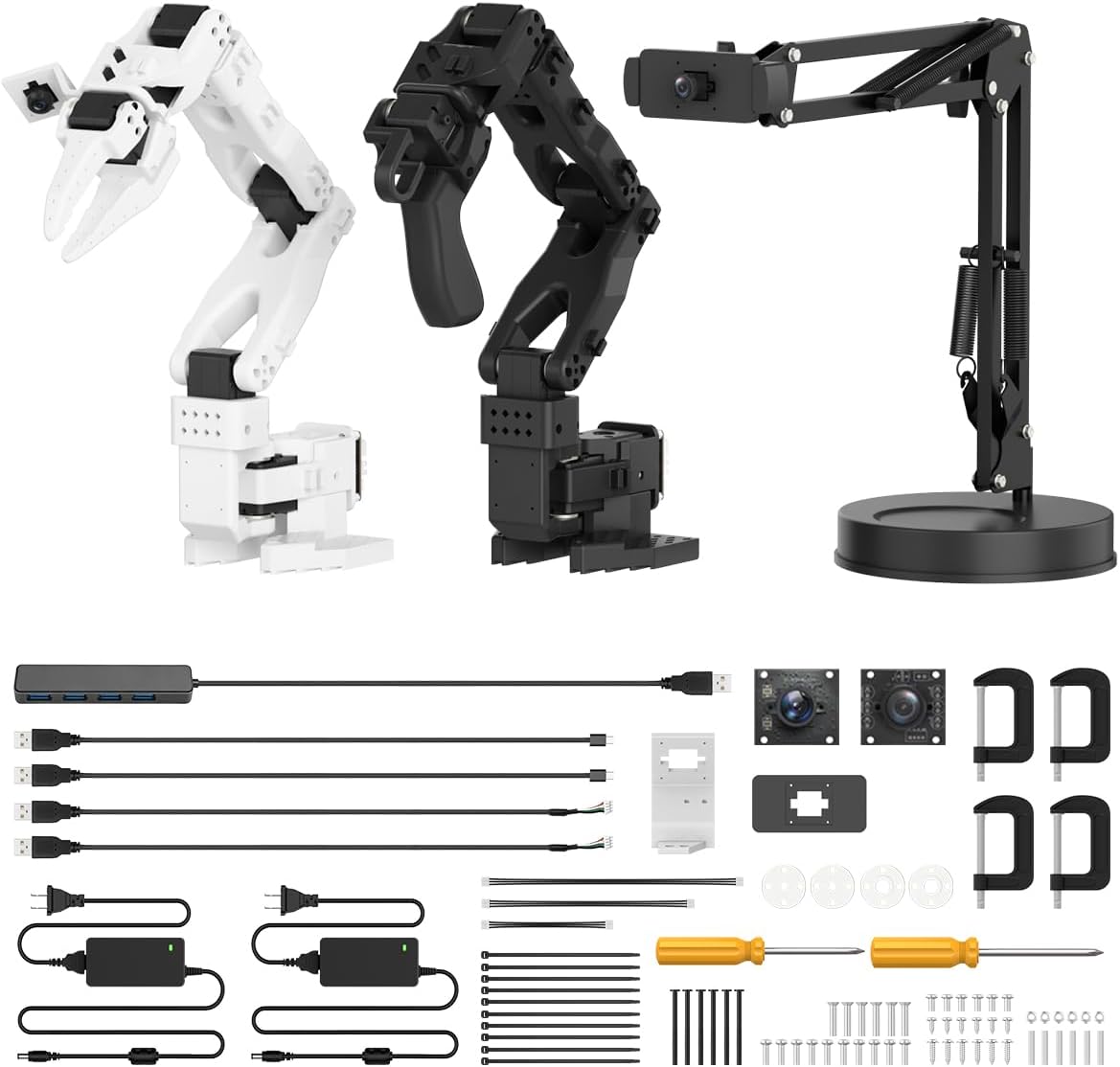
The Hiwonder SO-ARM101 is not merely a collection of standalone motors; it is an advanced six-axis robotic arm platform with twelve high-torque bus servos, a gripper-mounted camera, and an external vision camera. Its 4.3 rating reflects a specialized product for developers, educators, and researchers exploring embodied intelligence, imitation learning, and robotic manipulation.
We may earn a commission when you buy through this link, at no additional cost to you.
The motors use magnetic feedback, which supports more informed position control than a basic potentiometer-only servo. Their bus-based architecture is managed through the included Hiwonder BusLinker V3.0 debugging board. That board provides servo scanning, real-time status monitoring, trajectory control, calibration, and simplified debugging through the supplied PC software. This integrated approach is more meaningful than adding several independent PWM servos to a homemade arm.
The included cameras are equally important. A gripper-mounted view can support close manipulation, while the external camera provides environmental context for imitation learning. Compatibility with the LeRobot open-source framework gives developers access to shared code, templates, and pre-trained models, although they will still need to understand the hardware, power requirements, data collection, and training workflow to use it effectively.
Choose the SO-ARM101 if your goal is AI experimentation, vision-guided manipulation, or an integrated research platform rather than a single replacement joint. It is less appropriate for a simple pan-tilt mechanism because it introduces substantial complexity. Its premium value comes from the assembled arm, bus servos, cameras, control board, software, and open-source ecosystem working as one development system.
Two cameras give the platform both close-up and environmental views, enabling tasks that depend on object perception and imitation. This is a major step beyond a robot that merely moves joints to predetermined angles.
The BusLinker V3.0 board and magnetic-feedback servos create a serviceable control architecture with diagnostics and trajectory tools. This design is more appropriate for coordinated multi-joint motion than a collection of unrelated analog motors.
We may earn a commission when you buy through this link, at no additional cost to you.
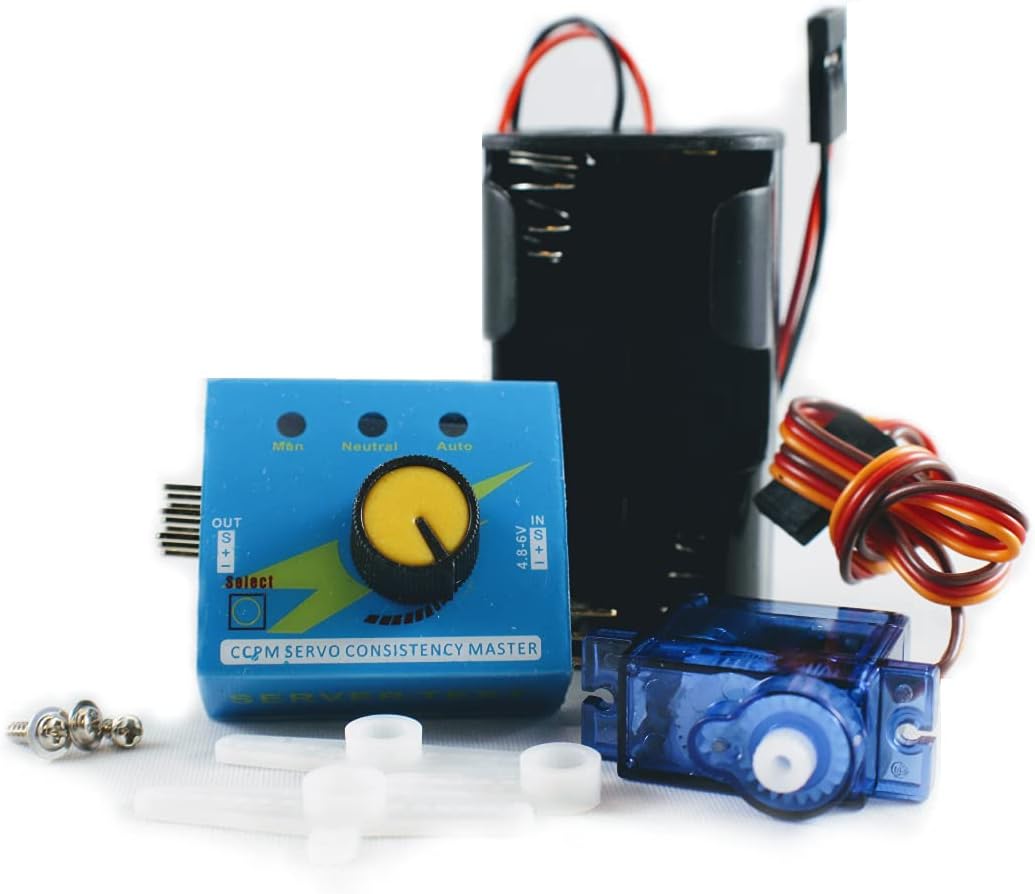
The Servo Motor Tester Kit is a useful bench accessory for builders who want to inspect, center, and diagnose servo behavior before installing a motor in a robot. It includes a 9G servo, a servo tester, a four-cell AA battery holder that produces 6V, and three types of servo horns. The 4.4 rating reflects a practical package with clear value for hobby robotics work.
We may earn a commission when you buy through this link, at no additional cost to you.
The tester offers three modes: manual or dial control, neutral positioning, and automatic movement. Its approximately 45–135-degree range provides enough movement to test a conventional 180-degree servo without necessarily driving it to either extreme. The included servo itself covers 0–180 degrees, and the tester can also be used with electronic speed controllers, expanding its usefulness beyond servo-only projects.
The tester is not a substitute for a robot controller, but it reduces the trial-and-error involved in finding a safe neutral point. That is particularly helpful when a linkage must move symmetrically around center or when a newly installed servo starts at an inconvenient angle. The four-AA holder offers a simple portable power source, and the included screw-secured horns make it easier to match the output to a particular hub or arm.
Buy this kit if you routinely replace servos, build mechanisms with center-sensitive linkages, or want a standalone way to test a motor before committing it to a robot. It is also a sensible companion to any of the higher-torque servos in this guide, since even a strong servo can be difficult to configure without a tester.
Neutral mode helps establish a repeatable center before the horn is attached. This reduces the chance of a mechanism starting against a mechanical stop and makes subsequent calibration more predictable.
The included AA battery holder makes it possible to test a servo away from a bench supply. The tester and horn assortment also turn the package into a compact toolkit for repairs and rapid servo checks.
We may earn a commission when you buy through this link, at no additional cost to you.
The Smraza SG90 Metal Gear kit is a compelling middle ground for small robots that need more durability than a conventional plastic-gear SG90. It includes ten servos with upgraded metal pinion gears and shafts, providing better resistance to tooth breakage and heat deformation. Its 4.4 rating and compact form make it well suited to micro robots, small arms, aircraft, boats, and other compact mechanisms.
We may earn a commission when you buy through this link, at no additional cost to you.
The listed stall torque is 1.9 kg-cm across a 180-degree range, and the stated operating voltage is 4.8V to 6.0V. Speed is listed at 0.08 seconds per 60 degrees, making it notably quicker than the standard four-pack in this guide. Its five-microsecond dead band is tighter than the seven-microsecond value stated for the Hosyond set, which can benefit applications requiring consistent fine positioning.
The electrical requirements remain significant despite the small dimensions. This servo needs a continuous PWM signal, and the manufacturer specifies a power supply capable of more than one amp of starting current. A robust shared supply is therefore preferable to powering several units directly from a microcontroller. It also uses a conventional three-pin PWM arrangement compatible with JR and Futaba receivers, and the package includes servo arms and 24.5 mm leads.
This kit is a good choice when an inexpensive micro servo must survive more demanding movement than a basic plastic model can tolerate. It is particularly appropriate for small robotic arms, compact aircraft mechanisms, and micro robots. It does not match the load capacity of the 25KG and 45KG servos, but it offers a meaningful durability and performance improvement for small builds.
The upgraded pinion and shaft target a common weakness of inexpensive micro servos: broken plastic teeth under repeated loading. That improvement makes this kit better suited to joints that see frequent starts, stops, and moderate mechanical stress.
A listed 0.08-second movement over 60 degrees is useful for quick pan, tilt, steering, and linkage motion. The tighter dead band also supports more consistent correction of small position errors.
We may earn a commission when you buy through this link, at no additional cost to you.
The 45KG Waterproof Servo is the strongest standalone actuator in this guide, carrying the highest rating and the most ambitious torque specification. It is aimed at demanding RC platforms, robotic arms, animatronics, and Arduino-based projects that need substantial holding power. The two-pack format also makes it practical to equip a pair of joints without sourcing units separately.
We may earn a commission when you buy through this link, at no additional cost to you.
At 8.4V, stall torque is listed at 51 kg-cm, or 708.2 oz-in, and response reaches 0.11 seconds per 60 degrees. The coreless motor, high-resolution digital chip, and high-precision potentiometer are intended to provide speed, stability, accurate positioning, low noise, and reduced vibration. High-precision stainless steel and aluminum gears are hard anodized to resist wear and stripping under high loads.
The IP67 rating and waterproof design set it apart for outdoor robots, damp environments, and rugged RC machines. Its standard 40 x 20 x 38.5 mm dimensions make it easier to compare with familiar high-torque servo housings, while the included 25-tooth metal horn supports efficient power transfer. The 8.4V maximum operating point is the critical specification: it requires a capable supply and careful voltage management, and users should not assume compatibility with a 5V-only circuit.
This is the premium choice for a high-load joint, crawler, boat mechanism, or large-scale animated mechanism. It is most compelling for builders who need the highest torque and water protection rather than a tiny, inexpensive servo. Ensure your power supply, wiring, controller, and mechanical mount are all rated for the load; a powerful servo cannot compensate for weak supporting hardware.
A listed 51 kg-cm stall torque gives this servo substantial headroom for large linkages, crawler steering, and gripping mechanisms. Stall torque is a peak capability, so normal operating loads should remain well below that threshold.
The IP67 enclosure and sealed hardware provide confidence in damp or dusty installations. Water resistance does not eliminate the need for sensible cable routing, corrosion prevention, or routine inspection after exposure.
We may earn a commission when you buy through this link, at no additional cost to you.
The Hanaive SG90 16 Pack is designed for makers who need many small actuators, making it particularly useful for classroom fleets, swarm robots, animation projects, and multi-axis mechanisms. It includes sixteen servos along with multiple servo arms and fixing screws. The 4.5 rating and extensive inventory make it a strong choice when replacement availability and project scale matter.
We may earn a commission when you buy through this link, at no additional cost to you.
The motors measure approximately 3.2 x 3.09 x 1.24 centimeters, making them particularly small and light. Stall torque is listed at 1.6 kg-cm at 4.8V, and the no-load speed reaches 0.1 second per 60 degrees at 4.8V and 0.08 second at 6V. Maximum travel is 180 degrees. Their JR and Futaba interface compatibility and three-wire connection scheme make them familiar additions to small robot platforms.
The manufacturer explicitly warns that reduced pulling force limits these servos to ordinary small electric aircraft models, not larger fixed-wing aircraft or electric helicopters. The same caution applies to robotic joints: a 1.6 kg-cm rating is adequate for lightweight mechanisms but unsuitable for a heavy gripper, long arm segment, or high-inertia load. The small package also requires accurate horn and bracket alignment to avoid binding.
Choose this pack when you need numerous inexpensive servos for micro robots, small arms, boats, RC toys, or teaching exercises. It offers more flexibility than a four-pack without moving into higher-torque pricing. For individual mechanisms with greater loads, use the metal-gear Smraza or one of the digital high-torque servos instead.
A large inventory allows one robot to use many joints while keeping spares for teaching, repairs, or multiple simultaneous builds. It is also easier to keep a consistent motor type across a fleet of small robots.
The compact dimensions suit micro mechanisms, but the torque rating clearly defines the appropriate application. Balance long linkages, use light loads, and avoid using these servos where a failed gear could damage a larger model.
We may earn a commission when you buy through this link, at no additional cost to you.
The 6DOF Robot Mechanical Arm Kit is a complete educational manipulator designed to demonstrate coordinated motion across six degrees of freedom. It includes six metal-gear MG996 servos, a claw, an aluminum bracket system, bearings, screws, extension cords, and multiple U- and L-shaped brackets. Its 2.8 rating is the lowest in the guide, so buyers should approach it as a specialized kit rather than a turnkey research-grade robot.
We may earn a commission when you buy through this link, at no additional cost to you.
The structure supports forward, backward, upward, and downward positioning as well as left-right gripping and carrying movements. Imported cup bearings are used at the steering joints to improve movement alignment, while the disc-shaped chassis helps the arm rotate smoothly. Bracket fittings are made from two-millimeter aluminum plate, providing more rigidity than thin plastic supports, although a six-axis arm still requires careful balance.
The included MG996 servos use metal gears and offer substantially more torque than the 9G micro servos elsewhere in this guide. However, their 180-degree positioning behavior means the builder must establish safe limits for every joint to prevent the arm from driving into its mechanical limits. Servo behavior can also vary under load, making calibration essential before the arm carries or grips an object.
This kit is most appropriate for college instruction, creator education, or an ambitious builder who wants to assemble a six-axis arm rather than purchase a single joint motor. It suits learning about inverse kinematics, linkage geometry, control, and mechanical assembly. Because it is not presented as a fully assembled intelligent platform with a controller or software stack, plan the control electronics and programming separately, and verify the included parts after delivery.
The six-axis structure gives students a tangible platform for studying joint limits, coordinate frames, trajectory planning, and grasping. Its educational value comes from the opportunity to assemble, wire, and program the mechanism.
Before attaching the claw or a payload, establish each servo’s neutral position and mechanical range. Slow, controlled tests can reveal binding, uneven gear loading, or a linkage that needs additional counterbalance.
We may earn a commission when you buy through this link, at no additional cost to you.
Choosing a robot servo requires matching mechanical load, motion speed, control architecture, electrical limits, and mounting requirements. The best unit is not always the one with the largest torque rating; it is the one that can be controlled reliably within the available space and power system.
Torque determines the load a joint can hold or move, but the stated stall rating is a peak rather than a continuous operating limit. Account for the weight of downstream links, payload, lever length, acceleration, friction, and shock loads. A longer arm needs more torque at the base because its effective load increases with distance from the pivot. Micro servos around 1–2 kg-cm suit light linkages, while high-torque digital models are more appropriate for crawler steering, grippers, and larger articulated arms.
Speed specifications are usually stated as the time required to move a certain angle, often 60 degrees, under no-load conditions. A lower time means faster motion, but real performance can be slower under load. Faster servos can improve responsiveness in pan-tilt mechanisms, steering, and pick-and-place systems, although they may transfer more shock into the mechanism. Consider whether the robot needs rapid repositioning or smooth, deliberate movement, and match that requirement to both speed and the arm’s mechanical design.
Plastic gears are adequate for very small, lightly loaded mechanisms, but they are more vulnerable to cracked teeth and heat deformation. Metal pinions and shafts improve resistance to wear, while all-metal gear trains are preferable for high-load joints. The motor housing also matters: CNC aluminum center shells aid rigidity and heat dissipation. Durable gears are especially important in robots that stall during startup, move against mechanical interference, or operate repeatedly at their load limit.
A conventional hobby servo accepts a PWM command and uses internal electronics to control its output shaft. Some products also include potentiometers for position sensing, while the Hiwonder bus servos provide magnetic feedback and support status monitoring through a dedicated controller. Potentiometer-based designs are straightforward to use with Arduino, Raspberry Pi, RC receivers, and dedicated servo boards. Bus systems are more appropriate when you need coordinated motion, diagnostics, or a scalable research platform.
The operating voltage determines which supplies and receiver logic are safe to use. Small SG90 servos commonly operate around 4.8V to 6V, while high-torque digital models may accept ranges such as 4.8–6.8V or extend to 8.4V. Starting current can be much higher than the current during smooth movement. Use a regulated supply with adequate capacity, route motor power separately from sensitive logic, and join the grounds correctly.
Most small hobby servos rotate through 180 degrees, while some high-torque models advertise a 270-degree control range. Rotation capability does not guarantee that the attached mechanism can safely use the entire range. Linkages, housings, and cables can impose earlier limits, and driving a joint into a hard stop can damage the gear train. Calibrate neutral and endpoint positions carefully, and consider a tester kit when accurate centering is important.
A servo must fit the available space without colliding with nearby links, wiring, sensors, or the robot chassis. Miniature servos are valuable for small robots and aircraft, while larger high-torque models require a correspondingly robust frame. Check the dimensions, output shaft, horn type, and bracket style. Kits that include long and short U-brackets, metal disks, and multiple horn options simplify installation, but every joint still needs secure fasteners and sufficient structural support.
Waterproof or sealed servos are useful for outdoor robots, boats, crawlers, and workshops where dust or moisture may enter. A sealed case can protect the motor and electronics, but the feedback mechanism, connector, and cable entry still require care. Indoor robots may not need an IP-rated enclosure. For any environment, use sensible strain relief, inspect connectors after exposure, and avoid assuming that a servo described as waterproof can tolerate every immersion or operating condition.
Begin by confirming the servo’s voltage range, signal method, torque requirement, rotation, and mounting pattern. Connect the signal lead to the controller, power the servo from a correctly rated supply, and establish a common ground between the power supply and controller. Do not attempt to power a high-torque servo directly from a microcontroller pin. Test the motor without a load, identify its neutral position, and then set conservative endpoint limits in software.
Install the horn only after confirming the output shaft’s orientation and the mechanism’s safe travel. Use the supplied or correctly sized screws, distribute mechanical loads across the bracket, and avoid placing excessive leverage on the output spline. For dual-shaft servos, use the reinforcing disks and brackets as intended. Keep cables clear of moving joints, provide strain relief, and inspect the linkage for binding whenever position changes become inaccurate or unusually noisy.
During operation, monitor for heat, buzzing, jerking, or a temporary loss of position. These symptoms can indicate an undersized supply, excessive load, loose horn, insufficient voltage, or mechanical interference. Reduce the payload, improve the power distribution, recalibrate neutral, and check the mounting before increasing the duty cycle. Clean external dust and debris, keep connectors dry when required, and store unused servos in a dry environment without forcing the output shaft.
The best servo for a robot arm depends on arm length, payload, joint arrangement, and control requirements. Small light arms can use metal-gear micro servos, while larger arms generally benefit from high-torque digital models with stable mounting hardware. A six-axis arm requires enough torque at every joint, including the wrist and gripper, so calculate loads rather than selecting only from headline torque figures.
Yes, SG90 micro servos are widely used for small robots, lightweight arms, pan-tilt mechanisms, boats, and educational projects. Their approximately 1–2 kg-cm class of torque is suitable for light linkages but not heavy payloads or large arm segments. Metal-gear versions are more durable, and a separate supply with adequate starting current is important.
Digital servos often provide faster response, stronger torque, tighter dead bands, and better behavior under load, making them preferable for larger robots and responsive mechanisms. Analog servos remain useful in simple educational builds and are often easier to control through standard PWM outputs. The control platform and mechanical load should guide the decision more than the label alone.
Erratic movement commonly results from insufficient supply current, incorrect grounding, a weak PWM signal, loose wiring, or mechanical binding. A servo should not normally be powered directly from a microcontroller’s supply pin. Check the rated voltage, use a common ground, verify the signal wire, and make sure the horn and linkage are not pushing against a mechanical limit.
A conventional PWM servo receives a command based on pulse width, usually through a three-wire connection. A bus servo communicates through a shared serial bus and may provide richer status data, magnetic feedback, device scanning, or coordinated motion control. PWM is simpler for individual joints, while bus systems become increasingly useful as robot complexity and diagnostic requirements grow.
Required torque depends on payload weight, link length, joint angle, friction, acceleration, and any external forces. The most heavily loaded base joint usually requires the highest torque, while the wrist may need less. Keep expected continuous demand comfortably below stall torque because stall ratings describe a brief peak condition rather than a safe long-term operating level.
In most cases, yes. The controller can usually provide the PWM command, but servo power should come from a suitably rated supply that can handle startup and stall current. Multiple servos should generally use a dedicated supply or a carefully designed distribution arrangement, with the controller and servo supply sharing a common ground.
Choose a sealed or water-resistant servo for exposed mechanisms and protect the connector and cable entry. Use flexible mounting, strain relief, and cable loops that will not tighten on every joint movement. Even a waterproof servo should be inspected after rain or immersion, and routine cleaning can prevent dirt from interfering with the horn and housing.
The top three selections cover distinct needs. The Hosyond SG90 10 Pack is the best budget option for learning, small robots, and multi-joint projects. The RDS3225 Dual Shaft Servo is the editor’s choice for a balanced standalone actuator with strong torque, quick response, sealing, and excellent mounting hardware, while the Hiwonder SO-ARM101 is the premium platform for vision, AI, and coordinated manipulation research.
Prioritize the factor that can cause the greatest failure: mechanical load. Select torque with realistic headroom, verify current requirements, ensure the mounting can carry reaction forces, and use continuous PWM or bus control as required by the design. Digital and metal-gear models add value when a robot must move quickly, operate repeatedly, or maintain accurate position under changing loads.
Also compare physical dimensions, rotation, feedback, and environmental protection before purchasing. Product listings and prices can change, so review the current specifications, included accessories, and controller compatibility at the time of purchase. A careful match between the servo and the joint is more important than owning the model with the largest number on the box.